Tag: Mark Lehtonen

Expert hockey insights and analysis from former coach Mark Lehtonen. Covering team strategies, player performance, and tactical breakdowns to give fans a deeper understanding of the game.

IHM ACADEMY - LESSON #4 DESIGNING OFFENSE FROM THE DRAW THE CIRCLE ATTACK SYSTEM BY COACH MARK LEHTONEN

IHM Academy - Lesson #4 By Coach Mark Lehtonen · IHM Academy

Designing Offense from the Draw - The Circle Attack

Designing Offense from the Draw - The Circle Attack

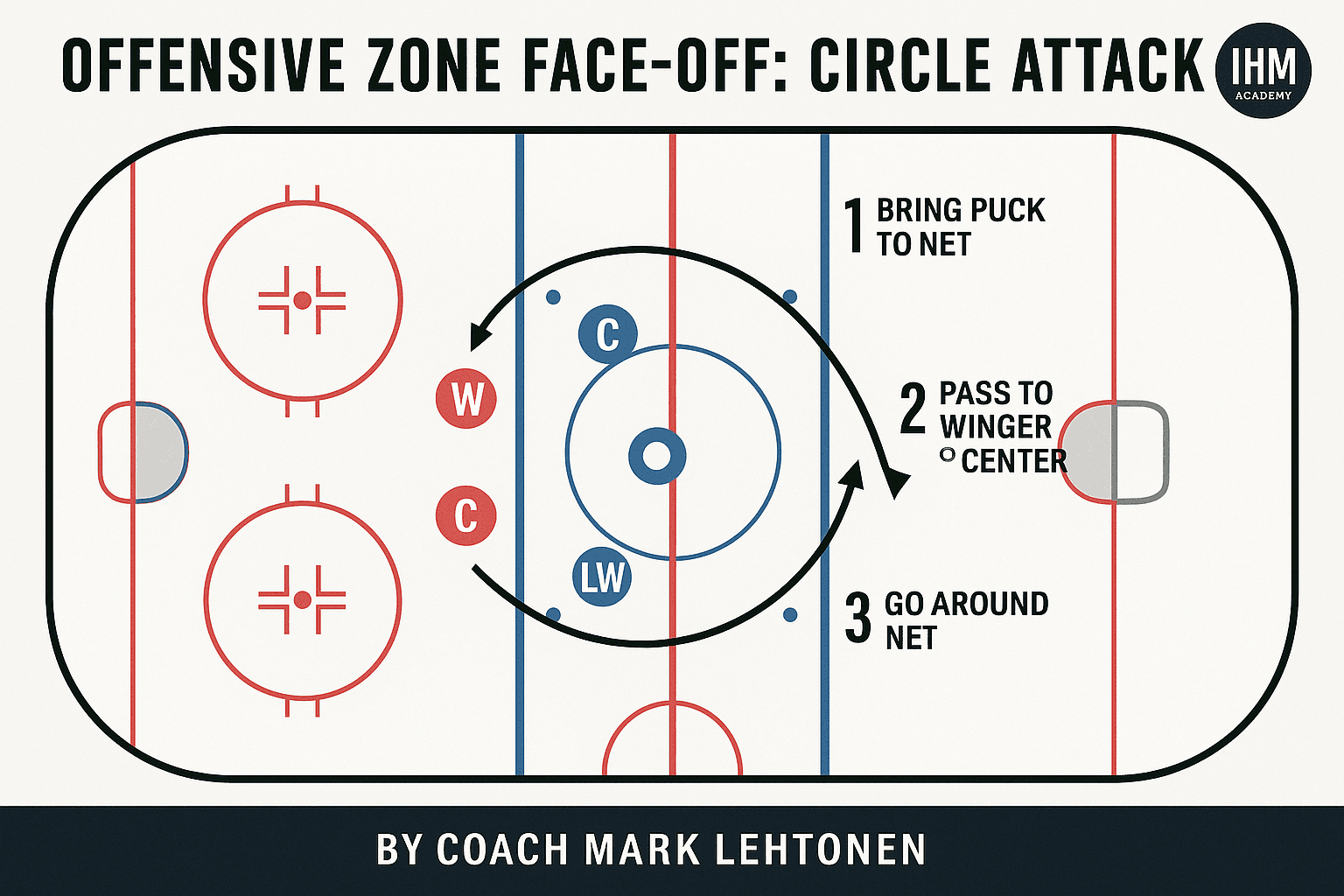
Face-offs in the offensive zone are not random battles. At the higher levels, they are scripted attacks. The Circle Attack is a set play built to generate an immediate scoring chance within seconds of winning the draw. The goal is not just to gain possession - it’s to attack with speed before the defenders can organize.

Objective

The goal of this play is to have the center win the puck backward into space so that the net-side winger can explode around the face-off circle, collect the puck in stride, and attack downhill with multiple options. This movement forces the defense to turn, chase, and react instead of defending in structure.

Roles and Timing

  • Center (C): The center’s job is not to just “win it back.” The puck must be directed to a spot, not a scramble. The ideal placement is just behind the inside hashmark of the circle, where your winger will arrive with speed.
  • Net-front winger: Starts low, near the crease. On the drop, this winger immediately loops around the top of the circle. That looping route is the heart of the play - they become the first puck carrier at full speed, not standing still on the wall.
  • Weak-side winger: Slides into soft ice high in the slot or weak side circle. This player becomes the “release valve.” If defenders collapse on the puck carrier, that weak-side forward is wide open for a one-touch shot.
  • Defensemen (D1 / D2): Hold width and stay ready on the blue line. One of them rotates middle for a potential high shot, the other stays spread to keep the PK honest. If nobody is pressured, that high option becomes a clean point shot through traffic.

Primary Reads for the Puck Carrier

  1. Drive the net: Attack the goalie immediately. If the defender is behind you, take it straight to the crease. This forces panic, rebounds, penalties, chaos - all good things for you.
  2. Feed the middle: If both defenders collapse to stop the drive, the puck carrier can hit the trailing forward in the slot. That’s often the best shot of the entire sequence: inside hashmark, goalie moving, defenders turning.
  3. Wrap and extend: If there’s no clean lane, continue behind the net. Now the team flows into a controlled offensive cycle. You didn’t lose the puck. You just turned the face-off win into set offensive zone time.

Why This Play Works

This system attacks the one moment when the defending team is weakest: right after the draw. Defenders are still tied up on sticks and bodies, the goalie’s sightlines aren’t set yet, and coverage assignments aren’t sorted. You are hitting them before they get organized.

Coaches like this play because it creates speed without requiring a risky stretch pass. All five of your skaters know their first movement before the puck even touches the ice. That’s what separates structure from chaos.

Coach Mark Lehtonen says:

“We don’t ‘hope’ to get a chance off the draw - we design one. The Circle Attack is timing, discipline, and trust. Your winger has to believe the puck is going to that spot. Your center has to put it there. That’s execution.”

Summary

The Circle Attack is how smart teams weaponize the offensive zone face-off. You’re not just winning a puck - you’re building a scoring chance in advance. When this play is timed correctly, the defense is already under pressure before they’ve even found the puck.

For more offensive design, special teams structure, and pro-level detail, explore IHM Academy. Learn hockey the way coaches teach it.


Penalty Kill Forecheck Explained - IHM Academy by Coach Mark Lehtonen

IHM Academy – Lesson #3 By Coach Mark Lehtonen

Penalty Kill Forecheck Explained

Penalty Kill Forecheck - Coaching Diagram

The penalty kill is not just about surviving. The best teams use it to control momentum, dictate entries, and steal time. A well-structured penalty kill forecheck can frustrate even elite power plays by forcing dump-ins, cutting passing options, and delaying clean possession.

The Purpose of the PK Forecheck

When a team goes short-handed, the objective is twofold – deny clean entry and force turnovers before the puck ever sets up in the zone. A strong PK forecheck disrupts the power play at its source: transition. You never let them enter with control; you make them chase the puck 200 feet.

Typical PK Forecheck Structures

1. Diamond (Passive Read)

The Diamond setup is used when protecting a lead or facing a high-skill power play. F1 pressures up ice only if the puck is loose; F2 and F3 angle toward the boards, forming the top of the diamond. The defensemen stay deeper, controlling the middle and forcing the breakout wide. This structure delays puck movement and eats up seconds – time is your best defense.

2. Wedge +1 (Aggressive Read)

The Wedge +1 is the modern standard. It combines pressure and containment. The “+1” (F1) attacks the puck carrier immediately after a turnover or dump-in, while the other three players form a compact triangle or wedge behind. The shape flexes with the play – when one pushes, the others collapse and reset the wall.

This system works because it allows one player to pressure aggressively without breaking the box. The wedge rotates as one unit; each read triggers a collective motion, not an individual chase.

Entry Denial

The penalty kill forecheck begins at the offensive blue line. F1 angles the puck toward the boards, while F2 mirrors through the middle. Both defensemen hold the red line – never backing in early. The goal is to make the puck carrier either dump the puck or send a risky lateral pass under pressure. Every second the opponent spends retrieving the puck is a small victory.

Key Coaching Points

  • Short routes, big results: Don’t chase. Skate only as far as you can force a bad pass. Short bursts win the clock.
  • Stick in lane: On the PK, your stick is your best weapon – keep it extended, take away options.
  • Stay layered: Every movement should reveal a second defender behind. Never a single line of defense.
  • Pressure with purpose: A good PK doesn’t just clear the puck – it clears with possession and exits smartly.

Coach Mark Lehtonen says:

“A penalty kill that just survives is weak. A penalty kill that pressures is dangerous. When you force them to reset three times before entry – that’s when frustration sets in. Smart pressure wins more than blocked shots.”

Summary

The Penalty Kill Forecheck is where discipline meets aggression. It’s not a passive retreat – it’s a controlled attack designed to deny comfort. When executed properly, it changes the entire rhythm of the game. The opponent might have five skaters, but you control the ice.

Learn more systems and tactics in IHM Academy – where real hockey IQ begins.


IHM Academy - Lesson #2 By Coach Mark Lehtonen · IHM Academy

Elite Offensive Structure, Forecheck & Neutral Zone Systems

Elite Offensive Structure, Forecheck & Neutral Zone Systems

Elite Offensive Structure, Forecheck & Neutral Zone Systems

A complete pro-level module covering modern offensive structure, forechecking systems, neutral-zone tactics, transition principles, and elite special teams concepts. All lessons are authored in the signature style of Coach Mark Lehtonen for the IHM Academy.


Power Play Overload → Umbrella Rotation By Coach Mark Lehtonen · IHM Academy

IHM Academy - Lesson #11 · By Coach Mark Lehtonen


Cinematic hockey banner of an east-west deceptive cycle with metallic IHM Academy Lesson #10 title

IHM Academy - Lesson #10 · By Coach Mark Lehtonen


Cinematic hockey banner showing a neutral-zone turnover exploding into counter-attack, with metallic title IHM Academy - Lesson #9

IHM Academy - Lesson #9 · By Coach Mark Lehtonen


IHM Academy - Lesson #8 Neutral Zone Face-Off Loss

IHM Academy - Lesson #8 By Coach Mark Lehtonen


IHM Academy - Lesson #7 Neutral Zone Face-Off Win - Lane Activation & Speed Release

IHM Academy - Lesson #7 By Coach Mark Lehtonen


Gap Control & Angling - Controlling Speed and Space | IHM Academy (Coach Mark Lehtonen)

IHM Academy - Lesson #6 By Coach Mark Lehtonen


Backchecking vs. 2-on-1 - Defensive Recovery Principles | IHM Academy (Coach Mark Lehtonen)

IHM Academy - Lesson #5 · By Coach Mark Lehtonen

IHM ACADEMY - LESSON #4 DESIGNING OFFENSE FROM THE DRAW THE CIRCLE ATTACK SYSTEM BY COACH MARK LEHTONEN

IHM Academy - Lesson #4 By Coach Mark Lehtonen


Penalty Kill Forecheck Explained - IHM Academy by Coach Mark Lehtonen

IHM Academy – Lesson #3 By Coach Mark Lehtonen


HM Academy - Lesson #2’ and ‘Neutral Zone Forecheck · 1-2-2’.By Coach Mark Lehtonen

IHM Academy - Lesson #2 By Coach Mark Lehtonen


2-1-2 forecheck hockey system diagram - IHM Academy by Coach Mark Lehtonen.

IHM Academy - Lesson #1 By Coach Mark Lehtonen


HM Academy - Lesson #2’ and ‘Neutral Zone Forecheck · 1-2-2’.By Coach Mark Lehtonen

IHM Academy - Lesson #2 By Coach Mark Lehtonen · IHM Academy

Neutral Zone Forecheck 1-2-2 Explained

The neutral zone decides who controls the game. If you slow teams there, you control the tempo. If you lose it, you chase all night. The 1-2-2 neutral zone forecheck is a modern structure used to shut down transition attacks, force low-percentage entries, and turn mistakes into instant counter-attacks.

Neutral Zone 1-2-2 Forecheck Explained - IHM Academy by Coach Mark Lehtonen

What is the 1-2-2?

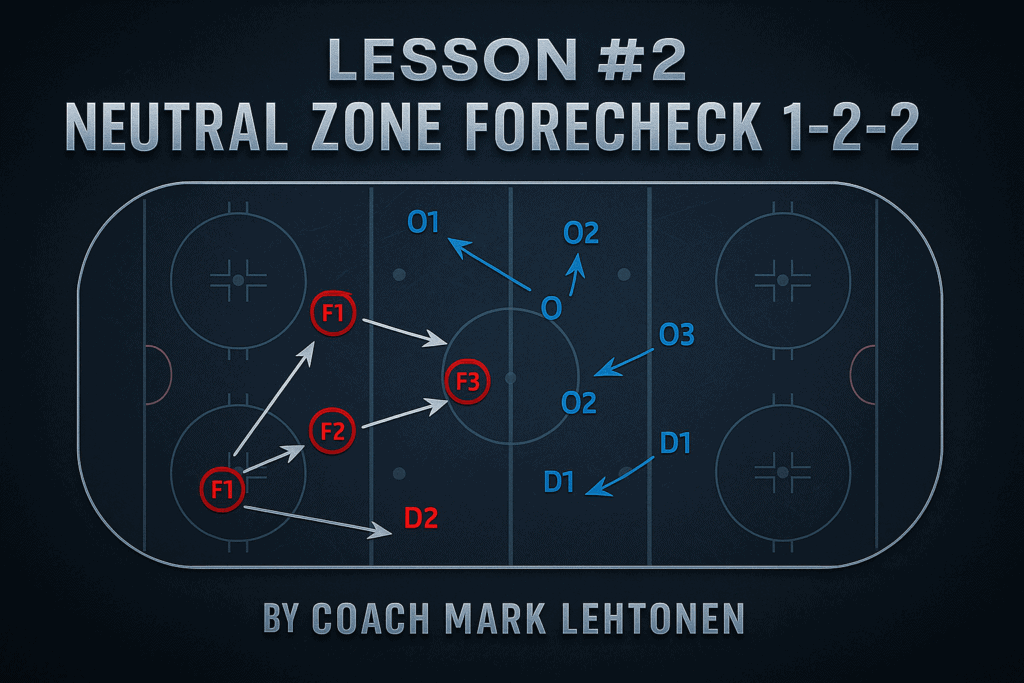
The numbers describe the shape. 1 forward applies the first layer of pressure. 2 forwards form a second layer across the width of the neutral zone. 2 defensemen sit behind that, controlling space and stepping up when the puck gets funneled to a predictable lane.

This is not a full-speed chase. It’s controlled pressure. You are not trying to steal the puck immediately – you are trying to force the puck into a decision you already prepared for.

Player Responsibilities

F1 – The first pressure

F1 is your trigger. This forward angles (forces) the puck carrier toward one side of the ice, ideally toward the boards. The key is angle, not speed. Bad F1s just skate fast. Good F1s steer the puck where the structure wants it.

If F1 chases straight through the middle, the entire 1-2-2 collapses. F1 must close time and space while taking away the middle lane.

F2 and F3 – The wall

F2 and F3 sit behind F1 and stretch horizontally across the neutral zone. Think of them as a moving barrier. One forward covers the strong side (the side where the puck is being pushed), the other covers the weak side.

Their job is to read the next pass. If the puck moves to the wall, the strong-side forward steps up and attacks. If the puck gets reversed or cut back to the middle, the weak-side forward jumps and kills that option.

Good 1-2-2 teams make the puck carrier feel like there’s open ice ahead - and then shut that lane right as the pass is released.

D1 and D2 – The gatekeepers

D1 and D2 hold a tight, aggressive gap behind the forwards. They are not passively “backing in.” They’re stalking the next move. The second the puck is funneled to the boards, the strong-side defenseman can step up on the entry, finish the body, and break the play.

The other defenseman shifts to middle ice and protects against a slip pass or a chip-and-chase behind the line. This prevents odd-man rushes against.

Why coaches love 1-2-2 in the neutral zone

  • It kills speed. Fast teams hate this system. You’re not letting them enter the zone with control; you’re forcing them to dump the puck early.
  • It creates predictable exits for you. When you win the puck on the wall, you already have F2 or F3 close enough to turn it the other way. You don’t just defend – you counter.
  • Low risk, high control. It’s safer than an all-in forecheck like 2-1-2 because you always keep numbers behind the puck. You’re rarely caught in an odd-man rush if everyone does their job.

Common mistakes that break the system

  • F1 overcommits straight-line. If F1 flies past the puck and doesn’t angle, the opponent just hits the middle with speed. That’s a free controlled entry against you.
  • F2 and F3 get too deep. The “2-2” line must stay in the neutral zone, not drift back to their own blue line. If they sag, you give the opponent the red line for free.
  • Defense backing in too early. D1 and D2 must hold the line mentally. If they just retreat, the structure dies. The whole point is to meet the puck at pressure points, not surrender ice.

Coach Mark Lehtonen says:

“People think 1-2-2 is passive. It’s not. It’s controlled aggression. You’re not chasing the puck – you’re telling the puck where to go. Good teams don’t hunt chaos. They create it on their terms.”

When to use the 1-2-2

Teams will lean on this structure when they’re protecting a lead, when they’re playing a dangerous transition opponent, or when the bench is tired and needs to control the pace. It’s also a go-to system on big ice (international hockey), where straight high-speed rushes are deadly if you give too much room in the neutral zone.

Summary

The 1-2-2 neutral zone forecheck is about discipline, spacing, and funneling the puck into pressure instead of gambling for a steal. You slow their transition, you take away the middle of the ice, and you force them to give you the puck on your terms. That’s intelligent hockey.

For more tactical lessons, visit IHM Academy – we break down systems, structure, and hockey IQ the way players actually hear it in the room.

Celebrini Leads Sharks to 6-5 OT Win Over Wild

Celebrini Stays Red Hot as Sharks Beat Wild 6-5 in Overtime | IHM News

by IHM Team | IHM News | October 27, 2025

ST. PAUL, Minn. – The San Jose Sharks’ young core delivered again, as Macklin Celebrini capped a three-point night with the overtime winner, sealing a thrilling 6-5 victory over the Minnesota Wild at Grand Casino Arena on Sunday.

Celebrini Leads Sharks to 6-5 OT Win Over Wild

Celebrini, who also added two assists, extended his point streak to four games (five goals, five assists). The 19-year-old rookie was unleashed on a breakaway after goaltender Yaroslav Askarov kicked out a huge rebound, racing down the ice to finish calmly and silence the Minnesota crowd.

“I’m playing with really good players,” Celebrini said post-game. “We’ve been clicking, supporting each other – I just happened to be in the right spots tonight.”

Momentum Swings and Rookie Firepower

It was a rollercoaster game where the Sharks squandered multiple leads but refused to break. William Eklund tallied two goals and an assist, while rookie Michael Misa scored his first NHL goal on a rebound near the crease. “It’s the easiest first goal I could ask for,” Misa joked. “You just have to go to the net and good things happen.”

Despite their struggles this season, the Sharks showed character and composure – an element coach Ryan Warsofsky praised after the game: “We woke them up with some penalties, but we responded well. These kids are learning fast.”

Wild Fight Back but Fall Short

The Wild clawed their way back thanks to Joel Eriksson Ek’s late goal that tied the game 5-5 with under three minutes left in regulation. Kirill Kaprizov and Brock Faber each had three assists, while Ryan Hartman and Marco Rossi added a goal and an assist apiece. “We fought back hard,” Hartman said. “But we’ve got to clean up the defensive zone – we can’t give up that many rush chances.”

Head coach John Hynes echoed that frustration: “One mistake in overtime cost us. But we’ll take the positives – the battle level was there.”

Coach Mark’s Take

Coach Mark Lehtonen, exclusive analyst for IHM, shared his take on the thrilling finish:

“Celebrini looks more and more like a future franchise cornerstone – poise, timing, decision-making, it’s all there. You can tell this group’s building chemistry. But for Minnesota, it’s another example of how fragile confidence can be – six losses in seven games says everything.”

Final Score: San Jose Sharks 6, Minnesota Wild 5 (OT)

Next Game: The Sharks return home to face the Colorado Avalanche, while the Wild will try to rebound against the Winnipeg Jets.

Author: IHM Team | Commentary by Coach Mark Lehtonen

Category: IHM News | Date: October 27, 2025


flames-end-losing-streak-vs-rangers-5-1

Flames Finally Breathe: Calgary Ends 8-Game Skid With Statement Win Over Rangers

by IHM Team | IHM News | October 27, 2025

The Calgary Flames finally got what they’ve been starving for: relief.

flames-end-losing-streak-vs-rangers-5-1

After eight straight losses, Calgary came out with energy, execution, and pride in a 5-1 win over the New York Rangers on Sunday night. It was the first time all season the Flames scored more than three goals in a game – and it did not look like an accident.

This was pressure hockey from a team that’s been under fire for two weeks.

Fast Start, Loud Message

The Flames struck early. Less than two minutes in, Nazem Kadri opened the scoring off a sharp give-and-go with Jonathan Huberdeau, ripping a clean wrister high glove on Igor Shesterkin.

Calgary doubled the lead midway through the first on Kevin Bahl’s first of the season, another high-glove snipe from distance. Same spot. Same result. Shesterkin never saw it clean.

The Rangers did answer right away – literally seconds later – with Noah Laba scoring his first career NHL goal in his 10th game, cutting it to 2-1. But that was as close as New York would get.

From that moment on, Calgary controlled the game.

Middle Frame: Stabilize, Then Punish

The second period didn’t have the chaos of the first. It had something more important for Calgary: control.

About halfway through the frame, Yegor Sharangovich made it 3-1 with his first of the season. That goal also snapped Connor Zary’s eight-game drought without a point. That’s not a small detail. Calgary needs the middle of the lineup to wake up. It woke up.

At that point you could feel it on the bench. This wasn’t just “please let us hang on.” This was “we’re taking this.”

Third Period: Coleman Slams the Door

The Flames then finished like a team that remembered how to win.

Blake Coleman scored twice in the third to blow the game open.
- First, a textbook shorthanded two-on-one with Mikael Backlund.
- Then, another one that beat Shesterkin from range, again with Backlund on the setup.

Final score: 5-1 Calgary.

It was ruthless. It was needed. And it was overdue.

Calgary has now scored eight goals in its last two games. That matches their total from the previous six combined. For a team that sat dead last in the league in offense, that matters.

Coach Mark Lehtonen’s Comment

“That’s what urgency looks like. You could feel a different mentality from Calgary shift after all the talk this week about trades and changes. Kadri set the tone right away. Coleman and Backlund finished the job like pros.

What I really liked: Calgary didn’t panic with the puck. They didn’t force plays through the middle. They played direct, used support, and attacked downhill.

If this is who they actually are, not just one good night, then the conversation in Calgary changes fast.”

What’s Next

These two teams meet only once more this season, in March at Madison Square Garden. That one is going to feel different now.

Next up:
- The Flames face the Toronto Maple Leafs on Tuesday.
- The Rangers go to Vancouver to play the Canucks.

Both opponents can score. We’re about to learn if Calgary just broke the skid… or actually turned a corner.

IHM Verdict

  • The losing streak is dead.
  • Kadri looked like a driver, not a passenger.
  • Coleman and Backlund closed like killers.
  • Calgary finally punched back.

This is the version of the Flames the rest of the league hoped would stay asleep.


Senators Crush Capitals 7-1 as Washington Implodes in Ovechkin’s 1500th Game

Senators Dominate Capitals 7-1 – Washington Collapses in Ovechkin’s 1500th Game

by IHM Team | IHM News | October 25, 2025

Ottawa Steamrolls Washington on Historic Night

Senators Crush Capitals 7-1 as Washington Implodes in Ovechkin’s 1500th Game

What was supposed to be a night of celebration for Alex Ovechkin’s 1,500th NHL game turned into a nightmare for the Washington Capitals. The Ottawa Senators stormed into Capital One Arena and dismantled the Caps 7-1, exposing every defensive and structural flaw imaginable.

It was the second half of a back-to-back for Washington after their 5-1 win over Columbus – and they looked completely out of gas. From the opening faceoff, the Senators dictated every shift, winning battles, dictating tempo, and controlling the puck with ease.

First Period - Slow Start, Missed Chances

Ottawa opened the scoring just seconds into the game, as Dylan Cozens slipped the puck past Charlie Lindgren on the very first shot. Washington had a power play opportunity midway through the period but failed to register meaningful pressure. Both teams exchanged minor penalties, yet it was clear which side had the energy advantage.

Ottawa outshot Washington 8-3, ending the frame with a 1-0 lead.

Second Period – Total Meltdown

The second period will go down as one of Washington’s worst in recent memory. The Senators exploded for three quick goals – from Shane Pinto, Cozens, and Nick Cousins – while the Capitals failed to register a single shot on goal for over 12 minutes.

Frustration boiled over late in the period when multiple players dropped the gloves behind Lindgren’s net. Both goaltenders – Lindgren and Ullmark – even joined the scuffle, resulting in offsetting penalties. Still, the Senators carried a commanding 4-0 lead and complete control of the game.

Third Period – No Mercy

Any hope of a comeback evaporated early in the third as Drake Batherson scored on the power play to make it 5-0. Trevor van Riemsdyk scored Washington’s lone goal of the night, preventing a shutout, but Ottawa quickly responded with two more – from Thomas Chabot and Batherson again – sealing an emphatic 7-1 final.

The Senators outshot the Capitals 32-13 and dominated every major statistical category, including faceoffs (62%).

Coach Mark Lehtonen’s Comment (IHM Analysis)

That was one of the ugliest games I’ve seen from Washington in years. Charlie Lindgren had a nightmare night – but let’s be honest, the issue wasn’t just in goal. Thirteen shots on target in 60 minutes? That’s unacceptable for an NHL team. There was no structure, no energy, no willingness to compete for the slot or win second pucks.

As for our Premium pick on Washington – yes, it didn’t hit tonight. But when a team collectively stops skating and loses every battle, there’s simply no system that can save you. What you saw on the ice wasn’t hockey – it was a collapse.

IHM Verdict

The Capitals looked flat, disconnected, and emotionally drained – a shocking contrast to their previous night’s dominance. If they don’t reset immediately, even Ovechkin’s milestones won’t mask the deeper problems surfacing in D.C.


ikita Kucherov Reaches 1000 NHL Points

Nikita Kucherov Joins the 1000-Point Club: Lightning Star Hits Milestone vs. Ducks

by IHM Team | IHM News | October 26, 2025

A Milestone Night in Tampa

Nikita Kucherov officially cemented his place among hockey’s elite, reaching 1,000 career NHL points in Tampa Bay’s matchup against the Anaheim Ducks on Saturday night.

ikita Kucherov Reaches 1000 NHL Points

The historic moment came in classic Kucherov style – a slick secondary assist on Jake Guentzel’s goal, with Brayden Point collecting the primary helper. The trio’s chemistry reflected the offensive brilliance that has defined Tampa Bay’s success over the past decade.

Kucherov now stands just 137 points behind franchise icon Steven Stamkos for the Lightning’s all-time scoring lead – a chase that now feels inevitable.

Consistency, Creativity, and Pure Class

For over a decade, Kucherov has been one of the most consistent offensive forces in the NHL. With five 100-point seasons, two Stanley Cups, and one Hart Trophy, his résumé places him firmly among the modern greats.

Last season, he delivered a masterpiece: 100 assists and 44 goals, joining a short list of playmakers in NHL history to hit triple digits in assists. This year, with seven points in eight games, Kucherov once again looks ready to command the scoring race.

“He’s a special player – vision, patience, confidence. What separates him is how calm he is when everything around him is chaos,” said Coach Mark Lehtonen. “Milestones like this don’t happen by accident – they happen because he’s obsessed with perfect execution every night.”

Legacy in Motion

Kucherov’s 1000th point is more than just a personal achievement – it’s another chapter in the Lightning’s golden era. From the dazzling power plays to clutch postseason moments, his artistry on the ice has become a cornerstone of Tampa Bay hockey culture.

If he maintains his current pace, Kucherov could surpass Steven Stamkos’ franchise record before the end of 2026. Whether as a playmaker or finisher, his impact continues to define an entire generation of Lightning hockey.

IHM Verdict

Kucherov’s milestone underscores his rare blend of consistency and creativity. He’s not just chasing numbers – he’s building a legacy that rivals any superstar of his era.


Calgary sits last in NHL scoring and pressure is boiling

Flames at a Breaking Point: Blockbuster Trade Pressure Mounts in Calgary

Author: IHM Team | Date: October 24, 2025

Calgary Heat Level: Critical

The Calgary Flames are not just slumping. They are boiling. Offense has collapsed, frustration is coming from inside the room, and according to multiple insiders the front office has already started pushing for a major move.

Calgary sits last in NHL scoring and pressure is boiling

The Flames sit last in the NHL in scoring at around 1.5 goals per game. They were 29th in offense last season. This is not just a bad week. This is who they have been for a while.

Insider Pierre LeBrun reported that the frustration level within the organization is high. His message: patience is running out. General manager Craig Conroy is not waiting for the usual trade window.

“There’s a lot of frustration with the Flames organization about their lack of scoring, and 32nd in the NHL right now, 1.5 goals a game. It’s mind boggling, and frankly, it’s not a new problem. They were 29th in the league in scoring a year ago,” LeBrun said. “GM Craig Conroy isn’t sitting on his hands. He is making calls and exploring the trade market, trying to find out what exactly is available that could potentially help his team offensively.”

Normally, real trade talks do not heat up until U.S. Thanksgiving. Calgary is moving earlier than that. That alone tells you how much pressure is inside the building.

“I Can’t Generate Offense”

After a 2-1 overtime loss to the Montreal Canadiens, goalie Dustin Wolf made a rare public statement about the state of the team’s attack: “I mean, I can’t generate offense.”

When the goalie says that, the message is not subtle. The room knows they are getting saves. The room also knows they are not finishing.

Kadri Watch

Elliotte Friedman pointed out that forward Nazem Kadri is suddenly in a different position contract-wise. His deal switched this year from a full no-move clause to a partial clause with a 13-team no-trade list.

That matters for one reason. Last year, Kadri was basically immovable unless he personally agreed. Now, Conroy has more room to maneuver.

Kadri is still seen around the league as a playoff-style center who can handle tough minutes and bring an edge. If Calgary wants a scoring piece back, Kadri is the kind of established name that could headline an early-season hockey trade instead of a future-for-future swap.

Why This Could Actually Happen Fast

Front offices usually hate early-season blockbusters. Salary cap space is tight, coaches still want to “fix it internally,” and ownership does not like the optics of panic. But Calgary looks like a team that is out of patience.

They are last in the league in offense. They cannot finish chances. The fanbase is restless. The goalie is saying it out loud. The GM is already burning the phone lines.

This is not normal October posture. This is urgent posture.

Coach Mark’s Comment

“Calgary is out of runway. You can play structured hockey and still lose if nobody can finish. That is exactly what we are seeing,” said Coach Mark Lehtonen.

“When a goaltender like Dustin Wolf basically says ‘I can’t score for you,’ that is not ego. That is a message to management. Kadri is the obvious lever. He still has compete, he still has playoff credibility, and now his contract is easier to move. If Conroy pulls this off early, it will not be for draft picks. It will be for real scoring help right now.”

IHM Verdict

  • The Flames are last in the NHL in goals per game.
  • Craig Conroy is already calling around the league looking for offense instead of waiting for the normal trade window.
  • Nazem Kadri’s contract just became easier to move because it shifted from full no-move to a partial no-trade with a 13-team list.
  • Dustin Wolf went public about lack of scoring. That is a pressure signal inside the room.
  • Calgary is on watch for the first true blockbuster of the season.

Bottom line: The rest of the league is officially watching Calgary.


IHM NEWS Vegas signs Carter Hart: 2 years, $4M. Eligible to play Dec 1. Adin Hill is hurt, Schmid is holding the net

Golden Knights Sign Carter Hart to 2-Year, $4M Deal

Author: IHM Team | Date: October 25, 2025

The Vegas Golden Knights have signed goaltender Carter Hart to a two-year, four million dollar contract. The deal carries an average annual value of two million dollars and comes eight days after Hart joined the team on a professional tryout.

IHM NEWS Vegas signs Carter Hart: 2 years, $4M. Eligible to play Dec 1. Adin Hill is hurt, Schmid is holding the net

Hart, 27, last played in the NHL for the Philadelphia Flyers during the 2023-24 season. He posted a 12-9-3 record with a 2.80 goals-against average, .906 save percentage and one shutout in 26 games before taking a leave of absence from the team on January 23.

Under League guidance, Hart and several other players involved in the 2018 Hockey Canada investigation were not eligible to sign NHL contracts before October 15 and are not eligible to play in NHL games before December 1. All five players accused in connection with that case were found not guilty. The NHL still called the original incident “deeply troubling and unacceptable,” and emphasized that its expectations for player conduct go beyond what is criminally prosecutable.

Hart said his focus is on rebuilding trust and getting back to playing meaningful hockey.

“It’s been a long road to get back to this point,” Hart said. “I’ve been out of the game for a year and a half. I’ve learned a lot, I’ve grown a lot. I’m excited to move forward. I want to show this community my true character and who I really am.”

Why Vegas Made This Move

Vegas is dealing with uncertainty in goal. Adin Hill, their number one, is week to week with a lower-body injury and has already exited two games this season. He is 1-0-2 with a 2.73 GAA and .888 save percentage.

In the meantime, the Golden Knights have leaned on Akira Schmid, who is 4-0-0 with a 2.57 GAA and .899 save percentage. He has held the crease and bought time, but the organization clearly wanted more insurance.

Head coach Bruce Cassidy said they are easing Hart in.

“He hasn’t played in a while and he needs work,” Cassidy said. “We all recognize that. He’ll get time with us, we’ll manage the plan as we go.”

Hart is eligible to play starting December 1. The first game on the schedule after that date is December 2 against the Chicago Blackhawks.

What Hart Says Now

Hart said physically he feels ready. He has been skating, working in controlled goalie sessions and staying in the gym, but admitted game pace is different.

“I feel great,” Hart said. “Practice and goalie skates are not the same as real game bullets. That will come. We have time to get ready for December 1.”

Inside the Room

The reaction from Vegas leadership has been supportive. Captain Mark Stone called Hart “a good goalie” and said the team is “happy to welcome him into our culture.” Jack Eichel said this is “a great place for him to just be a hockey player again.”

For Vegas, this is also culture management. They believe in their room. They believe they can absorb a high-profile signing without letting the noise get bigger than the hockey.

Coach Mark’s Comment

“This is all upside for Vegas,” said Coach Mark Lehtonen. “Low money, two-year term, proven NHL starter ceiling. If Hart settles in, this lets them manage Adin Hill’s workload, protect Akira Schmid and roll the hot hand. Most teams do not have that luxury.

The second layer is trust. When Vegas signs you, they are basically saying: we think you can exist in this room. Now it is on Hart to prove he is ready to just work, prepare and compete. If he looks anything close to his best form, this is a playoff move.”

Vegas is 5-0-2 and visits the Florida Panthers on Saturday. Hart will continue practicing with the team while he prepares for eligibility in December.