Tag: Calgary Flames

Flames’ Jonathan Huberdeau suffers setback in rehab

Story Summary

Calgary Flames veteran Jonathan Huberdeau has experienced a setback in his recovery from hip resurfacing surgery, general manager Craig Conroy said. Huberdeau, who was shut down in late January for chronic hip pain and underwent the procedure in March, is making positive progress in the gym but had difficulties with his skating a short time ago. The club intends to be cautious and will not rush him back; they expect him to be ” pretty close” at the beginning of the year but do not have a firm timing.

Key Facts

  • Jonathan Huberdeau suffered a setback in his recovery from hip resurfacing surgery, according to Flames general manager Craig Conroy.
  • Conroy said the setback affected Huberdeau’s skating and occurred ” maybe two weeks ago,” though the club emphasised the need for caution.
  • The Flames report Huberdeau’s progress in the gym has been very positive.
  • The team is prioritising ensuring he is 100 per cent comfortable with the hip before exposing him to physical contact.
  • Huberdeau was shut down in late January to address chronic hip pain and underwent hip resurfacing in March.
  • The 32-year-old is entering the fourth year of an eight-year, $84 million contract that runs through the 2030-31 season.
  • Huberdeau finished the previous season with 10 goals and 15 assists in 50 games.
  • Conroy said the procedure” is still on his schedule” and the Flames do not plan to rush his return, but they are not 100 per cent certain on the exact timing.

IHM Discussion

The Flames have signalled a conservative approach to a high-profile recovery. Hip resurfacing is a significant operation for a skater whose game depends on mobility and power; the club’s repeated emphasis on caution reflects a desire to protect both the player and the team’s long-term investment. Conroy’s comments balance optimism – noting strong gym progress – with pragmatism about on-ice readiness and contact situations.

For the Flames, the immediate question is how Huberdeau’s pace of recovery will align with training camp and the early season. The GM’s phrasing that Huberdeau should be ” pretty close” at the beginning of the year sets an expectation that the club anticipates he could be available early in the campaign, but it stops short of promising a definite return date. That uncertainty is notable given Huberdeau’s contract and role: he remains an important forward for the roster when healthy.

Why It Matters

Training camp is only weeks away, and the status of a veteran forward recovering from major hip surgery affects preparation for contact drills and line combinations. A cautious timeline could limit Huberdeau’s pre-season contact work and delay his return to game action.

Huberdeau is entering the fourth year of a long-term contract, and the club’s reluctance to rush him reflects its focus on his recovery rather than a short-term return.

Mini Q&A

What happened to Jonathan Huberdeau?

He experienced a setback in his recovery from hip resurfacing surgery, affecting his skating, according to Flames general manager Craig Conroy.

When did Huberdeau have the surgery?

Huberdeau underwent hip resurfacing in March after being shut down in late January to address chronic hip pain.

Will the Flames rush him back?

No. Conroy said the team will not rush him and wants him to be 100 per cent comfortable with the hip before returning to contact.

Is there a target for his return?

Conroy said he expects Huberdeau to be ” pretty close” at the beginning of the year, but the exact timing is not certain.

Coach Mark Comment

The key progression is from skating comfortably to being ready for contact. Calgary’s cautious approach gives Huberdeau time to clear each stage without forcing an early return.

What Comes Next

The Flames will continue to monitor Huberdeau’s gym progress and on-ice skating in the weeks ahead. Conroy indicated the club expects Huberdeau to be ” pretty close” at the beginning of the year, but did not provide a specific date; the team’s communications and conditioning reports during training camp will be the next checkpoints for his timeline.

IHM Final View

This is a measured recovery plan. Huberdeau’s skating setback underlines the uncertainty that can accompany a major procedure, and the Flames appear prepared to prioritise his recovery even if his availability at the start of the season remains unclear.

NHL Rumor Roundup: Flames Trade Candidates, Latest On Lohrei And Bruins

Story Summary

The Calgary Flames remain the subject of trade speculation as the club prepares for a season with nine defensemen competing for six blueline spots. Calgary Sun writers Daniel Austin and Kent Wilson flagged Zach Whitecloud as the Flames’ most valuable trade chip but wrote the team may keep the 29-year-old for experience and leadership unless Simon Nemec and Zayne Parekh step up. Other players mentioned in trade discussions include Connor Zary, Morgan Frost, Joel Farabee and prospect Hunter Brzustewicz. Frost can become an unrestricted free agent next July, which increases his trade relevance. Mason Lohrei told The Boston Globe he is looking forward to the challenge of earning a full-time roster spot with the Boston Bruins; he appeared in three of Boston’s six playoff games last spring.

Key Facts

  • Daniel Austin and Kent Wilson of the Calgary Sun reported the Flames will have nine defensemen competing for six blueline spots heading into training camp in September.
  • Kent Wilson identified Zach Whitecloud, 29, as the Flames’ most valuable trade chip but wrote the Flames may keep him for experience and leadership unless Simon Nemec and Zayne Parekh step up.
  • Connor Zary was the subject of trade chatter last season, according to Daniel Austin.
  • Michael DeRosa suggested Morgan Frost might fit on the Montreal Canadiens‘ second line and noted Frost can become an unrestricted free agent next July.
  • Other Flames players mentioned as potential trade candidates included Joel Farabee and prospect Hunter Brzustewicz.
  • The Flames were sellers over the past two seasons as management traded veterans for younger players, draft picks and prospects.
  • Kent Wilson wrote the Flames will likely continue selling this season if they are out of the playoff picture by the March 1 trade deadline, or possibly sooner.
  • Mason Lohrei, 25, was the subject of trade conjecture last season and appeared in only three of the Bruins’ six playoff games last spring.
  • Lohrei told The Boston Globe he is looking forward to the challenge of earning a full-time roster spot this season.
  • Speculation about Lohrei’s future continued into the off-season after limited playoff usage, but his comments indicate he will pursue a role in Boston for the time being.

IHM Discussion

The Flames’ defensive depth is a central storyline. With nine capable options for six spots, Calgary faces decisions that will shape its short-term competitiveness and long-term rebuild. Kent Wilson’s reporting frames Zach Whitecloud as both a trade asset and a veteran the Flames may prefer to retain for stability and leadership. That duality is common for teams balancing development and immediate need: valuable experience can be convertible to future assets, but it also helps stabilise a young corps.

Morgan Frost’s situation is distinct. DeRosa noted Frost’s potential fit elsewhere and explicitly reported that Frost can become an unrestricted free agent next July. That contract timeline increases Frost’s trade value for teams seeking a top-six centre with a defined window of control. Connor Zary’s previous trade chatter and mentions of Joel Farabee and Hunter Brzustewicz reflect a broader list of movable or evaluable pieces; some may be re-signed, others packaged, and some held in the minors as part of a longer plan.

The Flames’ past two seasons of selling veterans for youth and picks set a precedent: if Calgary falls out of playoff contention, Kent Wilson says management will likely sell again ahead of the March 1 trade deadline. That specific deadline remains the practical checkpoint for whether rebuilding clubs double down on prospect accumulation or pivot toward contention.

In Boston, Mason Lohrei’s trajectory is less transactional for now. He was discussed in trade conjecture last season and saw limited playoff use, but his public comment to The Boston Globe about pursuing a full-time spot signals an internal focus. Lohrei’s determination and off-season work – – reduce the immediate likelihood of a move and reframe him as a player seeking to secure his role rather than as a readily movable asset.

Why It Matters

Decisions on veterans such as Whitecloud and Frost will shape the Flames’ identity for the coming season. Keeping experienced rearguards supports young defencemen’s development and short-term competitiveness; trading those veterans could accelerate a rebuild by adding picks or prospects. Frost’s impending unrestricted free-agent status adds urgency: a strong performance could turn him into a significant trade chip, while poor form could cost the Flames a potential asset.

For the Bruins, Lohrei’s effort to win a full-time role matters because it affects Boston’s depth and trade flexibility. If Lohrei earns a stable spot, the Bruins may be less inclined to involve him in deals when centre help is sought. Conversely, if he fails to lock in a role, he will remain a player to monitor should the Bruins seek upgrades down the middle.

IHM Market Outlook

The market signal from these reports is that Calgary retains at least one high-value movable piece in Zach Whitecloud, but the Flames may prefer to keep him unless younger options impress. That preference dampens an immediate sell-off for top veterans while keeping the door open for opportunistic moves.

Morgan Frost’s status as a player who can reach unrestricted free agency next July makes him especially trade-relevant: teams that value short-term centre help will watch his training-camp performance closely. Joel Farabee could be re-signed, DeRosa suggested, lowering his immediate availability; prospect Hunter Brzustewicz could be held in the minors for further seasoning rather than packaged right away.

The March 1 trade deadline is the market’s natural focal point. Kent Wilson’s view that Calgary will likely sell if out of the playoff race by then sets a conditional timeline for major moves. Between now and the deadline, the Flames’ evaluations – particularly how Nemec and Parekh progress – will influence whether identified veterans are traded or retained.

Mini Q&A

Who are the main Flames players mentioned as possible trade candidates?

The players named in recent reporting include Zach Whitecloud, Morgan Frost, Connor Zary, Joel Farabee and prospect Hunter Brzustewicz.

Is Zach Whitecloud expected to be traded?

Kent Wilson called Whitecloud the Flames’ most valuable trade chip but wrote he expects the team may keep the 29-year-old for experience and leadership unless Simon Nemec and Zayne Parekh step up.

What makes Morgan Frost a notable trade candidate?

Michael DeRosa noted Frost as a potential fit elsewhere and reported that Frost can become an unrestricted free agent next July, a timeline that can increase his trade value.

Will Mason Lohrei be leaving the Bruins?

Lohrei has been subject to trade conjecture, but he told The Boston Globe he is " looking forward to the challenge" of earning a full-time roster spot this season, which suggests he will pursue a role in Boston for the time being.

When will we likely get clarity on these roster and trade questions?

Training camp in September should clarify roster battles, and the March 1 trade deadline is the conditional market checkpoint Kent Wilson cited for potential selling by the Flames.

Coach Mark Comment

Competition for roster spots is a useful tool for teams. Nine defencemen competing for six places creates internal pressure that reveals who is ready for NHL minutes. For younger players such as Simon Nemec and Zayne Parekh, training camp is a test not just of ability but of consistency and decision-making under game speed. From a coach’s perspective, a veteran like Zach Whitecloud offers reliable situational play and leadership – qualities teams rarely want to lose mid-season unless the return is materially better than the on-ice stability he provides.

What Comes Next

The March 1 trade deadline remains the conditional checkpoint for whether Calgary widens its seller approach again. Morgan Frost can become an unrestricted free agent next July, making his performance this season pivotal to any trade evaluation.

IHM Final View

The reporting paints a pragmatic picture: Calgary retains flexibility. Whitecloud appears both valuable on-ice and as a marketable asset, but the Flames are likely to keep him unless younger defencemen force their way onto the roster. Morgan Frost’s contract timeline makes him the most trade-timely of the forwards mentioned. Mason Lohrei’s public resolve to earn a full-time Bruins role lowers the immediate likelihood of a move from Boston.

Calgary Flames Begin A New Chapter As Simon Nemec Leads Defensive Rebuild

Calgary Flames Begin A New Chapter As Simon Nemec Leads Defensive Rebuild

Date: July 13, 2026

By IceHockeyMan Newsroom

The Calgary Flames are entering one of the most important seasons of their modern rebuild.

After another disappointing campaign that ended well outside the Stanley Cup Playoffs, management has made it clear the organisation is shifting its long-term strategy. Rather than chasing short-term solutions, Calgary is building around a younger core while adding players capable of growing with the franchise over the next several seasons.

The biggest statement came through the acquisition of defenseman Simon Nemec.

Already considered one of the NHL’s most talented young blueliners, the 22-year-old arrives in Calgary carrying enormous expectations. Alongside veteran Jake Middleton, Nemec is expected to transform a defensive group that lacked consistency throughout much of last season.

At the same time, the departure of respected veteran Blake Coleman opens valuable opportunities for Calgary’s next generation of forwards, signalling that internal development will now play an even bigger role in determining the club’s future.

The Flames may still be some distance away from legitimate Stanley Cup contention, but this offseason feels less like another rebuild and more like the beginning of a new competitive window.


Simon Nemec Becomes The Centrepiece Of Calgary’s New Blue Line

Few players arriving this summer possess a higher ceiling than Simon Nemec.

Still only 22 years old, the Slovak defenseman already brings valuable NHL experience while continuing to develop into one of hockey’s most complete young two-way defenders.

Calgary invested heavily to acquire him because management believes Nemec can become the foundation of its defence for years to come.

His mobility allows him to escape pressure with confidence, while his vision and puck-moving ability should immediately improve the Flames’ transition game. Rather than relying on long stretch passes or dumping pucks out of danger, Calgary hopes Nemec can consistently move the puck under control and launch cleaner offensive attacks.

Equally important is his ability to log significant minutes against top competition.

As rebuilding teams mature, having a defenseman capable of playing in every situation becomes essential. Nemec appears ready to take on exactly that responsibility.

IHM Signal: Every successful rebuild eventually reaches a point where elite young talent begins replacing experienced veterans as the team’s foundation. Simon Nemec represents that turning point for Calgary’s defence.


Jake Middleton Brings Stability And Physical Presence

While Nemec provides long-term upside, Jake Middleton offers something equally valuable: reliability.

The experienced defenseman arrives from Minnesota after establishing himself as one of the league’s most dependable shutdown blueliners.

Middleton is unlikely to dominate highlight reels, but his game is built around winning battles, protecting the front of the net and making life difficult for opposing forwards.

Those qualities became increasingly important after Calgary struggled with defensive consistency throughout last season.

His arrival should also reduce pressure on younger defensemen still adjusting to full-time NHL responsibilities.

Veterans capable of handling difficult defensive assignments often allow younger teammates greater freedom to develop their offensive games naturally.


Saying Goodbye To Blake Coleman Changes More Than The Scoresheet

The departure of Blake Coleman may prove more significant than simple statistics suggest.

Although his 20 goals will certainly be missed, Calgary also loses one of its hardest-working leaders.

Coleman became known for his relentless forechecking, penalty killing and ability to set the competitive standard every night regardless of the score.

Replacing those habits is often far more difficult than replacing offensive production.

Veteran players shape dressing-room culture through daily preparation, professionalism and consistency.

Now those responsibilities begin shifting toward Calgary’s younger leadership group.

The organisation hopes that players such as Matt Coronato, Yegor Sharangovich and Joel Farabee can not only increase their offensive production but also assume greater responsibility inside the locker room.


The Next Generation Is Ready To Compete

Perhaps the most exciting aspect of Calgary’s offseason is the opportunity now available for several young forwards.

Aydar Suniev enters training camp following another productive season in the American Hockey League and appears well positioned to challenge for a permanent NHL role.

Jonathan Castagna arrives after an impressive collegiate career, while Tyson Gross already demonstrated flashes of NHL potential during his brief appearance late last season.

General manager Craig Conroy has openly stated that Coleman’s departure creates meaningful ice time for younger players.

Rather than filling every vacancy through free agency, Calgary wants its prospects to earn larger roles through performance.

That philosophy reflects growing confidence in the organisation’s player development system.

If even two of these young forwards establish themselves as regular NHL contributors this season, Calgary’s long-term outlook immediately becomes much brighter.


Scoring Remains Calgary’s Biggest Question

While the Flames have strengthened their defence, the offensive picture remains far less certain.

Calgary finished last season as one of the NHL’s lowest-scoring teams, averaging just 2.54 goals per game. Losing Blake Coleman removes another reliable source of secondary scoring, placing even greater responsibility on the club’s remaining forwards.

Jonathan Huberdeau’s return from hip surgery will be one of the biggest storylines entering training camp. The organization still believes the former 100-point forward can rediscover the offensive creativity that made him one of the league’s elite playmakers.

At the same time, Matt Coronato, Yegor Sharangovich and Joel Farabee are expected to elevate their production and become more consistent contributors throughout the season.

Calgary does not necessarily need a superstar scorer overnight, but it does need several players capable of producing 20 to 30 goals if the club hopes to move back into the playoff conversation.

IHM Signal: Improving team defence is often the fastest way to become competitive again, but sustained success ultimately depends on offensive growth. Calgary’s young forwards now face the challenge of proving they can become reliable NHL scorers.


Craig Conroy’s Long-Term Vision Is Becoming Clear

General manager Craig Conroy continues to show patience despite outside pressure for immediate results.

Rather than sacrificing future assets for quick fixes, Calgary appears focused on building a roster capable of competing together over multiple seasons.

The acquisition of Simon Nemec fits perfectly into that philosophy.

Instead of adding an aging veteran, the Flames secured a 22-year-old defenseman who can grow alongside the organization’s developing core.

Conroy has also made it clear that younger players will receive genuine opportunities rather than remaining blocked behind veterans.

That approach creates healthy internal competition while accelerating development across the organization.


Can Calgary Return To The Playoff Race?

The Pacific Division continues to present enormous challenges.

Vegas, Edmonton and Los Angeles remain established contenders, while several younger teams are also improving rapidly.

For Calgary, immediate Stanley Cup contention remains unrealistic.

However, meaningful progress should not be measured solely by playoff qualification.

If Nemec establishes himself as a true number-one defenseman, the young forwards continue developing and the overall team identity becomes more consistent, the Flames could finish this season in a far stronger position than where they began it.

Sometimes the most important season during a rebuild is not the one that ends with a playoff berth, but the one that proves the foundation is finally in place.


Coach Mark

I like the direction Calgary is taking.

For several years the Flames appeared caught between rebuilding and trying to remain competitive. This offseason feels far more focused.

Simon Nemec immediately becomes one of the organization’s most valuable long-term assets, while Jake Middleton brings exactly the type of defensive stability younger teams often require.

The offensive side still concerns me.

Calgary cannot rely solely on internal improvement forever. At some point the organization will likely need another proven top-six scorer to support Huberdeau and the younger forwards.

That said, the overall structure of the roster looks healthier today than it did one year ago.

If the development pipeline continues producing NHL contributors, Calgary may surprise more people than expected over the next two seasons.


Looking Ahead

The 2026-27 campaign should be viewed as another important building block rather than a final destination.

Success for Calgary will not only be measured by wins and losses, but by how quickly players like Simon Nemec, Aydar Suniev, Tyson Gross and Jonathan Castagna establish themselves as everyday NHL contributors.

If those players take meaningful steps forward while the veterans provide stability, the Flames could enter the summer of 2027 with one of the league’s most promising young cores.

Patience remains necessary, but for the first time in several seasons, Calgary’s long-term direction appears both clear and encouraging.


Fan Pulse

Can Simon Nemec become the franchise defenseman Calgary has been searching for, or do the Flames still need another elite offensive star before they can truly contend?


Q&A

Who is Calgary’s biggest offseason acquisition?
Simon Nemec, who is expected to become the cornerstone of the Flames’ defence.

Why is Blake Coleman’s departure significant?
Beyond losing 20 goals, Calgary also loses an experienced leader, penalty killer and one of its hardest-working forwards.

Which prospects could make the roster this season?
Aydar Suniev, Jonathan Castagna and Tyson Gross all enter training camp with realistic opportunities to earn NHL roles.

What remains Calgary’s biggest weakness?
Consistent offensive production after finishing among the NHL’s lowest-scoring teams last season.

What is the organization’s primary objective?
Continue building around its young core while creating a sustainable foundation for long-term playoff success.


Buffalo Sabres 2-6 Calgary Flames - NHL Game Recap | IHM News

Buffalo Sabres 2-6 Calgary Flames – NHL Game Recap | IHM News

Buffalo Sabres 2-6 Calgary Flames

Date: November 20, 2025 Author: IHM News

Calgary erupts for four in the third to crush Buffalo

The Calgary Flames delivered one of their most complete road performances of the season, storming past the Buffalo Sabres 6-2 thanks to a dominant third-period surge. Calgary controlled the interior lanes, won the majority of board battles, and repeatedly punished Buffalo’s turnovers with clean north-south transitions. The Sabres briefly tied the game late in the second period, but structural breakdowns in the third – especially on defensive rotations – allowed the Flames to seize total control. Calgary’s top six dictated the pace, while the blue line pushed play forward with layered support.

Game Flow

1st Period: Calgary set the tone early with two organized rush attacks. Andersson opened the scoring from the right circle, followed by Farabee finishing a perfectly timed weak-side slide. Buffalo’s only real push came through isolated entries that were quickly absorbed by Calgary’s tight F1-F2 pressure.

2nd Period: Buffalo responded with far better structure, capitalizing on a long shift in the offensive zone to cut the lead through Samuelsson. Thompson later tied the game 2-2 with a well-read slot release after Dahlin froze the defense high. The Flames, however, maintained shot volume and forced extended defensive time for Buffalo.

3rd Period: Calgary completely took over. Frost restored the lead early, Backlund extended it on a quick-strike counter, Farabee added his second with a deceptive curl-and-drag release, and Coronato capped the night moments later. Buffalo’s defensive gaps widened, coverage switches failed, and the Sabres could not regain structure once momentum shifted.

Numbers Box

  • Shots on goal: Buffalo 30, Calgary 34
  • Shots off target: Buffalo 13, Calgary 14
  • Shooting %: Buffalo 6.67% (2/30), Calgary 17.65% (6/34)
  • Blocked shots: Buffalo 16, Calgary 25
  • Goaltender saves: Buffalo 28, Calgary 28
  • PIM: Buffalo 2, Calgary 6
  • Streaks: Farabee – 2 goals; Frost – 1G, 1A

Team Notes

Buffalo Sabres: The Sabres generated decent volume but lacked slot penetration. Defensive rotation mistakes in the third proved decisive.

Calgary Flames: Fast transition game, strong puck support in all three zones, and excellent execution off turnovers drove the win.

Coach Mark Comment

Calgary managed the game with maturity. Their third-period push came from disciplined structure, not chaos. Buffalo struggled with defensive reads and allowed far too many middle-lane entries. Flames executed exactly the type of road performance coaches want.

Questions & Answers | IHM Performance Metrics

Q: What was the turning point of the game?
A: Calgary’s early third-period goal by Frost – it immediately shifted momentum and exposed Buffalo’s defensive instability.

Q: Why did Buffalo’s offense stall after tying the game?
A: They were forced into outside shooting lanes and couldn’t re-establish controlled zone time.

Q: Which metric best explains Calgary’s dominance?
A: Blocked shots (25). It reflected their defensive commitment and ability to dictate shot quality.

Q: How did Calgary generate four goals in one period?
A: Speed through the neutral zone, strong puck retrievals, and exploiting Buffalo’s delayed defensive switches.

More NHL news on IHM


Chicago Blackhawks 5-2 Calgary Flames - NHL Game Recap | IHM News

Chicago Blackhawks 5-2 Calgary Flames – NHL Game Recap | IHM News

Chicago Blackhawks 5-2 Calgary Flames

Bedard delivers hat trick as Blackhawks overpower Flames

Date: November 19, 2025 – Author: IHM News

Chicago delivered one of its most complete performances of the season, skating past Calgary 5-2 at United Center behind a dominant showing from Connor Bedard. The 19-year-old star controlled the pace from the second period onward, scoring three goals and generating a clear edge in transition play. Calgary pushed early and created second-chance looks, but Chicago’s defensive layers tightened after the opening 10 minutes and allowed the game to tilt in the home team’s favor.

The Flames tied the game twice, including a power-play strike late in the second period, but Chicago’s response shifts were immediate. Bedard’s transition goal early in the third restored the lead, and the Blackhawks never looked back. Physicality escalated dramatically in the closing minutes, with multiple misconduct penalties handed out after a post-whistle scrum.

Game Flow

First period: Chicago opened the scoring at 15:05 when Ryan Donato converted a quick slot feed during a broken-play sequence. Calgary had two early power plays but failed to connect, with Chicago’s PK compact around the dots.

Second period: Bedard extended the lead to 2-0 with a clean finish off a Rinzel pass, but Calgary answered on the man advantage when Matthew Coronato capitalized on a cross-seam setup. Chicago regained their structure late in the frame, denying controlled entries on three straight Flames possessions.

Third period: The period belonged entirely to Bedard. He restored Chicago’s lead at 4:57 on a perfectly timed trailer play and then completed the hat trick into the empty net at 19:19. Oliver Moore added another insurance marker in between, finishing a rebound chance generated by Nazar’s forecheck. The final minutes devolved into a parade of roughing and unsportsmanlike conduct penalties involving multiple players on both teams.

Numbers Box

  • Shots on goal: Chicago 23, Calgary 20
  • Saves: Chicago 18, Calgary 18
  • Blocked shots: Chicago 15, Calgary 11
  • PIM: Chicago 10, Calgary 10
  • Key performer: Connor Bedard – 3 goals, 7 SOG, dominant transition impact

Team Notes

Chicago continues to receive elevated production from its young core, with Nazar, Moore, and Rinzel each contributing to key scoring sequences. Calgary’s special teams showed flashes, but the Flames struggled to defend lateral movement in the defensive zone and allowed Chicago’s forwards to attack from the half-wall uncontested.

Coach Mark comment

Bedard managed the game exactly the way elite centers must. He dictated pace, attacked off the curl, and recognized when Calgary’s gaps widened in the neutral zone. Chicago’s defensive execution tightened as the game progressed, which is the main reason the momentum never tilted back to Calgary once the third period began.

Questions & Answers | IHM Performance Metrics

Q: What changed in Chicago’s transition game?
They began activating the weak-side D much earlier, creating 3-lane pressure and forcing Calgary into uncontrolled exits.

Q: Was the 5-2 scoreline reflective of the overall run of play?
Yes. Shot quality and zone time strongly favored Chicago after the first 12 minutes.

Q: How did Calgary’s special teams impact the game?
Their power play generated one goal but struggled to enter with control; Chicago read the drop-pass pattern effectively.

Q: What stood out about Bedard’s performance analytically?
His controlled-entry success rate was elite, and his release speed on all three goals was above his season average.

Q: Did Flames have a stretch where momentum tilted their way?
Only briefly in the late second period, but they failed to convert secondary chances created by their forecheck.

More NHL news on IHM → IceHockeyMan.com


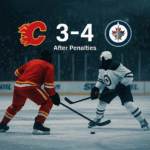
Calgary Flames 3-4 Winnipeg Jets (After Penalties)

Calgary Flames 3-4 Winnipeg Jets (After Penalties)| IHM News IHM

Calgary Flames 3-4 Winnipeg Jets (After Penalties)

Date: November 16, 2025 - Author: IHM News

Jets outlast Flames in a tight, momentum-swinging shootout battle

Winnipeg survived a night of constant pushback from Calgary and escaped with a 3-4 win after penalties, closing out one of the most volatile games of the week. The Flames held long stretches of pressure – outshooting Winnipeg 34-23 and generating far more attempts - but the Jets repeatedly answered at key moments, leaning on elite finishing from their top line and Connor Hellebuyck’s crucial shootout stop on Jonathan Huberdeau.

Calgary clawed back multiple times, including a dramatic late equalizer from Matthew Coronato at 18:45 of the third period. However, despite heavy zone time in overtime, the Flames couldn’t solve Hellebuyck, while Winnipeg’s shooters made their chances count. Gabe Vilardi scored the decisive shootout winner, securing two points for Winnipeg in a game where they spent long stretches in their own end.

How the game unfolded

Second-period scoring surge

After a scoreless first period, Winnipeg finally broke through early in the second: Mark Scheifele finished a clean zone entry from Kyle Connor and Josh Morrissey at 07:19 to make it 0-1. Calgary responded almost instantly, with Jalen Bean capitalizing on a rebound at 07:52.

Winnipeg struck again at 08:25 when Tyler Pearson buried a quick one-timer off a turnover. But Calgary stayed composed, tying the game 2-2 at 13:29 through Kevin Bahl, who hammered home a point shot through traffic.

Special teams tilt the third period

A penalty to Connor Zary at 00:58 for interference set up Winnipeg’s power-play unit, and Cole Perfetti needed only 82 seconds to convert - redirecting a perfect feed from Connor and Morrissey to restore the Jets’ lead at 2-3.

Calgary pushed relentlessly afterward, firing 14 shots on goal in the period. Their persistence paid off at 18:45, when Coronato tied the game 3-3 following sustained cycling in the Winnipeg zone.

Shootout: Vilardi seals it

The overtime period was tight and physical, with only three total shots. In the shootout, Calgary missed all three attempts (Frost, Huberdeau, Andersson), while Vilardi scored the lone goal for Winnipeg to close it out.

Numbers Box

  • Shots on goal: CGY 34 – WPG 23
  • Blocked shots: CGY 15 – WPG 22
  • Shooting percentage: CGY 8.82% – WPG 13.04%
  • Goaltender saves: Wolf 20/23 – Hellebuyck 31/34
  • Faceoff battle: Slight Calgary edge
  • Penalties: CGY 1 – WPG 3
  • PIM: CGY 2 – WPG 6

Coach Mark comment

Calgary played the right way for most of the night but lacked detail in the neutral zone during the second period. Winnipeg’s execution on special teams was the difference. Hellebuyck closing the door in OT and the shootout is what top-tier goalies do.

Questions & Answers | IHM Performance Metrics

Q: Why did Calgary lose despite controlling the shot volume?
A: Winnipeg generated higher-quality attempts and scored on special teams, while Calgary struggled to convert extended zone time.

Q: What swung momentum most?
A: Perfetti’s early third-period power-play goal shifted control back to Winnipeg.

Q: Why was the shootout so one-sided?
A: Winnipeg’s shooters were more patient, while Calgary’s attempts lacked speed variation and deception.

Q: Which players defined the game analytically?
A: Morrissey (transition control), Connor (chance creation), Coronato (finishing), Hellebuyck (high-danger saves).

Q: Is this result concerning for Calgary?
A: No – the underlying metrics show strong play. They simply lost a technical shootout battle.

More NHL news on IHM – visit the homepage.


Calgary Flames 2-0 San Jose Sharks - NHL Game Recap | IHM News

Calgary Flames 2-0 San Jose Sharks – NHL Game Recap | IHM News

Calgary Flames 2-0 San Jose Sharks

Date: November 14, 2025  |  Author: IHM News

Calgary leaned on structure and volume shooting to grind out a 2-0 home win over San Jose, outshooting the Sharks 36-15 and closing the night with a clean sheet on the scoreboard.

This felt like a classic Flames home game: controlled pace, heavy board work and very little room between the blue lines. Calgary steadily tilted the ice with layer-over-layer pressure, forcing the Sharks to chip pucks out rather than attack with speed. With both teams struggling to finish early, it was always going to be about who stayed patient longer and who blinked first under forecheck pressure.

The hosts generated most of their looks from extended zone time, rolling three effective forechecking units and using the low cycle to tire out San Jose’s defense. San Jose tried to answer with quick-strike rushes off turnovers, but they were limited to one-and-done entries and a small shot total. Calgary’s defensive box stayed compact in front of the net, clearing second chances and allowing their goaltender to see almost everything cleanly.

Special teams did not swing the scoreboard, but they did help Calgary manage momentum. The Flames’ penalty kill stayed aggressive at both blue lines, forcing the Sharks to regroup repeatedly and chewing up clock. On the other side, Calgary’s power play focused on puck possession and low-risk entries, even without finding a goal. The overall effect was the same: San Jose never really built a sustained wave in the offensive zone.

Game Flow

The first period was a feeling-out frame with very little open ice. Calgary owned the puck but could not solve San Jose’s shot lanes, while the Sharks’ best looks came from point shots through traffic that were handled calmly. Both teams went to the intermission scoreless, but the shot count already hinted at where the territorial edge was heading.

Early in the second, Calgary finally broke through. After another long offensive-zone shift, the Flames worked the puck low-to-high and then back into the slot, where Blake Coleman found space in front and snapped home the 1-0 goal. From there Calgary kept their foot on the gas, outshooting the Sharks comfortably in the frame and forcing San Jose to collapse even deeper around their crease.

The third period was all about game management from the home side. Calgary continued to finish checks, protect the middle of the ice and change smartly to avoid long shifts. San Jose pushed late with the goalie pulled, but a strong wall battle and quick outlet set up Samuel Honzek to slide the puck into the empty net for 2-0 in the final minute, sealing a workmanlike victory.

Numbers Box

  • Shots on goal: Calgary 36, San Jose 16
  • Blocked shots: Calgary 25, San Jose 13
  • Goaltending: Calgary starter turned aside every shot faced; San Jose’s netminder carried a heavy workload against 36 attempts
  • Penalties/PIM: Calgary 2 minors (4 PIM), San Jose 3 minors (6 PIM)
  • Key scorers: Coleman (GWG), Honzek (EN insurance)

Team Notes

Calgary’s top six forwards drove most of the possession, repeatedly winning races to loose pucks and forcing turnovers on the forecheck. On the back end, the Flames’ defense kept tight gaps in the neutral zone, denying San Jose clean entries and funneling play to the outside. For the Sharks, the positive note is how their penalty kill held up under pressure, but they will look at the shot chart and know they left too much offensive potential on the table.

Coach Mark comment

Calgary played a very mature home game. They did not chase offence, they trusted their structure and let the shot volume wear San Jose down. When your team limits the opponent to 16 shots and scores at key moments, that is the kind of blueprint that travels well through a long season.

Questions & Answers | IHM Performance Metrics

  • Q: What was the biggest tactical edge for Calgary in this game?
    A: Their layered forecheck and tight neutral-zone gap control. The Flames consistently denied San Jose controlled entries, which kept the Sharks from building any multi-chance shifts.
  • Q: How did the Flames manage the low-scoring nature of the night?
    A: They stayed patient, trusted their defensive shell and avoided forcing plays through the middle. Once they had the 1-0 lead, every shift focused on winning the next battle and keeping pucks below the San Jose goal line.
  • Q: What does this result say about Calgary’s defensive structure?
    A: Holding an NHL opponent to 15 shots usually means your layers are in sync. Calgary’s wingers tracked back hard, the defense held the dotted-line area and the goaltender saw clean looks with minimal rebounds.
  • Q: Where can San Jose find adjustments after this loss?
    A: They need more controlled exits and entries. Too many possessions ended with chips off the glass or hopeful dumps that Calgary handled easily, which limited any chance to attack with numbers.

More NHL news on IHM: stay updated with our latest coverage on the IceHockeyMan homepage and future Calgary Flames breakdowns in our NHL section.


Jake Sanderson celebration in red home

Senators Rally Late, Beat Flames 4-3 in Shootout | IHM News

Senators Rally Late, Beat Flames 4-3 in Shootout

by IHM Team | IHM News | Ottawa, Canadian Tire Centre

The Senators showed real growth under pressure. Jake Sanderson tied the game with 2:49 left in regulation when his shot from the left circle pinballed off bodies, kissed the crossbar, and dropped in. Ottawa then finished the job in the shootout on goals from Drake Batherson and Tim Stutzle, edging Calgary 4-3.

Ottawa trailed three different times in the third but never cracked. Lars Eller had a short-handed goal and an assist, Artem Zub scored through traffic, and Linus Ullmark made 27 saves. The Senators move to 4-1-1 in their last six and look increasingly comfortable in tight, grindy games.

“It was a mucky game,” Batherson said. “We knew they were desperate. We stayed patient and found a way.”

For Calgary, there were positives in defeat. Devin Cooley stopped 35 shots and was outstanding in overtime with seven saves, including multiple stops during a 4-on-3 penalty kill. Nazem Kadri, Yegor Sharangovich, and Matt Coronato scored, but the Flames could not close it out and fall to 1-8-2 in their last eleven.

Game Flow

  • 1-0 CGY (5:51, 1st): Sharangovich beats Ullmark high glove on the power play from the right circle.
  • 1-1 (7:37, 1st): Eller finishes a short-handed 2-on-1 off a Shane Pinto rebound. Ottawa’s first short-handed goal of the season.
  • 2-1 CGY (15:53, 1st): Coronato jams home a loose puck on the power play.
  • 2-2 (2:36, 3rd): Zub’s point shot finds a lane through a heavy screen.
  • 3-2 CGY (8:16, 3rd): Kadri executes a give-and-go with Jonathan Huberdeau, snaps it off the right post and in.
  • 3-3 (17:11, 3rd): Sanderson’s drive deflects twice, off the bar and over the line.
  • Shootout: Batherson and Stutzle score, Ullmark seals it.

Calgary coach Ryan Huska praised Cooley’s poise: “He made key saves at important times. Backup life is staying ready. He did that.”

Coach Mark Lehtonen’s Take

“Ottawa’s habits are maturing. They did not chase the game late. They layered their rushes, shot through traffic, and got bodies to the crease. Sanderson’s poise under pressure is big-time. Calgary’s structure was better, and Cooley battled, but game management in the last five minutes cost them. When you are in a spiral, you must close out the routine plays.”

IHM Verdict

Ottawa banked a grown-up win. Calgary showed effort and goaltending, but the margins in the third were the difference.

Final: Senators 4-3 SO Flames

Author: IHM Team | Commentary by Coach Mark Lehtonen


Premium NHL Analysis - 31 Oct 2025 Ottawa Senators vs Calgary Flames

Ottawa Senators vs Calgary Flames – Match Preview

Ottawa hosts Calgary tonight at Canadian Tire Centre in a matchup of contrasting momentum and structure. The Senators have found rhythm with disciplined puck support, aggressive forechecking pressure, and confident puck movement through the middle lane.

Calgary continues to seek consistency after a challenging stretch, with defensive gaps and breakout instability creating problems under sustained pressure. Depth scoring remains a question, and system execution has fluctuated in recent outings.

Ottawa’s ability to generate layered offense and force turnovers in transition gives them a stability edge on home ice. Expect a high-tempo matchup with a strong focus on tactical execution.

Yesterday’s tactical breakdown on Boston was executed cleanly – another strong read from Coach Mark’s system.

Full breakdown & Coach Mark’s private verdict available in Premium.

Unlock Premium Access

Calgary sits last in NHL scoring and pressure is boiling

Flames at a Breaking Point: Blockbuster Trade Pressure Mounts in Calgary

Author: IHM Team | Date: October 24, 2025

Calgary Heat Level: Critical

The Calgary Flames are not just slumping. They are boiling. Offense has collapsed, frustration is coming from inside the room, and according to multiple insiders the front office has already started pushing for a major move.

Calgary sits last in NHL scoring and pressure is boiling

The Flames sit last in the NHL in scoring at around 1.5 goals per game. They were 29th in offense last season. This is not just a bad week. This is who they have been for a while.

Insider Pierre LeBrun reported that the frustration level within the organization is high. His message: patience is running out. General manager Craig Conroy is not waiting for the usual trade window.

“There’s a lot of frustration with the Flames organization about their lack of scoring, and 32nd in the NHL right now, 1.5 goals a game. It’s mind boggling, and frankly, it’s not a new problem. They were 29th in the league in scoring a year ago,” LeBrun said. “GM Craig Conroy isn’t sitting on his hands. He is making calls and exploring the trade market, trying to find out what exactly is available that could potentially help his team offensively.”

Normally, real trade talks do not heat up until U.S. Thanksgiving. Calgary is moving earlier than that. That alone tells you how much pressure is inside the building.

“I Can’t Generate Offense”

After a 2-1 overtime loss to the Montreal Canadiens, goalie Dustin Wolf made a rare public statement about the state of the team’s attack: “I mean, I can’t generate offense.”

When the goalie says that, the message is not subtle. The room knows they are getting saves. The room also knows they are not finishing.

Kadri Watch

Elliotte Friedman pointed out that forward Nazem Kadri is suddenly in a different position contract-wise. His deal switched this year from a full no-move clause to a partial clause with a 13-team no-trade list.

That matters for one reason. Last year, Kadri was basically immovable unless he personally agreed. Now, Conroy has more room to maneuver.

Kadri is still seen around the league as a playoff-style center who can handle tough minutes and bring an edge. If Calgary wants a scoring piece back, Kadri is the kind of established name that could headline an early-season hockey trade instead of a future-for-future swap.

Why This Could Actually Happen Fast

Front offices usually hate early-season blockbusters. Salary cap space is tight, coaches still want to “fix it internally,” and ownership does not like the optics of panic. But Calgary looks like a team that is out of patience.

They are last in the league in offense. They cannot finish chances. The fanbase is restless. The goalie is saying it out loud. The GM is already burning the phone lines.

This is not normal October posture. This is urgent posture.

Coach Mark’s Comment

“Calgary is out of runway. You can play structured hockey and still lose if nobody can finish. That is exactly what we are seeing,” said Coach Mark Lehtonen.

“When a goaltender like Dustin Wolf basically says ‘I can’t score for you,’ that is not ego. That is a message to management. Kadri is the obvious lever. He still has compete, he still has playoff credibility, and now his contract is easier to move. If Conroy pulls this off early, it will not be for draft picks. It will be for real scoring help right now.”

IHM Verdict

  • The Flames are last in the NHL in goals per game.
  • Craig Conroy is already calling around the league looking for offense instead of waiting for the normal trade window.
  • Nazem Kadri’s contract just became easier to move because it shifted from full no-move to a partial no-trade with a 13-team list.
  • Dustin Wolf went public about lack of scoring. That is a pressure signal inside the room.
  • Calgary is on watch for the first true blockbuster of the season.

Bottom line: The rest of the league is officially watching Calgary.