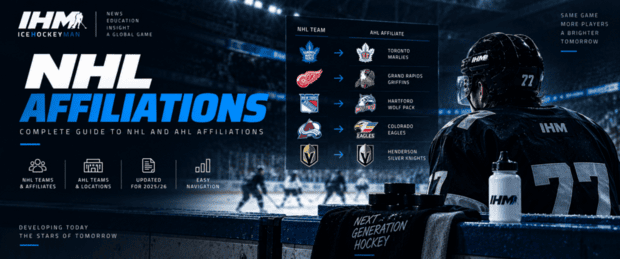
NHL Affiliations: AHL Farm Teams and Their NHL Partners for 2026/27
Updated: September 30, 2026
By: IceHockeyMan Editorial Team
The American Hockey League (AHL) is the primary development league for the National Hockey League and one of the most important stages in the pathway from prospect to NHL regular.
For the 2026/27 season, the AHL features 32 teams, with all 32 NHL organisations represented by a primary AHL affiliate. These partnerships allow NHL clubs to develop prospects, maintain professional roster depth, manage call-ups and assignments, and prepare players to step into NHL systems when opportunities arise.
This IceHockeyMan guide tracks every AHL-NHL affiliation for the 2026/27 season and explains how the farm-team system works, why affiliations matter, how players move between leagues, and what fans should watch throughout the season.
For fans following prospects, player development and fantasy hockey, AHL assignments and call-ups can provide an early indication of which players are moving closer to permanent NHL roles.
AHL Teams and NHL Affiliates - 2026/27 Season
Here is the complete AHL affiliation structure entering the 2026/27 season.
Major AHL Changes for the 2026/27 Season
Hamilton Hammers Replace Bridgeport in the Islanders’ Development System
One of the biggest structural changes entering the 2026/27 season is the arrival of the Hamilton Hammers.
Hamilton becomes the new AHL affiliate of the New York Islanders, replacing Bridgeport within the Islanders’ primary development structure.
The move gives the Islanders a new home for prospects, young professional players and NHL depth options during the 2026/27 campaign.
Chicago Wolves and Carolina Hurricanes
The Chicago Wolves are affiliated with the Carolina Hurricanes for the 2026/27 season.
This is important for prospect tracking because Chicago again functions as Carolina’s main AHL destination rather than operating independently.
Hurricanes prospects, goaltenders and NHL depth players assigned below the NHL level can therefore be followed through the Wolves during the season.
2026/27 AHL Season at a Glance
- Teams: 32
- Games per team: 72
- Total regular-season games: 1,152
- Regular-season opening: October 2, 2026
- Regular-season finale: April 11, 2027
- 2027 AHL All-Star Classic: February 7-8, 2027
The 2026/27 campaign is another major season for prospect development across North America, with hundreds of NHL-contracted players expected to spend time at AHL level.
Throughout the year, NHL injuries, roster changes, waiver decisions and prospect development will create frequent movement between the two leagues.
Why AHL Affiliations Matter
An AHL affiliate is much more than a reserve roster.
It functions as an extension of an NHL organisation’s hockey operations structure, giving prospects and depth players an environment in which they can develop professionally while remaining available for NHL promotion.
The AHL is particularly important in five major areas:
- prospect development
- NHL injury replacement
- goaltender development
- salary-cap and roster management
- preparing players for NHL tactical systems
An NHL organisation with strong development infrastructure can create significant roster value below the NHL level instead of relying entirely on trades and expensive free-agent acquisitions.
The AHL as the Final Development Stage Before the NHL
The transition from junior hockey, college hockey or European professional hockey to the NHL is rarely straightforward.
For many players, the AHL becomes the final major development stage before they establish themselves as full-time NHL players.
Young players must learn to handle:
- a long professional schedule
- stronger and more experienced opponents
- faster decision-making
- less time and space with the puck
- professional defensive responsibilities
- special-teams assignments
- travel and recovery demands
- competition for roster positions
This is why AHL production should never be judged only through goals and assists.
NHL organisations also evaluate whether players can consistently execute details that translate to the highest level.
How AHL and NHL Systems Work Together
Many organisations try to create tactical continuity between their NHL and AHL clubs.
The systems do not always match perfectly because coaches, personnel and opponent quality differ, but affiliates often develop players around similar organisational principles.
These can include:
- forechecking structure
- neutral-zone responsibilities
- defensive-zone coverage
- breakout patterns
- transition concepts
- power-play responsibilities
- penalty-killing principles
- player terminology and communication
This continuity can reduce the adjustment required when a player receives an NHL call-up.
A prospect who already understands the organisation’s terminology and tactical expectations can enter an NHL lineup more efficiently than a player who has to learn a completely new structure.
Coach Mark Comment: What the AHL Really Tells Us About NHL Readiness
“For me, the AHL is one of the most important levels in the entire development process because this is where talent starts being tested against professional habits.
A young player can dominate junior hockey, college hockey or even have very good numbers in Europe, but that does not automatically mean he is ready for the NHL. The AHL exposes weaknesses very quickly. The game is faster, players are stronger, the schedule is longer, there is less space, and mistakes are punished much more consistently.
When coaches watch a prospect in the AHL, they are not only looking at goals, assists or highlights. They are looking at how the player behaves shift after shift. Does he make the correct decision under pressure? Does he recognise danger early? Can he defend when he is tired? Can he play without the puck? Can he manage the game when his team is protecting a lead? Can he stay disciplined when the game becomes physical?
Those details matter enormously.
At junior level, a very talented player can sometimes solve problems with speed, hands or individual skill. At professional level, that advantage becomes smaller. The defenders are stronger, the gaps close faster, and opponents understand positioning much better. You cannot rely only on talent anymore.
This is why I always say that the AHL does not simply develop players. It reveals players.
It shows whether a player can translate his game into professional hockey.
One of the biggest mistakes fans make is looking only at the scoring table. Of course production matters, especially for offensive players, but NHL organisations are evaluating much more than points.
A centre may have fewer points but be trusted in defensive-zone face-offs, on the penalty kill and against the opponent’s best line. A defenceman may not produce much offensively but could be improving his gap control, first pass, positioning and decision-making under forecheck pressure. A winger may be learning how to create offence without cheating defensively.
These are all important signs of development.
Another thing I watch closely is consistency.
Almost every good prospect can play one excellent game. NHL teams want to know whether he can repeat good habits over 20, 40 or 60 games. Professional hockey is about repetition. Can you perform when your legs are heavy? Can you make good decisions after travel? Can you stay focused when you have not scored for five games?
That is where the AHL becomes very valuable.
The league also teaches players how to survive competition inside their own organisation. Every player wants an NHL job, but there may be five or six other players fighting for the same opportunity. That pressure forces young players to become more complete.
Sometimes the player who gets called up is not the player with the most points. It may be the player the NHL coach trusts more in a specific role.
If an NHL team needs a fourth-line centre, they may choose the player who wins face-offs, kills penalties and understands defensive structure. If they need a top-six winger, they may choose the player who can create offence. If they need an emergency defenceman, reliability may become more important than production.
This is why AHL development must always be viewed in context.
Another major factor is tactical familiarity.
Good organisations try to create a development pathway where players understand similar terminology and principles across the NHL and AHL levels. The systems do not have to be identical, but the player should understand the organisation’s expectations.
For example, if the NHL team wants aggressive pressure on the forecheck, the AHL player should understand the reads behind that pressure. If the NHL team uses a certain neutral-zone structure, the prospect should know his responsibilities before he is called up.
This can make the difference between a player looking comfortable in his first NHL game and a player looking completely lost.
Goaltenders are another good example of why the AHL is so important.
Young goalies often need games more than anything else. Sitting on an NHL bench does not always help development. Sometimes 40 or 50 AHL starts are much more valuable than 15 NHL appearances.
The AHL gives goaltenders the chance to learn professional traffic, rebound management, puck tracking and recovery habits against stronger shooters.
Defencemen also often need more time.
At NHL level, one bad read can immediately become a scoring chance. Defencemen need to understand spacing, pressure, retrievals and when to move the puck quickly. The AHL gives them repetitions without every mistake becoming a major NHL problem.
For forwards, the biggest challenge is often learning how to produce without having the puck all the time.
Young offensive players are used to being the best player on their team. At professional level, they must learn timing, support, positioning and how to create space for teammates. That is a different kind of hockey intelligence.
For me, one of the clearest signs that a prospect is becoming NHL-ready is when his game becomes calmer.
He stops forcing plays. He starts recognising when to attack and when to manage the puck. He understands risk. He knows when the simple play is the correct play.
That maturity is very important.
Sometimes fans become impatient when a highly rated prospect spends another season in the AHL, but extra time is not automatically a negative sign. In many cases, it can be exactly what the player needs.
A prospect who arrives in the NHL too early can lose confidence, play limited minutes and develop bad habits. A prospect who receives major responsibility in the AHL can continue building his game.
The goal should not be to reach the NHL as quickly as possible. The goal should be to arrive ready to stay there.
That is a very important difference.
The AHL is also critical for NHL teams during the season because injuries are unavoidable. A strong organisation cannot depend only on its opening-night NHL roster.
When injuries happen, the team needs players below the NHL level who can step into specific roles immediately.
This is why depth matters.
A good AHL system gives an NHL coach options.
If you need speed, you have someone ready. If you need defensive responsibility, you have someone ready. If you need a power-play player, you have someone ready. If you need a goaltender, you have someone who has been playing regularly.
That depth can make a major difference over an 82-game NHL season.
From a coaching perspective, I would tell fans to watch AHL players differently.
Do not ask only: how many points does he have?
Ask:
- Is he playing more important minutes?
- Is he being trusted late in games?
- Is he playing on special teams?
- Is his defensive responsibility increasing?
- Is he making fewer high-risk mistakes?
- Is he becoming more consistent?
- Can he handle stronger opponents?
- Can he play different roles?
Those questions often tell you more about NHL readiness than the scoring table alone.
When a young player starts earning more trust from his AHL coaching staff, that usually means something important is happening in his development.
For me, the AHL is the bridge between potential and reliability.
Potential gets a player drafted. Skill gets attention. But reliability is what keeps him in the NHL.
That is why the AHL remains such an important part of modern NHL development.”
How NHL Call-Ups from the AHL Work
A call-up occurs when an NHL organisation promotes a player from its AHL affiliate to its NHL roster.
Call-ups happen throughout the season and can be triggered by:
- NHL injuries
- illness
- poor performance
- schedule congestion
- goaltending needs
- lineup changes
- prospect development
- salary-cap considerations
Some players move between the AHL and NHL several times during one season.
These transactions are a normal part of professional roster management and do not necessarily mean an organisation has changed its long-term opinion of the player.
What Is an AHL Assignment?
An assignment generally refers to an NHL-contracted player being sent to an AHL affiliate when permitted under league and contract rules.
For younger players, an assignment can provide regular ice time that may not be available at NHL level.
Instead of playing limited minutes as an extra NHL forward or defenceman, a prospect may receive major AHL responsibility on:
- the power play
- the penalty kill
- late-game situations
- top forward lines
- top defensive pairings
That playing time can be critical to long-term development.
Waivers and AHL Assignments
Not every NHL player can simply be sent to the AHL whenever a club chooses.
Depending on factors including age, professional experience and contract status, a player may become subject to waivers.
This makes NHL roster management significantly more complicated as prospects gain professional experience.
Teams must balance player development against the possibility of losing useful organisational depth through the waiver process.
Two-Way Contracts and AHL Eligibility
A common misconception is that a two-way contract automatically determines whether a player can move freely between the NHL and AHL.
It does not.
A two-way contract primarily relates to how a player’s salary changes depending on whether he is playing at NHL or minor-league level.
Waiver status and assignment eligibility are separate issues.
This distinction becomes particularly important during NHL training camps and final roster cuts.
Why NHL Training Camp Matters to AHL Rosters
AHL rosters can change dramatically during NHL training camps.
Many players competing for NHL positions ultimately begin the season with an AHL affiliate after NHL organisations reduce their opening-night rosters.
Projected AHL depth charts during the summer can therefore look very different by the start of the regular season.
For prospect followers, final NHL roster cuts are one of the most important periods of the year.
Why AHL Call-Ups Matter for Fantasy Hockey
AHL transactions can also matter to fantasy hockey players.
A prospect receiving an NHL call-up may suddenly gain access to:
- NHL top-six minutes
- power-play opportunities
- increased shot volume
- better offensive linemates
- a longer-term NHL roster opportunity
However, not every call-up should be interpreted as a permanent promotion.
Some players are recalled simply to provide temporary roster cover and may return to the AHL once an injured NHL player becomes available.
Why Goaltender Development Is Especially Important in the AHL
Goaltenders often require a different development timeline from forwards and defencemen.
The AHL gives young goalies the opportunity to face professional shooters consistently while developing positioning, rebound control, puck tracking, recovery mechanics and workload management.
An organisation may prefer a highly regarded young goaltender to play regularly in the AHL rather than remain in the NHL as a backup with limited starts.
As a result, AHL goaltending situations can be especially important when evaluating future NHL depth charts.
Do NHL Teams Own Their AHL Teams?
Some NHL organisations own or directly control their AHL operations, while others maintain affiliation or operational agreements with independently structured franchises.
The development objective remains similar in either model: provide NHL-contracted players and prospects with a high-level professional environment below the NHL.
Direct organisational control can make it easier to coordinate coaching philosophy, staffing, player development programmes and tactical structure across both levels.
How Important Is AHL Success for an NHL Prospect?
A strong AHL season can be one of the clearest signs that a prospect is approaching NHL readiness, but statistics always require context.
Different players are asked to perform different roles.
A highly offensive winger may be judged heavily on production, while a defensive centre could be evaluated on face-offs, defensive-zone work, penalty killing and matchup responsibility.
Defencemen may require additional development time because mistakes at that position can be significantly more damaging at NHL speed.
For this reason, evaluating AHL prospects requires much more than simply ranking the league’s leading scorers.
What Is the Difference Between the AHL and NHL?
The NHL is the highest level of professional ice hockey, featuring the world’s strongest concentration of elite players.
The AHL sits directly below it in the North American professional structure and serves as the NHL’s primary development league.
Both leagues contain high-level professional players, but NHL hockey generally demands greater speed of execution, physical strength, consistency and tactical precision.
The biggest difference is often not whether an AHL player has individual skill, but whether he can execute that skill quickly and repeatedly against NHL-level pressure.
How Many NHL Players Have Played in the AHL?
The connection between the two leagues is enormous.
Nearly 90% of current NHL players have AHL experience during their professional development.
The league has also developed coaches, general managers, executives, officials, trainers and broadcasters who later moved into the NHL.
This makes the AHL much more than a collection of farm teams. It is one of the central development systems supporting the NHL.
Why Farm Systems Matter in the NHL Salary-Cap Era
Internal development has become especially valuable in an NHL environment where teams operate under a salary cap.
Established NHL players can become expensive, while young home-developed players can provide meaningful production on more manageable contracts.
A productive farm system can help an organisation:
- replace injured NHL players
- develop affordable roster depth
- prepare future top-six forwards
- develop NHL defencemen internally
- create competition for roster positions
- reduce dependence on free agency
- create assets that may later be included in trades
For successful NHL organisations, development below the NHL level is directly connected to long-term roster construction.
What to Watch During the 2026/27 AHL Season
The IceHockeyMan team will continue monitoring AHL-NHL movement throughout the 2026/27 campaign.
The most important developments include:
- top prospects earning NHL call-ups
- players being reassigned after NHL training camp
- goaltenders moving up NHL depth charts
- injury-related emergency recalls
- prospects taking larger AHL roles
- waiver-related roster moves
- late-season assignments before the Calder Cup Playoffs
- players positioning themselves for NHL roles in 2027/28
This page will remain an IceHockeyMan reference point for the 2026/27 AHL and NHL affiliation structure throughout the season.
AHL and NHL Affiliations FAQ
How many teams are in the AHL in 2026/27?
The American Hockey League has 32 teams for the 2026/27 season.
Does every NHL team have an AHL affiliate?
Yes. All 32 NHL organisations are represented by a primary AHL development affiliate for the 2026/27 season.
How many games does each AHL team play in 2026/27?
Each AHL club is scheduled to play 72 regular-season games.
When does the 2026/27 AHL season start?
The 2026/27 AHL regular season begins on October 2, 2026.
When does the 2026/27 AHL regular season end?
The regular season is scheduled to conclude on April 11, 2027.
Who is the New York Islanders’ AHL affiliate in 2026/27?
The Hamilton Hammers are the New York Islanders’ AHL affiliate for the 2026/27 season.
Who is the Carolina Hurricanes’ AHL affiliate?
The Chicago Wolves serve as Carolina’s AHL affiliate for the 2026/27 season.
Who is the Utah Mammoth’s AHL affiliate?
The Tucson Roadrunners are affiliated with the Utah Mammoth.
Can an AHL player be called up to the NHL during the season?
Yes. NHL organisations regularly recall eligible players from their AHL affiliates because of injuries, roster needs, performance or development decisions.
Can a player move between the NHL and AHL several times?
Yes. Depending on roster status, waivers and contract circumstances, some players move between the leagues multiple times during a season.
Do AHL teams use the same systems as their NHL affiliates?
Not always exactly, but many organisations try to align tactical principles, terminology and development priorities between their NHL and AHL teams.
Do all NHL prospects play in the AHL?
No. Elite prospects can move directly to the NHL from junior hockey, college hockey or European professional leagues. Other players use the AHL as an important intermediate development stage.
What is an AHL farm team?
An AHL farm team is the primary professional development affiliate of an NHL organisation. It provides prospects and depth players with high-level competition and prepares them for possible NHL roles.
Can AHL success predict NHL success?
AHL success can be an important indicator of NHL readiness, but it is not a guarantee. Age, role, skating, decision-making, defensive performance and the ability to translate skills to NHL speed all matter.
Why do some prospects stay in the AHL longer than others?
Development timelines differ. Some players need additional time to improve strength, skating, defensive awareness, consistency or decision-making before an organisation believes they are ready for regular NHL responsibility.
How many NHL players have AHL experience?
Nearly 90% of current NHL players have played in the AHL during their development path, demonstrating how important the league remains to NHL player development.
IceHockeyMan will keep this 2026/27 AHL-NHL affiliations guide updated throughout the season as organisational relationships, player development pathways and league information change.