
Offensive Zone Cycle – Low Switch & Pop Support (East-West Deception Style)
A cycle is not “wasting time in the corner.” A real cycle stretches defenders east-west, forces coverage switches, and opens the middle. Bad teams skate in circles; smart teams change angles and attack seams. We don’t cycle to survive – we cycle to manipulate and strike.
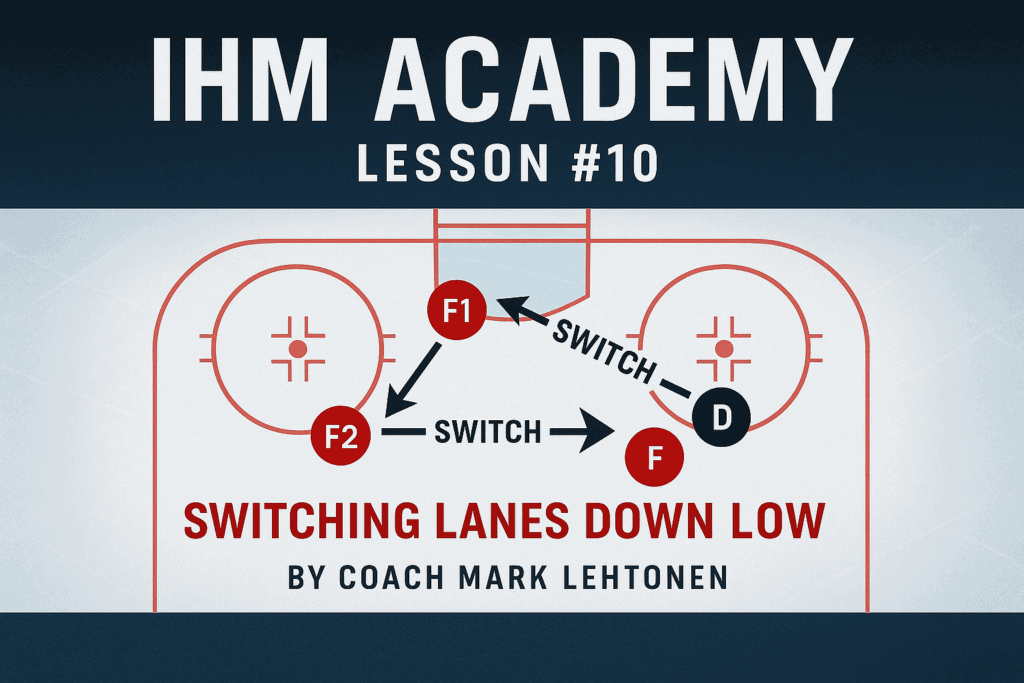
Objective
Use low support, deceptive switching, and weak-side pop timing to pull defenders off structure and create a middle-lane attack with speed.
Core Principle
Switch low → Pull coverage → Hit the weak-side pop in stride. We don’t dump and chase the corner; we cut east-west, lean pressure, and pop into space.
Roles & Execution
- F1: Drive below the dots, sell net drive, then inside cut across the dots to change the angle.
- F2: Low support under F1 with tight spacing (2-3 stick lengths), stick available, eyes middle.
- F1 ↔ F2 Low Switch: Quick shoulder fake → exchange lanes → force D to hand off coverage or over-commit.
- F3: Stay outside the pile; pop into soft ice above the dots on the weak side; catch in stride for shot or downhill attack.
- D1 / D2: Hold width up top; be patient. Join only if middle is secured and cycle control is established.
Key Cues
- Tight cycle spacing: 2-3 stick lengths between F1/F2 – close enough to connect, far enough to pull a defender.
- Stop-start cuts: No lazy circles. Sell one route, exit on another.
- Sell the drive: Threaten the net before you pull east-west.
- F3 waits, then pops: Don’t dive too early; arrive as the switch forces confusion.
- Middle belongs to us: If there’s no middle threat, the cycle is cardio.
Why It Works
East-west deception stretches the defensive box, forces switches, and creates timing gaps. The weak-side pop becomes a free look because defenders are turning heads and handing off coverage. We create the shot, not just possession.
Coach Mark Lehtonen says:
“Don’t skate to skate – skate to move someone out of your lane. Fakes win cycles. Contact without deception is just cardio.”
Common Mistakes
- Big circles: Easy to track; no deception or separation.
- F3 too deep: Middle threat disappears; cycle dies on the wall.
- D jumping early: Creates the wrong 3v2 the other way.
- No shoulder fake: Defenders read the route; switch fails.
- Puck released outside too early: Kills spacing and timing before the pop is open.
Micro-Drills
- Low Switch Cut: F1 below dots under pressure → inside cut; F2 under-support → quick exchange; return pass to F1 or hit F3 pop for shot.
- East-West Pressure Box: Cones at hashmarks; F1 drive-in → stop-cut → escape east; F2 under-support; F3 time the pop above dots for one-touch.
Summary
Cycle to attack, not to survive. Low support → deception → switch → weak-side pop → middle strike. We drag defenders out of structure and punish the gap they leave. Skill beats structure when structure creates the skill.
Explore more offensive zone concepts at IHM Academy.