Tag: Neutral Zone

What Is a Neutral Zone in Ice Hockey?

IHM Knowledge Center

What Is a Neutral Zone in Ice Hockey?

What happens in the middle of the ice between both teams’ zones, and why is the neutral zone critical for transitions and control?

Editor: Coach Mark • Updated: April 19, 2026

Short Answer

The neutral zone is the area between the two blue lines where teams transition between offense and defense.

Full Explanation

The neutral zone is the central part of the ice located between the two blue lines. It connects the defensive and offensive zones and is where transitions occur.

Teams move the puck through the neutral zone to enter the offensive zone or to reset play when under pressure.

Unlike the offensive or defensive zones, the neutral zone is less structured and more dynamic, with both teams competing for control and positioning.

This is where speed, timing, and decision-making are most important.

NHL vs IIHF Rule Differences

The neutral zone is defined the same way in NHL and IIHF.

Differences appear only in how teams use the neutral zone tactically, not in the rules themselves.

Both leagues rely heavily on neutral zone play for transitions.

Role in Transition Play

The neutral zone is the transition zone between attack and defense.

Teams use it to:

  • Carry the puck into the offensive zone
  • Dump the puck for controlled entry
  • Reset positioning
  • Apply pressure to disrupt the opponent

Strong neutral zone play often determines which team controls the game.

Why These Situations Are Controversial

The neutral zone itself is not controversial, but many key calls happen there.

Most controversies involve:

  • Offside decisions at the blue line
  • Icing setups from neutral zone clears
  • Interference or obstruction plays

Because the neutral zone connects all phases of play, it is involved in many rule decisions.

Edge Case: Quick Transition Leading to Offside

A key edge case occurs when a team transitions quickly through the neutral zone and enters the offensive zone too early.

Players may cross the blue line before the puck due to speed or miscommunication.

This results in an offside call, even if the play appears fluid.

Timing errors in transition are common at high speed.

IHM Signal System: How to Read the Situation

To understand neutral zone play, focus on these signals:

  • Transition signal: Is the team moving from defense to offense?
  • Control signal: Who has puck possession?
  • Spacing signal: Are players positioned for entry?

Trigger-level rule:

If a team moves through the neutral zone with control and proper spacing, a clean zone entry is almost always created.

If spacing is poor or timing is off, turnovers or offside calls are likely.

IHM Insight: Why This Rule Is Misunderstood

The neutral zone is misunderstood because it does not have a single clear objective like scoring or defending.

However, it is the most important area for controlling the pace of the game.

Teams that dominate the neutral zone usually control transitions and overall flow.

Understanding transition vs structure is key.

Mini Q&A

What is the neutral zone?
The area between the two blue lines.

What happens there?
Teams transition between offense and defense.

Why is it important?
It controls game flow and puck movement.

Can offside happen here?
Yes, at the blue line.

Is it structured like other zones?
No, it is more dynamic.

Why This Rule Exists

The neutral zone exists to connect offensive and defensive play and structure transitions across the ice.

It ensures organized movement between zones.

Key Takeaways

  • The neutral zone is between the blue lines
  • It controls transitions
  • Possession is critical
  • Timing affects entry
  • It influences overall game flow
Cinematic hockey banner showing a neutral-zone turnover exploding into counter-attack, with metallic title IHM Academy - Lesson #9

IHM Academy – Lesson #9 · By Coach Mark Lehtonen

Neutral Zone Transition Triggers – Turn Defense Into Strike Force

In the neutral zone, the team that thinks faster wins. A turnover isn’t a pause – it’s a trigger. We don’t “start an attack”; we launch a structured strike while the opponent is still reorganizing.

Top-down coaching diagram of neutral-zone transition: F1 north-first touch, F2 under support, F3 weak-side slash through the middle, D1/D2 structure

Objective

Convert neutral-zone recoveries into immediate, structured offense by owning the middle lane, activating speed, and forcing defenders into late decisions.

Core Principle

FIRST TOUCH NORTH → SUPPORT SLASH → MIDDLE OWNERSHIP. If the first action after a recovery is lateral or backwards, the moment dies. If it’s north with layered support, the defense panics.

Roles & Timing

  • F1 (puck winner): One quick stride north, head up, sell middle. Do not drift east-west.
  • F2 (nearest support): Arrives on an angled lane under F1 – available for a quick pop or touch pass.
  • F3 (weak-side slash): Cuts through the middle with speed. This is the playmaker: it splits coverage and opens the outside lane by threatening the seam.
  • D1: Holds the blue line with a small north step; joins only if structure behind is stable.
  • D2: Anchors the middle; protects against immediate counter if play stalls.

Teaching Cues

  1. Head up early: Scan before you touch the puck; decide before you receive.
  2. Staggered depth: Do not stack lanes; create layers for quick-touch plays.
  3. Middle threat first: Show the seam to open the flank.
  4. Tempo shift: Half-second hesitation kills transition; explode on recovery.
  5. No parallel routes: Cross or slash; don’t skate side-by-side.

Why It Works

We attack while their structure collapses: the middle-lane slash forces the defense to guess; the north-first touch prevents regroup; layered support protects possession if pressure arrives. It’s controlled aggression – not chaos.

Coach Mark Lehtonen says:

“Bad teams race. Smart teams steer. Own the middle and you own the shift.”

Common Mistakes

  • Dragging the puck east-west after the recovery.
  • Stacking two forwards in the same lane (no depth).
  • F3 watching the play instead of slashing through the seam.
  • D jumping without middle security from the partner.

Quick Micro-Drills

  • 3v2 NZ Turnover Pop: Coach rims a loose puck; F1 recovers → F2 under pop → F3 seam slash; finish off the rush.
  • Seam Read Relay: On whistle, weak-side forward must cross the dots in three strides; coach passes only if slash is on time.

Summary

Neutral-zone transition is a mindset: recover → explode north → slash middle → support underneath. We don’t chase speed – we remove options and attack space. That’s how defense becomes strike force.

Study more transition and entry concepts at IHM Academy.


IHM Academy - Lesson #8 Neutral Zone Face-Off Loss

IHM Academy – Lesson #8 · By Coach Mark Lehtonen

By Coach Mark Lehtonen · IHM Academy

Neutral Zone Face-Off Loss – Pressure, Structure & Lane Denial

Losing a neutral-zone draw is not a mistake – it’s a trigger. Elite teams don’t panic or react passively. They activate pressure, deny middle ice, and force a predictable breakout. A face-off loss becomes a win when your structure and patience create a turnover.

Neutral Zone Face-Off Loss - Lane Denial & Pressure Triggers

Objective

Eliminate immediate middle support options, force play to the wall, and pressure into a turnover or dump-in.

Core Responsibilities

  • C – contest, delay, and then immediately jump to track middle support.
  • Strong-side wing – pressure to force puck wide, stick inside lane.
  • Weak-side wing – collapse to middle, protect inside first, then read.
  • D1 – hold blue line angle, deny middle step, stay inside the dots.
  • D2 – anchor middle ice, ready to close gap or retreat if stretched.

Pressure Phases

  1. Face-off drop: Win tie-up, or immediately lock onto your lane responsibility.
  2. First read: If puck goes D-to-D, strong-side pressure increases.
  3. Middle denial: Weak-side forward locks inside seam.
  4. Commit & close: Force the puck to the boards – angle, don’t chase.

Coaching Cues

  • Inside first, outside second – we don’t open middle ice.
  • Sticks active – blade on ice, kill middle lanes.
  • Skate through checks – do not stop feet after tie-up.
  • Read top hand – identify breakout side fast.
  • No fly-bys – finish lanes with control, not chaos.

Why It Works

This system forces the opponent to make the longest, slowest breakout choice – off the wall. It eliminates the quick middle pop and destroys stretch options before they develop. Neutral-zone control starts with structure, not speed.

Coach Mark Lehtonen says:

“You don’t lose a draw – you trigger a trap. The moment they think they gained possession, we remind them how expensive middle ice is against us.”

Summary

Face-off losses reveal discipline. Hold middle ice, angle to the wall, press with purpose. We don’t chase pucks – we remove options and wait for our moment to strike.

Train your neutral-zone reads and pressure habits at IHM Academy.


HM Academy - Lesson #2’ and ‘Neutral Zone Forecheck · 1-2-2’.By Coach Mark Lehtonen

IHM Academy - Lesson #2 By Coach Mark Lehtonen · IHM Academy

Neutral Zone Forecheck 1-2-2 Explained

The neutral zone decides who controls the game. If you slow teams there, you control the tempo. If you lose it, you chase all night. The 1-2-2 neutral zone forecheck is a modern structure used to shut down transition attacks, force low-percentage entries, and turn mistakes into instant counter-attacks.

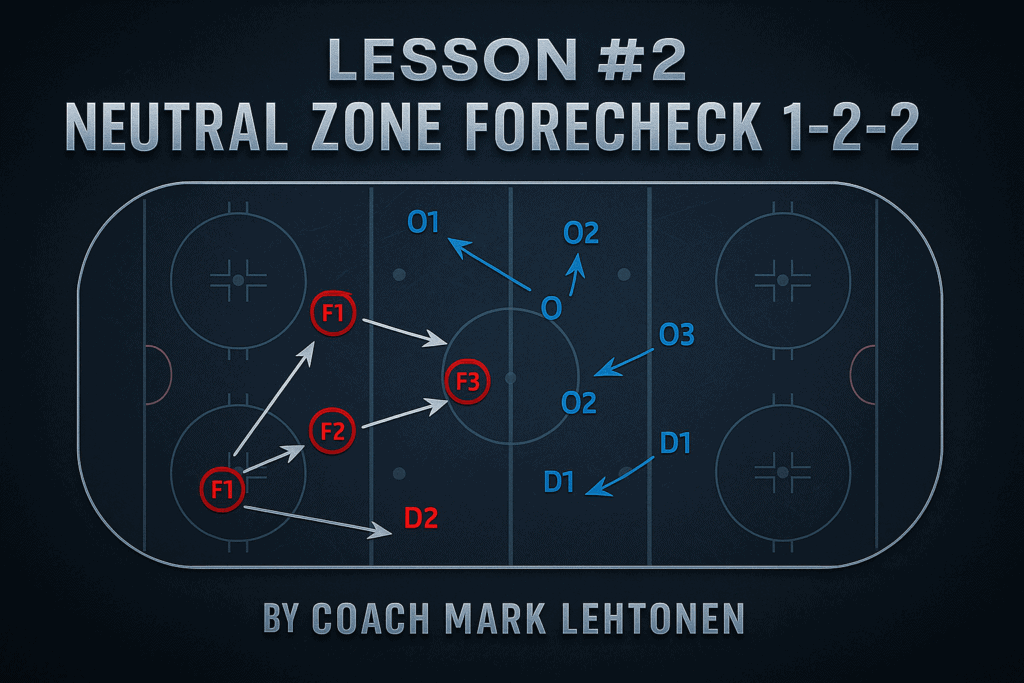
Neutral Zone 1-2-2 Forecheck Explained - IHM Academy by Coach Mark Lehtonen

What is the 1-2-2?

The numbers describe the shape. 1 forward applies the first layer of pressure. 2 forwards form a second layer across the width of the neutral zone. 2 defensemen sit behind that, controlling space and stepping up when the puck gets funneled to a predictable lane.

This is not a full-speed chase. It’s controlled pressure. You are not trying to steal the puck immediately – you are trying to force the puck into a decision you already prepared for.

Player Responsibilities

F1 – The first pressure

F1 is your trigger. This forward angles (forces) the puck carrier toward one side of the ice, ideally toward the boards. The key is angle, not speed. Bad F1s just skate fast. Good F1s steer the puck where the structure wants it.

If F1 chases straight through the middle, the entire 1-2-2 collapses. F1 must close time and space while taking away the middle lane.

F2 and F3 – The wall

F2 and F3 sit behind F1 and stretch horizontally across the neutral zone. Think of them as a moving barrier. One forward covers the strong side (the side where the puck is being pushed), the other covers the weak side.

Their job is to read the next pass. If the puck moves to the wall, the strong-side forward steps up and attacks. If the puck gets reversed or cut back to the middle, the weak-side forward jumps and kills that option.

Good 1-2-2 teams make the puck carrier feel like there’s open ice ahead - and then shut that lane right as the pass is released.

D1 and D2 – The gatekeepers

D1 and D2 hold a tight, aggressive gap behind the forwards. They are not passively “backing in.” They’re stalking the next move. The second the puck is funneled to the boards, the strong-side defenseman can step up on the entry, finish the body, and break the play.

The other defenseman shifts to middle ice and protects against a slip pass or a chip-and-chase behind the line. This prevents odd-man rushes against.

Why coaches love 1-2-2 in the neutral zone

  • It kills speed. Fast teams hate this system. You’re not letting them enter the zone with control; you’re forcing them to dump the puck early.
  • It creates predictable exits for you. When you win the puck on the wall, you already have F2 or F3 close enough to turn it the other way. You don’t just defend – you counter.
  • Low risk, high control. It’s safer than an all-in forecheck like 2-1-2 because you always keep numbers behind the puck. You’re rarely caught in an odd-man rush if everyone does their job.

Common mistakes that break the system

  • F1 overcommits straight-line. If F1 flies past the puck and doesn’t angle, the opponent just hits the middle with speed. That’s a free controlled entry against you.
  • F2 and F3 get too deep. The “2-2” line must stay in the neutral zone, not drift back to their own blue line. If they sag, you give the opponent the red line for free.
  • Defense backing in too early. D1 and D2 must hold the line mentally. If they just retreat, the structure dies. The whole point is to meet the puck at pressure points, not surrender ice.

Coach Mark Lehtonen says:

“People think 1-2-2 is passive. It’s not. It’s controlled aggression. You’re not chasing the puck – you’re telling the puck where to go. Good teams don’t hunt chaos. They create it on their terms.”

When to use the 1-2-2

Teams will lean on this structure when they’re protecting a lead, when they’re playing a dangerous transition opponent, or when the bench is tired and needs to control the pace. It’s also a go-to system on big ice (international hockey), where straight high-speed rushes are deadly if you give too much room in the neutral zone.

Summary

The 1-2-2 neutral zone forecheck is about discipline, spacing, and funneling the puck into pressure instead of gambling for a steal. You slow their transition, you take away the middle of the ice, and you force them to give you the puck on your terms. That’s intelligent hockey.

For more tactical lessons, visit IHM Academy – we break down systems, structure, and hockey IQ the way players actually hear it in the room.