Tag: 1-2-2 Forecheck

What Is a 1-2-2 Forecheck in Hockey? | IHM

IHM Knowledge Center

What Is a 1-2-2 Forecheck in Hockey?

How do teams balance pressure and defensive stability, and why is the 1-2-2 forecheck one of the most widely used systems in hockey?

Editor: Coach Mark • Updated: April 19, 2026

Short Answer

A 1-2-2 forecheck is a balanced system where one player pressures the puck, two support in the middle, and two stay back to maintain defensive structure.

Full Explanation

The 1-2-2 forecheck is one of the most versatile systems in hockey. It combines elements of aggressive pressure and defensive control, allowing teams to adapt to different game situations.

This system is designed to:

  • Apply controlled pressure on the puck
  • Protect against quick counterattacks
  • Maintain structure through transitions
  • Force predictable breakout decisions

It is often used as a default system because of its flexibility.

Structure of the 1-2-2 Forecheck

The system is built around three layers:

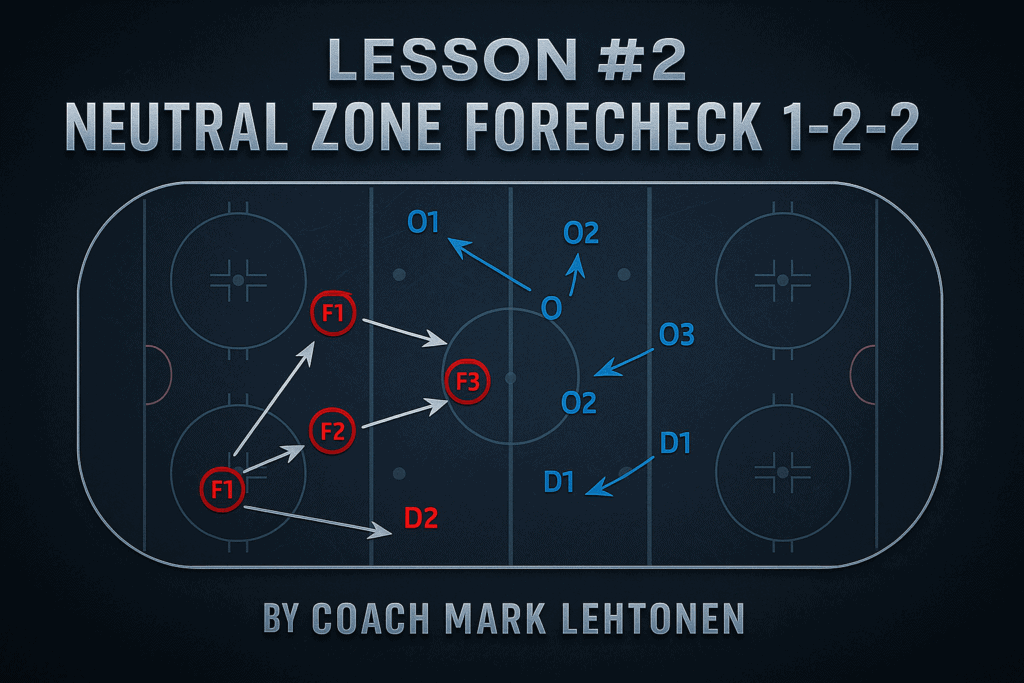
  • F1: Applies pressure on the puck carrier
  • F2 and F3: Control the middle of the ice and support pressure
  • D1 and D2: Stay deeper to protect against long passes

This creates a compact and stable defensive structure.

How the 1-2-2 Balances Pressure and Control

Unlike aggressive systems, the 1-2-2 does not overcommit to pressure.

Instead, it:

  • Forces the opponent into predictable breakout lanes
  • Limits speed through the neutral zone
  • Maintains defensive coverage at all times

This makes it effective against both fast and structured teams.

1-2-2 vs Other Forecheck Systems

The 1-2-2 sits between two extremes:

  • 2-1-2: High pressure, high risk
  • 1-3-1: High control, lower pressure

The 1-2-2 provides a balance between these approaches.

Coaches often adjust the aggressiveness within the 1-2-2 depending on the game situation.

Why These Decisions Are Controversial

The 1-2-2 is sometimes criticized for being too conservative.

Common complaints include:

  • Not applying enough pressure
  • Allowing controlled breakouts
  • Lack of offensive aggression

However, it reduces risk and maintains structure.

Edge Case: Switching Between Aggressive and Passive Modes

A key edge case occurs when teams adjust the aggressiveness of the 1-2-2.

The system can shift:

  • Into a more aggressive forecheck (closer to 2-1-2)
  • Into a more passive structure (closer to 1-3-1)

This flexibility makes it difficult for opponents to predict.

IHM Signal System: Reading the 1-2-2

To identify and analyze the 1-2-2 forecheck, focus on:

  • Pressure signal: Is F1 applying controlled pressure?
  • Middle control: Are F2 and F3 positioned centrally?
  • Depth signal: Are defensemen protecting against long plays?

Trigger-level rule:

If the opponent is forced into controlled but predictable breakouts without gaining speed, the 1-2-2 is functioning effectively.

IHM Insight: Why Coaches Prefer 1-2-2

The 1-2-2 is the most coach-friendly system because it adapts to different situations.

It allows teams to:

  • Maintain defensive stability
  • Control game tempo
  • Adjust pressure levels without changing structure

It is often the foundation of team identity.

Mini Q&A

What is a 1-2-2 forecheck?
A balanced system with one pressure player and structured support.

Is it aggressive or defensive?
It is a balanced system.

How does it compare to 2-1-2?
It is less aggressive and more structured.

How does it compare to 1-3-1?
It applies more pressure.

Why is it popular?
Because of its flexibility and balance.

Why This Rule Exists

The 1-2-2 forecheck exists to provide teams with a flexible system that balances pressure and defensive security.

Key Takeaways

  • The 1-2-2 balances pressure and structure
  • It adapts to different game situations
  • It limits opponent speed and options
  • It reduces defensive risk
  • It is widely used at all levels of hockey
HM Academy - Lesson #2’ and ‘Neutral Zone Forecheck · 1-2-2’.By Coach Mark Lehtonen

IHM Academy - Lesson #2 By Coach Mark Lehtonen · IHM Academy

Neutral Zone Forecheck 1-2-2 Explained

The neutral zone decides who controls the game. If you slow teams there, you control the tempo. If you lose it, you chase all night. The 1-2-2 neutral zone forecheck is a modern structure used to shut down transition attacks, force low-percentage entries, and turn mistakes into instant counter-attacks.

Neutral Zone 1-2-2 Forecheck Explained - IHM Academy by Coach Mark Lehtonen

What is the 1-2-2?

The numbers describe the shape. 1 forward applies the first layer of pressure. 2 forwards form a second layer across the width of the neutral zone. 2 defensemen sit behind that, controlling space and stepping up when the puck gets funneled to a predictable lane.

This is not a full-speed chase. It’s controlled pressure. You are not trying to steal the puck immediately – you are trying to force the puck into a decision you already prepared for.

Player Responsibilities

F1 – The first pressure

F1 is your trigger. This forward angles (forces) the puck carrier toward one side of the ice, ideally toward the boards. The key is angle, not speed. Bad F1s just skate fast. Good F1s steer the puck where the structure wants it.

If F1 chases straight through the middle, the entire 1-2-2 collapses. F1 must close time and space while taking away the middle lane.

F2 and F3 – The wall

F2 and F3 sit behind F1 and stretch horizontally across the neutral zone. Think of them as a moving barrier. One forward covers the strong side (the side where the puck is being pushed), the other covers the weak side.

Their job is to read the next pass. If the puck moves to the wall, the strong-side forward steps up and attacks. If the puck gets reversed or cut back to the middle, the weak-side forward jumps and kills that option.

Good 1-2-2 teams make the puck carrier feel like there’s open ice ahead - and then shut that lane right as the pass is released.

D1 and D2 – The gatekeepers

D1 and D2 hold a tight, aggressive gap behind the forwards. They are not passively “backing in.” They’re stalking the next move. The second the puck is funneled to the boards, the strong-side defenseman can step up on the entry, finish the body, and break the play.

The other defenseman shifts to middle ice and protects against a slip pass or a chip-and-chase behind the line. This prevents odd-man rushes against.

Why coaches love 1-2-2 in the neutral zone

  • It kills speed. Fast teams hate this system. You’re not letting them enter the zone with control; you’re forcing them to dump the puck early.
  • It creates predictable exits for you. When you win the puck on the wall, you already have F2 or F3 close enough to turn it the other way. You don’t just defend – you counter.
  • Low risk, high control. It’s safer than an all-in forecheck like 2-1-2 because you always keep numbers behind the puck. You’re rarely caught in an odd-man rush if everyone does their job.

Common mistakes that break the system

  • F1 overcommits straight-line. If F1 flies past the puck and doesn’t angle, the opponent just hits the middle with speed. That’s a free controlled entry against you.
  • F2 and F3 get too deep. The “2-2” line must stay in the neutral zone, not drift back to their own blue line. If they sag, you give the opponent the red line for free.
  • Defense backing in too early. D1 and D2 must hold the line mentally. If they just retreat, the structure dies. The whole point is to meet the puck at pressure points, not surrender ice.

Coach Mark Lehtonen says:

“People think 1-2-2 is passive. It’s not. It’s controlled aggression. You’re not chasing the puck – you’re telling the puck where to go. Good teams don’t hunt chaos. They create it on their terms.”

When to use the 1-2-2

Teams will lean on this structure when they’re protecting a lead, when they’re playing a dangerous transition opponent, or when the bench is tired and needs to control the pace. It’s also a go-to system on big ice (international hockey), where straight high-speed rushes are deadly if you give too much room in the neutral zone.

Summary

The 1-2-2 neutral zone forecheck is about discipline, spacing, and funneling the puck into pressure instead of gambling for a steal. You slow their transition, you take away the middle of the ice, and you force them to give you the puck on your terms. That’s intelligent hockey.

For more tactical lessons, visit IHM Academy – we break down systems, structure, and hockey IQ the way players actually hear it in the room.