Tag: Mark Lehtonen

Expert hockey insights and analysis from former coach Mark Lehtonen. Covering team strategies, player performance, and tactical breakdowns to give fans a deeper understanding of the game.

IHM Academy - Lesson #8 Neutral Zone Face-Off Loss

IHM Academy – Lesson #8 · By Coach Mark Lehtonen

By Coach Mark Lehtonen · IHM Academy

Neutral Zone Face-Off Loss – Pressure, Structure & Lane Denial

Losing a neutral-zone draw is not a mistake – it’s a trigger. Elite teams don’t panic or react passively. They activate pressure, deny middle ice, and force a predictable breakout. A face-off loss becomes a win when your structure and patience create a turnover.

Neutral Zone Face-Off Loss - Lane Denial & Pressure Triggers

Objective

Eliminate immediate middle support options, force play to the wall, and pressure into a turnover or dump-in.

Core Responsibilities

  • C – contest, delay, and then immediately jump to track middle support.
  • Strong-side wing – pressure to force puck wide, stick inside lane.
  • Weak-side wing – collapse to middle, protect inside first, then read.
  • D1 – hold blue line angle, deny middle step, stay inside the dots.
  • D2 – anchor middle ice, ready to close gap or retreat if stretched.

Pressure Phases

  1. Face-off drop: Win tie-up, or immediately lock onto your lane responsibility.
  2. First read: If puck goes D-to-D, strong-side pressure increases.
  3. Middle denial: Weak-side forward locks inside seam.
  4. Commit & close: Force the puck to the boards – angle, don’t chase.

Coaching Cues

  • Inside first, outside second – we don’t open middle ice.
  • Sticks active – blade on ice, kill middle lanes.
  • Skate through checks – do not stop feet after tie-up.
  • Read top hand – identify breakout side fast.
  • No fly-bys – finish lanes with control, not chaos.

Why It Works

This system forces the opponent to make the longest, slowest breakout choice – off the wall. It eliminates the quick middle pop and destroys stretch options before they develop. Neutral-zone control starts with structure, not speed.

Coach Mark Lehtonen says:

“You don’t lose a draw – you trigger a trap. The moment they think they gained possession, we remind them how expensive middle ice is against us.”

Summary

Face-off losses reveal discipline. Hold middle ice, angle to the wall, press with purpose. We don’t chase pucks – we remove options and wait for our moment to strike.

Train your neutral-zone reads and pressure habits at IHM Academy.


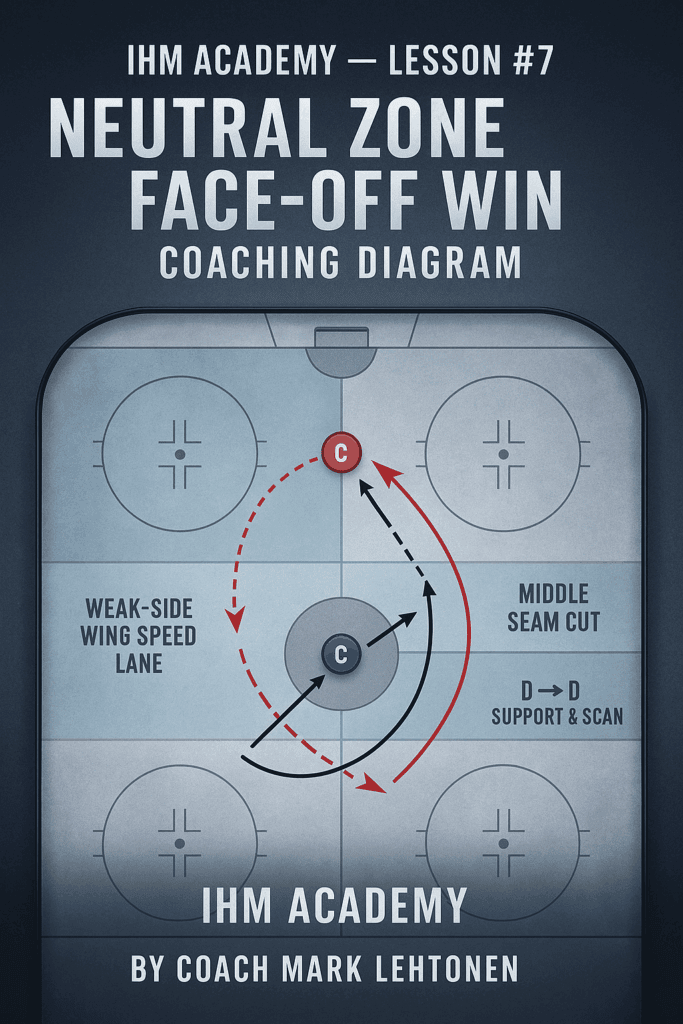
IHM Academy - Lesson #7 Neutral Zone Face-Off Win - Lane Activation & Speed Release

IHM Academy - Lesson #7 · By Coach Mark Lehtonen

Neutral Zone Face-Off Win – Lane Activation & Speed Release

A neutral-zone draw isn’t a reset – it’s an opportunity to strike. At the higher levels, possession off the neutral-zone face-off is one of the most efficient ways to enter with speed and catch opponents in transition. We don’t simply “win it back” – we build lanes and stretch pressure instantly.

Coach Mark Lehtonen explains how to turn neutral-zone face-offs into fast-break scoring opportunities through lane timing and structured release.

Objective

Create confusion for defenders by sending forwards into pre-planned lanes with speed, opening passing seams for a fast controlled entry.

Structure & Timing

  • C wins the puck back with a strong pivot to the inside shoulder.
  • Weak-side wing explodes up-ice into the far-side lane immediately on the drop.
  • Strong-side wing delays half a beat before cutting middle to force defensive switches.
  • D-man receives and scans early – head up, deception, freeze forechecker.
  • Second D supports underneath to reset if pressure comes.

Why It Works

Defenders hate indecision. By sending forwards into different predetermined lanes, we force hesitation:

  • Coverage confusion – who takes the middle cut?
  • Weak-side defender breaks structure
  • Passing seam opens before defensive rotation completes
  • Speed advantage – we move first

Key Teaching Cues

  1. Head up by the D – sell middle, release wide.
  2. Forward timing – first fast, second late cut.
  3. Staggered depth – avoid stacking lanes.
  4. Middle ice threat first – it opens the flank.
  5. Commit to pace – hesitation kills the play.

What Players Must Feel

Neutral-zone face-offs are not “neutral”. We are attacking. The first three strides determine whether we enter with speed or dump and chase. This system punishes slow defensive recognition – we sprint into space before they organize.

Coach Mark Lehtonen says:

“Speed isn’t straight-line – it’s timing. If one forward runs and one delays, the defense has to guess. Every guess we force is a lane we create.”

Summary

Win, separate, stretch – that’s the formula. Controlled entries start with structure. Set lanes, clean timing, strong pivot on the draw, and a defenseman scanning early. Every neutral-zone face-off is a runway – build speed and attack.

Study more tactical entries and timing principles at IHM Academy.


Gap Control & Angling - Controlling Speed and Space | IHM Academy (Coach Mark Lehtonen)

IHM Academy – Lesson #6 · By Coach Mark Lehtonen

Gap Control & Angling – Controlling Speed, Space, and Advantage

The best defenders don’t chase – they guide. Gap control and angling are the foundation of elite defensive play. These skills allow you to slow opponents, close space at the right time, and force turnovers instead of reacting to them. When done correctly, the attacker plays in your structure, not theirs.

Top-down tactical hockey diagram on dark ice, steel tones, red vs blue players labeled D and F. 1-on-1 neutral-zone angling

Objective

Control the attacker’s options by managing space, steering their route, and winning position before physical contact ever happens. Defense starts before the puck crosses your blue line.

Gap Control Principles

  • Match the attacker’s speed – too slow and you’re dead, too fast and you overrun the play.
  • Stick length gap – one stick length is the gold standard entering the blue line.
  • Inside-out body position – always between attacker and middle ice.
  • Close gap early – better to squeeze in the neutral zone than give space at blue line.

Angling Mechanics

  • Deny middle first – if you remove the inside, the outside is predictable.
  • Lead the attacker to pressure – boards, backchecker, partner support.
  • Stick on ice, toes angled – your feet dictate their path.
  • Hands quiet, hips low – won battles happen before contact.

Body Positioning

  1. Shoulder inside shoulder – body-line dominance.
  2. Stick in lane – blade seals passing lane; body seals skating lane.
  3. Finish with control – pin, bump, or ride-off – not chaos, control.

Game Intelligence

Elite defenders don’t chase speed – they remove options. Your first job is to take away space and steer the rush. Backpressure turns good defenders into elite ones. Neutral zone wins save more goals than desperation blocks.

Coach Mark Lehtonen says:

“Good defense isn’t about stopping an attacker – it’s about making them skate where you want and when you want. If you decide the route, you already won the battle.”

Summary

Gap and angling create predictable offense – predictable offense is easy to kill. Control space, deny middle, steer play, trust support. Defense is geometry and timing, not chaos.

Study more details and pro habits at IHM Academy.

Red Wings edge the Kings 4-3 in a shootout.

Red Wings Survive Late Push, Beat Kings 4-3 in Shootout | IHM News

Red Wings edge the Kings 4-3 in a shootout.

by IHM Team | IHM News | Los Angeles, Crypto.com Arena

Detroit built a 3-1 cushion on the road, saw Corey Perry tie it with two goals in 40 seconds late in the third, then kept their composure to close a 4-3 shootout win. Marco Kasper scored twice, Alex DeBrincat added a goal and assist, and Cam Talbot made 35 saves plus a perfect 3-for-3 in the shootout.

Los Angeles extended its point streak to seven games but remains winless at home. Quinton Byfield had two assists, Darcy Kuemper stopped 24 shots, and an overtime power-play winner from Kevin Fiala was overturned for goalie interference.

“Two points is two points. We battled through the swings and finished the job in the shootout,” said Alex DeBrincat.

Game Flow

  • 1-0 LAK (12:39 2nd): Alex Laferriere short-handed breakaway, backhand finish.
  • 1-1 DET (13:22 2nd, PP): DeBrincat one-timer from the left circle on a feed from Lucas Raymond.
  • 2-1 DET (15:46 2nd, PP): Marco Kasper redirects Axel Sandin-Pellikka long shot. Good goal after stick-height review.
  • 3-1 DET (14:45 3rd): Kasper crashes the net on an odd-man rush from Mason Appleton.
  • 3-2 LAK (17:47 3rd, 6-on-5): Corey Perry cleans up a deflected point shot.
  • 3-3 LAK (18:27 3rd, 6-on-5): Perry redirects Byfield wrist shot from the slot.
  • OT: Kevin Fiala goal waved off for goalie interference at 4:21.
  • Shootout: Raymond scores the lone tally. Talbot stops all three attempts.

Cam Talbot rebounded from a tough previous start: big save on a 2-on-1 in the opening minute set his rhythm and the bench’s belief.

Coach Mark Lehtonen’s Take

“Detroit will like the response. Special teams delivered, Kasper played inside ice and stopped at the paint, and Talbot was calm in the skill moments. The Kings drove late with volume and net presence, which is their identity. The difference came down to the small goalkeeping details and one clean shot in the shootout.”

IHM Verdict

A grown-up road win for the Red Wings: controlled special teams, a young center driving the middle, and veteran goaltending in leverage time. The Kings bank a point again but still need a first home win to match their road form.

Final: Red Wings 4-3 Kings (SO)

Author: IHM Team | Commentary by Coach Mark Lehtonen


San Jose Sharks celebration at SAP Center

Sharks Blitz Early, Handle Devils 5-2 | IHM News

Sharks Blitz Early, Handle Devils 5-2

by IHM Team | IHM News | San Jose, SAP Center

San Jose landed three quick punches in the first period and never let New Jersey breathe. William Eklund scored 42 seconds in, Philipp Kurashev and Alexander Wennberg added two more in a five-minute span, and the Sharks closed out a confident 5-2 home win.

Wennberg and Kurashev finished with a goal and an assist each. Will Smith and Tyler Toffoli also scored. Timothy Liljegren posted two assists, and Alex Nedeljkovic stopped 29 shots as San Jose collected its first home and first regulation win of the season. The Sharks have now won three of five and look more organized shift to shift.

For New Jersey, Dawson Mercer delivered both goals on the power play with Dougie Hamilton supplying two helpers, but the Devils could not overcome the opening ten minutes. After an eight-game heater, they have now dropped two in a row.

“Just compete and play. I liked our start and the maturity in the third,” Sharks coach Ryan Warsofsky said.

Game Flow

  • 1-0 SJ (0:42 1st): Eklund outraces the bounce and beats Jake Allen five hole.
  • 2-0 SJ (12:12 1st): Wennberg threads from the wall, Kurashev one-timer glove side.
  • 3-0 SJ (15:47 1st): Mario Ferraro shot deflects in off Wennberg.
  • 3-1 (19:00 1st): Mercer tips Jack Hughes puck in on the power play.
  • 4-1 SJ (16:50 2nd): Macklin Celebrini wins the draw, Smith scores on his own rebound.
  • 5-1 SJ (18:30 2nd): Dmitry Orlov wrister glances off Toffoli and in.
  • 5-2 (4:19 3rd): Mercer redirects Hamilton point shot on the power play.

Nedeljkovic credited the group in front: “We were detailed, blocked shots, good layers. A lot never got through.”

Coach Mark Lehtonen’s Take

“San Jose played to identity. Early pace, direct entries, pucks to the blue paint, and they protected the house for Nedeljkovic. For the Devils, this was not structure as much as urgency. When your first three shifts lose races and sticks, you chase. Special teams kept them alive, but five-on-five compete has to spike.”

IHM Verdict

Clean, professional home win for the Sharks with clear shot selection and middle-lane drive. New Jersey’s response after the first was better, but the opening blitz decided it.

Final: Sharks 5-2 Devils

Author: IHM Team | Commentary by Coach Mark Lehtonen


Jake Sanderson celebration in red home

Senators Rally Late, Beat Flames 4-3 in Shootout | IHM News

Senators Rally Late, Beat Flames 4-3 in Shootout

by IHM Team | IHM News | Ottawa, Canadian Tire Centre

The Senators showed real growth under pressure. Jake Sanderson tied the game with 2:49 left in regulation when his shot from the left circle pinballed off bodies, kissed the crossbar, and dropped in. Ottawa then finished the job in the shootout on goals from Drake Batherson and Tim Stutzle, edging Calgary 4-3.

Ottawa trailed three different times in the third but never cracked. Lars Eller had a short-handed goal and an assist, Artem Zub scored through traffic, and Linus Ullmark made 27 saves. The Senators move to 4-1-1 in their last six and look increasingly comfortable in tight, grindy games.

“It was a mucky game,” Batherson said. “We knew they were desperate. We stayed patient and found a way.”

For Calgary, there were positives in defeat. Devin Cooley stopped 35 shots and was outstanding in overtime with seven saves, including multiple stops during a 4-on-3 penalty kill. Nazem Kadri, Yegor Sharangovich, and Matt Coronato scored, but the Flames could not close it out and fall to 1-8-2 in their last eleven.

Game Flow

  • 1-0 CGY (5:51, 1st): Sharangovich beats Ullmark high glove on the power play from the right circle.
  • 1-1 (7:37, 1st): Eller finishes a short-handed 2-on-1 off a Shane Pinto rebound. Ottawa’s first short-handed goal of the season.
  • 2-1 CGY (15:53, 1st): Coronato jams home a loose puck on the power play.
  • 2-2 (2:36, 3rd): Zub’s point shot finds a lane through a heavy screen.
  • 3-2 CGY (8:16, 3rd): Kadri executes a give-and-go with Jonathan Huberdeau, snaps it off the right post and in.
  • 3-3 (17:11, 3rd): Sanderson’s drive deflects twice, off the bar and over the line.
  • Shootout: Batherson and Stutzle score, Ullmark seals it.

Calgary coach Ryan Huska praised Cooley’s poise: “He made key saves at important times. Backup life is staying ready. He did that.”

Coach Mark Lehtonen’s Take

“Ottawa’s habits are maturing. They did not chase the game late. They layered their rushes, shot through traffic, and got bodies to the crease. Sanderson’s poise under pressure is big-time. Calgary’s structure was better, and Cooley battled, but game management in the last five minutes cost them. When you are in a spiral, you must close out the routine plays.”

IHM Verdict

Ottawa banked a grown-up win. Calgary showed effort and goaltending, but the margins in the third were the difference.

Final: Senators 4-3 SO Flames

Author: IHM Team | Commentary by Coach Mark Lehtonen


Martin Nečas commits to Colorado long-term - Avalanche lock in their speed weapon for 8 years

Martin Nečas Signs 8-Year Contract With Colorado Avalanche | IHM News

by IHM Team | IHM News | October 30, 2025

Martin Nečas commits to Colorado long-term - Avalanche lock in their speed weapon for 8 years

The Colorado Avalanche locked in a key piece of their future, signing forward Martin Nečas to an eight-year contract. The 26-year-old winger, who could have become an unrestricted free agent after this season, chose long-term stability in Denver after a blistering start and seamless fit with Colorado’s core.

Nečas opened the year on an eight-game point streak and already sits at 13 points in 11 games, bringing elite transition speed to the Avs top six. Since arriving via the blockbuster three-team trade last January that sent Mikko Rantanen and Taylor Hall to Carolina, Nečas has produced 40 points in his first 38 games in burgundy and blue. That is the fastest start for a newcomer since the franchise moved to Denver.

“Having a full camp here, being with the guys, it just felt right,” Nečas said. “This is a special group. I wanted to commit.”

A former 12th overall pick, Nečas now cements himself alongside Nathan MacKinnon and Cale Makar as part of Colorado’s championship window. He has 339 career points and continues to evolve into a dynamic dual-threat scoring driver. He was also among the first six players named to Team Czechia’s preliminary roster for Milano Cortina 2026.

Why Colorado Moved Fast

General manager Chris McFarland called Nečas “an electric top-line winger entering his prime.” Players with that speed and play-driving ability almost never hit the market. You either draft them or pay a steep price. Colorado did both: acquired the profile in a bold trade, then kept him before free agency could complicate the picture.

What The Numbers Say

  • 13 points in 11 games to start the season
  • 8-game point streak out of the gate
  • 40 points in first 38 Avalanche games since the trade
  • 339 NHL points overall across Carolina and Colorado

Production is only part of the story. Nečas extends possessions, attacks with pace, and fits Colorado’s pressure identity. He is a clean schematic match.

Coach Mark Lehtonen’s Take

“Smart move from both sides. Nečas fits Colorado’s speed and pressure style. He extends plays, attacks downhill, and creates off motion. You do not let those guys walk. For the Avs, it is about keeping a Cup window wide open. For Nečas, it is about the right room and a winning standard. He has earned this.”

IHM Verdict

This is the kind of deal that stabilizes a contender. Colorado keeps a prime-age top-line winger who fits their identity and timeline. For Nečas, it is clarity and a real shot at rings in Denver.

Author: IHM Team | Commentary by Coach Mark Lehtonen

Category: IHM News | Date: October 30, 2025


Flyers’ Travis Konecny Extension Is Aging Horribly - and It’s Only Year One

Flyers’ Travis Konecny Extension Already Aging Poorly | IHM News

Flyers’ Travis Konecny Extension Is Aging Horribly – and It’s Only Year One

by IHM Team | IHM News | October 28, 2025

When the Philadelphia Flyers gave Travis Konecny an eight-year, $70 million extension in July 2024, it looked bold – maybe even visionary. But less than a year later, that deal already looks like a time bomb.

Flyers’ Travis Konecny Extension Is Aging Horribly - and It’s Only Year One

A Rebuild With a Veteran Core

General manager Daniel Brière made the deal knowing the Flyers were still rebuilding. Konecny’s new cap hit – $8.75 million – makes him the highest-paid player in team history. That number might fit a contender, but for a club still finding its identity, it’s becoming an anchor.

The contract runs until Konecny is 36. His supposed “prime” is being spent on a non-playoff team – and his production has fallen dramatically.

The Numbers Tell a Bleak Story

Since January 29, 2025, Konecny has scored four goals and 22 points in 39 games – an eight-goal, 46-point pace while playing over 20 minutes per night.

  • 23rd percentile in points per 60 minutes
  • 3rd percentile in goals per 60 minutes
  • Outscored 50-34 at even strength
  • 39.7% expected goal share away from Couturier and Michkov

He’s no longer driving play; he’s just occupying space in it.

The Cam Atkinson Comparison

Before the extension was signed, some analysts warned this could become another Cam Atkinson scenario – productive 20s, steep decline post-30. That’s exactly what’s happening.

Atkinson’s contract with Columbus became a cap casualty before he retired in 2025. Konecny’s could become an even more expensive version of that story.

Long-Term Risk for the Flyers

The Flyers’ rebuild depends on flexibility – cap space, youth, and patience. Konecny’s $8.75M deal through 2032 could cripple all three. Worse, his decline may overlap with Matvei Michkov’s rise – right when Philadelphia needs freedom to build around him.

Coach Mark Lehtonen’s Take

“You can justify overpaying for a veteran leader when you’re close to winning. But the Flyers aren’t there yet.
Konecny’s contract feels emotional – like paying for what he was, not what he’s becoming.

Every coach sees when a player loses that half-step – it changes everything: forecheck, timing, puck battles. I don’t think he’s finished, but unless he finds that spark soon, this deal will age like milk in the sun.”

IHM Verdict

The red flags are waving. The Flyers paid top dollar for a player already on the wrong side of his curve. Year One of eight – and the trendline points down.

Author: IHM Team | Commentary by Coach Mark Lehtonen

Category: IHM News | Date: October 28, 2025


Sidney Crosby just became the 9th player in NHL history to reach 1,700 career points

Sidney Crosby Reaches 1,700 Points as Penguins Beat Blues 6-3 | IHM News

Crosby Hits 1,700 Points as Penguins Beat Blues 6-3

by IHM Team | IHM News | October 28, 2025

Sidney Crosby keeps rewriting hockey.

Sidney Crosby just became the 9th player in NHL history to reach 1,700 career points

The Pittsburgh captain put up a goal and two assists in a 6-3 win over the St. Louis Blues, and in the process became just the ninth player in NHL history to reach 1,700 career points. The milestone was sealed on Bryan Rust’s goal early in the third period.

Crosby now sits at 1,701 career points (632 goals, 1,069 assists). Only Wayne Gretzky, Jaromir Jagr, Mark Messier, Gordie Howe, Ron Francis, Marcel Dionne, Steve Yzerman and Mario Lemieux have ever touched that level. He is second all time in Penguins history behind Lemieux.

The 38-year-old center hit 1,700 in 1,362 games. That is the fourth-fastest pace in NHL history, behind Gretzky, Lemieux and Dionne.

“This is a group of players I grew up idolizing,” Crosby said. “I never thought I’d be anywhere near them. I’m just grateful I’ve been able to play this long.”

Pittsburgh is rolling too. The Penguins improved to 7-2-1 and are now 5-0-1 in their past six.

Game Flow

Pittsburgh came out aggressive. The Penguins scored twice on their first two shots in the opening minute: Bryan Rust at 0:39 and Anthony Mantha at 0:55. St. Louis got burned immediately.

“Poor start,” Blues coach Jim Montgomery said. “Two mistakes in two minutes and their top guys made us pay.”

St. Louis did fight back. Nick Bjugstad made it 2-1, and Jordan Kyrou tied it 2-2 late in the first with a wrist shot off the rush. Kyrou extended his point streak to seven games.

But every time the Blues pushed, Crosby answered. In the second period, with the game tied, Crosby threaded a cross-ice feed to Parker Wotherspoon on a delayed penalty. Wotherspoon scored to make it 3-2.

Early in the third, Rust tipped an Erik Karlsson point shot to push it to 4-2. Crosby had the secondary assist on that goal. That was his 1,700th career point.

“To be the guy on his 1,700th point is something I’m going to remember,” Rust said.

Mathieu Joseph cut it to 4-3 for St. Louis, but Crosby answered again. He broke free, got in alone, followed his own rebound and finished to make it 5-3 with under four minutes left. Evgeni Malkin added the empty-netter for 6-3.

Tristan Jarry made 26 saves. Karlsson had three assists. Rust scored twice. Malkin posted a goal and a helper. This was not nostalgia. This was an active statement from Pittsburgh’s core.

Coach Dan Muse said after the game that the second and third periods looked much more like Penguins hockey: “You get two early and you can think it’s going to come easy. We can’t think that way. I liked our response later in the game.”

Blues Outlook

St. Louis has now dropped four straight (0-3-1). The Blues were able to push in the first and second, but never controlled the pace long enough to flip the game in their favor.

“We didn’t push well enough to take the lead and have them chase,” Montgomery said. “That’s the difference.”

Off-Ice Situation

The Penguins confirmed that an adult male fan fell from the upper concourse to the lower bowl area and was taken to a local hospital. Coach Dan Muse opened his postgame comments by saying the team’s thoughts are with that fan and his family.

Coach Mark Lehtonen’s Take (IHM Analysis)

“That is not just another stat night. You are talking about a 38-year-old center still driving games in the best league in the world. Crosby did not just collect points. He controlled momentum. When St. Louis answered, he answered back harder.

What I liked most was timing. Big plays at pressure moments. That is what elite captains do. That is why that locker room still follows him.

And for Pittsburgh overall, this looks like a veteran core that still believes. Karlsson was sharp. Malkin was sharp. Rust was hungry. If they stay healthy and keep this pace, they are not just sentimental favorites. They are dangerous.”

IHM Verdict

The Crosby story is not over. Pittsburgh is not done. Final score: Penguins 6, Blues 3.

Author: IHM Team | Commentary by Coach Mark Lehtonen

Category: IHM News | Date: October 28, 2025


Backchecking vs. 2-on-1 - Defensive Recovery Principles | IHM Academy (Coach Mark Lehtonen)

IHM Academy - Lesson #5 · By Coach Mark Lehtonen · IHM Academy

Backchecking vs. 2-on-1 – Defensive Recovery Principles

Backchecking vs. 2-on-1 - Defensive Recovery Principles

Every transition has a heartbeat – the moment when an offensive rush turns into a defensive emergency. The 2-on-1 rush is the most dangerous situation in hockey, and how you manage it defines your team’s defensive identity. A well-executed backcheck can turn what looks like a guaranteed scoring chance into nothing more than a dump-in.

Objective

The goal of an effective backcheck against a 2-on-1 is to neutralize the secondary attacker before the puck crosses the defensive blue line. That requires instant recognition, clear communication, and synchronized effort between the lone defenseman and the tracking forward.

Structure and Communication

  • Recognition: The defenseman must immediately identify that support is coming from behind. The earlier they know a backchecker is present, the sooner they can close the gap on the puck carrier.
  • Communication: A quick, loud call – “I’ve got puck!” or “You’ve got weak side!” – eliminates confusion. The defender commits to the puck carrier while the backchecker locks onto the trailer.
  • Gap Control: The defenseman’s stick must take away the middle of the ice. By controlling the passing lane early, the puck carrier is forced wide or into a low-percentage shot.

Backchecker Responsibilities

  • Skate through the middle: The backchecker must attack with speed through the center lane. Their feet never stop until they are goal-side of the weak-side forward.
  • Stick on stick: Arriving late is fine – arriving lazy isn’t. The backchecker must eliminate the weak-side player’s stick immediately to deny any pass or rebound.
  • Read the defenseman’s body: If the defender angles the puck carrier outside, the backchecker closes inside. If the defense steps up early, the backchecker supports from behind to recover loose pucks.

Defender’s Tactics

  1. Close the gap early: Once the defender knows there’s support coming, they can step up on the puck carrier confidently.
  2. Stick positioning: Blade flat to the ice, inside-out angle – the goal is to make the pass across impossible.
  3. Force to the boards: Keep body between puck and net, forcing a shot from a poor angle.

Transition Mindset

Great backchecking is not about speed – it’s about *commitment*. The moment your forwards realize the play has turned, their first three strides must be full effort backward. The earlier they engage, the easier it is for the defenseman to control space. A disciplined team transforms broken plays into controlled recoveries.

Coach Mark Lehtonen says:

“Every 2-on-1 starts as a 3-on-2 that died. You kill it by effort and communication. The backchecker doesn’t save the day – he erases the mistake before it becomes one.”

Summary

Backchecking versus a 2-on-1 is about unity. The defenseman controls space; the backchecker controls the weak side. Together, they turn panic into control. When both players trust the system, the 2-on-1 becomes just another rush – not a highlight reel against you.

Learn more defensive transition tactics and recovery reads at IHM Academy.