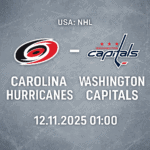
Date: 12.11.2025
Venue: Lenovo Center (Raleigh, NC)
The upcoming matchup in Raleigh brings together two teams, each carrying very different recent form and structural trends. Carolina continues to demonstrate one of the league’s most organized systems, relying on fast puck movement, strong retrieval habits, and high-quality offensive-zone rotations. Their play through the neutral zone has been especially sharp, allowing them to maintain territorial advantage for long stretches throughout recent games.
Washington approaches this meeting with several questions surrounding lineup stability and transition efficiency. In recent outings they have struggled with controlled exits, often being forced into dump-and-chase situations that limit their ability to sustain pressure. Defensive-zone rotations have also shown inconsistencies, particularly when opponents increase pace or attack through layered entries.
A key area to watch will be the midfield battle, where Carolina’s structured forecheck meets Washington’s attempts to generate speed through stretch outlets. Both teams have skaters capable of shifting momentum quickly, and special teams may play a significant role given the contrasting tactical approaches. Carolina tends to build pressure through cycling and inside-lane movement, while Washington continues to rely on perimeter puck control and point activation.
Goaltending matchups add another layer of intrigue. Carolina’s recent stability in net has contributed to their ability to close out tight periods, whereas Washington has faced inconsistency in rebound control and traffic management. With both teams playing on varied schedules, energy management and bench depth could influence the flow of the later stages.
In summary, this game offers an interesting clash between structural discipline and opportunistic playmaking. Both sides enter with distinct stylistic identities, and the tactical execution in the first 10-12 minutes may set the tone for the rest of the evening.
Note: our previous breakdown on the Anaheim game landed smoothly and without stress, as the team controlled the matchup from start to finish. Below is the full tactical analysis for tonight’s game, which you can review in detail here-
Tactical Breakdown
Anaheim approaches this matchup with their familiar layered 1-2-2 structure, a system built around disciplined puck support and rapid counterattacks. Their recent games show a strong emphasis on controlled exits, using their defensemen as the first activation point and attacking in waves through the neutral zone. The Ducks generate high-danger chances by rotating their wingers low and forcing opposing defenders into extended shifts.
Winnipeg enters with a more aggressive forecheck style, leaning heavily on their speed. Their 2-1-2 pressure has produced turnovers, but it also leaves gaps behind their forwards when the first wave is broken. Against Anaheim’s compact structure, these gaps could become liabilities in transition.
Advanced Metrics (Last 5 Games)
Anaheim Ducks: 5-0-0 record, allowing only 2.0 goals per game. Their expected goals against (xGA) is trending downward, sitting at 2.4 per 60. Offensive zone possession time increased by 11% over their previous 10-game average.
Winnipeg Jets: xG production remains respectable at 3.1 per 60, but their defensive numbers slipped, conceding 4+ goals in three of the last five. Their high-danger attempts allowed (HDCA) jumped noticeably due to inconsistent backchecking and fatigue on long shifts.
Line-Up & Usage Notes
Anaheim Injuries: Granlund (lower body), Gudas (lower body).
Winnipeg Injuries: Barron (injury), Perfetti (ankle), Samberg (wrist).
Anaheim’s first line continues to drive play with strong zone entries and effective east-west puck movement. Strome’s availability (questionable) will influence power-play structure. Ducks’ defensive core rotates efficiently, minimizing breakdowns.
Winnipeg relies on transition bursts but lacks depth support due to injuries. If their third line continues to struggle on defensive coverages, Anaheim’s forecheck may create sustained pressure.
Coach’s Verdict
This matchup brings together two teams on very different trajectories. Anaheim enters this game in strong form,
showing stability across all three zones and delivering consistent execution in transition play. Their recent stretch
of performances highlights excellent forecheck pressure and improved puck support, which reduces turnovers in the
neutral zone.
Winnipeg, despite sitting high in the standings earlier in the season, has recently shown vulnerability.
Their defensive structure has loosened, especially in the slot area, where they are allowing too many clean looks
on goal. Injuries to key depth players also affect their rotation and special teams efficiency.
Anaheim’s momentum, stronger current form (five consecutive wins), and home-ice advantage at Honda Center
make them the more reliable side here. Their offensive depth is balanced, and the team is creating a high number
of high-danger scoring chances.
Premium Pick - Anaheim Ducks - Win (Including Overtime)
Note: Our previous analysis on Philadelphia was extremely close, but the game slipped away in overtime - read yesterday’s recap for details.