Tag: St. Louis Blues

Four Things the Blues Must Fix to Reach the Playoffs

Story Summary

The St. Louis Blues did substantial roster work over the summer under new general manager Alexander Steen, moving pieces in trades and adding free agents ahead of the 2026-27 season. That activity gives them a clearer runway back toward the playoffs, but four concrete on-ice questions stand between the club and a postseason return: whether Robert Thomas becomes a genuine goal threat, the development of the team’s younger forwards and defence prospects, Philip Broberg’s push to justify heavier usage, and a rebound from Jordan Binnington in a contract year.

Key Facts

  • Alexander Steen completed multiple trades before the draft and signed free agents as the Blues reshaped the roster.
  • Robert Thomas has never scored more than 26 goals in a season but has 373 points in his last 361 games and ranked 31st in the league over that span; he had 64 points last season.
  • Jordan Kyrou was traded to the Washington Capitals; Brayden Schenn left for Long Island.
  • Jimmy Snuggerud scored 21 goals and finished with 51 points in 70 games in his rookie season.
  • The Blues added multiple first-round picks and strengthened their prospect pool for 2026-27.
  • Theo Lindstein averaged 15:46 TOI per game last season and is expected to take a larger share of minutes.
  • Logan Mailloux must demonstrate that his late-season form was substantive rather than opportunistic.
  • After Justin Faulk was traded on March 6, Philip Broberg averaged 24:06 TOI in 21 games, up from 23:05 in 60 games beforehand; he assumed most of the power-play time previously handled by Faulk.
  • Jordan Binnington posted an.873 save percentage and a -22.4 goals-saved above expected figure (MoneyPuck); those were the fourth-lowest and dead-last marks respectively among goalies with at least 25 appearances. The Blues gave him 41 appearances.
  • Starter Joel Hofer posted a.909 save percentage and made 46 appearances despite missing no time due to injury.
  • Binnington is entering a contract year.

IHM Discussion

The summer transactions reset the Blues’ immediate expectations: they moved off some veteran scoring and added draft capital and depth. That rewrite creates a new roster architecture where Robert Thomas now projects as the primary offensive trigger. Thomas’ career scoring rate – 373 points in 361 games – is strong, but the team’s top-line output fell short last season when the leading scorer managed 64 points. For St. Louis to climb out of middling finishes, Thomas must convert more chances into goals rather than simply sustaining his point pace.

That task is tied directly to the club’s youth wave. Jimmy Snuggerud’s 21 goals and 51 points in 70 games provide a real floor of support, and names such as Jake Neighbours and Dalibor Dvorsky are cited as players with room to grow. That is a pragmatic requirement: a handful of young players stepping up would materially reduce pressure on Thomas and widen the Blues’ scoring base.

On defence, the Broberg example illustrates how a single personnel change can remap minutes and roles. After Justin Faulk’s March 6 trade, Broberg’s average ice time rose to 24:06 across 21 games and he took over most PP1 duties. The Blues will lean on that development. The sourced minutes split – 24:06 after the trade versus 23:05 before it – is not dramatic but shows a clear increase in trust and responsibility. How Broberg translates that into stable, strong two-way play and special-teams output will be decisive for the club’s blue-line depth.

Finally, goaltending remains the clearest swing factor. The numbers cited are stark: Binnington’s.873 save percentage and a -22.4 goals-saved above expected figure put him at or near the bottom of the league among regulars, yet he was used for 41 games. By contrast, Joel Hofer posted a.909 save percentage in 46 appearances. With Binnington in a contract year, the onus is on him to reset those numbers, or for coaching staff to alter deployment so the team’s netminding becomes a reliable foundation rather than a liability.

Why It Matters

Each of the four issues maps to a core roster lever. Thomas scoring more would directly raise top-line threat and create breathing room for secondary scorers. Prospect growth supplies the Blue Line and wings with incremental scoring and defensive support without costing assets. Broberg’s step into a larger role stabilises right-side minutes and the power play, and a corrected goaltending split removes the single biggest swing factor in one-goal games. The combination of those changes is the practical pathway by which St. Louis can move from retool mode to a genuine playoff push in 2026-27.

What Comes Next

The calendar now points to the 2026-27 season as the real proving ground for these four areas: Thomas’ shooting output, the developmental jump from Snuggerud and company, Broberg’s sustained usage and special-teams impact, and Binnington’s form in his contract year will all be measurable through the coming campaign.

Mini Q&A

Q: Is Robert Thomas already the team’s top offensive option?

Thomas is effectively the Blues’ go-to offensive player after recent departures. He has strong underlying production – 373 points in 361 games – but must add more goals to lead a playoff-calibre attack.

Q: Which youngsters offer the most immediate help?

Jimmy Snuggerud is the clearest example, having scored 21 goals and recorded 51 points in 70 games as a rookie. Jake Neighbours and Dalibor Dvorsky are listed as prospects with upside; the source suggests three or four young players stepping up would be a meaningful boost.

Q: What changed for Philip Broberg after the Faulk trade?

After Faulk was traded on March 6, Broberg averaged 24:06 TOI in 21 games, an increase from 23:05 across 60 games beforehand, and took over most of the power-play one minutes. That workload rise is expected to continue into the new season.

Q: How urgent is the goaltending question?

Very. Binnington’s.873 save percentage and -22.4 goals-saved above expected figure among goalies with at least 25 appearances is a significant drag. He has 41 appearances on the ledger and enters a contract year; the team needs either improvement from him or a different deployment pattern.

Coach Mark Comment

From a coaching perspective, the Blues have to be surgical with usage. If Thomas is the top offensive option, he needs line and zone-start support that turns his chance-creation into goals. For Broberg, the coaching staff must manage his ice time so his minutes grow without burning him out; the post-trade jump to 24:06 shows he can handle extra responsibility in short bursts, but 26-plus minutes a night was explicitly flagged as unlikely.

On goaltending, a coach must be willing to change deployment based on performance and not loyalty. The numbers for Binnington demand action – either a clear bounce-back or a different plan for starts and workload distribution.

IHM Final View

The Blues have reshaped their roster and fortified their prospect pool, but the club’s immediate fate rests on four measurable things: Thomas becoming a bigger goal threat, several youngsters turning potential into real output, Broberg sustaining an expanded role, and Binnington answering his contract-year question. If enough of those boxes are ticked in 2026-27, St. Louis moves from hopeful to contender for a playoff spot; if not, the summer work will look premature rather than transformative.

IHM NHL Rumors: Connor Hellebuyck remains one of the biggest names attached to NHL trade speculation

Connor Hellebuyck remains one of the biggest names attached to NHL trade speculation

By IceHockeyMan Editorial Team | August 12, 2026

Connor Hellebuyck remains one of the biggest names attached to NHL trade speculation this summer, but the latest reporting suggests the market around the Winnipeg Jets goaltender is currently much quieter than the volume of public discussion might suggest.

Elliotte Friedman said after checking around the league that there appears to be limited movement at the moment. That does not close the door on a trade. It simply changes the timing of the story. Winnipeg does not appear to be operating under immediate pressure, while interested teams can afford to wait for greater clarity as training camps move closer.

A quiet market does not mean the talks are over

Hellebuyck has repeatedly appeared in trade discussion, with several possible destinations mentioned during the offseason. Buffalo has been among the clubs linked publicly, although the existence of speculation should not be confused with evidence that advanced negotiations are taking place.

The important distinction is between interest and momentum. Teams can discuss a player internally, contact Winnipeg about price or monitor the situation without moving anywhere close to completing a deal. Friedman’s description of the market as quiet points toward that middle stage rather than a definitive outcome.

For Winnipeg, there is little reason to force the process simply to create movement. A goaltender of Hellebuyck’s profile represents both immediate competitive value and a significant trade asset. If the return does not match the organisation’s expectations, waiting becomes a legitimate strategy.

IHM Signal: Winnipeg’s leverage improves if several teams develop urgent goaltending needs closer to camp. The Jets can wait for the market to create pressure rather than accepting a return simply because trade discussion has lasted through the summer.

Why the timing matters for Winnipeg

A Hellebuyck trade would affect much more than one roster position. Moving an established starting goaltender would immediately change Winnipeg’s depth chart, salary structure and expectations for the season.

The Jets would also need a clear plan for replacing his workload in the crease. That could mean acquiring another goaltender as part of the return, trusting an internal option with a larger role or using the additional cap flexibility to strengthen several areas of the roster instead of replacing Hellebuyck directly with another high-cost starter.

Those decisions become harder once training camp begins. Coaches want defined workloads and stable combinations, while management wants to avoid entering the season with unresolved questions at one of hockey’s most important positions. That creates a natural pressure point later in the summer even if the market is quiet today.

The buyers can afford to wait too

The same timing works in the opposite direction for potential trade partners. Clubs looking for an established starter do not necessarily need to meet Winnipeg’s asking price in August if they believe the Jets may become more flexible later.

Goaltending markets can change quickly. An injury, an underwhelming camp or a team deciding its current tandem is not strong enough can create a buyer that did not exist several weeks earlier. One change elsewhere in the league can therefore alter both the number of interested clubs and the value of the available options.

This is why a quiet period should not be mistaken for a dead market. The conditions for a deal can change without much warning once roster decisions become more immediate.

IHM Market Outlook

The central issue is leverage. Winnipeg controls an asset that can materially change another team’s outlook, but the Jets also need sufficient value to justify creating their own goaltending problem.

Potential buyers face the opposite calculation. Hellebuyck offers proven quality, but acquiring him would require both the trade return and the roster commitment needed to absorb the consequences of the move.

That gap between Winnipeg’s valuation and a buyer’s willingness to pay may explain why there is more public conversation than visible movement. The market does not need dozens of active teams to change. It only needs one organisation to decide that its current goaltending situation is no longer good enough.

What Comes Next

Training camp is the next natural checkpoint. If Winnipeg still has Hellebuyck and no serious deal has developed, the club can continue into the season with an elite goaltender rather than treating a trade as mandatory.

If another team develops a stronger need, however, negotiations could accelerate quickly. That is the part of the story worth monitoring: not the volume of rumours, but whether a genuine buyer emerges with enough motivation to meet Winnipeg’s price.

For now, the clearest conclusion is also the simplest one. Hellebuyck remains a major name on the market, but there is no confirmed trade and no evidence that Winnipeg needs to force a decision immediately.

Mini Q&A

Q: Is Connor Hellebuyck confirmed to be traded?
A: No. The current reporting describes trade speculation and a market that is relatively quiet rather than an advanced or completed deal.

Q: Why would Winnipeg wait?
A: Waiting can increase leverage if another club develops an urgent need in goal. Winnipeg does not have to accept a weaker return simply to complete a trade during the summer.

Q: What could restart the market?
A: Training-camp performance, injuries or another team becoming dissatisfied with its existing goaltending options could create stronger demand.

Fan Pulse

If you were running Winnipeg, would you hold Hellebuyck until the right offer arrives or make the move before training camp to give the roster immediate clarity?

Alex Ovechkin scores his 900th NHL goal with the Washington Capitals | IHM News

Alex Ovechkin scores his 900th NHL goal with the Washington Capitals | IHM News

By IHM Team | IHM News | November 6, 2025

Capitals captain hits landmark No. 900 in 6-1 win vs Blues, extends an untouchable record

WASHINGTON – The NHL has a new club and it has a membership of one. Alex Ovechkin reached 900 career goals on Wednesday night at Capital One Arena, scoring 2:39 into the second period of the Washington Capitals’ 6-1 victory over the St. Louis Blues and pushing his all-time record to a tier no player had ever touched.

The 40-year-old captain found the moment in classic predator mode. Stationed low on the right circle after Washington’s initial thrust, Ovechkin reacted first to a rebound from Jakob Chychrun’s shot and shoveled a backhand past a sliding Jordan Binnington, who could not recover across his crease. The Capitals bench emptied for a quick on-ice celebration as the building erupted. Binnington secured the milestone puck – a souvenir soon to be headed for Ovechkin’s personal vault.

Ovechkin spoke afterward about the scale of the number and the relief of delivering it in front of home fans and family. Teammates called the goal inevitable. Defenseman John Carlson said the milestone should spark another wave of momentum, echoing a familiar theme over two decades: doubts surface, and Ovechkin erases them.

This latest summit comes months after he passed Wayne Gretzky with No. 895 in April, establishing the new NHL record that only he continues to elevate. He needed three more to hit 900. After opening the season with four outings without a goal, he ended that mini-drought with a third-period strike against Minnesota on Oct. 17 and added No. 899 a week later versus Columbus before planting the flag tonight.

Washington is still built around the pressure Ovechkin creates on entries and on the power-play flank, but the 900th came from second-chance instinct, not the trademark one-timer. It fit the wider picture of late-career adaptation: different routes to the same destination.

Ovechkin is in the final season of his contract. Whether he chooses another chase – toward the round figure of 1,000 – can wait. For now, the league’s ledger shows a category with a single name. Nine hundred.

Around the milestone

  • Second-period time of goal: 2:39.
  • Opposing goalie: Jordan Binnington (STL).
  • Teammate setup: rebound of Jakob Chychrun shot.
  • Game result: Capitals 6, Blues 1.

What they said

  • Ovechkin called it a special moment and appreciated delivering it at home with family in the building.
  • T.J. Oshie recently dismissed doubts about another 30-goal season for Ovechkin, citing a career of proving people wrong.
  • Logan Thompson joked about Binnington tucking the puck away to ensure it found the right hands.

The NHL’s most prolific goal scorer has authored another chapter. The number is new; the feeling in Washington is familiar.

Coach Mark comment
Ovechkin again showed elite read on second pucks and interior positioning. This was not a set-piece one-timer but a veteran goal built on timing and anticipation. The larger point is consistency under pressure and the ability to adapt his routes to the net. History continues because details remain sharp.


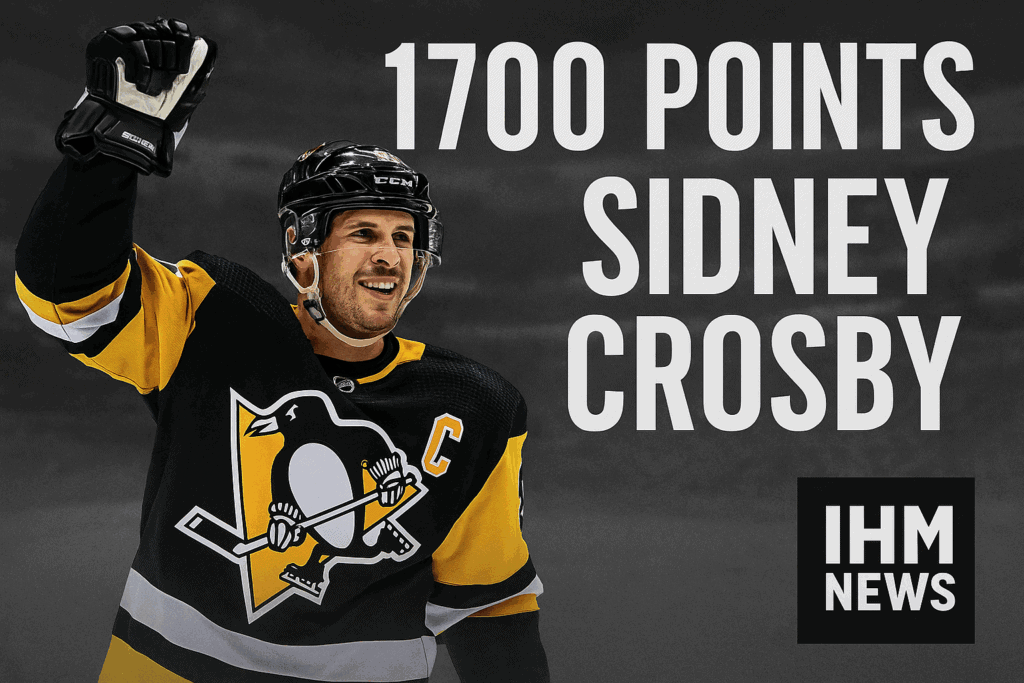
Sidney Crosby just became the 9th player in NHL history to reach 1,700 career points

Sidney Crosby Reaches 1,700 Points as Penguins Beat Blues 6-3 | IHM News

Crosby Hits 1,700 Points as Penguins Beat Blues 6-3

by IHM Team | IHM News | October 28, 2025

Sidney Crosby keeps rewriting hockey.

Sidney Crosby just became the 9th player in NHL history to reach 1,700 career points

The Pittsburgh captain put up a goal and two assists in a 6-3 win over the St. Louis Blues, and in the process became just the ninth player in NHL history to reach 1,700 career points. The milestone was sealed on Bryan Rust’s goal early in the third period.

Crosby now sits at 1,701 career points (632 goals, 1,069 assists). Only Wayne Gretzky, Jaromir Jagr, Mark Messier, Gordie Howe, Ron Francis, Marcel Dionne, Steve Yzerman and Mario Lemieux have ever touched that level. He is second all time in Penguins history behind Lemieux.

The 38-year-old center hit 1,700 in 1,362 games. That is the fourth-fastest pace in NHL history, behind Gretzky, Lemieux and Dionne.

“This is a group of players I grew up idolizing,” Crosby said. “I never thought I’d be anywhere near them. I’m just grateful I’ve been able to play this long.”

Pittsburgh is rolling too. The Penguins improved to 7-2-1 and are now 5-0-1 in their past six.

Game Flow

Pittsburgh came out aggressive. The Penguins scored twice on their first two shots in the opening minute: Bryan Rust at 0:39 and Anthony Mantha at 0:55. St. Louis got burned immediately.

“Poor start,” Blues coach Jim Montgomery said. “Two mistakes in two minutes and their top guys made us pay.”

St. Louis did fight back. Nick Bjugstad made it 2-1, and Jordan Kyrou tied it 2-2 late in the first with a wrist shot off the rush. Kyrou extended his point streak to seven games.

But every time the Blues pushed, Crosby answered. In the second period, with the game tied, Crosby threaded a cross-ice feed to Parker Wotherspoon on a delayed penalty. Wotherspoon scored to make it 3-2.

Early in the third, Rust tipped an Erik Karlsson point shot to push it to 4-2. Crosby had the secondary assist on that goal. That was his 1,700th career point.

“To be the guy on his 1,700th point is something I’m going to remember,” Rust said.

Mathieu Joseph cut it to 4-3 for St. Louis, but Crosby answered again. He broke free, got in alone, followed his own rebound and finished to make it 5-3 with under four minutes left. Evgeni Malkin added the empty-netter for 6-3.

Tristan Jarry made 26 saves. Karlsson had three assists. Rust scored twice. Malkin posted a goal and a helper. This was not nostalgia. This was an active statement from Pittsburgh’s core.

Coach Dan Muse said after the game that the second and third periods looked much more like Penguins hockey: “You get two early and you can think it’s going to come easy. We can’t think that way. I liked our response later in the game.”

Blues Outlook

St. Louis has now dropped four straight (0-3-1). The Blues were able to push in the first and second, but never controlled the pace long enough to flip the game in their favor.

“We didn’t push well enough to take the lead and have them chase,” Montgomery said. “That’s the difference.”

Off-Ice Situation

The Penguins confirmed that an adult male fan fell from the upper concourse to the lower bowl area and was taken to a local hospital. Coach Dan Muse opened his postgame comments by saying the team’s thoughts are with that fan and his family.

Coach Mark Lehtonen’s Take (IHM Analysis)

“That is not just another stat night. You are talking about a 38-year-old center still driving games in the best league in the world. Crosby did not just collect points. He controlled momentum. When St. Louis answered, he answered back harder.

What I liked most was timing. Big plays at pressure moments. That is what elite captains do. That is why that locker room still follows him.

And for Pittsburgh overall, this looks like a veteran core that still believes. Karlsson was sharp. Malkin was sharp. Rust was hungry. If they stay healthy and keep this pace, they are not just sentimental favorites. They are dangerous.”

IHM Verdict

The Crosby story is not over. Pittsburgh is not done. Final score: Penguins 6, Blues 3.

Author: IHM Team | Commentary by Coach Mark Lehtonen

Category: IHM News | Date: October 28, 2025


Pittsburgh Penguins vs St. Louis Blues28 Oct 2025

Pittsburgh Penguins vs St. Louis Blues - Expert Game Preview by Coach Mark Lehtonen

Tonight, all eyes turn to PPG Paints Arena in Pittsburgh, where the Penguins prepare to host the St. Louis Blues in another heated NHL regular season clash. It’s a matchup between two franchises built on very different philosophies - one relying on speed, structure, and transition control, and the other seeking to rediscover their defensive identity.

The Penguins have recently showcased remarkable consistency in their puck movement and forecheck rhythm. Their top lines, centered around elite veterans, remain among the most disciplined in the league. What truly separates this Pittsburgh roster is its ability to switch tempo - they can explode in transition after absorbing pressure, maintaining a near-flawless puck exit percentage from the defensive zone.

The Blues, meanwhile, continue their search for stability. Injuries have taken a toll on their depth - with key absences such as Torey Krug (ankle) and Robert Thomas (upper body) forcing adjustments to both special teams and five-on-five systems. Coach staff in St. Louis has emphasized tighter neutral zone spacing, but execution has lagged behind intent in recent outings.

Analytics from the past two weeks underline a clear contrast between the clubs: Pittsburgh ranks inside the top five in expected goals per 60 minutes, while St. Louis sits near the bottom third in defensive zone recoveries. The difference in efficiency during second periods - often the “momentum frame” of the game - has also favored the Penguins, who maintain puck possession above 55% through the middle frame.

Beyond the numbers, this contest will likely hinge on small tactical details - faceoff execution, net-front battles, and transition pace. The home atmosphere at PPG Paints Arena adds another psychological layer, as the Penguins have turned the building into one of the most difficult environments for visiting teams this October.

For an in-depth breakdown including tactical charts, coaching insights, and the full analytical verdict from Coach Mark Lehtonen, visit our Premium section below:

👉 Access the Full Premium NHL Analysis