Tag: ihm academy

Shift Length Strategy in Hockey | IHM Academy

Shift Length Strategy in Hockey | IHM Academy

Date: March 19, 2026

By IceHockeyMan Academy | Author Mark Lehtonen

Series: Game Management & Bench Intelligence

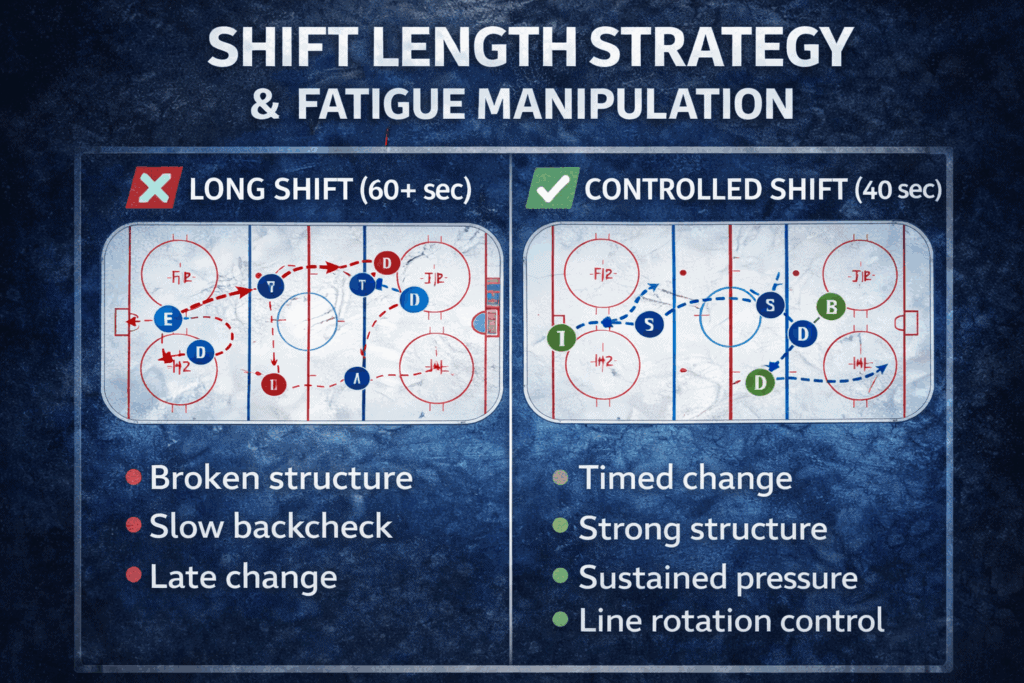
Lesson 4: Shift Length Strategy & Fatigue Manipulation

Shift length is one of the most underestimated performance variables in ice hockey. While fans focus on speed, skill, and physicality, elite coaching staffs understand a deeper layer of the game: energy distribution over time.

A hockey game is not only about execution - it is about managing physical output across 60 minutes. The teams that control fatigue, control the game.


⏱️ Optimal Shift Length: The Hidden Standard

At the professional level, optimal shift length typically ranges between 35-45 seconds. This window allows players to operate at high intensity without entering oxygen debt.

Once a shift extends beyond 50-55 seconds, performance metrics begin to decline:

  • Slower decision-making
  • Reduced skating acceleration
  • Loss of defensive structure
  • Delayed puck support

This is not visible immediately - but it accumulates shift by shift.


⚡ Micro-Fatigue: The Invisible Opponent

Fatigue in hockey is not only about exhaustion. It builds in layers.

Micro-fatigue refers to small, repeated energy losses that affect performance over time.

A player staying 10-15 seconds too long on multiple shifts may:

  • Lose positioning discipline
  • Miss backchecking assignments
  • React slower in transition

This is how games are lost without obvious mistakes.


🔁 Bench Control and Line Rotation

Elite teams maintain strict bench discipline:

  • Short, consistent shifts
  • Quick changes in neutral zones
  • Pre-planned rotation patterns

Coaches monitor not just time on ice, but shift quality.

A “good shift” is not long - it is efficient.


🔥 Late Game Fatigue & Oxygen Debt

In the third period, fatigue becomes tactical.

Players who overextend early shifts enter oxygen debt, which leads to:

  • Heavy skating mechanics
  • Poor gap control
  • Loss of puck battles

This is where games are decided.


🧩 Line Shortening Strategy

In critical moments, coaches reduce rotation:

  • Top 6 forwards take more shifts
  • Reliable defense pairs stay longer
  • Energy players are used situationally

But this only works if fatigue has been managed earlier.


🎯 Tactical Insight: Fatigue as a Weapon

Advanced teams don’t just manage their own energy - they exploit the opponent’s fatigue.

This includes:

  • High-tempo forechecking against tired lines
  • Quick re-entry pressure after long defensive shifts
  • Forcing icing situations to trap players

🧠 Coach Mark Comment

Shift length is not about discipline alone - it is about understanding energy economics. Players who learn to change early extend their effectiveness over the entire game. Coaches who manage fatigue properly control tempo without touching the puck.


❓ Q&A: Shift Length and Fatigue in Hockey

What is the ideal shift length in hockey?

Typically 35-45 seconds at high intensity.

What happens if a shift is too long?

Performance declines, positioning breaks down, and reaction time slows.

What is micro-fatigue?

Accumulated small energy losses that impact performance over multiple shifts.

Why is fatigue important in late game situations?

Fatigue affects decision-making and skating, often determining outcomes.

How do teams use fatigue strategically?

By increasing pressure against tired players and controlling tempo.


Lesson board:
Lesson 4: Shift Length Strategy & Fatigue Manipulation

IHM Academy - Performance Metrics Masterclass - Lesson 30

IHM Academy - Performance Metrics Masterclass – Lesson 30

Lesson 30 – Offensive Layering Index (OLI) & Secondary Threat Activation

Date: 13 January


Introduction

Modern offensive hockey is no longer built around a single primary attack option. Elite teams consistently score because they operate in layers. The Offensive Layering Index (OLI) is designed to measure how effectively a team creates, maintains, and activates multiple offensive layers within the same possession or sequence.

From a coaching perspective, OLI is not about volume shooting. It is about forcing defensive structures to process too many simultaneous threats. When the defensive system collapses toward the first layer, the second and third layers become decisive.


What Is Offensive Layering Index (OLI)

OLI measures how many structured offensive layers are active during sustained zone time. Each layer represents a credible scoring or playmaking threat that forces defensive adjustment.

  • Primary layer: puck carrier or first shot threat
  • Secondary layer: weak-side support or trailing attacker
  • Tertiary layer: high-slot presence, point activation, or net-front rotation

A high OLI team is not predictable. Defenders are forced to choose, hesitate, and switch coverage responsibilities. That hesitation window is where goals are created.


Secondary Threat Activation

Secondary threat activation is the coaching mechanism behind OLI. It refers to how quickly and intentionally the second offensive option becomes dangerous once the primary action draws pressure.

Coaching staffs script these activations through:

  • Delayed trailer timing
  • Weak-side forward release patterns
  • Low-to-high puck movement with immediate net-front rotation
  • Defensemen stepping into the second layer rather than holding static points

Elite teams do not wait for defensive breakdowns. They manufacture them through layered pressure.


How Coaching Staffs Use OLI in Game Preparation

OLI is actively studied by coaching staffs during opponent preparation. Video analysis focuses on identifying which defensive triggers cause the opponent to overcommit.

Once these triggers are identified, the game plan is adjusted to:

  • Force early collapse from low defenders
  • Exploit slow weak-side rotations
  • Overload one layer to free another

During games, benches monitor OLI trends shift by shift. If secondary layers stop activating, systems are adjusted in real time.


OLI and In-Game System Switching

OLI also plays a critical role in in-game system switching. When teams face compact defensive structures, increasing layering depth becomes more effective than increasing pace.

Coaches may switch from direct attacks to layered possession systems that slowly stretch defensive integrity. This is often visible in playoff hockey where space is limited.


Common Errors That Lower OLI

  • Static net-front presence without rotation
  • Premature shots that kill layered structure
  • Defensemen hesitating to join secondary layers
  • Forwards collapsing into the same lane

These errors simplify defensive reads and reduce offensive unpredictability.


Coach Mark Comment

Offense is not about speed alone. It is about forcing defenders to think while moving. Layered offense removes certainty from the defensive system. When defenders are unsure which threat is real, they are already late.


Q&A - Offensive Layering Index

Why is OLI more effective than shot volume?

Because layered offense attacks decision-making rather than positioning. Defenders can block shots. They cannot block hesitation.

Can low-tempo teams achieve high OLI?

Yes. OLI is independent of pace. It depends on spacing, timing, and activation discipline.

How fast should secondary threats activate?

Ideally within one defensive rotation. If activation is delayed, the layer loses its impact.


Internal Links


IHM Academy - Learn the Game Like a Coach

IHM Academy - Performance Metrics Masterclass - Lesson 29

IHM Academy – Performance Metrics Masterclass – Lesson 29

Lesson 29 – Zone Entry Denial Efficiency (ZEDE) & Blue Line Standup Discipline

Date: 13 January

Lesson Focus: This lesson explains how teams suppress offense before it starts by denying controlled zone entries. We define Zone Entry Denial Efficiency (ZEDE), break down what it measures, how it appears on the ice, and how Coach Mark translates entry denial patterns into structured match verdict logic.


Extended Core Definition

Zone Entry Denial Efficiency (ZEDE) measures how reliably a team prevents the opponent from entering the offensive zone with control. A controlled entry is any entry where the puck carrier maintains possession across the blue line (carry-in or clean pass-in) with the ability to generate immediate structure.

ZEDE is not only about defensemen. It is a full five-man metric that combines neutral-zone spacing, back-pressure angles, gap control, and blue-line decision discipline. High ZEDE teams force dumps, broken entries, and soft chips that can be recovered. Low ZEDE teams allow clean carries, middle-lane penetration, and late-trailer attacks that create instant high-danger sequences.


What ZEDE Actually Measures

  • Controlled entry denial rate: frequency of forcing dump-ins or turnovers at the blue line.
  • Middle-lane closure speed: how quickly the team seals the interior lane before the line is crossed.
  • Gap integrity: ability of defenders to hold the blue line without backing in too early.
  • Back-pressure quality: whether forwards pressure from inside-out and remove the carrier’s clean options.
  • Second-wave tracking: recognition and pickup of late trailers and weak-side stretch routes.

ZEDE is a pre-shot suppression metric. If a team denies controlled entries, it also reduces cycle quality, slot touches, and rebound chaos over time.


Blue Line Standup Discipline

Blue line standup discipline is the decision layer inside ZEDE. It describes how consistently defenders choose the correct hold line action:

  • Stand up: hold the line and challenge when support and spacing are correct.
  • Angle out: steer the carrier wide when the middle is protected but support is delayed.
  • Controlled retreat: give the line only when the risk of being beaten is higher than the reward of denial.

The mistake is not retreating. The mistake is retreating too early, or standing up without support. Great teams defend the blue line like a system, not like a duel.


Game Impact Map

  • Shot volume suppression: fewer controlled entries means fewer organized shot sequences.
  • Slot touch reduction: denial prevents inside lanes and late trailers from arriving on time.
  • Fatigue control: fewer sustained defensive-zone shifts, more neutral-zone resets.
  • Goaltender stability: fewer east-west rushes and fewer broken-slot looks.
  • Momentum control: denial breaks the opponent’s pace and frustrates transition identity.

Tactical Layer – How ZEDE Appears on Ice

High ZEDE teams show clear, repeatable patterns:

  • Inside-out pressure: the puck carrier is forced away from the middle before the blue line.
  • One layer challenges, one layer seals: the first checker pressures, the second checker removes the seam.
  • Gap stays alive: defenders do not drift backward without a trigger.
  • Stick lanes first: denial is created by removing passing lanes before contact is made.
  • Dump-in quality control: dumps are forced into corners that favor the defending team’s retrieval routes.

Low ZEDE teams show predictable weaknesses:

  • soft gaps that invite controlled carries
  • wide middle lanes that allow seam passes through the line
  • late recognition of the weak-side drive or trailer
  • panic retreats that give the opponent time to set structure

Coaching Staff Layer

ZEDE is heavily influenced by coaching rules. Staffs define:

  • which forward pressures the carrier and from which angle
  • who seals the middle lane and when they release
  • which defenseman steps up and which defenseman protects the inside
  • how to handle stretch passes and weak-side activation

Elite staffs also adjust denial posture based on opponent identity. Against speed teams, denial must be layered and angle-based. Against heavy dump teams, denial includes retrieval preparation and wall exits. ZEDE is not one system. It is a rule set that adapts to the opponent’s transition style.


How Coach Mark Uses ZEDE in Real Pre-Game Analysis

Coach Mark studies entry profiles as early indicators of which team will control the game flow. The key is not the first entry. The key is whether entries stay controlled after the first adjustments.

First period: Mark identifies whether a team holds the blue line with structure, or retreats without pressure. He tracks whether the opponent can enter through the middle, or is forced wide and dumped.

Second period: He watches the adjustment phase. Opponents attempt to fix entry denial with chips, delays, and cross-ice passes. High ZEDE teams respond by tightening spacing and picking up late trailers earlier.

Third period: ZEDE often decides the finish. If the trailing team cannot enter with control, it cannot build sustained pressure. The game becomes dump-and-chase desperation, which usually produces low-quality looks and counter-attack risk.


Verdict Translation Layer

ZEDE translates into verdict logic through control and stability:

  • High ZEDE advantage: favors structured control, fewer breakdown moments, and reduced late chaos.
  • Low ZEDE risk: increases opponent cycle quality and slot pressure, especially if the team also struggles with net-front control.
  • Mismatch trigger: if one team consistently denies controlled entries while the other allows them, the possession gap grows every period.

ZEDE pairs naturally with earlier lessons. If TRR is strong, a team can recover after turnovers. If ZEDE is also strong, the opponent cannot even start the next attack cleanly.


Advanced Mistake Patterns

  • Back-pressure drifting: forwards chase from outside-in, leaving the middle open.
  • Early retreat habit: defensemen give the line before the carrier is threatened.
  • Step-up without support: standup attempts get beaten because the second layer is late.
  • Trailer blindness: the late attacker arrives uncontested into the high slot.
  • Dump corner mistakes: forcing a dump is good, forcing it into a bad retrieval corner is not.

Q&A

Q1: What is the cleanest ZEDE signal in a live game?
A: The opponent repeatedly chooses dump-ins because controlled carries are being denied. When a skilled team stops carrying and starts dumping, ZEDE is winning.

Q2: Does ZEDE depend more on defensemen or forwards?
A: It depends on the system, but forwards often drive it. Good back-pressure and middle sealing allow defensemen to hold the line with confidence.

Q3: Why do some teams deny entries but still give up chances?
A: Because dumps are being forced into favorable corners for the opponent, or retrieval execution fails. Denial must connect to retrieval and exit structure.

Q4: Can ZEDE be strong while the team is outshot?
A: Yes. A team can deny clean entries but still concede volume from outside after dump recoveries. The key is whether the chances are low danger or high danger.

Q5: How does ZEDE relate to late-game protection?
A: When leading, high ZEDE prevents the trailing team from generating fast controlled entries, forcing time-consuming dump cycles that bleed the clock.

Q6: What is the most common standup mistake?
A: Standing up without support. A missed step-up creates instant odd-man rush exposure. Discipline is choosing the correct moment, not being aggressive every time.


Internal Links


Coach Mark Summary: ZEDE is how you stop offense before it forms. Deny controlled entries, force predictable dumps, retrieve with discipline, and you remove the opponent’s ability to generate clean slot pressure. The blue line is not a location. It is a tactical decision point.

IHM Academy - Performance Metrics Masterclass - Lesson 28

IHM Academy - Performance Metrics Masterclass – Lesson 28

Lesson 28 - Transition Recovery Rate (TRR) & Structural Reset Speed

Lesson Focus: This lesson explains how quickly and consistently a team restores its defensive and transitional structure after puck loss. We break down why recovery speed, spacing discipline, and first-read decisions define whether transitions become threats or are neutralized early.


Extended Core Definition

Transition Recovery Rate (TRR) measures the speed and quality with which a team re-establishes its structural shape immediately after losing puck possession. TRR is not about skating speed alone. It evaluates recognition timing, lane closure priority, communication clarity, and role execution under sudden directional change.

High TRR teams absorb turnovers without panic, reset layers rapidly, and force opponents into low-efficiency entries. Low TRR teams concede interior access, odd-man rushes, and delayed trailers due to broken spacing and late reads.


What TRR Actually Measures

  • Recognition latency: time between puck loss and first corrective movement.
  • Lane compression: speed of closing middle lanes and inside seams.
  • Back-pressure quality: angle, stick position, and recovery path discipline.
  • Role clarity: whether players instinctively assume reset responsibilities.
  • Communication efficiency: early verbal and non-verbal cues that prevent overlap.

TRR converts chaotic moments into controllable sequences. It determines whether a turnover becomes a scoring chance or a dead transition.


Game Impact Map

  • Rush suppression: high TRR kills odd-man entries before they form.
  • Interior denial: early middle-lane closure forces wide, low-danger shots.
  • Fatigue control: clean resets reduce long defensive-zone shifts.
  • Goaltender protection: fewer lateral rushes and broken-slot looks.
  • Final Verdict: TRR superiority stabilizes games and suppresses momentum swings.

Tactical Layer - How TRR Appears on Ice

  • Immediate inside-out skating paths after puck loss.
  • Centers dropping below the puck without hesitation.
  • Defensemen holding gap while reading second-wave support.
  • Wingers collapsing to seal lanes before expanding again.
  • Controlled stick positioning that delays rather than chases.

Elite TRR looks calm. Poor TRR looks frantic.


Coaching Staff Layer

TRR is trained, not improvised. Coaching staffs define reset rules: who takes middle, who delays puck carrier, who tracks the late trailer, and who protects the weak side. These rules must be automatic, not reactive.

Elite staffs drill transition failure scenarios specifically, forcing players to reset structure under disadvantage, fatigue, and delayed recognition. TRR is one of the clearest indicators of coaching quality.


How Coach Mark Uses TRR in Real Pre-Game Analysis

Coach Mark studies how teams behave immediately after turnovers. Some teams reset instinctively. Others hesitate, look for the puck, or overcommit.

First period: Mark notes first-reaction speed after neutral-zone turnovers.

Second period: He tracks whether recovery lanes tighten or widen under pace.

Third period: TRR often decides games. Fatigue magnifies hesitation, and late goals frequently originate from one slow reset.


Verdict Translation Layer

When TRR is high, Coach Mark’s verdict logic shifts toward lower transition volatility and controlled game flow. When TRR drops, late-game chaos risk rises sharply, especially against fast, counter-attacking teams.


Advanced Mistake Patterns

  • Puck watching: players track the puck instead of lanes.
  • Overcommitting: two players attacking the same carrier.
  • Late middle coverage: allowing interior penetration.
  • Silent resets: lack of communication during transition.
  • Fatigue shortcuts: gliding instead of correcting angles.

Q&A

Q1: Is TRR more important than forecheck pressure?
A: In fast leagues, yes. One failed reset often outweighs several good forecheck shifts.

Q2: Which position drives TRR most?
A: Centers, due to responsibility for middle-lane control.

Q3: Can systems hide poor TRR?
A: Temporarily. Over time, poor reset speed is always exposed.

Q4: Does TRR interact with fatigue metrics?
A: Strongly. Fatigue delays recognition and first-step execution.

Q5: Why do late goals often look “simple”?
A: Because the reset failed, not because the play was complex.


Internal Links


Coach Mark Summary: TRR defines whether turnovers become problems or opportunities. Teams that reset fast stay in control. Teams that hesitate invite chaos.

IHM Academy - Performance Metrics Masterclass - Lesson 27

IHM Academy - Performance Metrics Masterclass – Lesson 27

Lesson 27 - Matchup Stress Index (MSI) & Exploiting Line Mismatches

Lesson Focus: This lesson explains how coaching staffs and elite teams create controlled pressure by targeting unfavorable matchups, forcing specific lines, pairs, or individuals into sustained stress. We break down what MSI measures, how it shows up on the ice, and how Coach Mark translates it into structured match verdict logic.

Extended Core Definition

Matchup Stress Index (MSI) quantifies how effectively a team creates and sustains pressure by targeting unfavorable player matchups. It measures the cumulative tactical stress imposed on specific lines, defensive pairs, or individual players when they are forced to operate outside their optimal role, tempo, or ice location.

MSI is not about star power. It is about who is uncomfortable, why, and for how long. High MSI situations typically produce delayed breakdowns: widened gaps, late switches, panic clears, penalties, and eventually high-danger chances created by structural fatigue and decision degradation.

What MSI Actually Measures

MSI evaluates matchup stress through multiple layers that combine into a measurable risk curve:

  • Repeated exposure of weak defensive pairs against speed, skill, or heavy net-front cycles.
  • Forced role expansion where a line must defend more than it attacks, draining its offensive value.
  • Handedness disadvantages that ruin retrieval angles, breakout timing, and wall exits under pressure.
  • Tempo overload where a slower unit is forced into repeated high-speed transition defending.
  • Fatigue amplification caused by consecutive long shifts, icings, or failed clears.
  • Decision quality collapse where players start shortcutting systems and abandoning assignments.

A high MSI does not always produce immediate goals. The true signal is that MSI predicts future structural failure if the matchup is repeated and unmanaged.

Game Impact Map

  • Defensive erosion: targeted players begin to lose gap discipline, giving controlled entries and inside access.
  • Penalty pressure: stress leads to reaching, hooking, holding, and late stick infractions.
  • Exit instability: panic clears replace structured exits, creating rapid re-entry pressure loops.
  • Bench instability: coaches shorten rotations, overuse “safe” lines, and burn energy management.
  • Late-game vulnerability: mismatch fatigue peaks in the third period and after special teams sequences.

Tactical Layer - How MSI Appears on Ice

MSI is visible in real time if you know what to watch. It appears as repeated discomfort patterns, not just isolated mistakes:

  • One line repeatedly starts in the defensive zone against the same opponent and never resets tempo.
  • Defense pairs get caught on long shifts after icings, blocked clears, or failed retrieval decisions.
  • Speed mismatches force early retreats and passive defending, widening slot lanes and rebound exposure.
  • Physical mismatches lead to delayed puck support, failed wall battles, and net-front loss under pressure.
  • Centers are dragged wide to compensate, opening interior seams for late high-slot attackers.

MSI often rises quietly, then spikes. You typically see the spike after 2-3 repeated unfavorable sequences, especially when the same unit cannot complete a clean exit.

Coaching Staff Layer

Elite coaching staffs actively hunt MSI. They identify which opposing units break first under pressure and then engineer repetition. The staff’s job is to turn a single mismatch into a full-game advantage.

Key staff-driven MSI mechanisms include:

  • Last-change exploitation: matching speed or skill lines against slow pairs or vulnerable third lines.
  • Controlled line changes: changing at moments that trap tired defenders on the ice.
  • Zone-start engineering: deploying mismatch lines with offensive-zone starts to force extended cycles.
  • Tempo manipulation: speeding up retrieval pressure and entry pace exactly when the weak unit is on.
  • Matchup protection detection: recognizing when the opponent hides a pair or line and forcing it back out.

MSI is not accidental. It is manufactured through deliberate bench decisions and system triggers.

How Coach Mark Uses MSI in Real Pre-Game Analysis

Coach Mark studies how teams react when a unit is exposed repeatedly. Some teams immediately adjust rotations. Others stubbornly protect their system and let mismatch stress build until it breaks them.

First period: Mark identifies which lines are being protected, which pairs avoid top competition, and whether a coach is already “hiding” a unit. Early avoidance is one of the strongest MSI indicators.

Second period: Mark looks for repetition: the same vulnerable unit getting targeted again and again. He watches for signs of stress accumulation: longer time-to-exit, late shoulder checks, and increased panic touches.

Third period: Mark expects the MSI payoff. If mismatch stress has been sustained without adjustment, the third period often produces decisive errors: lost net-front positioning, failed switches, or a late penalty caused by fatigue and desperation.

High MSI teams often score immediately after line changes, icings, or extended defensive sequences because those are the moments when mismatch stress converts into structural collapse.

Verdict Translation Layer

When MSI rises, Coach Mark’s verdict logic shifts toward late-game volatility. MSI drives:

  • higher third-period scoring probability
  • momentum swings after repeated matchup exposure
  • penalty risk for the stressed unit
  • overtime breakdown potential if mismatch fatigue remains unresolved

MSI often explains why a goal happened, not just how. The scoring play is usually a symptom. The real cause is the sustained stress the matchup created over multiple shifts.

Advanced Mistake Patterns

  • Refusing to break a failing matchup: coaches stay committed even when the unit is visibly collapsing.
  • Over-trusting veteran pairs under fatigue: experience does not override speed and timing degradation.
  • Late recognition of speed disadvantages: the adjustment comes after damage is already done.
  • Protecting one line at the expense of others: imbalance creates secondary collapses elsewhere.
  • Reactive bench management: waiting for the goal against before making the change.

Q&A

Q1: Is MSI more valuable when a team has last change?
A: Yes. Last change enables deliberate mismatch engineering and repeated exposure of weak units.

Q2: Can MSI exist in low-event games?
A: Absolutely. Stress accumulates even without shots. The signal is discomfort, exit failure, and repeated defensive resets.

Q3: Which position is most vulnerable to MSI?
A: Centers, because their two-way responsibility forces them to cover the widest tactical area under fatigue.

Q4: Does MSI interact with fatigue metrics?
A: Strongly. MSI amplifies late-shift collapse patterns by repeatedly exhausting the same unit in unfavorable conditions.

Q5: Can strong teams still suffer high MSI?
A: Yes, if bench discipline fails or if the coaching staff mismanages matchups during special teams or late-game sequences.

Q6: What is the clearest in-game MSI indicator?
A: The same unit repeatedly failing to exit cleanly, followed by visible gap widening and late switches on the next shift.


Coach Mark Summary: MSI is a coaching-driven weapon. If a staff can repeatedly expose the same weak unit, stress becomes cumulative, decisions degrade, and structure eventually breaks. The scoreboard usually follows the matchup long before the matchup becomes obvious to casual viewers.


IHM Academy - Performance Metrics Masterclass - Lesson 25

IHM Academy - Performance Metrics Masterclass - Lesson 25

Lesson 25 - Late-Shift Structural Collapse Probability (LSCP) & Fatigue Exposure Index

Extended Core Definition

Late-Shift Structural Collapse Probability (LSCP) measures the likelihood that a team’s defensive or transitional structure breaks down due to accumulated fatigue within extended or poorly managed shifts. Unlike basic time-on-ice metrics, LSCP focuses on structural degradation rather than physical exhaustion alone.

LSCP identifies moments when spacing widens, reaction timing slows, coverage responsibilities blur, and decision-making shortcuts replace structured execution. It is a fatigue-driven tactical failure metric, not a conditioning metric.

Game Impact Map

  • Defensive Spacing: Late shifts stretch gaps between defenders and collapse slot integrity.
  • Coverage Errors: Missed assignments and delayed switches spike dramatically.
  • Transition Failure: Clean exits turn into survival clears or turnovers.
  • Goaltender Exposure: Broken layers force goalies into multi-save chaos sequences.
  • Final Verdict: High LSCP teams concede decisive chances late in periods and games.

Tactical Layer - How LSCP Appears on Ice

  • Defensemen stop closing early and begin retreating passively.
  • Centers fail to return below the puck on time.
  • Weak-side defenders lose backside awareness.
  • Wingers stop supporting low exits and drift high.
  • Communication drops and switches occur half a second late.

Coaching Staff Layer

LSCP is heavily influenced by bench management, line rotation discipline, and shift-length enforcement. Coaching staffs track which units are most vulnerable to late-shift collapse and which players lose structural discipline first under fatigue.

Elite staffs actively prevent LSCP by shortening shifts late in periods, avoiding unnecessary long cycles, and pre-emptively changing personnel after failed clears. LSCP is managed as a risk curve, not a random occurrence.

How Coach Mark Uses This in Real Pre-Game Analysis

Coach Mark studies which teams tolerate extended shifts without losing shape. Some teams remain compact at 45 seconds; others collapse structurally after 35.

In the first period, Mark tracks early warning signs: delayed back pressure, slow stick positioning, and widened defensive triangles.

In the second period, he notes whether coaches adapt or allow repeated long shifts. Failure to adjust increases LSCP exponentially in the third.

In the third period, Mark expects high-LSCP teams to concede goals immediately after extended defensive-zone shifts, failed exits, or icing sequences.

Verdict Translation Layer

When LSCP indicators rise for one team, Coach Mark’s verdict logic shifts toward late-game volatility. Fatigue-driven collapse is one of the strongest predictors of third-period goals, overtime breakdowns, and momentum reversals.

Advanced Mistake Patterns

  • Delayed line changes: players stay on despite lost structure.
  • Panic clears: fatigue replaces pattern execution.
  • Backside blindness: defenders stop scanning weak-side threats.
  • Overextended cycles: offense keeps pressure but loses recovery shape.
  • Bench mismanagement: failure to protect tired matchups.

Q&A

Q1: Is LSCP purely a conditioning issue?
A: No. It is primarily a structural discipline and bench-management issue.

Q2: Which position collapses first under LSCP?
A: Centers, because their two-way responsibility is hardest to maintain under fatigue.

Q3: Can veteran teams still suffer high LSCP?
A: Yes, if bench discipline and shift enforcement break down.

Q4: How does LSCP interact with Bench Adaptation Index (BAI)?
A: Strong BAI reduces LSCP by proactive rotation and system switching.

Q5: Why are LSCP goals often described as “ugly goals”?
A: Because they come from broken structure, not clean tactical execution.

Q6: Is LSCP more dangerous in playoffs?
A: Yes. Low-event games amplify the impact of single structural failures.


IHM Academy - Performance Metrics Masterclass - Lesson 24

IHM Academy - Performance Metrics Masterclass – Lesson 24

Lesson 24 - Reversal Suppression Index (RSI) & Forecheck Pressure Collapse Probability

Extended Core Definition

Reversal Suppression Index (RSI) measures how effectively a team prevents opponents from executing clean puck reversals during retrieval under pressure. A reversal is one of the safest and most effective escape mechanisms in modern hockey. RSI evaluates how quickly and how often the forechecking team shuts down the reversal lane, eliminating the defender’s safest option and forcing chaotic, rushed plays.

High RSI means the forecheck consistently predicts, jumps, and kills reversal opportunities. Low RSI allows opponents to repeatedly escape pressure with simple switches, maintaining control and tempo. RSI is a direct indicator of forecheck intelligence and synchronization.

Game Impact Map

  • Tempo Control: Eliminating reversals forces rushed exits and vertical panic clears.
  • Territorial Pressure: High RSI traps teams in their zone, generating extended attack cycles.
  • Turnover Probability: Forced strong-side plays produce predictable lanes for interceptions.
  • Fatigue Accumulation: Low-reversal exits burn energy and crack defensive stamina early.
  • Final Verdict: Sustained RSI superiority creates long offensive sequences and late-game defensive collapse from the opponent.

Tactical Layer - How RSI Appears on Ice

  • F1 angling: cutting the net-side angle so defenders cannot wrap or reverse cleanly.
  • F2 pre-reading: arriving early on the weak side to shut the switch before it happens.
  • D activation: jumping wall battles to block the reversal path behind the net.
  • Communication: coordinated timing so forecheck pressure hits both sides simultaneously.
  • Pressure sequencing: layered forecheck waves that force defenders into predictable patterns.

Coaching Staff Layer

RSI is almost entirely a coaching-driven mechanism. Forecheck schemes define the angling rules, pressure triggers, weak-side jumps, and the exact moment when F2 must commit. The staff preassigns how deep the defensemen are allowed to pinch, how the center mirrors defensive retrievals, and whether late pressure is encouraged or avoided.

Elite staffs create “reversal traps” – situations where defenders believe the reversal is open, but pressure arrives half a second early, forcing turnovers behind the goal line or into the high slot.

How Coach Mark Uses This in Real Pre-Game Analysis

Before the game, Coach Mark identifies how often the opponent uses reversals as their primary escape. Some teams reverse on almost every retrieval; others only when forced. He then studies how easily their structure breaks if the reversal lane disappears.

In the first period, Mark watches whether defenders lose timing on the weak side. Early panic reversals into pressure, late misreads, or hesitation signals a vulnerable team.

In the second period, RSI becomes a tempo weapon. With fresher legs, the forechecking team can suffocate reversals and create extended-zone sequences. Mark notes how many retrievals convert into sustained pressure versus quick clears.

In the third period, fatigue amplifies RSI. Defensemen begin to turn their backs too early or too late, making the reversal predictable. Mark expects high-turnover probability behind the net, leading to slot rebounds or quick one-touch finishes.

Verdict Translation Layer

When one team demonstrates significantly stronger RSI, Coach Mark’s verdict logic shifts toward expecting increased territorial dominance and elevated turnover production. Over sixty minutes, suppressing reversals forces the opponent into survival exits, raising both scoring opportunity volume and late-game structural collapse risk.

Advanced Mistake Patterns

  • Early shoulder-turns by defenders: telegraphing the reversal and letting F2 jump instantly.
  • Strong-side panic clears: caused by immediate suppression of the weak-side switch.
  • Delayed goaltender touches: miscommunication destroys timing for the reversal.
  • Static wingers: failing to support retrieval and forcing desperate wall plays.
  • Fatigue-driven hesitations: late in games, defenders stop checking both sides before turning.

Q&A Reversal Suppression Index (RSI) & Forecheck Pressure Collapse Probability

Q1: Why is reversal suppression more valuable than forcing a chip-up exit?
A: Chips leave the zone but surrender control. Suppressing reversals destroys structured exits entirely.

Q2: Which forecheck formation benefits RSI most?
A: 2-1-2 aggressive, because it overloads both sides of the net and pre-reads the switch.

Q3: How does RSI affect goalie workload?
A: Higher RSI produces more broken-slot chances and rebound sequences.

Q4: Can a team with weak skating still produce high RSI?
A: Yes – smart angling and pre-reading often matter more than raw speed.

Q5: What is the most common defensive collapse pattern under pressure?
A: Predictable strong-side reversals or blind spins into double pressure.

Q6: How does RSI interact with Zone Exit Efficiency (ZEE)?
A: Strong RSI directly kills ZEE by denying the safest escape pattern.


IHM Academy · Performance Metrics Masterclass - Lesson 21

IHM Academy · Performance Metrics Masterclass - Lesson 21

Lesson 21 - Bench Adaptation Index (BAI) & In-Game System Switching

Extended Core Definition

The Bench Adaptation Index (BAI) measures how effectively and rapidly a coaching staff modifies tactical systems when the original game plan fails. It reflects strategic intelligence, emotional control and structural flexibility of the bench.

Hockey games are rarely won by original systems alone. They are won by the speed and quality of in-game adaptations.

Game Impact Map

  • Tempo: Post-adjustment rhythm shifts momentum.
  • Structure: New formations rewrite risk profiles.
  • Shot Quality: Tactical changes redirect offensive zones.
  • Late Mistakes: Poor adaptation multiplies late defensive errors.
  • Final Verdict: High BAI predicts late structural reversals.

Tactical Layer - What Adaptation Looks Like on Ice

  • Neutral zone formation switches after failed entries.
  • Forecheck scheme changes after repeated clean breakouts.
  • Defensive pairing reshuffles to stabilize slot protection.
  • Bench shortening or expansion depending on pressure level.

Coaching Staff Layer

BAI belongs entirely to the bench. It reflects the coaching staff’s willingness to abandon failing ideas and reprogram systems in real time. Elite staffs treat the first period as data collection and the second as recalibration.

Timeout timing, bench shortening, matchup targeting and special teams deployment all fall under BAI control.

How Coach Mark Uses This in Real Pre-Game Analysis

Before a match, Coach Mark studies each bench’s historical adaptation profile: how they react after conceding early, whether they tighten or destabilize after momentum loss, and how quickly their system evolution appears on ice.

In-game, the first major tactical switch becomes a key signal. If one bench adapts within five to seven minutes while the other remains rigid, late structural dominance becomes highly probable.

By the third period, BAI often overrides talent. Adaptive benches win close games more often than superior rosters.

Verdict Translation Layer

When BAI separation is clear, Coach Mark’s verdict logic anticipates late-game reversals, comeback potential, and momentum ownership regardless of early scoreline.

Advanced Mistake Patterns

  • Rigid benches collapse after two unanswered goals.
  • Over-adaptation leads to structural chaos.
  • Late-line shuffling destroys chemistry under pressure.
  • Timeouts used emotionally instead of strategically weaken BAI.

Q&A – Bench Adaptation Index (BAI) & In-Game System Switching

Q1: Can BAI be measured without video analysis?
A: No. It requires full phase comparison.

Q2: Does roster depth affect BAI?
A: Directly. It determines adaptation bandwidth.

Q3: Are veteran coaches always high BAI?
A: No. Some veterans remain system-rigid.

Q4: When is BAI most decisive?
A: After momentum-breaking goals.

Q5: Can players override low BAI?
A: Only temporarily through individual brilliance.

Q6: Is BAI more important than tactics?
A: Yes in late-game pressure situations.


IHM Academy · Performance Metrics Masterclass - Lesson 20

IHM Academy · Performance Metrics Masterclass - Lesson 20

Lesson 20 - Pace Disruption Index (PDI) & Tempo Control

Extended Core Definition

The Pace Disruption Index (PDI) measures how effectively a team destroys the opponent’s preferred rhythm and forces the game into an uncomfortable tempo. It reflects the ability to reset flow through neutral zone pressure, stoppage creation, forecheck timing and line deployment.

Tempo is not simply speed. Tempo is emotional control, structural stability, and decision comfort. Teams that dominate PDI do not just play fast or slow - they force the opponent into the wrong rhythm repeatedly.

Game Impact Map

  • Tempo: Forces rhythm teams into hesitation and chaos.
  • Structure: Breaks scripted offensive sequences.
  • Shot Quality: Reduces layered shooting cycles.
  • Late Mistakes: Frustration-driven penalties and turnovers rise.
  • Final Verdict: High PDI superiority stabilizes late-game control.

Tactical Layer - How PDI Appears on Ice

  • Repeated neutral zone resets after controlled entry attempts.
  • Delayed regroup forcing long shifts.
  • Forced dump-ins against possession teams.
  • Interrupted offensive-zone cycling patterns.

Coaching Staff Layer

PDI is a direct coaching weapon. It is engineered through line matching, forecheck wave timing, neutral zone trap selection and bench rotation logic. The bench decides when to accelerate chaos and when to suffocate flow through stoppages.

Elite staffs use PDI consciously. They force tempo shifts right after goals, penalties, and neutral zone faceoffs to destabilize the opponent’s structure.

How Coach Mark Uses This in Real Pre-Game Analysis

Before the match, Coach Mark evaluates whether a team relies on flow-based offense or structured possession. He studies how often each bench disrupts tempo through forced resets, dump pressure and forecheck wave timing.

In the first period, he reads if the rhythm team establishes clean cycles or if early neutral resets begin appearing. In the second period, Mark tracks whether the pace-controlled team maintains discipline or starts chasing the rhythm. In the third period, sustained PDI dominance usually results in late frustration errors, rushed decisions and defensive breakdowns.

This is one of the key metrics Mark uses to detect whether the emotional tempo belongs to one bench before the scoreboard reflects it.

Verdict Translation Layer

When PDI separation is clear, Coach Mark’s verdict logic shifts toward structural control rather than score-based narratives. High PDI teams dominate late-game decisions, not necessarily early scoring.

Advanced Mistake Patterns

  • Flow teams panic when forced into repeated resets.
  • Over-aggressive tempo disruption backfires against elite passers.
  • Poor penalty management collapses PDI instantly.
  • Fatigued lines lose tempo discipline first.

Q&A – Pace Disruption Index (PDI) & Tempo Control

Q1: Can tempo be controlled without possession?
A: Yes. Through neutral denial, stoppages and line pressure waves.

Q2: Does fast hockey always mean high PDI?
A: No. Fast pace without disruption usually benefits rhythm teams.

Q3: What kills PDI fastest?
A: Poor bench rotation and emotional penalties.

Q4: Is PDI visible in public box score stats?
A: No. It requires video-based phase tracking.

Q5: Can one dominant line control PDI alone?
A: Only temporarily. PDI belongs to the full bench.

Q6: When does PDI become most decisive?
A: In the final 10 minutes when emotional pressure peaks.


IHM Academy · Performance Metrics Masterclass - Lesson 19

IHM Academy · Performance Metrics Masterclass – Lesson 19

Lesson 19 – Defensive Compactness Ratio (DCR) & Slot Sealing

Extended Core Definition

DCR measures how tightly a defensive unit compresses space between the dots under sustained pressure. It reflects rotational discipline, net-front layering, and denial of inner-lane passes.

Game Impact Map

  • Tempo: Forces attackers into perimeter circulation.
  • Structure: Prevents collapse into goalie screens.
  • Shot Quality: Reduces rebound chaos.
  • Late Mistakes: Fatigue erodes DCR first.
  • Final Verdict: Stable DCR favors low-volatility outcomes.

Tactical Layer

  • Box compression after failed clears.
  • Weak-side defender slot sealing.

Coaching Staff Layer

DCR is drilled via net-front rotation systems and weak-side collapse timing taught in daily defensive units.

How Coach Mark Uses This in Real Pre-Game Analysis

Mark studies whether a team’s slot defense holds under layered pressure. In early phases, he checks if defenders maintain inside positioning without puck chasing. Second period fatigue exposure becomes the key signal. By the final frame, DCR erosion predicts rebound-driven breakdowns.

Verdict Translation Layer

When a low-DCR unit faces heavy net-drive structures, Mark’s verdict logic shifts toward structural vulnerability in late phases.

Advanced Mistake Patterns

  • Over-collapsing opens cross-slot seams.
  • Delayed net-front box-outs destroy DCR fastest.

Q&A – Defensive Compactness Ratio (DCR) & Slot Sealing

Q: Can zone pressure compensate low DCR?
A: Only temporarily.

Q: Does DCR change mid-game?
A: Yes, under fatigue or tactical adjustments.

Q: Is DCR more important than shot blocking?
A: Yes. Position beats reaction.

Q: Can aggressive pinches destroy DCR?
A: Often yes.

Q: Does rink size affect DCR?
A: Larger ice penalizes poor rotation.