Date: March 19, 2026
By IceHockeyMan Academy | Author Mark Lehtonen
Series: Game Management & Bench Intelligence
Lesson 4: Shift Length Strategy & Fatigue Manipulation
Shift length is one of the most underestimated performance variables in ice hockey. While fans focus on speed, skill, and physicality, elite coaching staffs understand a deeper layer of the game: energy distribution over time.
A hockey game is not only about execution - it is about managing physical output across 60 minutes. The teams that control fatigue, control the game.
⏱️ Optimal Shift Length: The Hidden Standard
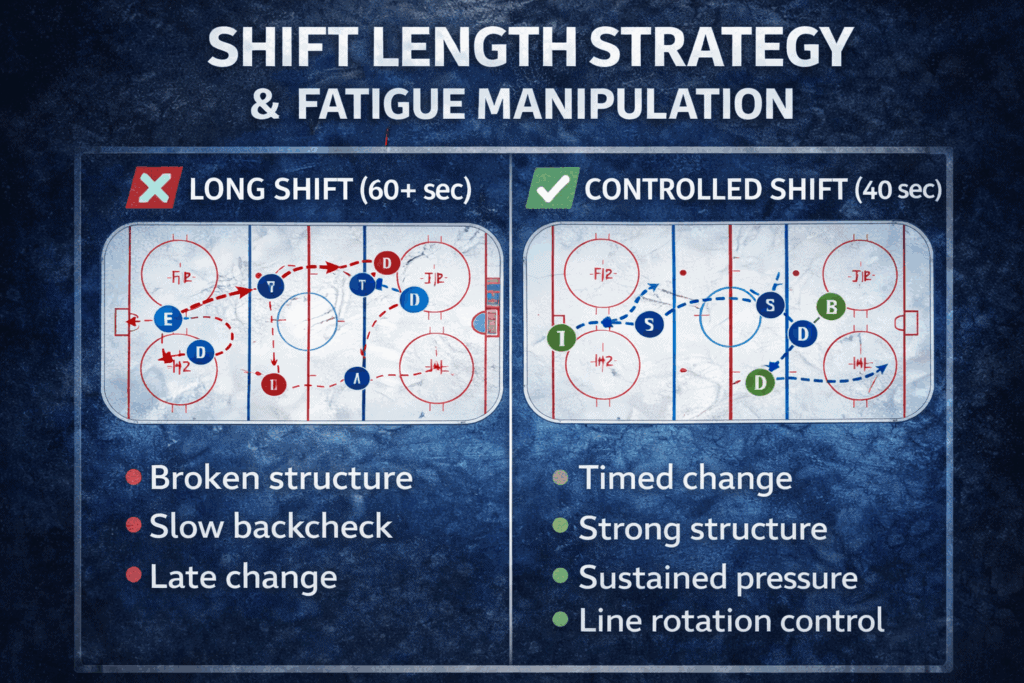
At the professional level, optimal shift length typically ranges between 35-45 seconds. This window allows players to operate at high intensity without entering oxygen debt.
Once a shift extends beyond 50-55 seconds, performance metrics begin to decline:
- Slower decision-making
- Reduced skating acceleration
- Loss of defensive structure
- Delayed puck support
This is not visible immediately - but it accumulates shift by shift.
⚡ Micro-Fatigue: The Invisible Opponent
Fatigue in hockey is not only about exhaustion. It builds in layers.
Micro-fatigue refers to small, repeated energy losses that affect performance over time.
A player staying 10-15 seconds too long on multiple shifts may:
- Lose positioning discipline
- Miss backchecking assignments
- React slower in transition
This is how games are lost without obvious mistakes.
🔁 Bench Control and Line Rotation
Elite teams maintain strict bench discipline:
- Short, consistent shifts
- Quick changes in neutral zones
- Pre-planned rotation patterns
Coaches monitor not just time on ice, but shift quality.
A “good shift” is not long - it is efficient.
🔥 Late Game Fatigue & Oxygen Debt
In the third period, fatigue becomes tactical.
Players who overextend early shifts enter oxygen debt, which leads to:
- Heavy skating mechanics
- Poor gap control
- Loss of puck battles
This is where games are decided.
🧩 Line Shortening Strategy
In critical moments, coaches reduce rotation:
- Top 6 forwards take more shifts
- Reliable defense pairs stay longer
- Energy players are used situationally
But this only works if fatigue has been managed earlier.
🎯 Tactical Insight: Fatigue as a Weapon
Advanced teams don’t just manage their own energy - they exploit the opponent’s fatigue.
This includes:
- High-tempo forechecking against tired lines
- Quick re-entry pressure after long defensive shifts
- Forcing icing situations to trap players
🧠 Coach Mark Comment
Shift length is not about discipline alone - it is about understanding energy economics. Players who learn to change early extend their effectiveness over the entire game. Coaches who manage fatigue properly control tempo without touching the puck.
❓ Q&A: Shift Length and Fatigue in Hockey
What is the ideal shift length in hockey?
Typically 35-45 seconds at high intensity.
What happens if a shift is too long?
Performance declines, positioning breaks down, and reaction time slows.
What is micro-fatigue?
Accumulated small energy losses that impact performance over multiple shifts.
Why is fatigue important in late game situations?
Fatigue affects decision-making and skating, often determining outcomes.
How do teams use fatigue strategically?
By increasing pressure against tired players and controlling tempo.
Lesson board: