Category: IHM Academy

IHM Academy by Coach Mark Lehtonen is your ultimate destination for learning the game like a pro.
From tactical systems and line matchups to training methods and mental preparation - every lesson is built on real coaching experience.
Dive into the fundamentals, master advanced hockey IQ, and understand the game through the eyes of a coach.

📚 Learn Hockey. The Coach’s Way.

Gap Control & Angling - Controlling Speed and Space | IHM Academy (Coach Mark Lehtonen)

IHM Academy – Lesson #6 · By Coach Mark Lehtonen

Gap Control & Angling – Controlling Speed, Space, and Advantage

The best defenders don’t chase – they guide. Gap control and angling are the foundation of elite defensive play. These skills allow you to slow opponents, close space at the right time, and force turnovers instead of reacting to them. When done correctly, the attacker plays in your structure, not theirs.

Top-down tactical hockey diagram on dark ice, steel tones, red vs blue players labeled D and F. 1-on-1 neutral-zone angling

Objective

Control the attacker’s options by managing space, steering their route, and winning position before physical contact ever happens. Defense starts before the puck crosses your blue line.

Gap Control Principles

  • Match the attacker’s speed – too slow and you’re dead, too fast and you overrun the play.
  • Stick length gap – one stick length is the gold standard entering the blue line.
  • Inside-out body position – always between attacker and middle ice.
  • Close gap early – better to squeeze in the neutral zone than give space at blue line.

Angling Mechanics

  • Deny middle first – if you remove the inside, the outside is predictable.
  • Lead the attacker to pressure – boards, backchecker, partner support.
  • Stick on ice, toes angled – your feet dictate their path.
  • Hands quiet, hips low – won battles happen before contact.

Body Positioning

  1. Shoulder inside shoulder – body-line dominance.
  2. Stick in lane – blade seals passing lane; body seals skating lane.
  3. Finish with control – pin, bump, or ride-off – not chaos, control.

Game Intelligence

Elite defenders don’t chase speed – they remove options. Your first job is to take away space and steer the rush. Backpressure turns good defenders into elite ones. Neutral zone wins save more goals than desperation blocks.

Coach Mark Lehtonen says:

“Good defense isn’t about stopping an attacker – it’s about making them skate where you want and when you want. If you decide the route, you already won the battle.”

Summary

Gap and angling create predictable offense – predictable offense is easy to kill. Control space, deny middle, steer play, trust support. Defense is geometry and timing, not chaos.

Study more details and pro habits at IHM Academy.

Backchecking vs. 2-on-1 - Defensive Recovery Principles | IHM Academy (Coach Mark Lehtonen)

IHM Academy - Lesson #5 · By Coach Mark Lehtonen · IHM Academy

Backchecking vs. 2-on-1 – Defensive Recovery Principles

Backchecking vs. 2-on-1 - Defensive Recovery Principles

Every transition has a heartbeat – the moment when an offensive rush turns into a defensive emergency. The 2-on-1 rush is the most dangerous situation in hockey, and how you manage it defines your team’s defensive identity. A well-executed backcheck can turn what looks like a guaranteed scoring chance into nothing more than a dump-in.

Objective

The goal of an effective backcheck against a 2-on-1 is to neutralize the secondary attacker before the puck crosses the defensive blue line. That requires instant recognition, clear communication, and synchronized effort between the lone defenseman and the tracking forward.

Structure and Communication

  • Recognition: The defenseman must immediately identify that support is coming from behind. The earlier they know a backchecker is present, the sooner they can close the gap on the puck carrier.
  • Communication: A quick, loud call – “I’ve got puck!” or “You’ve got weak side!” – eliminates confusion. The defender commits to the puck carrier while the backchecker locks onto the trailer.
  • Gap Control: The defenseman’s stick must take away the middle of the ice. By controlling the passing lane early, the puck carrier is forced wide or into a low-percentage shot.

Backchecker Responsibilities

  • Skate through the middle: The backchecker must attack with speed through the center lane. Their feet never stop until they are goal-side of the weak-side forward.
  • Stick on stick: Arriving late is fine – arriving lazy isn’t. The backchecker must eliminate the weak-side player’s stick immediately to deny any pass or rebound.
  • Read the defenseman’s body: If the defender angles the puck carrier outside, the backchecker closes inside. If the defense steps up early, the backchecker supports from behind to recover loose pucks.

Defender’s Tactics

  1. Close the gap early: Once the defender knows there’s support coming, they can step up on the puck carrier confidently.
  2. Stick positioning: Blade flat to the ice, inside-out angle – the goal is to make the pass across impossible.
  3. Force to the boards: Keep body between puck and net, forcing a shot from a poor angle.

Transition Mindset

Great backchecking is not about speed – it’s about *commitment*. The moment your forwards realize the play has turned, their first three strides must be full effort backward. The earlier they engage, the easier it is for the defenseman to control space. A disciplined team transforms broken plays into controlled recoveries.

Coach Mark Lehtonen says:

“Every 2-on-1 starts as a 3-on-2 that died. You kill it by effort and communication. The backchecker doesn’t save the day – he erases the mistake before it becomes one.”

Summary

Backchecking versus a 2-on-1 is about unity. The defenseman controls space; the backchecker controls the weak side. Together, they turn panic into control. When both players trust the system, the 2-on-1 becomes just another rush – not a highlight reel against you.

Learn more defensive transition tactics and recovery reads at IHM Academy.


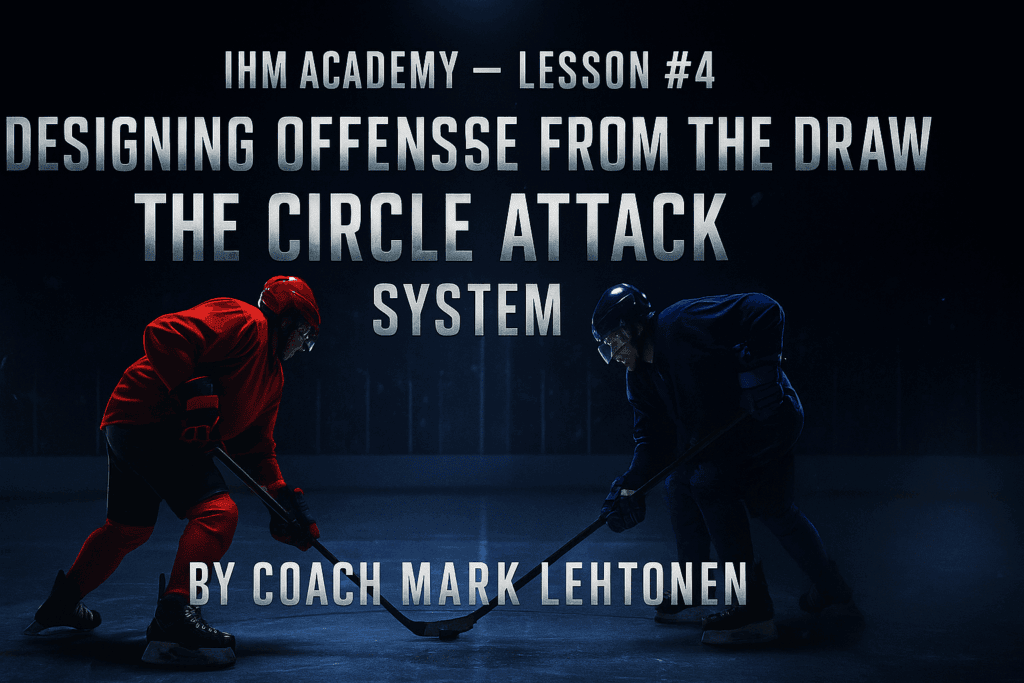
IHM ACADEMY - LESSON #4 DESIGNING OFFENSE FROM THE DRAW THE CIRCLE ATTACK SYSTEM BY COACH MARK LEHTONEN

IHM Academy - Lesson #4 By Coach Mark Lehtonen · IHM Academy

Designing Offense from the Draw - The Circle Attack

Designing Offense from the Draw - The Circle Attack

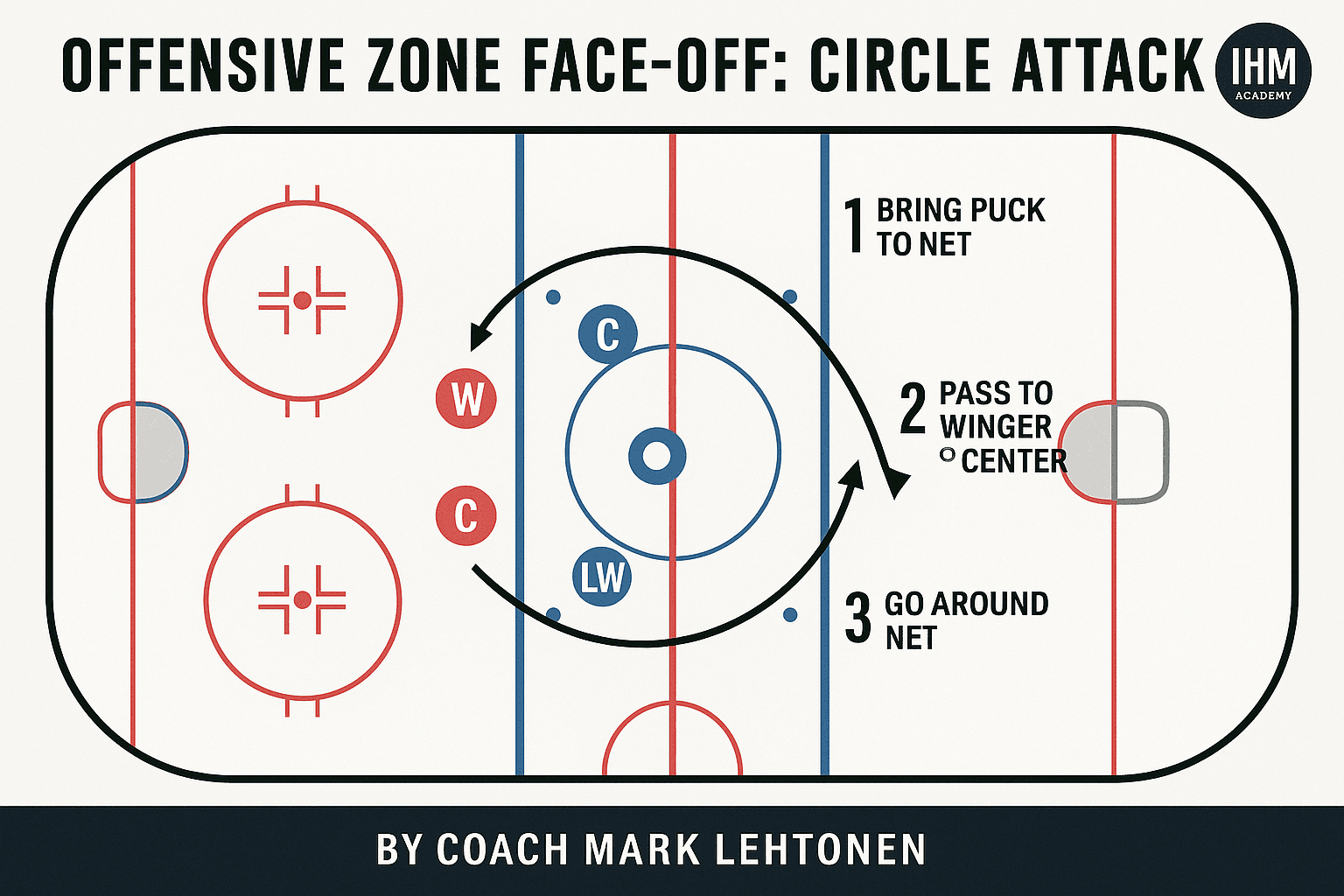
Face-offs in the offensive zone are not random battles. At the higher levels, they are scripted attacks. The Circle Attack is a set play built to generate an immediate scoring chance within seconds of winning the draw. The goal is not just to gain possession - it’s to attack with speed before the defenders can organize.

Objective

The goal of this play is to have the center win the puck backward into space so that the net-side winger can explode around the face-off circle, collect the puck in stride, and attack downhill with multiple options. This movement forces the defense to turn, chase, and react instead of defending in structure.

Roles and Timing

  • Center (C): The center’s job is not to just “win it back.” The puck must be directed to a spot, not a scramble. The ideal placement is just behind the inside hashmark of the circle, where your winger will arrive with speed.
  • Net-front winger: Starts low, near the crease. On the drop, this winger immediately loops around the top of the circle. That looping route is the heart of the play - they become the first puck carrier at full speed, not standing still on the wall.
  • Weak-side winger: Slides into soft ice high in the slot or weak side circle. This player becomes the “release valve.” If defenders collapse on the puck carrier, that weak-side forward is wide open for a one-touch shot.
  • Defensemen (D1 / D2): Hold width and stay ready on the blue line. One of them rotates middle for a potential high shot, the other stays spread to keep the PK honest. If nobody is pressured, that high option becomes a clean point shot through traffic.

Primary Reads for the Puck Carrier

  1. Drive the net: Attack the goalie immediately. If the defender is behind you, take it straight to the crease. This forces panic, rebounds, penalties, chaos - all good things for you.
  2. Feed the middle: If both defenders collapse to stop the drive, the puck carrier can hit the trailing forward in the slot. That’s often the best shot of the entire sequence: inside hashmark, goalie moving, defenders turning.
  3. Wrap and extend: If there’s no clean lane, continue behind the net. Now the team flows into a controlled offensive cycle. You didn’t lose the puck. You just turned the face-off win into set offensive zone time.

Why This Play Works

This system attacks the one moment when the defending team is weakest: right after the draw. Defenders are still tied up on sticks and bodies, the goalie’s sightlines aren’t set yet, and coverage assignments aren’t sorted. You are hitting them before they get organized.

Coaches like this play because it creates speed without requiring a risky stretch pass. All five of your skaters know their first movement before the puck even touches the ice. That’s what separates structure from chaos.

Coach Mark Lehtonen says:

“We don’t ‘hope’ to get a chance off the draw - we design one. The Circle Attack is timing, discipline, and trust. Your winger has to believe the puck is going to that spot. Your center has to put it there. That’s execution.”

Summary

The Circle Attack is how smart teams weaponize the offensive zone face-off. You’re not just winning a puck - you’re building a scoring chance in advance. When this play is timed correctly, the defense is already under pressure before they’ve even found the puck.

For more offensive design, special teams structure, and pro-level detail, explore IHM Academy. Learn hockey the way coaches teach it.


Penalty Kill Forecheck Explained - IHM Academy by Coach Mark Lehtonen

IHM Academy – Lesson #3 By Coach Mark Lehtonen

Penalty Kill Forecheck Explained

Penalty Kill Forecheck - Coaching Diagram

The penalty kill is not just about surviving. The best teams use it to control momentum, dictate entries, and steal time. A well-structured penalty kill forecheck can frustrate even elite power plays by forcing dump-ins, cutting passing options, and delaying clean possession.

The Purpose of the PK Forecheck

When a team goes short-handed, the objective is twofold – deny clean entry and force turnovers before the puck ever sets up in the zone. A strong PK forecheck disrupts the power play at its source: transition. You never let them enter with control; you make them chase the puck 200 feet.

Typical PK Forecheck Structures

1. Diamond (Passive Read)

The Diamond setup is used when protecting a lead or facing a high-skill power play. F1 pressures up ice only if the puck is loose; F2 and F3 angle toward the boards, forming the top of the diamond. The defensemen stay deeper, controlling the middle and forcing the breakout wide. This structure delays puck movement and eats up seconds – time is your best defense.

2. Wedge +1 (Aggressive Read)

The Wedge +1 is the modern standard. It combines pressure and containment. The “+1” (F1) attacks the puck carrier immediately after a turnover or dump-in, while the other three players form a compact triangle or wedge behind. The shape flexes with the play – when one pushes, the others collapse and reset the wall.

This system works because it allows one player to pressure aggressively without breaking the box. The wedge rotates as one unit; each read triggers a collective motion, not an individual chase.

Entry Denial

The penalty kill forecheck begins at the offensive blue line. F1 angles the puck toward the boards, while F2 mirrors through the middle. Both defensemen hold the red line – never backing in early. The goal is to make the puck carrier either dump the puck or send a risky lateral pass under pressure. Every second the opponent spends retrieving the puck is a small victory.

Key Coaching Points

  • Short routes, big results: Don’t chase. Skate only as far as you can force a bad pass. Short bursts win the clock.
  • Stick in lane: On the PK, your stick is your best weapon – keep it extended, take away options.
  • Stay layered: Every movement should reveal a second defender behind. Never a single line of defense.
  • Pressure with purpose: A good PK doesn’t just clear the puck – it clears with possession and exits smartly.

Coach Mark Lehtonen says:

“A penalty kill that just survives is weak. A penalty kill that pressures is dangerous. When you force them to reset three times before entry – that’s when frustration sets in. Smart pressure wins more than blocked shots.”

Summary

The Penalty Kill Forecheck is where discipline meets aggression. It’s not a passive retreat – it’s a controlled attack designed to deny comfort. When executed properly, it changes the entire rhythm of the game. The opponent might have five skaters, but you control the ice.

Learn more systems and tactics in IHM Academy – where real hockey IQ begins.


IHM Academy - Lesson #2 By Coach Mark Lehtonen · IHM Academy

Elite Offensive Structure, Forecheck & Neutral Zone Systems

Elite Offensive Structure, Forecheck & Neutral Zone Systems

Elite Offensive Structure, Forecheck & Neutral Zone Systems

A complete pro-level module covering modern offensive structure, forechecking systems, neutral-zone tactics, transition principles, and elite special teams concepts. All lessons are authored in the signature style of Coach Mark Lehtonen for the IHM Academy.


Power Play Overload → Umbrella Rotation By Coach Mark Lehtonen · IHM Academy

IHM Academy - Lesson #11 · By Coach Mark Lehtonen


Cinematic hockey banner of an east-west deceptive cycle with metallic IHM Academy Lesson #10 title

IHM Academy - Lesson #10 · By Coach Mark Lehtonen


Cinematic hockey banner showing a neutral-zone turnover exploding into counter-attack, with metallic title IHM Academy - Lesson #9

IHM Academy - Lesson #9 · By Coach Mark Lehtonen


IHM Academy - Lesson #8 Neutral Zone Face-Off Loss

IHM Academy - Lesson #8 By Coach Mark Lehtonen


IHM Academy - Lesson #7 Neutral Zone Face-Off Win - Lane Activation & Speed Release

IHM Academy - Lesson #7 By Coach Mark Lehtonen


Gap Control & Angling - Controlling Speed and Space | IHM Academy (Coach Mark Lehtonen)

IHM Academy - Lesson #6 By Coach Mark Lehtonen


Backchecking vs. 2-on-1 - Defensive Recovery Principles | IHM Academy (Coach Mark Lehtonen)

IHM Academy - Lesson #5 · By Coach Mark Lehtonen

IHM ACADEMY - LESSON #4 DESIGNING OFFENSE FROM THE DRAW THE CIRCLE ATTACK SYSTEM BY COACH MARK LEHTONEN

IHM Academy - Lesson #4 By Coach Mark Lehtonen


Penalty Kill Forecheck Explained - IHM Academy by Coach Mark Lehtonen

IHM Academy – Lesson #3 By Coach Mark Lehtonen


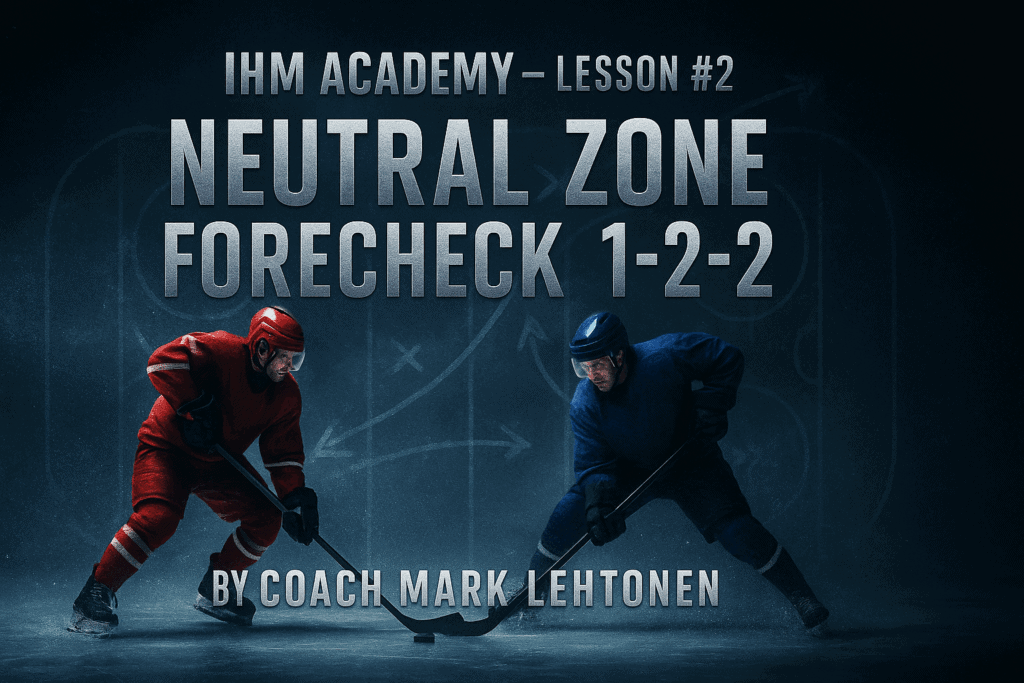
HM Academy - Lesson #2’ and ‘Neutral Zone Forecheck · 1-2-2’.By Coach Mark Lehtonen

IHM Academy - Lesson #2 By Coach Mark Lehtonen


2-1-2 forecheck hockey system diagram - IHM Academy by Coach Mark Lehtonen.

IHM Academy - Lesson #1 By Coach Mark Lehtonen


HM Academy - Lesson #2’ and ‘Neutral Zone Forecheck · 1-2-2’.By Coach Mark Lehtonen

IHM Academy - Lesson #2 By Coach Mark Lehtonen · IHM Academy

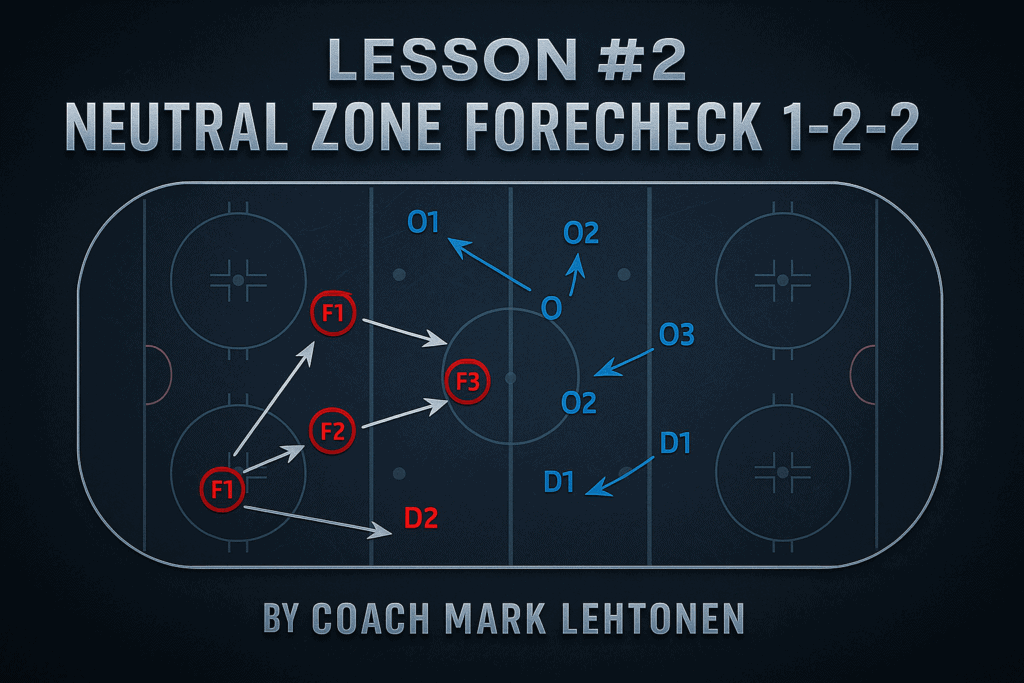
Neutral Zone Forecheck 1-2-2 Explained

The neutral zone decides who controls the game. If you slow teams there, you control the tempo. If you lose it, you chase all night. The 1-2-2 neutral zone forecheck is a modern structure used to shut down transition attacks, force low-percentage entries, and turn mistakes into instant counter-attacks.

Neutral Zone 1-2-2 Forecheck Explained - IHM Academy by Coach Mark Lehtonen

What is the 1-2-2?

The numbers describe the shape. 1 forward applies the first layer of pressure. 2 forwards form a second layer across the width of the neutral zone. 2 defensemen sit behind that, controlling space and stepping up when the puck gets funneled to a predictable lane.

This is not a full-speed chase. It’s controlled pressure. You are not trying to steal the puck immediately – you are trying to force the puck into a decision you already prepared for.

Player Responsibilities

F1 – The first pressure

F1 is your trigger. This forward angles (forces) the puck carrier toward one side of the ice, ideally toward the boards. The key is angle, not speed. Bad F1s just skate fast. Good F1s steer the puck where the structure wants it.

If F1 chases straight through the middle, the entire 1-2-2 collapses. F1 must close time and space while taking away the middle lane.

F2 and F3 – The wall

F2 and F3 sit behind F1 and stretch horizontally across the neutral zone. Think of them as a moving barrier. One forward covers the strong side (the side where the puck is being pushed), the other covers the weak side.

Their job is to read the next pass. If the puck moves to the wall, the strong-side forward steps up and attacks. If the puck gets reversed or cut back to the middle, the weak-side forward jumps and kills that option.

Good 1-2-2 teams make the puck carrier feel like there’s open ice ahead - and then shut that lane right as the pass is released.

D1 and D2 – The gatekeepers

D1 and D2 hold a tight, aggressive gap behind the forwards. They are not passively “backing in.” They’re stalking the next move. The second the puck is funneled to the boards, the strong-side defenseman can step up on the entry, finish the body, and break the play.

The other defenseman shifts to middle ice and protects against a slip pass or a chip-and-chase behind the line. This prevents odd-man rushes against.

Why coaches love 1-2-2 in the neutral zone

  • It kills speed. Fast teams hate this system. You’re not letting them enter the zone with control; you’re forcing them to dump the puck early.
  • It creates predictable exits for you. When you win the puck on the wall, you already have F2 or F3 close enough to turn it the other way. You don’t just defend – you counter.
  • Low risk, high control. It’s safer than an all-in forecheck like 2-1-2 because you always keep numbers behind the puck. You’re rarely caught in an odd-man rush if everyone does their job.

Common mistakes that break the system

  • F1 overcommits straight-line. If F1 flies past the puck and doesn’t angle, the opponent just hits the middle with speed. That’s a free controlled entry against you.
  • F2 and F3 get too deep. The “2-2” line must stay in the neutral zone, not drift back to their own blue line. If they sag, you give the opponent the red line for free.
  • Defense backing in too early. D1 and D2 must hold the line mentally. If they just retreat, the structure dies. The whole point is to meet the puck at pressure points, not surrender ice.

Coach Mark Lehtonen says:

“People think 1-2-2 is passive. It’s not. It’s controlled aggression. You’re not chasing the puck – you’re telling the puck where to go. Good teams don’t hunt chaos. They create it on their terms.”

When to use the 1-2-2

Teams will lean on this structure when they’re protecting a lead, when they’re playing a dangerous transition opponent, or when the bench is tired and needs to control the pace. It’s also a go-to system on big ice (international hockey), where straight high-speed rushes are deadly if you give too much room in the neutral zone.

Summary

The 1-2-2 neutral zone forecheck is about discipline, spacing, and funneling the puck into pressure instead of gambling for a steal. You slow their transition, you take away the middle of the ice, and you force them to give you the puck on your terms. That’s intelligent hockey.

For more tactical lessons, visit IHM Academy – we break down systems, structure, and hockey IQ the way players actually hear it in the room.

2-1-2 forecheck hockey system diagram - IHM Academy by Coach Mark Lehtonen.

IHM Academy – Lesson #1 By Coach Mark Lehtonen · IHM Academy

2-1-2 Forecheck Explained

The 2-1-2 forecheck is one of hockey’s most balanced and aggressive pressure systems. It’s designed to close time and space in the offensive zone, disrupt the opponent’s breakout, and immediately convert puck recovery into scoring opportunities.

Tactical diagram of the 2-1-2 forecheck system in ice hockey, showing F1 and F2 pressure, F3 coverage, and D1/D2 rotations - IHM Academy Coaching Edition by Coach Mark Lehtonen.

Structure of the System

The formation is simple on paper: two forwards deep (F1 and F2), one high forward (F3), and two defensemen (D1 and D2) holding the blue line. But the key lies in timing, rotation, and reading the play.

F1 drives in first to pressure the puck carrier immediately after a dump-in or turnover. His job is to force a rushed decision – ideally pushing the puck toward the boards or into a contested corner. F2 reads F1’s angle and closes the nearest passing lane, supporting from the opposite side. These two create the “2” in the 2-1-2 – a synchronized wave of forecheckers working below the goal line.

F3 remains high in the slot area, between the tops of the circles. This player is the safety valve – responsible for cutting off middle-lane exits, reacting to turnovers, and covering if a defenseman pinches. If F3 drifts too low, the team loses control of the neutral zone – a classic coaching mistake even at pro level.

Defensive Support and Rotation

Behind the forwards, both defensemen stay tight at the blue line, sealing the walls. When the puck is moved up one side, D1 has the green light to pinch aggressively and force a turnover along the boards. The moment that happens, F3 must rotate back to occupy D1’s vacated position – maintaining the “2-1-2” structure. This automatic rotation is what keeps the system stable even during chaos.

D2 shades toward the middle, ready to recover loose pucks or defend quick counters. The unit as a whole constantly shifts in small, controlled motions – think of it as a living net closing around the puck carrier.

Key Coaching Concepts

  • Layered Pressure: Each forechecker attacks on a different layer, preventing clean possession or stretch passes.
  • Controlled Aggression: Pinching is encouraged – but only when support is confirmed behind.
  • Communication: Talk dictates success. Without clear calls between F2, F3, and the pinching D, the system breaks instantly.
  • Transition Readiness: When a turnover occurs, F3 and D2 immediately activate – turning defense into offense within seconds.

Coach Mark Lehtonen says:

“A perfect 2-1-2 feels like a wave – first you force, then you trap, then you attack again. The best teams don’t just chase the puck – they close the ice, one decision at a time. Discipline from F3 is what separates an organized forecheck from chaos.”

Summary

The 2-1-2 forecheck remains a cornerstone of modern hockey because it combines relentless pressure with tactical security. It can be used after controlled dumps, on offensive face-offs, or even immediately after neutral-zone turnovers. When executed with proper spacing, timing, and communication, it traps opponents, exhausts their breakout patterns, and creates sustained offensive-zone dominance.

Explore more lessons in IHM Academy – including detailed breakdowns of power-play structures, neutral-zone traps, and transition systems used by professional coaches worldwide.