Category: IHM Academy

IHM Academy by Coach Mark Lehtonen is your ultimate destination for learning the game like a pro.
From tactical systems and line matchups to training methods and mental preparation - every lesson is built on real coaching experience.
Dive into the fundamentals, master advanced hockey IQ, and understand the game through the eyes of a coach.

📚 Learn Hockey. The Coach’s Way.

IHM Academy - Performance Metrics Masterclass • Lesson 1

IHM Academy – Performance Metrics Masterclass • Lesson 1

IHM Academy – Performance Metrics Masterclass • Lesson 1

Performance Metrics Masterclass – Lesson 1
High-Danger Goals, Goals Above Expected, Ice Tilt, Speed Bursts and Shot Differential

Date: November 8, 2025 | Series: IHM Academy – Performance Metrics Masterclass | Lesson: 1

Welcome to Lesson 1 of the IHM Academy Performance Metrics Masterclass. This module builds a working toolkit for coaches, analysts, and ambitious players. You will learn the five metrics that most reliably explain why teams sustain form across weeks, not just nights: High-Danger Goals, Goals Above Expected, Ice Tilt, Speed Bursts and Shot Differential. We define them, show how they are built, explain how to apply them in practice, and give you pro-level checklists, drills, and a repeatable workflow.


1) High-Danger Goals (HDG)

Definition. High-Danger Goals are goals scored from areas and situations with inherently higher scoring probability due to distance, lateral puck movement, traffic, and pre-shot actions (passes across the slot, rebounds, tips). Think inner slot, net-front, and east-west seams.

Why it matters. HDG is a strong signal of repeatable offense. Teams that consistently arrive in the interior create both primary shots and second-puck chaos. It scales with playoff hockey where space is compressed.

Analyst’s rule of thumb. Sustained contenders typically land in the top third of the league in HDG share. A sudden spike in HDG without a change in slot entries or low-to-high pass rate is usually noise.

Minimal model. Mark inner slot as a polygon bounded by the goal posts extended, hashmarks, and the mid-slot dot line. Tag a shot as “high danger” if any of the following occur within 3 seconds before release: (1) Royal-road pass (across center lane), (2) rebound, (3) deflection/tip within 10 feet, or (4) release location inside inner slot.

Pro example. Ducks opening month: 28 HDG (Top-2 league). The repeatable driver was net-front layering on P1 and a weak-side crash from P3 after low-to-high. When those layers show on video and the counts rise, the signal is genuine.


2) Goals Above Expected (GAX)

Definition. GAX = Actual Goals − Sum of expected goals (xG) on each qualifying attempt. It captures finishing above or below what shot quality predicts, adjusted by context like pass type and goalie set.

Why it matters. Positive GAX over meaningful volume can indicate elite shooting, deception, or shot preparation. It also flags unsustainable runs when driven by fluke bounces without process.

Computation sketch.

For each shot i:
  xG_i = f(distance, angle, pre-shot movement, shot type, traffic, goalie lateral set)
GAX = Σ(goals_i) − Σ(xG_i)

Pro example. Cutter Gauthier +5.91 Goals Above Expected early season. The video confirms: heavy mid-range velocity, one-touch releases, and layered net-front traffic. The metric aligns with tape – the strongest validation.


3) Ice Tilt

Definition. A time-weighted territorial control proxy describing how long a team spends pushing play in the offensive half relative to the opponent, often approximated by sustained possession and controlled entries leading to attempts.

Why it matters. Ice Tilt predicts streak stability. Teams that own the first period tend to dictate matchups and draw the game into their preferred structure.

Analyst’s cue. First-period Ice Tilt advantage is a leading indicator for multi-game form. Ducks led the league in first-period tilt during their surge; their game states favored front-foot hockey and early PP opportunities.


4) Speed Bursts (20+ mph) and Max Speed

Definition. Count of discrete skates exceeding 20 mph and the single-shift maximum speed. This is not a vanity metric – it’s a proxy for separation, retrieval pressure, and threat in transition.

Use correctly. Speed is only valuable when attached to route efficiency. Bursts that end on the outside wall without inside support are empty miles.

Pro examples. Logan Cooley at 23.97 mph (No. 2 league) translates directly to controlled entries and east-west pressure. Nick Schmaltz couples above-average burst count with high total distance, indicating repeatable pace over long shifts rather than single sprints.


5) Shot Differential (5-on-5)

Definition. Team shots on goal minus shots allowed at 5v5, game-normalized. It is a sturdy backbone metric: you rarely see long winning streaks from teams living in the red here.

Pro example. Utah Mammoth at +5.4 per game (No. 2 league). That is process-level dominance and matches video of their retrieval speed and interior reloads.


Case Study A – Anaheim Ducks: Why the Breakout Holds

  • Interior creation: 28 HDG early (Top-2). Net-front layering + quick seam passes.
  • Finishing over model: Gauthier at +5.91 GAX with mid-range velocity and one-touch mechanics.
  • Game state control: Best first-period Ice Tilt; they script starts and play ahead.
  • Depth threat: Multiple PPG producers and multi-goal game frequency signaling repeatable shot prep.

Applied coaching adjustments that keep it real

  1. Keep a weak-side crash rule after low-to-high. If F3 is late, HDG collapses.
  2. Preserve the net-front box-out culture on D. Don’t sacrifice interior to chase hits.
  3. On PP1, avoid static 1-3-1. Add slot interchange to preserve east-west velocity before the shot.

Case Study B – Utah Mammoth: Speed With Structure

  • Shot volume engine: +5.4 5v5 shot differential; most games outshooting opponents.
  • High-danger finishing: Nick Schmaltz 96th percentile high-danger shots; mix of tips and seam attacks.
  • Transition threat: Logan Cooley max 23.97 mph; drives controlled entries, inside lanes, and delay-pass options.
  • Defensive workload: 2nd fewest shots against; retrieval speed plus clean exits.

Coaching guardrails

  1. Build route discipline for fast wingers: speed burst must end inside dots or on a delay cut into support.
  2. Keep D hinge timing tight; exit under pressure into middle support to maintain shot differential.
  3. Protect Schmaltz’s interior routes with F3 high so tips are not one-and-done rushes.

Player Micro-Profiles

Cutter Gauthier – Why the Model Loves Him

  • Shot quality: Heavy mid-range, minimal dusting, one-touch habits increase xG and GAX.
  • Traffic literacy: Shoots through screens, not around them.
  • Action item: Keep a pre-shot “checklist”: seam, screen, stick down, release.

Nick Schmaltz – Interior Repeatability

  • High-danger shot mix: Rebounds, tips, center-lane cuts.
  • Pace sustainability: High total distance with maintained touch quality late in shifts.
  • Action item: Two-touch finishes at net-front; practice stick angle changes within 0.3 s.

Logan Cooley – Speed That Translates

  • Max speed with endpoints: Bursts end on inside ice, not glass.
  • Entry tree: Straight attack, delay cut, or drop as first three options.
  • Action item: 3-lane entry drill with inside shoulder check before blue line.

How to Build a Repeatable Analyst Workflow (Weekly)

  1. Collect. Export shot locations, pre-shot passes, rebounds, tips, and on-ice traffic flags. Tag your inner-slot polygon once and reuse.
  2. Compute. HDG, team xG, player xG, and GAX by game and rolling 5-game windows.
  3. Context. Overlay Ice Tilt by period and game state (tied vs trailing vs leading).
  4. Speed layer. Pair 20+ mph burst counts with entry outcomes (controlled vs dump vs turnover).
  5. Synthesize. Build a one-page: Top 5 drivers, risk flags, and one coaching adjustment.
  6. Validate with tape. Metric movement without video corroboration is a yellow flag.

Practice Drills That Drive the Metrics

Drill 1 – Royal-Road into Net-Front Chaos (HDG)

Set 3 forwards vs 2 D + goalie. Start from low-to-high, weak-side pop to bumper, force a seam pass, immediate shot. F3 crashes far post. Count only if release < 1.2 s after seam.

Drill 2 – One-Touch Mid-Range Release (GAX booster)

Feeder at the dot, shooter between circles. No stickhandling allowed. Add a screen and a late stick flash from defender to simulate traffic.

Drill 3 – Three-Lane Entry Speed Tree (Bursts that matter)

Winger gets timing pass entering at 20+ mph. Options: straight drive, delay to trailer, or drop to late F3. Score only when shot originates inside dots within 4 seconds after entry.

Drill 4 – Exit Under Pressure to Middle Support (Shot Differential)

D retrieval, shoulder check, hinge, middle support to C. Add backpressure timer. Missed middle support = turnover. Track successful exits vs fails.


Red Flags and How to Fix Them

  • HDG drops but xG stays flat: You are shooting from the outside. Add low-to-high to seam, commit F3 to far post crashes.
  • GAX negative run: Shooters are dusting pucks. Install one-touch rules for mid-slot reps.
  • Poor first-period Ice Tilt: Re-script first shift matchups and first two exits. Remove risky neutral-zone stretch for 10 minutes.
  • High burst count, low entries: Speed without routes. Force inside finish options on drills.
  • Shot differential negative: Retrieval gap. Cut D-to-D rim habits, increase middle exits and short support.

Quick Reference – Bench Cards

  • Interior Rule: If the shot is outside dots with no screen, we are off plan.
  • Speed Rule: Every burst ends inside dots or into a delay cut.
  • PP Rule: No static 1-3-1 for two consecutive entries. Interchange.
  • Exit Rule: First look is middle. If closed, hinge, then middle again.

Coach Mark comment

The metrics work when the routes are honest. Interior play creates scoring truth. Speed without an inside finish is decoration. Build layers at the net, protect the middle on exits, and the numbers will follow.


Glossary

  • xG (expected goals): Probability a shot becomes a goal based on context.
  • GAX: Goals Above Expected = Goals − ΣxG.
  • Ice Tilt: Time-weighted territorial control proxy by period and game state.
  • High-Danger: Inner-slot or preceded by rebound, tip, or royal-road seam.
  • 20+ mph burst: Discrete skate exceeding 20 mph, tied to a possession outcome.

Checklist – End of Lesson 1

  1. Tag inner-slot polygon and pre-shot events in your template.
  2. Compute HDG, xG, and GAX for team and top six forwards.
  3. Log Ice Tilt by period for last five games.
  4. Pair 20+ mph bursts with entry outcomes.
  5. Publish a one-page scoreboard with one tactical change.
  6. Run Drills 1-4 twice this week; re-measure next game.

Questions & Answers | IHM Performance Metrics

Why are the Anaheim Ducks performing so well this season?

The Ducks rank near the top of the league in high-danger scoring and first-period territorial control (Ice Tilt). Their young core led by Carlsson and Gauthier drives shot volume and transition pace, while special teams and goaltending have been good enough to protect leads.

What makes Cutter Gauthier’s analytics profile elite?

Gauthier combines heavy shot volume with elite shot quality. He leads the team in Goals Above Expected, sits in the top percentiles for average shot speed and high-danger attempts, and consistently attacks through the middle lanes where shooting percentage is highest.

What is Ice Tilt and why does it matter?

Ice Tilt measures which team controls the puck and zone time over stretches of play. Strong Ice Tilt early in games predicts shot advantage and helps teams draw penalties, stack offensive zone faceoffs, and protect expected-goals leads.

How does Goals Above Expected work?

Goals Above Expected is the difference between a player’s actual goals and the model’s expected total from all of his shots after accounting for location, pre-shot movement, traffic, and goalie positioning. Positive numbers signal finishing talent or superior shot selection.

Why are the Utah Mammoth trending up in our model?

Utah pairs a strong shot differential with top-end speed and a low shots-against profile. They outshoot opponents most nights, keep attempts to the outside, and convert off the rush through Cooley, Keller, and Schmaltz.

What do high-danger goals tell us about a team?

High-danger goals indicate repeatable process: inside-lane entries, net-front presence, and east-west puck movement. Teams that win the slot consistently sustain scoring even when power-play luck cools.

How should I read shot differential per game?

Shot differential per game is a clean proxy for five-on-five puck control. Positive numbers usually pair with favorable expected-goals share and correlate with standings over larger samples.

What stands out in Nick Schmaltz’s start?

Schmaltz is producing shots from every band of the rink and sits in the mid-90th percentiles for high-danger attempts. He also adds value with deflections and interior touches on the power play.

How fast is Logan Cooley and does top speed translate to goals?

Cooley’s top speed sits near the top of the league. More importantly, he stacks frequent 20+ mph bursts that pull defenders apart and create cross-slot passes, which lift expected-goals on his line.

Are the Ducks legitimate playoff contenders based on the metrics?

Yes. With top-tier high-danger creation, strong Ice Tilt to start games, and improving five-on-five possession, their profile matches recent conference finalists rather than early-season pretenders.


Performance Metrics Master Lessons | IHM Academy

Performance Metrics Master Lessons | IHM Academy

A pro-level module breaking down modern NHL analytics: shot-quality models, high-danger scoring, Ice Tilt momentum, speed tracking, projected goals, possession metrics and elite player evaluation. Lessons crafted in the signature coaching style of Mark Lehtonen for the IHM Academy.

IHM Academy · Performance Metrics - How Coach Mark Lehtonen Turns Performance Metrics Into Structured Match Verdicts

IHM Academy · Performance Metrics - How Coach Mark Lehtonen Turns Performance Metrics Into Structured Match Verdicts


  • IHM Academy - Performance Metrics Masterclass – Lesson 30

    IHM Academy – Performance Metrics Masterclass – Lesson 30

    Lesson 30 – Offensive Layering Index (OLI) & Secondary Threat Activation Date: 13 January Introduction Modern offensive hockey is no longer built around a single primary attack option. Elite teams consistently score because they operate in layers. The Offensive Layering Index (OLI) is designed to measure how effectively a team creates, maintains, and activates multiple…
  • IHM Academy – Performance Metrics Masterclass – Lesson 29

    IHM Academy – Performance Metrics Masterclass – Lesson 29

    Lesson 29 – Zone Entry Denial Efficiency (ZEDE) & Blue Line Standup Discipline Date: 13 January Lesson Focus: This lesson explains how teams suppress offense before it starts by denying controlled zone entries. We define Zone Entry Denial Efficiency (ZEDE), break down what it measures, how it appears on the ice, and how Coach Mark…

  • IHM Academy - Performance Metrics Masterclass – Lesson 28

    IHM Academy – Performance Metrics Masterclass – Lesson 28

    Lesson 28 – Transition Recovery Rate (TRR) & Structural Reset Speed Lesson Focus: This lesson explains how quickly and consistently a team restores its defensive and transitional structure after puck loss. We break down why recovery speed, spacing discipline, and first-read decisions define whether transitions become threats or are neutralized early. Extended Core Definition Transition…

  • IHM Academy - Performance Metrics Masterclass – Lesson 27

    IHM Academy – Performance Metrics Masterclass – Lesson 27

    Lesson 27 – Matchup Stress Index (MSI) & Exploiting Line Mismatches Lesson Focus: This lesson explains how coaching staffs and elite teams create controlled pressure by targeting unfavorable matchups, forcing specific lines, pairs, or individuals into sustained stress. We break down what MSI measures, how it shows up on the ice, and how Coach Mark…

  • IHM Academy - Performance Metrics Masterclass – Lesson 26

    IHM Academy – Performance Metrics Masterclass – Lesson 26

    Lesson 26 – Net-Front Control Differential (NFCD) & Slot Chaos Generation Extended Core Definition Net-Front Control Differential (NFCD) measures which team consistently controls the low-slot and crease area during live play. It evaluates positioning, stick dominance, body leverage, timing of box-outs, and the ability to either create or eliminate chaos directly in front of the…

  • IHM Academy - Performance Metrics Masterclass - Lesson 25

    IHM Academy – Performance Metrics Masterclass – Lesson 25

    Lesson 25 – Late-Shift Structural Collapse Probability (LSCP) & Fatigue Exposure Index Extended Core Definition Late-Shift Structural Collapse Probability (LSCP) measures the likelihood that a team’s defensive or transitional structure breaks down due to accumulated fatigue within extended or poorly managed shifts. Unlike basic time-on-ice metrics, LSCP focuses on structural degradation rather than physical exhaustion…

  • IHM Academy - Performance Metrics Masterclass – Lesson 24

    IHM Academy – Performance Metrics Masterclass – Lesson 24

    Lesson 24 – Reversal Suppression Index (RSI) & Forecheck Pressure Collapse Probability Extended Core Definition Reversal Suppression Index (RSI) measures how effectively a team prevents opponents from executing clean puck reversals during retrieval under pressure. A reversal is one of the safest and most effective escape mechanisms in modern hockey. RSI evaluates how quickly and…

  • IHM Academy - Performance Metrics Masterclass – Lesson 23

    IHM Academy – Performance Metrics Masterclass – Lesson 23

    Lesson 23 – Cross-Lane Activation Rate (CLAR) & East-West Threat Probability Extended Core Definition Cross-Lane Activation Rate (CLAR) measures how frequently a team triggers east-west puck movement inside the offensive zone with synchronized support layers. It evaluates timing, spacing, and the ability to stretch defensive shape horizontally, forcing goaltenders into lateral adjustments. High CLAR means…
  • IHM Academy - Performance Metrics Masterclass – Lesson 22

    IHM Academy – Performance Metrics Masterclass – Lesson 22

    Lesson 22 – Zone Exit Efficiency (ZEE) & Breakout Stability Under Pressure Extended Core Definition Zone Exit Efficiency (ZEE) measures how reliably a team moves the puck out of its defensive zone with control when under forecheck pressure. It is not only about leaving the zone; it is about how the puck leaves the zone:…

  • IHM Academy · Performance Metrics Masterclass - Lesson 21

    IHM Academy · Performance Metrics Masterclass – Lesson 21

    Lesson 21 – Bench Adaptation Index (BAI) & In-Game System Switching Extended Core Definition The Bench Adaptation Index (BAI) measures how effectively and rapidly a coaching staff modifies tactical systems when the original game plan fails. It reflects strategic intelligence, emotional control and structural flexibility of the bench. Hockey games are rarely won by original…

  • IHM Academy · Performance Metrics Masterclass - Lesson 20

    IHM Academy · Performance Metrics Masterclass – Lesson 20

    Lesson 20 – Pace Disruption Index (PDI) & Tempo Control Extended Core Definition The Pace Disruption Index (PDI) measures how effectively a team destroys the opponent’s preferred rhythm and forces the game into an uncomfortable tempo. It reflects the ability to reset flow through neutral zone pressure, stoppage creation, forecheck timing and line deployment. Tempo…

  • IHM Academy · Performance Metrics Masterclass – Lesson 19

    IHM Academy · Performance Metrics Masterclass – Lesson 19

    Lesson 19 – Defensive Compactness Ratio (DCR) & Slot Sealing Extended Core Definition DCR measures how tightly a defensive unit compresses space between the dots under sustained pressure. It reflects rotational discipline, net-front layering, and denial of inner-lane passes. Game Impact Map Tactical Layer Coaching Staff Layer DCR is drilled via net-front rotation systems and…

  • IHM Academy · Performance Metrics Masterclass - Lesson 18

    IHM Academy · Performance Metrics Masterclass – Lesson 18

    Lesson 18 – Transition Speed Index (TSI) & Counter-Attack Structure Extended Core Definition The Transition Speed Index (TSI) measures how quickly and efficiently a team converts a defensive recovery into an organized attacking threat. It does not describe raw skating speed. It measures structural decision velocity under pressure: retrieval, first pass, support, lane activation, and…

  • IHM Academy · Performance Metrics Masterclass – Lesson 17

    IHM Academy · Performance Metrics Masterclass – Lesson 17

    Lesson 17 – Shift Load & Fatigue Control The Hidden Physics of Winning Hockey Most fans watch the puck. Coaches watch oxygen debt. Fatigue management is the invisible layer of elite hockey control. 1. Average Shift Length (ASL) 2. High-Intensity Burst Count (HIBC) After the 4th full-speed burst, muscle efficiency drops by 22-28%. 3. Recovery…

  • IHM Academy · Performance Metrics Masterclass – Lesson 16

    IHM Academy · Performance Metrics Masterclass – Lesson 16

    Lesson 16 – Slot Dominance Index Why Games Are Won in Five Square Meters The slot is not a location. It is a battlefield. Over 70% of elite-level goals originate from the slot area. Control of this zone decides offensive lethality and defensive survival. 1. Slot Entry Frequency (SEF) 2. Slot Shot Conversion (SSC) Measures…


IHM Academy · Performance Metrics Masterclass - Lesson 5

IHM Academy · Performance Metrics Masterclass - Lesson 5


Performance Metrics Masterclass - Lesson 4: Zone Entries, Exits & Transition Speed

IHM Academy · Performance Metrics Masterclass - Lesson 4


IHM Academy · Performance Metrics Masterclass - Lesson 3

Performance Metrics Masterclass - Lesson 3 : Zone Entry Efficiency & Controlled Breakout Success


IHM Academy · Performance Metrics Masterclass - Lesson 2

IHM Academy · Performance Metrics Masterclass - Lesson 2


IHM Academy - Performance Metrics Masterclass • Lesson 1

IHM Academy - Performance Metrics Masterclass • Lesson 1


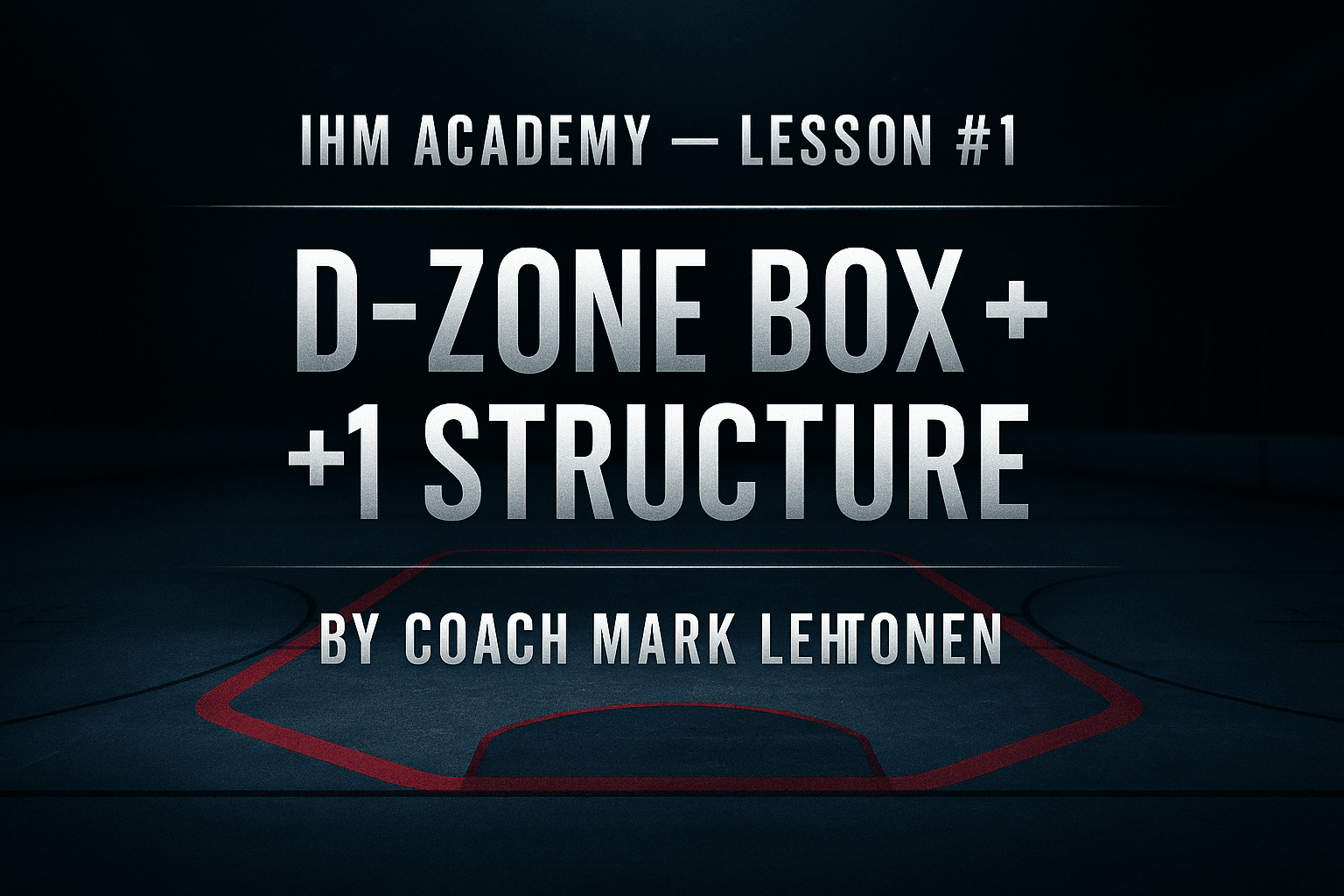
IHM Academy D-Zone Box +1 Structure

IHM Academy · Defensive Zone Coverage-Lesson #1

D-Zone Box +1 Structure

D-Zone Box +1 is a foundational, pro-level defensive structure used across the NHL and top European leagues. It delivers stability, spatial control, and clear roles-the three pillars of elite team defense. Four players form a compact box that protects the slot, while a fifth player-the +1 pressure forward-applies controlled pressure to the puck, steering play to the boards and out of dangerous ice.

D-Zone Box +1 Structure

🎯 Primary Objective

  • Protect the slot first (inside positioning beats everything).
  • Force the opponent to play the perimeter under pressure.
  • Create turnovers through smart, directed pressure.
  • Convert stops into clean exits the instant we win possession.

When the structure holds, we control danger. When it breaks, the opponent controls tempo.

🧠 Structure: Roles & Responsibilities

D1 – Net-Side Defense

  • Own the near-post lane and body-position inside the attacker.
  • Neutralize sticks at the crease; deny tips and rebounds.
  • Shoulders square to the slot; eyes through traffic.

D2 – Weak-Side Defense

  • Stay slightly higher and inside-ready to guard backdoor.
  • Support D1’s net battle; protect middle-lane seams.
  • First look on recovery: middle support → quick up or reverse.

F1 – Pressure Forward (+1)

  • Apply controlled pressure to the puck carrier (stick on puck, body on hands).
  • Steer play into the corner/boards; never over-pursue behind the net.
  • As puck moves below or across, reload back into the top of the box.

F2 – Strong-Side Top

  • Hold the strong-side top of the box; protect high lane and point.
  • Support F1 to create 2v1 pressure without collapsing the middle.
  • Stick in lanes; body inside the dot line.

F3 – Weak-Side High

  • Anchor the middle of the box-inside dots.
  • Deny diagonal seam; read backdoor threats.
  • Be first out when we win the puck (middle support for exit).

🔧 Key Coaching Cues

  • Inside first. Win inside body position before you chase the puck.
  • Sticks in lanes. Blades angled to deny seams and middle kicks.
  • Feet under you. Short, efficient steps-no lunges.
  • Box shrinks when puck goes low. Tighten toward the crease.
  • Don’t over-pursue. Pressure with structure; one presses, four protect.

📣 Coach Mark Lehtonen says

Bad defense is chaos.
Good defense is discipline.
Elite defense is structure + pressure.

❌ Common Mistakes

MistakeConsequence
F1 chases too deep below the goal lineOpens high ice and diagonal seams
D1 loses inside net-front positionUncontested tips/rebounds in the crease
F3 sinks too lowMiddle seam re-opens; slot shots
D2 ignores weak-side threatBackdoor becomes available
Box doesn’t shrink when puck goes lowSpace near the net → breakdowns

🧪 Micro-Drills

  • 2v2 Net-Front Box-Out – inside body, tie up sticks, eyes through traffic.
  • Corner Pressure Trap – F1 angle + F2 seal; turnover → quick middle exit.
  • Low-to-High Read – box tightens low; recover to points with sticks in lanes.

🧱 Summary

Box +1 is simple, stable, and scalable. It protects the house, creates turnovers through controlled pressure, and converts stops into clean exits. Master this structure and everything else in Defensive Zone Coverage stacks naturally on top of it: low-zone rotation, switch/no-switch rules, overload defense, and rapid recoveries.

IHM Academy - Defensive Zone Coverage

IHM Academy – Defensive Zone Coverage

Defensive Zone Coverage

Welcome to the IHM Academy Defensive Zone Coverage module – a complete pro-level guide to modern NHL and European defensive structures. Here we break down rotations, responsibilities, pressure rules, net-front battles, low support, switch triggers, weak-side reads, and the tactical details that separate elite defensive teams from average ones. All lessons are authored in the signature style of Coach Mark Lehtonen.


  • IHM Academy · Defensive Zone Coverage-Lesson 6

    IHM Academy · Defensive Zone Coverage-Lesson 6

    By Coach Mark Lehtonen · IHM Academy · Defensive Zone Coverage IHM Academy – Defensive Zone Coverage · Lesson #6Weak-Side Awareness & Backdoor Protection The weak side decides games. Teams defend well on the puck side because it’s visible, loud, and instinctive. But goals are scored behind your structure – on delayed seams, weak-side pinches,…

  • IHM Academy · Defensive Zone Coverage-Lesson 5

    IHM Academy · Defensive Zone Coverage-Lesson 5

    IHM Academy – Defensive Zone Coverage · Lesson #5D-Zone Faceoff Coverage & Responsibilities Defensive-zone faceoffs decide momentum, possession, and scoring chances. A single blown assignment can turn a harmless draw into a Grade-A chance against. Elite teams treat D-zone faceoffs as structured mini-systems, with fixed roles, predictable rotations, and non-negotiable responsibilities. You don’t react in…

  • IHM Academy · Defensive Zone Coverage-Lesson 4

    IHM Academy · Defensive Zone Coverage-Lesson 4

    By Coach Mark Lehtonen · IHM Academy · Defensive Zone Coverage IHM Academy – Defensive Zone Coverage · Lesson 4: Net-Front Defense & Slot Protection The defensive zone does not break first on the boards – it breaks in the slot. Teams that lose the middle of the ice give up screens, tips, and rebounds…


IHM Academy · Defensive Zone Coverage-Lesson #3

IHM Academy · Defensive Zone Coverage-Lesson #3


IHM Academy · Defensive Zone Coverage-Lesson #2

IHM Academy · Defensive Zone Coverage-Lesson #2


IHM Academy D-Zone Box +1 Structure

IHM Academy · Defensive Zone Coverage-Lesson #1


IHM Academy- Learn the Game Like a Coach

IHM Academy- Learn the Game Like a Coach

IHM Academy- Learn the Game Like a Coach

IHM Academy is a professional hockey learning hub led by Coach Mark Lehtonen. Learn modern systems, structures and reads used in the NHL and top European leagues: offensive concepts, forecheck and neutral-zone tactics, special teams, and complete Defensive Zone Coverage. Each lesson includes a clear tactical breakdown, coaching language, a clean board diagram, and a cinematic banner - built to make you think like a coach and play with purpose.

Pro-level hockey academy by Coach: elite systems, special teams and D-zone coverage with clear diagrams and coach-grade explanations.

Systems Categories


Performance Metrics Master Lessons | IHM Academy

Performance Metrics Master Lessons | IHM Academy


IHM Academy - Defensive Zone Coverage

Defensive Zone Coverage


Elite Offensive Structure, Forecheck & Neutral Zone Systems

Elite Offensive Structure, Forecheck & Neutral Zone Systems


Power Play Overload → Umbrella Rotation By Coach Mark Lehtonen · IHM Academy

IHM Academy - Lesson #11 · By Coach Mark Lehtonen

Power Play Overload → Umbrella Rotation

The best power plays don’t stand still.
They start in one structure and evolve as pressure shifts.

Overload creates pressure on the weak side and forces the PK to collapse and rotate.
Umbrella opens the high ice and shooting lanes once you stretch their shape.

The goal is simple:

Win numbers low → pull the PK in → strike high with layered traffic and deception.

Bad PP units run a formation.
Elite PP units run an evolution.

🎯 Objective

Use an overload entry and low-side manipulation to force the PK into coverage stress, then rotate into an umbrella to create:

  • 1-timer lanes up top
  • Slot seam plays
  • Net-front rebounds and tips
  • Extended zone control

We don’t chase a shot –
we manufacture the breakdown.

🧠 Core Concepts

PhasePurpose
Overload Set (3 players on one side low)Force PK into collapse, outnumber battles
Low Support + Quick TouchesFreeze the weak-side PK forward
Bumper Delayed MoveDrag middle PK defender down
Rotation Up TopStretch box → convert into umbrella
Middle Shooting ThreatIf they collapse again → seam pass option

This is three-dimensional PP thinking – puck, spacing, and timing.

🧩 Player Roles

Quarterback (QB-D)
Reads pressure
Buys time through deception
Initiates umbrella shift

Half-Wall Playmaker (F1)
Drives defender down
Low-high touch options

Goal-Line / Below-Goal Playmaker (F2)
Quick touch passes
Bait PK into switching coverage

Net-front (F3)
Screens → pops → high slot bumper timing
Battle positioning

Weak-side flank (F4)
Hidden shooter lane
Arrives as play swings high

🔧 Key Cues

  • Eyes up overload → attack the backside
  • Freeze PK feet before rotation
  • F3 always inside dots
  • QB never stands still
  • Bumper timing > bumper location
  • Use double fakes before high return pass

💬 Coach Mark says

“Standing PP dies.
Moving PP kills.”

“You don’t force shots.
You force panic.”

❌ Common Mistakes

MistakeWhy it kills the PP
Static formationPK reads easy, no breakdowns
Bumper too earlyMiddle lane disappears
Weak-side player watchingHe must arrive, not wait
Goal-line player passiveNeeds to be the bait engine
No net-front timingShots without layers = saves

🎓 Micro-Drills

Overload Touch Triangle → High Kickout
3 low players quick-touch
Kick puck low-high
Umbrella set → one-timer

Bumper Delay + Screen Switch
F3 screen
Pop high late
Return pass into seam

🧱 Summary

Overload earns gravity.
Umbrella weaponizes space.

We don’t pass for looks –
we pass to bend the PK shape
and fire when they’re stretched.

Elite PP isn’t a pattern –
it’s pressure, timing, deception, and structure discipline.

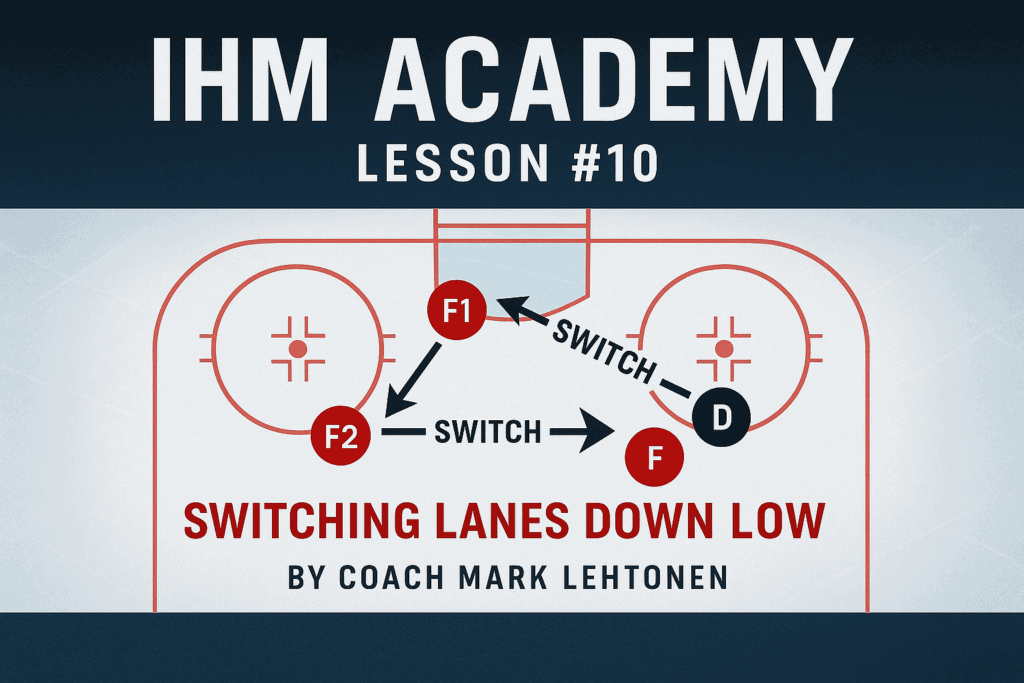
Cinematic hockey banner of an east-west deceptive cycle with metallic IHM Academy Lesson #10 title

IHM Academy - Lesson #10 · By Coach Mark Lehtonen

Offensive Zone Cycle – Low Switch & Pop Support (East-West Deception Style)

A cycle is not “wasting time in the corner.” A real cycle stretches defenders east-west, forces coverage switches, and opens the middle. Bad teams skate in circles; smart teams change angles and attack seams. We don’t cycle to survive – we cycle to manipulate and strike.

Top-down coaching diagram showing low switch between F1/F2 and weak-side pop by F3 into soft ice above the dots.

Objective

Use low support, deceptive switching, and weak-side pop timing to pull defenders off structure and create a middle-lane attack with speed.

Core Principle

Switch low → Pull coverage → Hit the weak-side pop in stride. We don’t dump and chase the corner; we cut east-west, lean pressure, and pop into space.

Roles & Execution

  • F1: Drive below the dots, sell net drive, then inside cut across the dots to change the angle.
  • F2: Low support under F1 with tight spacing (2-3 stick lengths), stick available, eyes middle.
  • F1 ↔ F2 Low Switch: Quick shoulder fake → exchange lanes → force D to hand off coverage or over-commit.
  • F3: Stay outside the pile; pop into soft ice above the dots on the weak side; catch in stride for shot or downhill attack.
  • D1 / D2: Hold width up top; be patient. Join only if middle is secured and cycle control is established.

Key Cues

  • Tight cycle spacing: 2-3 stick lengths between F1/F2 – close enough to connect, far enough to pull a defender.
  • Stop-start cuts: No lazy circles. Sell one route, exit on another.
  • Sell the drive: Threaten the net before you pull east-west.
  • F3 waits, then pops: Don’t dive too early; arrive as the switch forces confusion.
  • Middle belongs to us: If there’s no middle threat, the cycle is cardio.

Why It Works

East-west deception stretches the defensive box, forces switches, and creates timing gaps. The weak-side pop becomes a free look because defenders are turning heads and handing off coverage. We create the shot, not just possession.

Coach Mark Lehtonen says:

“Don’t skate to skate – skate to move someone out of your lane. Fakes win cycles. Contact without deception is just cardio.”

Common Mistakes

  • Big circles: Easy to track; no deception or separation.
  • F3 too deep: Middle threat disappears; cycle dies on the wall.
  • D jumping early: Creates the wrong 3v2 the other way.
  • No shoulder fake: Defenders read the route; switch fails.
  • Puck released outside too early: Kills spacing and timing before the pop is open.

Micro-Drills

  • Low Switch Cut: F1 below dots under pressure → inside cut; F2 under-support → quick exchange; return pass to F1 or hit F3 pop for shot.
  • East-West Pressure Box: Cones at hashmarks; F1 drive-in → stop-cut → escape east; F2 under-support; F3 time the pop above dots for one-touch.

Summary

Cycle to attack, not to survive. Low support → deception → switch → weak-side pop → middle strike. We drag defenders out of structure and punish the gap they leave. Skill beats structure when structure creates the skill.

Explore more offensive zone concepts at IHM Academy.


Cinematic hockey banner showing a neutral-zone turnover exploding into counter-attack, with metallic title IHM Academy - Lesson #9

IHM Academy – Lesson #9 · By Coach Mark Lehtonen

Neutral Zone Transition Triggers – Turn Defense Into Strike Force

In the neutral zone, the team that thinks faster wins. A turnover isn’t a pause – it’s a trigger. We don’t “start an attack”; we launch a structured strike while the opponent is still reorganizing.

Top-down coaching diagram of neutral-zone transition: F1 north-first touch, F2 under support, F3 weak-side slash through the middle, D1/D2 structure

Objective

Convert neutral-zone recoveries into immediate, structured offense by owning the middle lane, activating speed, and forcing defenders into late decisions.

Core Principle

FIRST TOUCH NORTH → SUPPORT SLASH → MIDDLE OWNERSHIP. If the first action after a recovery is lateral or backwards, the moment dies. If it’s north with layered support, the defense panics.

Roles & Timing

  • F1 (puck winner): One quick stride north, head up, sell middle. Do not drift east-west.
  • F2 (nearest support): Arrives on an angled lane under F1 – available for a quick pop or touch pass.
  • F3 (weak-side slash): Cuts through the middle with speed. This is the playmaker: it splits coverage and opens the outside lane by threatening the seam.
  • D1: Holds the blue line with a small north step; joins only if structure behind is stable.
  • D2: Anchors the middle; protects against immediate counter if play stalls.

Teaching Cues

  1. Head up early: Scan before you touch the puck; decide before you receive.
  2. Staggered depth: Do not stack lanes; create layers for quick-touch plays.
  3. Middle threat first: Show the seam to open the flank.
  4. Tempo shift: Half-second hesitation kills transition; explode on recovery.
  5. No parallel routes: Cross or slash; don’t skate side-by-side.

Why It Works

We attack while their structure collapses: the middle-lane slash forces the defense to guess; the north-first touch prevents regroup; layered support protects possession if pressure arrives. It’s controlled aggression – not chaos.

Coach Mark Lehtonen says:

“Bad teams race. Smart teams steer. Own the middle and you own the shift.”

Common Mistakes

  • Dragging the puck east-west after the recovery.
  • Stacking two forwards in the same lane (no depth).
  • F3 watching the play instead of slashing through the seam.
  • D jumping without middle security from the partner.

Quick Micro-Drills

  • 3v2 NZ Turnover Pop: Coach rims a loose puck; F1 recovers → F2 under pop → F3 seam slash; finish off the rush.
  • Seam Read Relay: On whistle, weak-side forward must cross the dots in three strides; coach passes only if slash is on time.

Summary

Neutral-zone transition is a mindset: recover → explode north → slash middle → support underneath. We don’t chase speed – we remove options and attack space. That’s how defense becomes strike force.

Study more transition and entry concepts at IHM Academy.


IHM Academy - Lesson #8 Neutral Zone Face-Off Loss

IHM Academy – Lesson #8 · By Coach Mark Lehtonen

By Coach Mark Lehtonen · IHM Academy

Neutral Zone Face-Off Loss – Pressure, Structure & Lane Denial

Losing a neutral-zone draw is not a mistake – it’s a trigger. Elite teams don’t panic or react passively. They activate pressure, deny middle ice, and force a predictable breakout. A face-off loss becomes a win when your structure and patience create a turnover.

Neutral Zone Face-Off Loss - Lane Denial & Pressure Triggers

Objective

Eliminate immediate middle support options, force play to the wall, and pressure into a turnover or dump-in.

Core Responsibilities

  • C – contest, delay, and then immediately jump to track middle support.
  • Strong-side wing – pressure to force puck wide, stick inside lane.
  • Weak-side wing – collapse to middle, protect inside first, then read.
  • D1 – hold blue line angle, deny middle step, stay inside the dots.
  • D2 – anchor middle ice, ready to close gap or retreat if stretched.

Pressure Phases

  1. Face-off drop: Win tie-up, or immediately lock onto your lane responsibility.
  2. First read: If puck goes D-to-D, strong-side pressure increases.
  3. Middle denial: Weak-side forward locks inside seam.
  4. Commit & close: Force the puck to the boards – angle, don’t chase.

Coaching Cues

  • Inside first, outside second – we don’t open middle ice.
  • Sticks active – blade on ice, kill middle lanes.
  • Skate through checks – do not stop feet after tie-up.
  • Read top hand – identify breakout side fast.
  • No fly-bys – finish lanes with control, not chaos.

Why It Works

This system forces the opponent to make the longest, slowest breakout choice – off the wall. It eliminates the quick middle pop and destroys stretch options before they develop. Neutral-zone control starts with structure, not speed.

Coach Mark Lehtonen says:

“You don’t lose a draw – you trigger a trap. The moment they think they gained possession, we remind them how expensive middle ice is against us.”

Summary

Face-off losses reveal discipline. Hold middle ice, angle to the wall, press with purpose. We don’t chase pucks – we remove options and wait for our moment to strike.

Train your neutral-zone reads and pressure habits at IHM Academy.


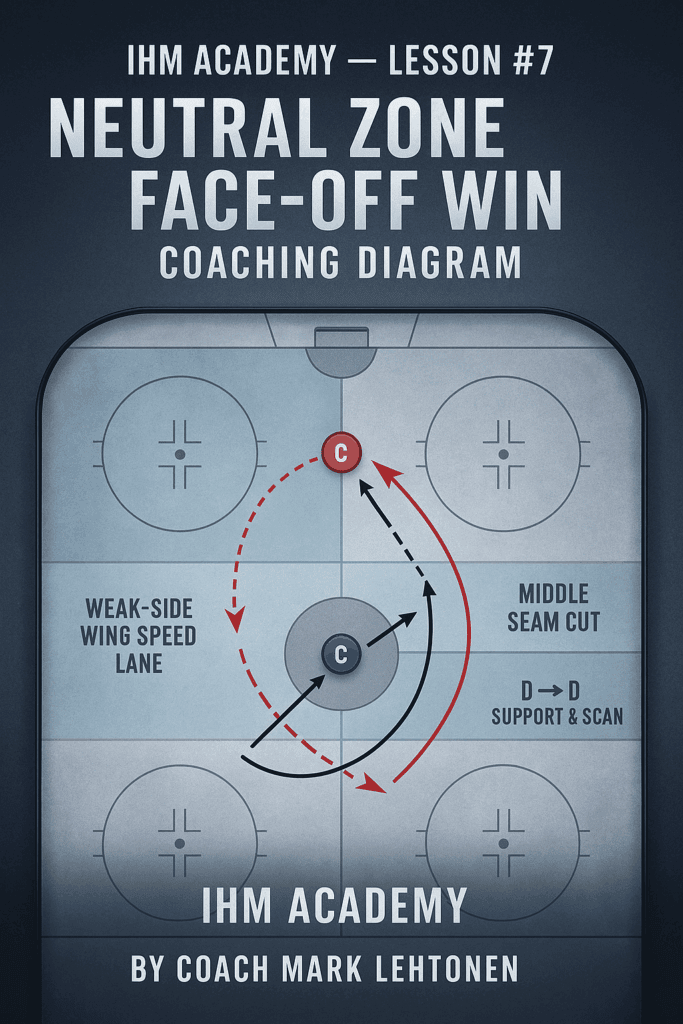
IHM Academy - Lesson #7 Neutral Zone Face-Off Win - Lane Activation & Speed Release

IHM Academy - Lesson #7 · By Coach Mark Lehtonen

Neutral Zone Face-Off Win – Lane Activation & Speed Release

A neutral-zone draw isn’t a reset – it’s an opportunity to strike. At the higher levels, possession off the neutral-zone face-off is one of the most efficient ways to enter with speed and catch opponents in transition. We don’t simply “win it back” – we build lanes and stretch pressure instantly.

Coach Mark Lehtonen explains how to turn neutral-zone face-offs into fast-break scoring opportunities through lane timing and structured release.

Objective

Create confusion for defenders by sending forwards into pre-planned lanes with speed, opening passing seams for a fast controlled entry.

Structure & Timing

  • C wins the puck back with a strong pivot to the inside shoulder.
  • Weak-side wing explodes up-ice into the far-side lane immediately on the drop.
  • Strong-side wing delays half a beat before cutting middle to force defensive switches.
  • D-man receives and scans early – head up, deception, freeze forechecker.
  • Second D supports underneath to reset if pressure comes.

Why It Works

Defenders hate indecision. By sending forwards into different predetermined lanes, we force hesitation:

  • Coverage confusion – who takes the middle cut?
  • Weak-side defender breaks structure
  • Passing seam opens before defensive rotation completes
  • Speed advantage – we move first

Key Teaching Cues

  1. Head up by the D – sell middle, release wide.
  2. Forward timing – first fast, second late cut.
  3. Staggered depth – avoid stacking lanes.
  4. Middle ice threat first – it opens the flank.
  5. Commit to pace – hesitation kills the play.

What Players Must Feel

Neutral-zone face-offs are not “neutral”. We are attacking. The first three strides determine whether we enter with speed or dump and chase. This system punishes slow defensive recognition – we sprint into space before they organize.

Coach Mark Lehtonen says:

“Speed isn’t straight-line – it’s timing. If one forward runs and one delays, the defense has to guess. Every guess we force is a lane we create.”

Summary

Win, separate, stretch – that’s the formula. Controlled entries start with structure. Set lanes, clean timing, strong pivot on the draw, and a defenseman scanning early. Every neutral-zone face-off is a runway – build speed and attack.

Study more tactical entries and timing principles at IHM Academy.