Tag: Power Play

What Is a Minor Penalty in Ice Hockey?

IHM Knowledge Center

What Is a Minor Penalty in Ice Hockey?

What is a minor penalty, how long does it last, and when does it end early?

Editor: Coach Mark • Updated: February 27, 2026

Short Answer

A minor penalty is a two-minute penalty that results in a power play for the opposing team and can end early if a goal is scored.

Full Explanation

A minor penalty is the most common type of penalty in ice hockey. It is assessed for standard infractions such as tripping, hooking, slashing, or interference.

When a minor penalty is called, the offending team plays shorthanded for two minutes. The opposing team receives a power play.

If the team on the power play scores during the two-minute penalty, the minor penalty immediately ends and the penalized player may return to the ice.

If no goal is scored, the full two minutes must be served.

Why Minor Penalties Exist

Minor penalties maintain fairness and discourage illegal actions while keeping the game flowing. They are designed to penalize infractions without removing players for the remainder of the game.

Key Takeaways

  • A minor penalty lasts two minutes.
  • The team plays shorthanded during this time.
  • A goal cancels the minor penalty.
  • It is the most common type of penalty.

What Is a Delayed Penalty in Ice Hockey?

IHM Knowledge Center

What Is a Delayed Penalty in Ice Hockey?

What is a delayed penalty, how does it work, and when does the whistle finally stop play?

Editor: Coach Mark • Updated: February 23, 2026

Short Answer

A delayed penalty occurs when a team commits an infraction, but play continues until the offending team gains possession of the puck.

Full Explanation

When a referee signals a penalty against one team, the official raises an arm to indicate a delayed penalty. Instead of stopping play immediately, the game continues if the non-offending team has possession of the puck.

Play is stopped only when the penalized team gains control of the puck. At that moment, the whistle blows and the penalty is enforced.

During a delayed penalty, the attacking team often pulls its goaltender for an extra skater because the opposing team cannot legally score unless they gain possession.

If the non-offending team scores during the delayed penalty situation, the minor penalty is usually wiped out.

Why Delayed Penalties Exist

This rule prevents a team from benefiting from its own infraction and allows the attacking team to maintain advantage and scoring opportunity.

Key Takeaways

  • The referee signals a delayed penalty with a raised arm.
  • Play continues until the offending team gains possession.
  • The attacking team may pull the goalie for an extra skater.
  • A goal can cancel a minor penalty during the delay.

What Is a Delayed Penalty in Ice Hockey?

IHM Knowledge Center

What Is a Delayed Penalty in Ice Hockey?

What is a delayed penalty, how does it work, and when is play stopped after a referee signals an infraction?

Editor: Coach Mark • Updated: February 11, 2026

Short Answer

A delayed penalty allows play to continue until the penalized team gains possession of the puck, after which the whistle is blown.

Full Explanation

When a referee identifies a penalty against one team, he raises his arm to signal a delayed penalty. Play continues because the non-offending team maintains puck control.

The whistle is blown only when the penalized team gains possession or control of the puck.

During a delayed penalty, the attacking team often pulls their goalie for an extra skater to create a temporary power play situation.

If the attacking team scores before the whistle, the minor penalty is usually cancelled.

Why Delayed Penalties Matter

Delayed penalties reward puck possession and increase scoring pressure, adding strategic depth to power play opportunities.

Key Takeaways

  • Referee signals by raising his arm.
  • Play continues until possession changes.
  • Teams may pull the goalie for advantage.
  • Minor penalties can be cancelled by a goal.

What Is a Power Play in Ice Hockey?

IHM Knowledge Center

What Is a Power Play in Hockey?

What is a power play in hockey, how does it create an advantage, and what determines when it starts and ends?

Editor: Coach Mark • Updated: April 11, 2026

Short Answer

A power play occurs when one team has more players on the ice due to an opponent’s penalty, creating a temporary man advantage.

Full Explanation

A power play is created when a player from one team is sent to the penalty box, forcing that team to play with fewer skaters for a set amount of time.

The opposing team gains a numerical advantage, most commonly 5-on-4, although situations like 5-on-3 can also occur.

This advantage allows the attacking team to control the puck, create space, and generate higher-quality scoring chances.

The power play continues until the penalty time expires or a goal is scored, depending on the type of penalty.

This is closely related to “man advantage hockey”, “penalty box rules hockey”, and “special teams hockey systems”.

How a Power Play Starts and Ends

A power play begins when the referee signals a penalty and the penalized player leaves the ice.

It ends in one of three main ways:

  • The penalty time expires
  • The attacking team scores (for most minor penalties)
  • A new penalty changes the on-ice player balance

Major penalties, however, continue for the full duration even if a goal is scored.

Types of Power Play Situations

Power plays vary depending on the number of players involved:

  • 5-on-4 (standard power play)
  • 5-on-3 (two-player advantage)
  • 4-on-3 (during overtime or coincidental penalties)

Each situation creates different spacing, passing lanes, and tactical setups.

NHL vs IIHF Power Play Differences

Both NHL and IIHF follow the same core rules, but game pace and tactical execution can differ.

NHL power plays often rely heavily on structured formations and quick puck movement, while international play may emphasize more direct shooting and simpler setups.

These differences affect scoring rates and tactical approaches.

Decision & Controversy Layer

Power plays can become controversial due to how penalties are called and interpreted.

Fans often focus on whether a penalty “should have been called,” while referees judge based on rule violations and positioning.

A borderline call can completely change game momentum by creating a power play opportunity.

This leads to debate in “power play penalty calls hockey”, “soft penalty controversy NHL”, and “game changing penalties hockey”.

Edge Case: Simultaneous Penalties and No Power Play

An important edge case occurs when both teams receive penalties at the same time.

In these situations, teams may play 4-on-4 instead of creating a power play, because both sides lose a player equally.

This changes game dynamics completely and removes the expected advantage.

IHM Signal System

Signal: Space Creation vs Defensive Collapse

To understand power plays, focus on how space is created and used:

  • Is the attacking team spreading the defense?
  • Are passing lanes opening between players?
  • Is the defense collapsing toward the net?
  • Is puck movement forcing goalie repositioning?

Trigger-level rule:

If the attacking team maintains controlled puck movement and forces defensive rotation, a high-quality scoring chance will almost always develop.

If puck movement is slow or predictable, the advantage is reduced.

IHM Insight

Most fans think a power play is just about having more players, but the real advantage comes from structure and puck movement.

At the professional level, teams use specific formations to manipulate defensive positioning and create shooting lanes.

A poorly executed power play can look ineffective despite the numerical advantage.

The difference between average and elite teams is how efficiently they convert space into scoring chances.

Mini Q&A: Power Play Explained

  • What creates a power play?
    A penalty that forces the opponent to play with fewer players.
  • Does a power play end after a goal?
    Yes, for most minor penalties.
  • What is a 5-on-3 power play?
    A two-player advantage situation.
  • Can both teams have penalties at the same time?
    Yes, which can cancel out the power play.
  • Why do some power plays fail?
    Due to poor puck movement and lack of structure.

Why This Rule Exists

The power play rewards teams for drawing penalties and enforces discipline by penalizing rule violations with a competitive disadvantage.

Key Takeaways

  • A power play creates a man advantage.
  • It begins after a penalty is called.
  • Structure and puck movement determine success.
  • Not all advantages lead to goals.

What Is a Penalty in Ice Hockey?

IHM Knowledge Center

What Is a Penalty in Ice Hockey?

What is a penalty in ice hockey, why are penalties called, and how do they impact game flow and special teams?

Editor: Coach Mark • Updated: December 12, 2025

Short Answer

A penalty is a rule infraction that results in a player being removed from the ice for a set amount of time, giving the opposing team a power play.

Full Explanation

Penalties are called to enforce fair play and player safety. When a penalty occurs, the offending player serves time in the penalty box while their team plays shorthanded.

Penalties vary in severity and duration depending on the type of infraction. Minor penalties last two minutes, while major penalties last five minutes and often involve more dangerous actions.

During a penalty, the opposing team gains a power-play opportunity, which significantly increases scoring chances due to numerical advantage.

Officials may also assess misconduct penalties for unsportsmanlike behavior, which affect the player but not the team’s on-ice strength.

Why Penalties Matter

Penalties directly influence momentum, fatigue and game outcomes. Strong special teams play is often the difference between winning and losing close games.

Key Takeaways

  • Penalties enforce safety and fair competition.
  • Shorthanded teams play with fewer skaters.
  • Power plays increase scoring probability.
  • Penalty discipline is critical to team success.
Vancouver Canucks 3-5 Winnipeg Jets | IHM Game Recap

Vancouver Canucks 3-5 Winnipeg Jets | IHM Game Recap

Vancouver Canucks 3-5 Winnipeg Jets

Date: November 12, 2025   |   Author: IHM News

Deck: Special teams swung the night – Winnipeg scored twice on the power play and survived a late push before sealing it with an empty-netter.

At Rogers Arena, Winnipeg cooled off Vancouver with a 5-3 road victory built on crisp special-teams execution and a steady night from Connor Hellebuyck (30 saves). The Canucks actually grabbed a brief lead in the first, but a rapid two-goal response from the Jets flipped the script and forced Vancouver to chase. A scoreless second tightened the screws before Winnipeg’s power play struck again early in the third; Brock Boeser’s late goal gave the building life, yet Alex Iafallo hit the empty net to close it out.

How the game flowed

First period: Winnipeg opened through Jansen Harkins/Toews J. (listed as Toews J. on the feed) at 4:57 for 0-1. Vancouver answered at 10:21 via Kiefer Sherwood (1-1), then took a 2-1 edge on a Jay DeBrusk power-play marker at 11:58. Winnipeg answered immediately: Josh Morrissey tied it 2-2 on the PP at 14:38, and Nino Niederreiter pushed the Jets ahead 2-3 at 14:53.

Second period: Tight, heavy sticks and blocked lanes. No scoring; Vancouver switched in net as Kevin Lankinen relieved Thatcher Demko to start the frame.

Third period: Another Winnipeg PP conversion – Gabriel Vilardi made it 2-4 at 0:48. Vancouver kept grinding and Brock Boeser cut it to 3-4 at 18:30. With the Canucks’ net empty, Alex Iafallo finished it off at 19:14 for 3-5.

Numbers box

  • Shots on goal: Vancouver 33, Winnipeg 30
  • Shooting %: VAN 9.09% (3/33), WPG 16.67% (5/30)
  • Power play: VAN 1/2, WPG 2/4 (two key conversions – Morrissey, Vilardi)
  • Blocks: VAN 17, WPG 14
  • Goaltenders: Demko/Lankinen combined 25 saves on 29; Hellebuyck 30/33 (90.9% SV)
  • Penalties (min): VAN 4 (8), WPG 2 (4)
  • Game-winners: Vilardi PP early 3rd proved decisive; Iafallo EN sealed it

Team notes

  • Jets: Top unit moved the puck quickly through the flank and bumper; Morrissey’s one-touch timing dismantled Vancouver’s box. Hellebuyck was tidy on screens and tips.
  • Canucks: First-period push was strong, but the parade to the box in the opening frame ceded momentum. Boeser continues to be the late-game threat.

Coach Mark comment

Winnipeg won the situational minutes – goals inside 2-3 shifts of swings, especially after Vancouver’s PP marker. Morrissey controlled the weak-side seam, and Vilardi’s inside-lane timing on the third-period PP is tape-to-teach. Vancouver’s PK spacing got stretched east-west; that’s the clip they’ll work on before the next one.

Questions & Answers | IHM Performance Metrics

Q: What was the turning point?
A: The 15-second, two-goal reply in the first (Morrissey PPG, then Niederreiter 5-on-5) flipped score effects and forced Vancouver to chase.

Q: Why did the Jets’ power play work?
A: Quick puck speed through the flank to the point, Morrissey shooting without dusting it, and Vilardi arriving to the slot line on time.

Q: Did Vancouver deserve more at 5-on-5?
A: They edged shots 33-30 and zone time was fine, but Winnipeg owned the high-leverage sequences (special teams + goalie saves).

Q: Goalie edge?
A: Hellebuyck’s 30/33 with strong rebound control vs. a Canucks tandem at 25/29; that’s the difference in a one-goal game before the EN.

Q: Any lineup nuggets?
A: Jets’ top pair (Morrissey-DeMelo) handled the heavy minutes; Boeser’s line generated Vancouver’s late push and should stay intact.

More NHL news on IHM


Colorado Avalanche 4-1 Anaheim Ducks - Finished | IHM Game Recap

Colorado Avalanche 4-1 Anaheim Ducks | IHM Game Recap

Colorado Avalanche 4-1 Anaheim Ducks

November 12, 2025 – Author: IHM News

Wedgewood turns away 35 shots; Necas nets the dagger on the power play as Colorado controls the third.

Colorado snapped out quickly and never really let go, beating the Anaheim Ducks 4-1 at home after a wire-to-wire, shot-heavy night. Artturi Lehkonen scored 28 seconds in, Gabriel Landeskog restored the lead in the second, and Martin Necas delivered the key third-period power-play strike before an empty-netter sealed it. Scott Wedgewood handled the rest with a composed 35-save performance, outdueling Lukas Dostal as the Avalanche managed special teams and game state down the stretch.

How it happened

First period – 1-1. Colorado set the tone immediately: Lehkonen finished from the slot at 00:28 off touches from Nathan MacKinnon and Cale Makar. Anaheim answered late when Leo Carlsson tied it 1-1 at 18:16, capping a greasy sequence around the crease. The frame also featured a parade of minors that foreshadowed a special-teams-tilted night.

Second period – 2-1 COL. With the game tightening, the Avalanche leaned on their forecheck and blue-line activation. Gabriel Landeskog snapped the 1-1 deadlock at 11:37, finishing a feed from Valeri Nichushkin with defenseman Sam Malinski jumping into the play.

Third period – Avalanche close the door. A delay-of-game minor put Anaheim under pressure, and Colorado cashed: Necas ripped the PPG at 07:02 (Lehkonen, MacKinnon) for a crucial two-goal cushion. With Dostal pulled, Parker Kelly iced it into the empty net at 17:39 (MacKinnon, Nelson). From there, Wedgewood’s structure-clean lanes, square on first shots-did the rest.

Numbers Box

  • Shots on goal: COL 36, ANA 36
  • Shots off target: COL 15, ANA 9
  • Shooting %: COL 11.11% (4/36), ANA 2.78% (1/36)
  • Blocked shots: COL 19, ANA 13
  • Goalie saves: Wedgewood (COL) 35/36 – 97.22%; Dostal (ANA) 32/36 – 91.43%
  • Penalties: COL 3, ANA 5
  • PIM: COL 6, ANA 10
  • Power play: COL 1/5, ANA 0/3
  • Notable: Lehkonen GWG + 2-point night; MacKinnon 2 A; Necas PPG; Colorado wins the special-teams battle.

Team Notes

  • Colorado: Fast start metric matters-Lehkonen’s first-minute goal set the ice tilt. Blue line activation (Makar/Toews/Malinski) drove the middle frame.
  • Anaheim: Created volume (36 SOG) but struggled to get interior looks; 0-for-4 on the power play proved costly.

Coach Mark Comment

Colorado’s neutral-zone work funneled Anaheim outside and protected the slot. The third-period detail on the PP was clinical- quick puck speed, middle-lane presence, and a one-touch finish from Necas. Wedgewood’s reads were calm, especially on east-west.

Questions & Answers | IHM Performance Metrics

Q1: What was the true separator at 5-on-5?

A: Colorado’s controlled exits and layered entries-defenseman activation plus F3 discipline-tilted possession even with shots equal.

Q2: How did special teams impact the result?

A: The Avalanche went 1/4 and denied Anaheim on all four attempts; the single PPG arrived at a clutch game state to make it 3-1.

Q3: Which matchup mattered most?

A: MacKinnon’s line versus Anaheim’s top six; Colorado generated interior touches and drew the key penalty that led to the dagger.

Q4: Goalie edge?

A: Wedgewood (97.22% SV) out-performed Dostal (91.43%), particularly on first-chance looks from the dots.

Q5: What’s the takeaway for the next meeting?

A: If Anaheim doesn’t win the net-front and PP entries, Colorado’s pace and blue-line support will keep dictating shot quality.

More NHL news on IHM


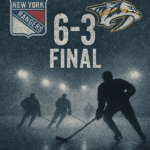
New York Rangers 6-3 Nashville Predators | Game Recap | IHM News

New York Rangers 6-3 Nashville Predators | Game Recap | IHM News

New York Rangers 6-3 Nashville Predators

Date: November 11, 2025
Author: IHM News

Rangers Finally Win at Home, Snap Franchise-Worst Streak

The New York Rangers erupted for six goals at Madison Square Garden, snapping a franchise-worst seven-game home losing streak and earning a much-needed 6-3 win over the Nashville Predators. Artemi Panarin struck twice, Alexis Lafreniere fueled the offense with a multipoint night, and rookie Gabe Perreault collected his first NHL point as the Rangers rediscovered rhythm on home ice. For Nashville, Matthew Wood’s first career NHL hat trick wasn’t enough to offset defensive breakdowns and inconsistent goaltending.

Rangers Take Control Early

Mika Zibanejad opened the scoring at 10:39 of the first period, breaking a long home scoring drought for New York. Although Matthew Wood tied the game on a power play, Vladislav Gavrikov restored the lead late in the period with a quick strike that lifted the building and set momentum in the Rangers’ favor.

Second Period Surge Breaks Nashville

New York struck three times in the middle frame, showcasing pace, puck movement, and confidence that had been missing in previous home losses. Lafreniere sliced through the defense for a power-play goal, Panarin blasted a one-timer through Juuse Saros, and Will Cuylle finished a clean 3-on-2 rush to make it 5-1.

Predators Push Late but Fall Short

Wood completed his hat trick with two more power-play markers in the third period, but the Rangers countered quickly. Panarin banked a sharp-angle shot off a defender and in, stopping any Nashville comeback hopes and sealing New York’s first home victory of the season.

Numbers Box

  • Shots on Goal: Rangers 18, Predators 30
  • Power Play: Rangers 1/2, Predators 2/4
  • Goalies: Shesterkin 27 saves; Saros 7 saves on 12 shots; Annunen 5 saves
  • Notable: Wood’s first NHL hat trick; Perreault first NHL point; Rangers snap 0-6-1 home start

Coach Mark Comment

Rangers finally built a layered offensive game at home. Their pace through the neutral zone and quick-touch plays on entries created high-quality looks. The Predators generated on special teams, but their five-on-five structure broke too often. New York needed belief, and tonight’s execution gave them that.

Questions & Answers | IHM Performance Metrics

Why did the Rangers’ offense break through tonight?
They attacked in waves, supported entries better, and finally converted on Grade-A chances.

How much did Trocheck’s return matter?
His presence stabilized matchups, improved faceoffs, and lifted the entire top six emotionally.

Was Nashville’s loss mostly goaltending?
Saros struggled, but defensive gaps and failed clears played a larger role.

Is Wood’s hat trick a sign of long-term breakout?
The tools are real – shot, timing, positioning – but the Predators need more team cohesion to sustain his production.

What’s next?
Nashville travels to Stockholm for the Global Series; Rangers aim to build momentum at home.

More NHL coverage available now on IHM.


Vancouver Falls 4-5 to Colorado in Overtime | NHL Recap | IHM News

Vancouver Falls 4-5 to Colorado in Overtime | NHL Recap | IHM News

Vancouver Canucks 4-5 Colorado Avalanche (OT)

Date: November 10, 2025
Author: IHM News

Vancouver Falls 4-5 to Colorado in Overtime | NHL Recap

Vancouver Falls 4-5 to Colorado in Overtime | NHL Recap | IHM News

The Colorado Avalanche escaped Rogers Arena with a 5-4 overtime win after a chaotic, momentum-swinging game that featured elite finishing, defensive breakdowns, and special-teams volatility. Vancouver erased a two-goal deficit twice, forcing overtime with a late power-play goal, but Colorado’s skill core delivered when it mattered most.

Nathan MacKinnon powered the Avalanche with a dominant performance, scoring twice in the first period – including a power-play blast – and adding multiple primary contributions across all zones. Vancouver responded with structured pressure and opportunistic scoring, solving Colorado’s defensive coverage in the second and third periods.

Game Flow

MacKinnon opened the scoring at 6:41 of the first period on a setup from Nichushkin and Makar, beating Lankinen cleanly from distance. He struck again at 8:10 on the power play, firing home a rebound after strong puck circulation from Olofsson and Nichushkin.

Vancouver cut the deficit to 2-1 at 11:47 when Leo Karlsson converted a rebound created by Hronek and Kane. Early in the second period, Kiefer Sherwood tied the game 2-2 at 1:44 by capitalizing on a loose puck around the crease.

Colorado regained the lead 3-2 at 0:28 of the third when Artturi Lehkonen cleaned up a rebound created through net-drive pressure from Burns and MacKinnon. Vancouver answered shorthanded at 7:26 when O’Connor jumped on a turnover and beat Blackwood to tie it 3-3.

Lehkonen struck again at 9:47 on the power play, finishing a crisp passing sequence from Necas and MacKinnon. But Vancouver refused to go away – Jake DeBrusk hammered home a power-play equalizer at 16:59, with Boeser and Hughes setting up a perfect shooting lane.

In overtime, Colorado sealed the win quickly. Gavin Brindley scored just 1:08 into the extra frame off a feed from Makar and MacKinnon, giving the Avalanche a hard-earned 5-4 victory on the road.

Numbers Box

  • Shots on Goal: VAN 33, COL 33
  • Shots off Target: VAN 22, COL 13
  • Blocked Shots: VAN 13, COL 18
  • Goalie Saves: Lankinen 28/33 (84.8%), Blackwood 29/33 (87.9%)
  • Penalties: VAN 3, COL 5
  • PIM: VAN 6, COL 10
  • Power Play: VAN 1/5, COL 2/3 (based on shown scoring events: MacKinnon PPG, Lehkonen PPG x2, DeBrusk PPG)
  • Notable: MacKinnon 2G, Lehkonen 2G (including PPG), DeBrusk SHG + PPG, Brindley OT winner

Coach Mark Comment

MacKinnon drove the entire game with pace and control. Colorado’s power-play puck movement was sharp, and Lehkonen’s timing around the crease created consistent problems. Vancouver showed real fight, but their defensive detail in overtime cost them.

Questions & Answers | IHM Performance Metrics

Why did Colorado control the key moments?

Their top line generated the highest-danger touches, and their puck retrievals on the power play kept pressure sustained. MacKinnon dictated tempo every shift.

How did Vancouver stay in the game despite defensive issues?

Their transition counters were efficient, and they capitalized on Colorado turnovers. The shorthanded goal was a major momentum swing.

What made Lehkonen so impactful?

His crease positioning and timing off MacKinnon’s entries created repeat scoring chances. He won most of the inside-lane battles.

What ultimately decided the OT?

Colorado won the opening faceoff, gained clean entry, and used a quick rotation to isolate space for Brindley. Vancouver never touched the puck.

More NHL news and updates on IHM.


Anaheim Ducks 4-1 Winnipeg Jets | IHM Game Recap

Anaheim Ducks 4-1 Winnipeg Jets | IHM Game Recap

Anaheim Ducks 4-1 Winnipeg Jets

Date: November 10, 2025
Author: IHM News

Ducks dominate Jets with special-teams precision, extend home momentum

Anaheim delivered another composed, structured home performance, beating the Winnipeg Jets 4-1 behind two power-play goals from Leo Carlsson and a standout all-situations night from rookie Beckett Sennecke. Winnipeg generated a shot edge but struggled to break Anaheim’s layered defensive zone reads, while Lukas Dostal delivered calm, technically precise goaltending to steady the Ducks throughout.

Game Flow

1st Period: Anaheim controlled pace early and struck first at 07:18 when Beckett Sennecke buried a rebound created through Corey Gauthier’s entry pressure. Physicality ramped up, but the Ducks kept composure. At 19:03, Carlsson doubled the lead on the power play, snapping a one-timer off a crisp Terry-to-Kreider passing rotation for 2-0.

2nd Period: Winnipeg responded quickly at 04:22 through Kyle Connor, finishing off a Morrissey-Scheifele sequence. Anaheim stabilized fast, and Sennecke answered at 11:48 with his second of the night after controlled middle-lane support from McTavish and Gauthier, restoring a 3-1 lead.

3rd Period: Early in the period at 02:46, Carlsson struck again on the power play, timing the weak-side seam perfectly for 4-1. Winnipeg thought they pulled one back at 19:13, but a successful goalie-interference challenge overturned the goal. Anaheim closed out confidently.

Numbers Box

  • Shots on Goal: ANA 21, WPG 24
  • Shots off Target: ANA 23, WPG 19
  • Power Play: ANA 2/4, WPG 0/4
  • Blocked Shots: ANA 15, WPG 14
  • Saves: Dostal 23/24 (95.8%), Comrie 16/20 (80%)
  • PIM: ANA 8, WPG 8
  • Notable: Sennecke 2G, Carlsson 2 PPG goals, Ducks win special-teams battle

Coach Mark Comment

Carlsson’s timing on the power play keeps getting better. Sennecke showed real poise in tight areas, and Anaheim’s defensive reads were simple but effective. When the Ducks control their neutral-zone tempo like this, they’re difficult to break.

Questions & Answers | IHM Performance Metrics

Why did Anaheim control this matchup?

Their special teams dictated pace, and their neutral-zone layers forced Winnipeg into predictable entries. Dostal handled the rest.

What stood out about Beckett Sennecke’s performance?

His goal-scoring came from smart support routes and quick-release positioning. He consistently attacked inside ice.

How did Winnipeg generate more shots but fewer dangerous chances?

Anaheim kept most attempts to the perimeter. Jets lacked sustained slot penetration, especially at even strength.

What made Carlsson’s power-play goals possible?

Elite timing, clean east-west puck rotation, and Winnipeg’s passive penalty-kill spacing.

Is Anaheim’s home performance trend sustainable?

Yes. Their defensive structure and transition clarity hold up well against most opponents.

More NHL news available on IHM.