Tag: icehockey world

Global ice hockey coverage with analysis of major leagues, international tournaments, and emerging talents. From the NHL to European leagues, our insights connect fans with the latest trends, strategies, and stories shaping the world of hockey.

NHL Daily Recap - November 23, 2025 | IHM News

NHL Recap - 23 November 2025 | IHM News

NHL Recap - 23 November 2025

Date: November 23, 2025 Author: IHM News

Quick tactical recap of last night’s NHL slate. Home teams are listed first, road teams second, following the official game order.

Florida Panthers 3 – 6 Edmonton Oilers

Edmonton overwhelmed Florida with pace and direct attacking through the middle of the ice. The Oilers consistently generated rush chances off broken plays and punished every turnover at the offensive blue line. Florida’s defensive gaps were too soft, allowing Edmonton’s forwards to enter with control and attack off the delay. Special teams tilted the momentum heavily towards the Oilers in the middle frame and the Panthers never fully recovered.

Montreal Canadiens 5 – 2 Toronto Maple Leafs

Montreal outworked Toronto in all three zones and dictated the tempo with an aggressive forecheck. The Canadiens forced repeated turnovers on Toronto’s breakouts and cycled the puck deep, stretching the Leafs’ defensive structure. Montreal’s power play was sharp, using quick puck movement into the bumper and weak-side seams, while Toronto’s top-end skill was kept mostly to the perimeter. Goaltending support for Montreal was steady, controlling rebounds and limiting second-chance opportunities.

Philadelphia Flyers 6 – 3 New Jersey Devilss

Philadelphia turned this into a physical, grinding game and New Jersey never looked comfortable. The Flyers created offense from a strong neutral-zone trap, picking off passes and countering quickly with numbers. Devils’ entries were often one-and-done, as Philly’s defensive layers closed the middle and forced low-percentage shots from the outside. Flyers’ depth scoring stepped up, and their net-front presence made life very difficult for the Devils’ goaltender.

Pittsburgh Penguins 2 – 3 Seattle Kraken (AOT)

Pittsburgh controlled long stretches of puck possession but failed to convert extended zone time into a decisive lead. Seattle stayed patient, tightened their defensive zone coverage and grew into the game in the third period. The Kraken’s forecheck became more disruptive, forcing the Penguins to defend on tired legs. In overtime, Seattle’s puck support and clean 3-on-3 rotations opened space for the game-winner, capping off a disciplined road performance.

San Jose Sharks 2 – 3 Ottawa Senators

Ottawa managed the game with smart puck management and quick transitions. The Senators were sharper on retrievals and more efficient through the neutral zone, turning simple north-south plays into quality entries. San Jose showed flashes of offense but struggled to string together sustained pressure shifts. Ottawa’s defensive structure protected the middle of the ice late in the third, closing down San Jose’s push and securing a solid road win.

Washington Capitals 3 – 5 Tampa Bay Lightning

Tampa Bay exposed Washington’s defensive coverage with speed and sharp east-west puck movement. The Lightning repeatedly attacked off the rush, forcing Capitals defenders to pivot and chase. Washington generated some offence through set plays and point shots, but their defensive structure around the slot broke down too often. Tampa’s top-end talent dictated the game on the power play and at even strength, with Washington chasing the scoreline for most of the night.

Nashville Predators 0 – 3 Colorado Avalanche

Colorado delivered a professional, controlled road performance. The Avalanche owned the puck in transition, exiting cleanly and re-entering with full control, which kept Nashville pinned in their zone for long stretches. Predators struggled to generate high-danger looks, with most of their attempts coming from the outside. Colorado’s goaltender handled the limited traffic with confidence, completing the shutout as the Avs closed the game with mature puck management.

Utah Mammoth 3 – 2 New York Rangers

Utah produced one of the surprise results of the night by combining disciplined defensive play with opportunistic finishing. The Rangers drove possession and shot volume but struggled to break down Utah’s compact box in front of the net. Mammoth capitalized on their key scoring chances, including off a broken play in the slot, and relied on strong goaltending to protect the lead late. New York’s push in the final minutes lacked the final touch around the crease.

Anaheim Ducks 4 – 3 Vegas Golden Knights (AOT)

Anaheim showed real resilience to edge Vegas in overtime. The Ducks mixed a younger, high-energy forecheck with structured layers in the neutral zone to slow down the Golden Knights’ transition. Vegas still generated quality looks, but Anaheim’s counterattacks were dangerous all night. In extra time, the Ducks executed a clean 3-on-3 pattern, using speed wide to stretch coverage before finishing the decisive chance.

Calgary Flames 3 – 2 Dallas Stars (Pen)

Calgary and Dallas played a tight, structured game with both teams limiting clean looks from the slot. Flames focused on strong board battles and simple, direct plays to the net, while the Stars leaned on their transition game and puck support through the middle. Neither side could find a winner in extra time, and Calgary eventually prevailed in the shootout, with their shooters showing more composure in the decisive attempts.

Questions & Answers | IHM Performance Metrics

Florida Panthers - Edmonton Oilers
Q: Why did Edmonton win so convincingly in Florida?
A: They dominated transition play and punished Florida’s blue-line mistakes.

Montreal Canadiens - Toronto Maple Leafs
Q: What was the key factor in Montreal’s win over Toronto?
A: Relentless forechecking and pressure on Toronto’s breakouts.

Philadelphia Flyers - New Jersey Devils
Q: Why did the Flyers dismantle the Devils?
A: Superior neutral-zone control and goals off quick transition rushes.

Pittsburgh Penguins - Seattle Kraken
Q: What decided the outcome of this game?
A: Seattle’s more disciplined third period and execution in OT.

San Jose Sharks - Ottawa Senators
Q: What helped Ottawa secure the win?
A: Quick exits and smart late-game management.

Washington Capitals - Tampa Bay Lightning
Q: Why did Washington lose to Tampa Bay?
A: Defensive speed issues and repeated slot coverage failures.

Nashville Predators - Colorado Avalanche
Q: What was the key to Colorado’s shutout?
A: Total transition control and limiting Nashville’s dangerous looks.

Utah Mammoth - New York Rangers
Q: How did Utah beat the Rangers?
A: Strong defensive structure and timely goaltending.

Anaheim Ducks - Vegas Golden Knights
Q: How did Anaheim take it in overtime?
A: Aggressive OT energy and precise finishing.

Calgary Flames - Dallas Stars
Q: Why did Calgary win in the shootout?
A: More composed execution in the shootout attempts.

Coach Mark

Montreal and Colorado delivered the most controlled team performances on this slate. Utah’s win over the Rangers stands out as a discipline-and-goaltending result, while Washington will not be happy with their defensive details against Tampa Bay.


NHL Game Day Recap - November 21, 2025 | IHM News

NHL Game Day Recap – November 21, 2025 | IHM News

November 21, 2025 – Author: IHM News

NHL Game Day Recap: Capitals, Avalanche and Stars Headline Busy Slate

The Islanders’ shutout in Detroit, Washington’s eight-goal outburst in Montreal and Colorado’s third-period surge against the Rangers highlighted a night where contenders flexed and a few underdogs stole extra points.

A full NHL schedule delivered just about everything on November 21 – statement wins from offensive powerhouses, tense overtime finishes and another reminder that no lead is safe in today’s speed-driven league. On Long Island, New York completely suffocated Detroit in a one-sided shutout. In Montreal, the Capitals turned a road game into a track meet, piling up eight goals and exposing every crack in the Canadiens’ defensive structure. Out West, Colorado blew open a tight contest against the Rangers with a dominant third period in Denver, while Dallas and Seattle both grabbed important road victories to keep their early-season pushes on track. Here’s how the entire game day unfolded through the IHM lens.

Detroit Red Wings 0-5 New York Islanders

The Islanders delivered a clinic in structured road hockey, locking down the neutral zone and denying Detroit clean entries for most of the night. New York’s forecheck forced turnovers, fed a steady flow of chances off the cycle and slowly tilted the ice until the score line reflected their control. Detroit never found a counter to the Islanders’ layered support and finished the game chasing the puck and the scoreboard.

Florida Panthers 1-0 New Jersey Devils

Florida ground out a low-event win that looked more like a playoff chess match than a regular-season tilt. The Panthers kept New Jersey to the outside, packed the slot and trusted their goaltender behind a tight five-man box. One breakthrough was enough, and the Panthers’ ability to close out a one-goal game against a fast Devils team is an encouraging benchmark for their defensive identity.

Montreal Canadiens 4-8 Washington Capitals

Washington turned a road stop in Montreal into an offensive showcase, slicing through the Canadiens’ coverage with quick puck movement and east-west seams. The Capitals’ power play repeatedly stretched Montreal’s penalty kill, forcing long changes and generating second-chance looks around the crease. For the Canadiens, the night was a step back in terms of defensive structure, as gap control and box discipline broke down under sustained pressure.

Philadelphia Flyers 3-2 St. Louis Blues (AOT)

In Philadelphia, the Flyers and Blues traded heavy shifts and layered point shots in a game that felt like classic grind-it-out hockey. St. Louis responded well whenever the Flyers pushed, but Philadelphia’s resilience in the third period set the stage for the overtime winner. Extra-time execution – clean possession on the 3-on-3 and a composed finish off the rush – ultimately separated the teams.

Toronto Maple Leafs 2-3 Columbus Blue Jackets (AOT)

Toronto carried long stretches of puck control but struggled to turn zone time into truly dangerous looks, especially in the middle frame. Columbus stayed patient, collapsed to the slot and waited for transition opportunities, using their speed to attack space behind the Leafs’ pinching defenders. In overtime, that patience paid off as the Blue Jackets capitalized on a breakdown to escape with a hard-earned road victory.

Tampa Bay Lightning 2-1 Edmonton Oilers (AOT)

The Lightning and Oilers played a tighter game than the score might suggest, with both teams trading quality looks off controlled entries. Tampa Bay’s defensive layers around the blue paint minimized Edmonton’s second chances, even when the Oilers generated clean rushes through the neutral zone. In OT, the Lightning’s veteran core managed the puck effectively, circling to change matchups before striking on a clean scoring chance.

Chicago Blackhawks 2-3 Seattle Kraken

Seattle went into Chicago and earned two points by sticking to their depth-driven identity, rolling four lines and chipping pucks behind the Blackhawks’ defense. Chicago generated spurts of pressure, but the Kraken’s backchecking and support through the middle of the ice limited odd-man rushes the other way. A composed third period – with simple, direct hockey and strong wall plays – allowed Seattle to protect their advantage on the road.

Colorado Avalanche 6-3 New York Rangers

In Denver, Colorado turned a tight game against the Rangers into a third-period avalanche, scoring four times in the final frame to blow the contest open. New York struck early on the power play, but once the Avalanche found their rhythm, their puck speed and offensive layers were simply too much to contain. Colorado’s top players drove the pace, attacking off the rush and then re-loading high in the zone to create repeat pressure shifts that wore down the Rangers’ structure.

Utah Mammoth 1-4 Vegas Golden Knights

Vegas delivered a professional road performance against Utah, gradually imposing their five-man support game in all three zones. The Golden Knights’ neutral-zone gaps disrupted Utah’s attempts to build controlled exits, feeding quick counterattacks and extended offensive-zone sequences. Special teams and goaltending both leaned heavily in Vegas’ favour, turning a competitive opening into a comfortable multi-goal win by the final horn.

Anaheim Ducks 2-3 Ottawa Senators

The Ducks and Senators played one of the night’s more chaotic games, with momentum swinging dramatically through the second period. Anaheim erased an early deficit and briefly grabbed the lead, but discipline issues gave Ottawa the power-play windows they needed to respond. A third-period push from the Ducks fell just short as the Senators locked into a more compact defensive shell and closed out a narrow road victory.

San Jose Sharks 4-3 Los Angeles Kings (Pen)

San Jose showed real character against the Kings, matching Los Angeles’ structured approach with a harder, more competitive game in the dirty areas. The Sharks survived sustained Kings pressure at five-on-five and capitalized on key moments to keep the game within reach through sixty minutes and overtime. In the shootout, San Jose’s shooters displayed more poise, while their goaltender tracked the puck well and out-waited Los Angeles’ attempts to deke.

Vancouver Canucks 2-4 Dallas Stars

Dallas closed the night with a strong road win in Vancouver, leveraging their deep forward group and mobile blue line to control tempo. The Stars attacked Vancouver’s defensive gaps with width – spreading the ice, using late trailers and forcing the Canucks into constant rotation in their own zone. A disciplined third period, with smart puck placement and strong support below the goal line, allowed Dallas to protect their two-goal advantage and finish the trip on a high note.

Key numbers from the slate

  • 3 games decided beyond regulation: Flyers vs Blues, Maple Leafs vs Blue Jackets and Lightning vs Oilers, plus a shootout in Sharks vs Kings.
  • 19 combined goals scored by the Islanders, Capitals and Avalanche in three statement wins.
  • 2 shutout-style defensive performances: the Islanders blanking Detroit and Florida holding New Jersey to a single goal in a tight contest.
  • 4 third-period goals for Colorado to turn a 2-2 game against the Rangers into a 6-3 Avalanche win.
  • Road teams came away with crucial points in Anaheim, Utah, Chicago and Vancouver, underscoring how slim the margins are in the modern NHL.

Coach Mark comment

From a coaching standpoint this game day was all about how quickly momentum can flip when structure slips. The teams that stayed connected in all three zones – especially Colorado, Washington and Dallas – were rewarded with big wins, while clubs that lost their shape got punished on the scoreboard. It is another reminder that in today’s NHL you need disciplined five-man support and smart puck management for the full sixty minutes, not just good moments.

Questions & Answers | IHM Performance Metrics

Which win felt most “statement-like” from a contender?
Colorado’s 6-3 home victory over the Rangers stands out. Turning a tight game into a four-goal third-period surge shows how explosive their top end remains when they execute their transition game.

What was the most concerning result for a home team?
Montreal giving up eight at home to Washington raises red flags. Allowing that level of east-west passing and slot access suggests systemic issues in D-zone coverage, not just an off night.

Did any underdogs steal points with structure rather than pure talent?
Columbus fits that description. The Blue Jackets leaned on a compact defensive shell, accepted extended Leafs zone time and then attacked in transition, eventually converting in overtime.

What does this slate tell us about special teams trends?
Several games – Anaheim vs Ottawa, Montreal vs Washington, Colorado vs New York – turned on power-play moments and discipline. Teams that stayed out of the box or controlled entries on the penalty kill were able to stabilize games when 5-on-5 momentum dipped.

Which theme should bettors-agnostic fans watch going forward?
Focus on how well teams protect the middle of the ice late in games. Third-period goals and comeback patterns tonight showed that whoever owns the slot and net-front in the final ten minutes usually owns the result.

For more in-depth tactical breakdowns and daily coverage, visit IceHockeyMan – NHL News & Insights. More NHL news on IHM.


Utah Mammoth 2-3 New York Islanders (OT) - NHL Game Recap | IHM News

Utah Mammoth 2-3 New York Islanders (OT) – NHL Game Recap | IHM News

Utah Mammoth 2-3 New York Islanders (OT)

November 15, 2025 - Author: IHM News

Utah Mammoth 2-3 New York Islanders (OT) - NHL Game Recap | IHM News

New York escapes Salt Lake City with a 2-3 overtime win, powered by elite goaltending, timely special-teams execution and a composed finish from Schaefer just 2:06 into OT. Utah controlled large stretches of play, but discipline issues and missed conversion chances cost them a statement home win.

How the Game Unfolded

First period: Utah started aggressively, drawing momentum from early puck pressure and winning most puck races. Peterka tied the game 1-1 after Heineman opened the scoring for New York, and Guenther’s power-play marker pushed Utah ahead 2-1 after a sharp rotation sequence (low-to-high switch creating a shooting lane). However, the Mammoth also took three first-period minors that invited dangerous NYI pressure.

Second period: A grinding, tactical 20 minutes with both teams trading zone time but no scoring. Utah’s penalty kill was excellent during this stretch, forcing Islanders entries into the boards and breaking up their 1-3-1 setup before it could settle.

Third period: The turning point came at 13:44 when Drouin tied it 2-2 during a chaotic net-front sequence. Utah’s penalty trouble escalated again, stacking minors that drained momentum and left their top pair exhausted.

Overtime: Islanders struck quickly – Barzal won the opening puck touch, created a controlled entry, and Schaefer finished the sequence from the slot for the 3-2 winner.

Numbers Box

  • Shots on goal: Utah 29, New York 22
  • Shots off target: Utah 19, New York 16
  • Shooting %: Utah 6.9%, NYI 13.64%
  • Blocked shots: Utah 11, NYI 20
  • Goalie saves: Vejmelka 19, Rittich 27
  • Penalties: Utah 4, NYI 7
  • PIM: Utah 8, NYI 22

Team Notes

Utah: Strong transition game but discipline issues erased momentum and forced heavy minutes on their PK rotation. New York: Excellent defensive commitment, especially in the third period with 12 blocks.

Coach Mark comment

Utah had the structure to win this game, but discipline destroyed their flow. New York showed veteran composure – they managed fatigue well and executed their systems during key moments. Utah’s special teams need to settle down; the base is strong.

Questions & Answers | IHM Performance Metrics

Q: Did Utah outplay New York at even strength?
A: Yes. Utah generated more controlled entries and higher expected shot volume but failed to convert.

Q: What changed in overtime?
A: NYI executed a clean 3-man weave entry, while Utah lost their lane assignment on the first transition.

Q: Was goaltending the deciding factor?
A: Rittich’s 27 saves at 93.1% were game-saving, especially late in the third.

Q: Did penalties drive the outcome?
A: Absolutely. Utah’s stacked minors in P1 and P3 shifted momentum directly into NYI scoring moments.

Q: How does this impact standings?
A: Utah misses a valuable point in a tight wildcard race, while NYI gain separation.

More NHL news on IHM.


NHL Recaps - IHM News

NHL Recaps (Nov 14, 2025): 6 Games - IHM News

NHL Recaps – Six Games (14 November)

Date: 14 November 2025
Author: IHM News


Detroit Red Wings 6-3 Anaheim Ducks – Detroit Controls Every Phase

Detroit delivered a structured and high-tempo performance, overwhelming Anaheim with sustained zone pressure and fast transition play. The Red Wings turned the game early through aggressive forecheck rotations and precise puck recoveries, forcing Anaheim into constant defensive scrambling.

Anaheim created isolated bursts of offense but couldn’t consistently break through Detroit’s layered defensive posture. The Red Wings capitalised on nearly every Ducks’ turnover, widening the gap in the second half of the match.

Final Score: Detroit Red Wings 6, Anaheim Ducks 3

Coach Mark’s take

Detroit finally played to their roster identity. Their top four on defence pushed the pace, the first line owned the middle of the ice, and special teams gave them separation. When DeBrincat is attacking downhill and Larkin is driving the forecheck like this, the Red Wings are a very difficult out.


Florida Panthers 6-3 Washington Capitals – Panthers Too Explosive

Florida once again leaned on their elite shot creation and heavy-cycle dominance. Washington kept the pace early, but as soon as Florida settled into their controlled offensive zone sets, the Capitals’ defensive coverage broke down repeatedly.

The Panthers executed high-slot rotations with precision, generating continuous Grade-A looks. Washington produced pushback but couldn’t match the sheer offensive volume and puck-possession superiority Florida established through the final 40 minutes.

Final Score: Florida Panthers 6, Washington Capitals 3

Coach Mark’s take

This is what a mature contender looks like. Florida didn’t need to be spectacular; they just squeezed Washington in every zone. Marchand’s milestone is the headline, but the real story is how ruthlessly the Panthers manage risk when they have a lead.


Montreal Canadiens 0-7 Dallas Stars – Total Domination

Dallas delivered one of the most one-sided performances of the season. Their structured neutral-zone trap neutralised every Montreal entry attempt, while the Stars’ own transition game shredded the Canadiens’ defensive spacing.

Montreal never established rhythm. Dallas controlled possession, tempo and physicality, converting chances at an elite rate and shutting out Montreal with suffocating defensive layers.

Final Score: Montreal Canadiens 0, Dallas Stars 7

Coach Mark’s take

Dallas looked like a team in full control of its identity: heavy on pucks, patient with the puck, ruthless in front of the net. When their top line is humming and the defence moves the puck this cleanly, few teams can live with their tempo.


Ottawa Senators 5-3 Boston Bruins – Ottawa Wins the Tactical Battle

Ottawa played one of their cleanest games of the season, dictating offensive pace with sharp puck movement and decisive entries. Boston kept the game close, especially in the second period, but Ottawa consistently responded with structured counterattacks.

The Senators generated high-quality looks off broken plays and neutral-zone turnovers. Boston’s late push was energetic but insufficient against Ottawa’s disciplined closing structure.

Final Score: Ottawa Senators 5, Boston Bruins 3

Coach Mark’s take

This is the blueprint for Ottawa if they want to push into the playoff conversation. They used their speed advantage, trusted the puck through the middle, and didn’t panic after an early punch from Boston. Stutzle, again, looks like a true first-line centre.


Toronto Maple Leafs 3-4 Los Angeles Kings (AOT) – Kings Survive in Overtime

This matchup was a high-tempo contest defined by transitional bursts and rapid-fire momentum swings. Toronto matched LA shift-for-shift, pushing the Kings into extended defensive sequences.

However, LA’s ability to recover pucks in the offensive zone and extend plays proved decisive. In overtime, a single breakdown by Toronto opened the lane the Kings needed to seal the win.

Final Score: Toronto Maple Leafs 3, Los Angeles Kings 4 (AOT)

Coach Mark’s take

Los Angeles is one of the best road teams in the league for a reason. Their structure travels: they stay patient, don’t cheat offensively, and then rely on their skill to finish big moments. Toronto had enough looks to win this, but the details in overtime weren’t sharp enough.


Columbus Blue Jackets 5-4 Edmonton Oilers – High-Event Hockey

Both teams traded rush chances all game, creating one of the most open and chaotic matchups of the night. Edmonton’s top line produced heavily, but Columbus answered every surge with their own offensive sequences.

The Jackets’ ability to convert off Edmonton’s turnovers ultimately tipped the balance. A late Columbus push secured the final edge in a fast, high-event contest.

Final Score: Columbus Blue Jackets 5, Edmonton Oilers 4

Coach Mark’s take

This is exactly the type of game Columbus needs to win to change the conversation. When their depth lines outwork opponents and chip in offensively, it takes pressure off the top players and gives the coaching staff more flexibility with matchups.


Q&A – NHL Recap Knowledge Base

Who was the difference-maker for Detroit?

Alex DeBrincat. His touch around the net and connection with Patrick Kane punished every Ducks breakdown.

What went wrong for Anaheim?

Too many turnovers in the defensive zone and not enough traffic in front of Detroit’s net. When they did score, they immediately gave momentum back with mistakes in transition.

What does this mean going forward?

For Detroit, this is a template win – layered defence, disciplined power play, and their stars leading from the front. For Anaheim, it’s a reminder that their young core still has game-management lessons to learn.


How did Florida slow down Washington’s stars?

By killing plays early in the neutral zone and denying controlled entries. Washington saw very little clean speed through the middle.

What made the Panthers’ offence so effective?

The puck support. On every retrieval there was a quick second option, which allowed Florida to exit clean and attack with numbers.


Which team delivered the most dominant performance?

Dallas Stars – a 0-7 shutout built on complete territorial control.

What separated Dallas from Montreal in this game?

Execution speed. The Stars made decisions a half-second faster in every zone – on exits, entries, and puck support.

How did Montreal’s young core handle the pressure?

They struggled with Dallas’ forecheck and often ended up chasing the play. This is valuable, if painful, film for development.

Is this scoreline an outlier?

Scorelines like 0-7 usually are, but it underlines the gap between a true contender and a rebuilding roster when details slip.


How did Ottawa break through Boston’s defensive structure?

By attacking with layers through the neutral zone and using east-west movement on entries instead of simply dumping the puck behind the Bruins’ big defence.

What did Boston lack in this one?

A second push. After Ottawa took control, the Bruins struggled to create sustained cycles or second-chance looks around the crease.


Which match was the closest and required overtime?

Kings vs Maple Leafs, ending 3-4 in OT.

What was the tactical key for the Kings?

Controlling Toronto’s speed through the neutral zone. Their 1-3-1 slowed the Leafs just enough to force contested entries instead of clean rushes.

How did the Leafs look without a fully healthy lineup?

They still generated offence, but there were gaps in puck management and defensive coverage that the Kings exploited on second waves.


Which game produced the highest offensive tempo?

Columbus vs Edmonton – continuous rush chances and trading goals.

How did Columbus slow down Edmonton’s big guns?

They didn’t shut them down completely, but they kept bodies inside the dots and tried to deny east-west passing through the slot, forcing more outside shots.


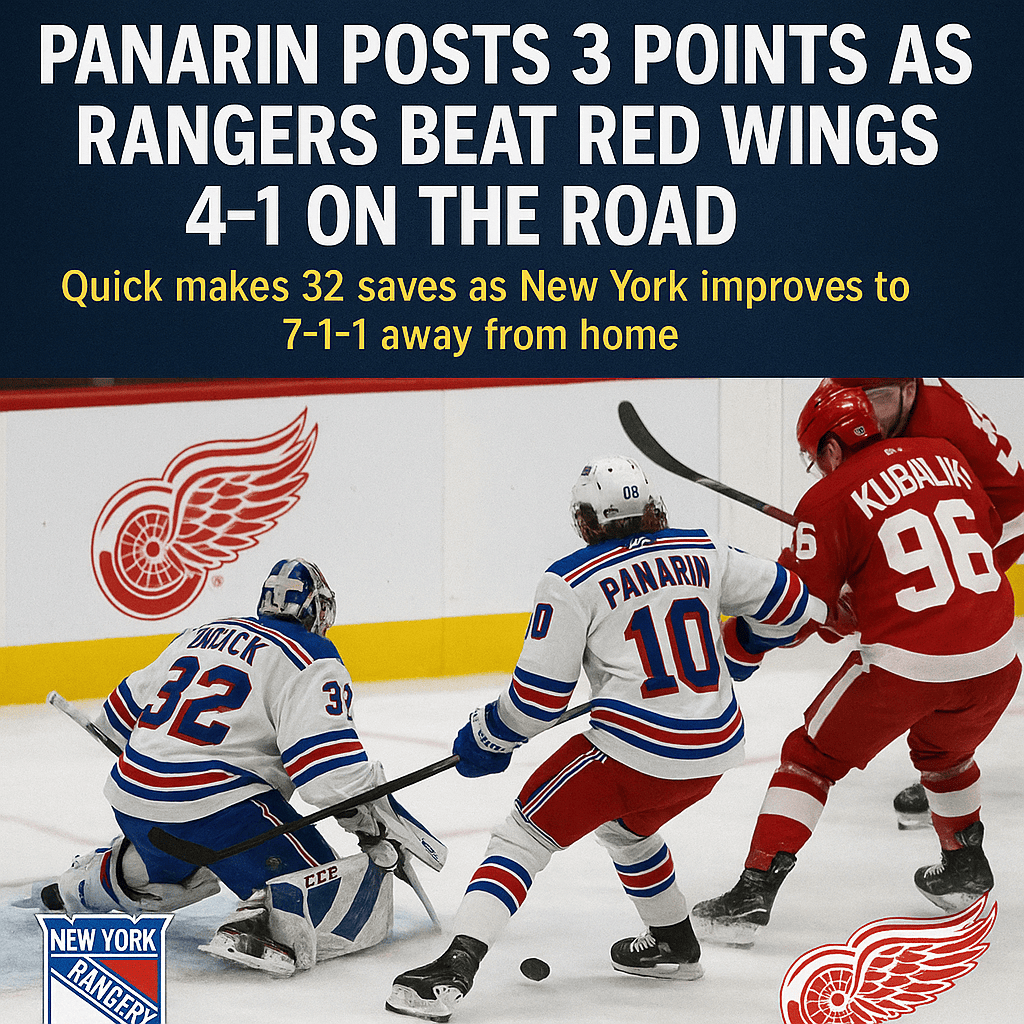
Panarin drives Rangers past Red Wings 4-1 on the road | IHM News

Panarin drives Rangers past Red Wings 4-1 on the road | IHM News

IHM NEWS – Panarin drives Rangers past Red Wings 4-1 on the road

Date: November 8, 2025  |  Author: IHM News

DETROIT – This is what it looks like when your stars set the tone. Artemi Panarin produced three points (1G, 2A) and Jonathan Quick turned aside 32 shots as the New York Rangers handled the Detroit Red Wings 4-1 at Little Caesars Arena, pushing New York to 7-1-1 away from home and extending their run of dominance over Detroit to seven straight wins.

Panarin drives Rangers past Red Wings 4-1 on the road | IHM News

Panarin’s line dictated pace and possession from the opening faceoff. Mika Zibanejad stacked two primary assists, Alexis Lafrenière snapped a 12-game goal drought and added an assist, and depth scoring arrived on time from Will Cuylle, whose first-period power-play strike set the tone.

Our best players were our best players,” coach Mike Sullivan said. “We’ve generated looks; tonight we finished.”

Detroit’s push was real. J.T. Compher tied it 1-1 in the first, and Patrick Kane returned from injury with six shots in 17:41 – including a near-gift after picking off a Quick outlet that the veteran goalie and Braden Schneider scrambled to erase. But between Quick’s economy of movement and the Rangers’ five-man layers through the neutral zone, Detroit never found a second wave.

How it happened

  • 1-0 NYR (6:46 1st, PPG): Will Cuylle trailed the rush and buried Zibanejad’s cross-ice feed.
  • 1-1 (11:06 1st): Compher walked into a quick release from Mason Appleton’s feed behind the net, beating Quick high glove.
  • 2-1 NYR (4:52 2nd): Michigan native Noah Laba tapped in Lafrenière’s crease-edge pass for his hometown moment and Lafrenière’s 200th NHL point.
  • 3-1 NYR (7:29 3rd): Panarin finished a Zibanejad delivery in stride – a scorer’s touch through a small window.
  • 4-1 NYR (8:27 3rd): Lafrenière from the slot to close it out.

Quick’s best sequences came late in the second: a point-blank denial on Kane after the interception, then a second-chance blocker swipe that killed the building’s surge. “He bails us out after our mistakes,” Schneider said. “Tonight he even cleaned up his own.”

Detroit coach Todd McLellan was blunt: “Physically there, but not sharp between the ears. When you’re not crisp, those look-in chances don’t fall.”

Numbers that matter

  • Road form: Rangers 7-1-1 away, structure travels.
  • Panarin vs DET: 28 points in last 16 vs Red Wings.
  • Goaltending: Quick .970 SV% at 5v5 on the night (32 saves overall).
  • Special teams: NYR score first on the PP; even-strength shot quality tilted their way in periods 2-3.

Coach Mark comment

New York solved Detroit’s first-touch pressure by widening the neutral-zone entries and letting Panarin attack off the inside-out delay. That pulled Detroit’s weak-side defender up a half-step, and the Rangers hit seams behind it (see Cuylle PPG and the Lafrenière/Laba connection). Quick’s puck tracking was elite; minimal rebounds, square early. This is sustainable road hockey.


Boston Bruins vs Ottawa Senators - Match Preview

Boston Bruins vs Ottawa Senators – Match Preview

7 Nov 2025 · TD Garden (Boston, MA)

The Boston Bruins return home to TD Garden with renewed momentum after several strong offensive performances. Their transition game continues to stand out, particularly through quick puck movement across the neutral zone and aggressive activation from the defense. On home ice, Boston typically amplifies their pace and suffocates opponents with extended shifts in the offensive zone.

Ottawa enters this matchup with notable inconsistencies. The Senators struggle with turnovers in key areas, especially at the blue lines, and their breakout structure has been unreliable. The absence of Brady Tkachuk, one of their most influential forwards, further complicates their ability to generate sustained pressure in the offensive zone.

Boston’s core remains stable, with the Pastrnak-Zacha combination continuing to drive offensive tempo. Defensively, the Bruins maintain a disciplined structure that limits high-danger opportunities against, making TD Garden one of the toughest arenas for visiting teams to dictate play.

We also highlight that our previous premium analysis on the Toronto Maple Leafs was successful, further reinforcing the strong analytics momentum heading into this highly anticipated matchup in Boston.

For the complete tactical breakdown and Coach Mark Lehtonen’s professional insight, visit our Premium section.


NHL Breakdown: Toronto vs Utah - November 6, 2025

NHL Breakdown: Toronto vs Utah – November 6, 2025

Scotiabank Arena in Toronto hosts a fascinating East vs West clash as the Maple Leafs welcome the surging Utah Mammoth. Utah continues to build a reputation as one of the most structured transition teams in the league, combining aggressive forecheck layers with quick middle-lane acceleration.

Toronto remains one of the most talented puck-possession teams in the NHL, but recent inconsistencies on defensive exits and coverage rotations have raised questions. Their top-six talent is undeniable, yet Utah’s ability to turn pressure into immediate rush chances will be a key storyline.

The Mammoth enter this matchup riding confidence from multiple strong offensive outings, while Toronto looks to tighten defensive assignments and avoid costly turnovers inside the neutral-zone funnel. Expect a tactical battle – tempo swings, tight forechecking, and special teams likely playing a significant role.

Venue: Scotiabank Arena (Toronto, ON)

Unlock Premium Access to read Coach Mark’s full tactical verdict and exact pick for this matchup.


Wild Beat Predators in OT After Dramatic Stamkos Equalizer

Minnesota beats Nashville 3-2 in OT after Stamkos equalizer with 0.3 seconds left | IceHockeyMan

By IHM Team | IHM News | November 5, 2025

Wild top Predators in OT after last-second equalizer by Stamkos

Johansson wins it at 3:38 of overtime as review confirms goalie-caused net displacement

ST. PAUL, Minn. Minnesota absorbed a gut punch and still closed the deal. After Steven Stamkos hammered a one-timer with 0.3 seconds on the clock to force overtime, the Wild regrouped and defeated the Predators 3-2 at Grand Casino Arena. The winner belonged to Marcus Johansson at 3:38 of OT in a rare sequence that required a long look from the NHL Situation Room.

The deciding play began when Nashville goaltender Justus Annunen knocked the net off its moorings during a scramble. Johansson’s first attempt struck the left side where the post should have been, and he immediately tapped the puck into the vacant space. On-ice officials ruled goal. Video review supported the call, determining Annunen’s actions displaced the net prior to the puck crossing, which by rule awards the goal.

Minnesota leaned on its top pieces all night. Kirill Kaprizov recorded a goal and an assist, again steering the power-play tempo from the top of the slot, and Brock Faber logged two primary helpers including the low-slot shot that Zeev Buium redirected for a second-period power-play strike. Filip Gustavsson handled 32 of 34 shots with sturdy tracking through layers.

Nashville earned its point in dramatic fashion. With Annunen pulled for the extra skater, Stamkos darted into the left circle and uncorked a clean one-timer off a high feed, beating Gustavsson over the shoulder with 0.3 seconds remaining to tie the game 2-2. Earlier, rookie Matthew Wood had pulled the Predators level 1-1 by slipping behind coverage for a back-door finish on a Michael McCarron backhand pass.

Minnesota opened the scoring at 10:44 of the first on a man advantage. Kaprizov walked into a wrist shot from the high slot through traffic for his third goal in six games, part of an eight-point surge in that span. The Wild restored control late in period two when Buium angled Faber’s low drive past Annunen for 2-1, setting the stage for the wild finish.

Scoring summary

  • 1st, 10:44 MIN PP – Kaprizov 3, wrist shot from the slot (Faber, Johansson), 1-0
  • 2nd, 5:16 NSH – Wood, back-door tap-in from McCarron, 1-1
  • 2nd, 16:01 MIN PP – Buium, redirection of Faber shot in low slot (Faber, Kaprizov), 2-1
  • 3rd, 19:59 NSH – Stamkos, one-timer from high left circle with extra attacker, 2-2
  • OT, 3:38 MIN – Johansson, awarded after goalie-caused net displacement, 3-2

Goaltenders

MIN: Gustavsson 32 saves on 34. NSH: Annunen 22 saves on 25.

Team notes

  • Minnesota power play goes 2-for-x on the night, both goals created through Faber’s point activation and Kaprizov’s half-wall gravity.
  • Kaprizov up to 8 points in his last 6 games, continuing to drive controlled entries and east-west looks.
  • Nashville drops a second straight in overtime after a 5-4 OT loss to Vancouver the previous night.

Coach Mark comment
Minnesota showed mature game management after an emotional swing. The Kaprizov unit kept pace and spacing simple, Faber’s point timing was excellent, and the bench reset quickly before overtime which is a good playoff indicator.


Jacob Markstrom

Markstrom Turns Away 43 as Devils Silence Kings 4-1 | IHM News

By IHM Team | IHM News | November 2, 2025

Markstrom Turns Away 43 as Devils Silence Kings 4-1

Mercer scores twice shorthanded, Halonen nets first NHL goal, New Jersey perfect on the kill

Jacob Markstrom

LOS ANGELES. Jacob Markstrom was the difference. The New Jersey goalie stopped 43 shots and iced a 4-1 road win over the Los Angeles Kings at Crypto.com Arena. The performance arrived one day after Markstrom signed a two-year, $12M extension that starts in 2026-27.

Dawson Mercer struck twice shorthanded in the third period, Nico Hischier opened the scoring on a Luke Hughes point shot, and Brian Halonen beat Darcy Kuemper glove side for his first NHL goal. New Jersey snapped a two-game skid and moved to 9-3-0. The Devils killed all four Kings power plays and turned the game with their penalty kill.

Los Angeles saw a seven-game point streak end. Andrei Kuzmenko scored their lone goal from the low slot off an Anze Kopitar feed. Kuemper finished with 18 saves. The Kings remain winless at home this season.

What decided it

  • Goaltending: Markstrom’s 43 saves included multiple high-danger stops in the second and a clean OT-kill stand late.
  • Special teams: New Jersey went 4-for-4 on the kill and scored twice shorthanded through Mercer.
  • Starts and answers: Hischier’s redirect at 1:22 set the tone. When LA pushed, Mercer’s second closed the door into an empty net.

Milestones and notes

  • Luke Hughes recorded his 100th NHL point on Hischier’s tip.
  • Brian Halonen scored his first NHL goal and point in his 12th career game.
  • The Kings fell to 0-3-2 at home.

Coach Mark: Markstrom owned the blue paint tonight. The kill was connected, sticks in lanes, quick exits, and Mercer read the ice like a veteran. That combination wins playoff games.


IHM Academy - Lesson #8 Neutral Zone Face-Off Loss

IHM Academy – Lesson #8 · By Coach Mark Lehtonen

By Coach Mark Lehtonen · IHM Academy

Neutral Zone Face-Off Loss – Pressure, Structure & Lane Denial

Losing a neutral-zone draw is not a mistake – it’s a trigger. Elite teams don’t panic or react passively. They activate pressure, deny middle ice, and force a predictable breakout. A face-off loss becomes a win when your structure and patience create a turnover.

Neutral Zone Face-Off Loss - Lane Denial & Pressure Triggers

Objective

Eliminate immediate middle support options, force play to the wall, and pressure into a turnover or dump-in.

Core Responsibilities

  • C – contest, delay, and then immediately jump to track middle support.
  • Strong-side wing – pressure to force puck wide, stick inside lane.
  • Weak-side wing – collapse to middle, protect inside first, then read.
  • D1 – hold blue line angle, deny middle step, stay inside the dots.
  • D2 – anchor middle ice, ready to close gap or retreat if stretched.

Pressure Phases

  1. Face-off drop: Win tie-up, or immediately lock onto your lane responsibility.
  2. First read: If puck goes D-to-D, strong-side pressure increases.
  3. Middle denial: Weak-side forward locks inside seam.
  4. Commit & close: Force the puck to the boards – angle, don’t chase.

Coaching Cues

  • Inside first, outside second – we don’t open middle ice.
  • Sticks active – blade on ice, kill middle lanes.
  • Skate through checks – do not stop feet after tie-up.
  • Read top hand – identify breakout side fast.
  • No fly-bys – finish lanes with control, not chaos.

Why It Works

This system forces the opponent to make the longest, slowest breakout choice – off the wall. It eliminates the quick middle pop and destroys stretch options before they develop. Neutral-zone control starts with structure, not speed.

Coach Mark Lehtonen says:

“You don’t lose a draw – you trigger a trap. The moment they think they gained possession, we remind them how expensive middle ice is against us.”

Summary

Face-off losses reveal discipline. Hold middle ice, angle to the wall, press with purpose. We don’t chase pucks – we remove options and wait for our moment to strike.

Train your neutral-zone reads and pressure habits at IHM Academy.