Tag: IHM Recap

NHL DAILY RECAP | December 30, 2025 | IHM News

NHL DAILY RECAP | December 30, 2025 | IHM News

NHL DAILY RECAP | December 30, 2025

Quick read for busy fans: Overtime drama in New York and Boston, a defensive masterclass in Edmonton despite a 42 shot barrage, and chaos games where the shot share lied. Full stats for every matchup below.

Date: December 30, 2025


Final Scores

  • Carolina Hurricanes 3, New York Rangers 2 (OT)
  • Florida Panthers 5, Washington Capitals 3
  • Ottawa Senators 1, Columbus Blue Jackets 4
  • Winnipeg Jets 1, Edmonton Oilers 3
  • St. Louis Blues 2, Buffalo Sabres 4
  • Calgary Flames 2, Boston Bruins 1 (OT)
  • Colorado Avalanche 5, Los Angeles Kings 2
  • Utah Mammoth 3, Nashville Predators 4
  • Anaheim Ducks 4, San Jose Sharks 5
  • Seattle Kraken 2, Vancouver Canucks 3 (SO)
  • Vegas Golden Knights 2 Minnesota Wild 5

Game-by-Game Breakdown

Carolina Hurricanes 3, New York Rangers 2 (OT)

Carolina carried the territorial battle, but this one still required extra time because the Rangers leaned on survival structure and goaltending. The Hurricanes owned the shot volume (34 on goal) and forced long defensive shifts, while New York tried to compress the middle and turn blocked lanes into quick exits. The key was patience. Carolina kept the puck above the circles, rotated to create new shooting angles, and eventually broke the stalemate in overtime.

Stats Box
Shots on Goal: CAR 34 | NYR 19
Shots off Target: CAR 25 | NYR 7
Shooting %: CAR 8.82% (3/34) | NYR 10.53% (2/19)
Blocked Shots: CAR 18 | NYR 11
Goalkeeper Saves: CAR 17 | NYR 31
Save %: CAR 89.47% (17/19) | NYR 91.18% (31/34)
Penalties: CAR 2 | NYR 4
PIM: CAR 4 | NYR 8

Florida Panthers 5, Washington Capitals 3

Florida won this with a combination of finishing and layered pressure. Washington was not buried on shots (29 to 25), but Florida’s chances were cleaner and arrived with more speed through the seam. The Capitals could not consistently protect the slot once the Panthers established a cycle and started pulling defenders out of shape. Florida’s conversion rate (5 on 29) did the rest.

Stats Box
Shots on Goal: FLA 29 | WSH 25
Shots off Target: FLA 19 | WSH 17
Shooting %: FLA 17.24% (5/29) | WSH 12.00% (3/25)
Blocked Shots: FLA 21 | WSH 6
Goalkeeper Saves: FLA 22 | WSH 24
Save %: FLA 88.00% (22/25) | WSH 85.71% (24/28)
Penalties: FLA 5 | WSH 6
PIM: FLA 12 | WSH 12

Ottawa Senators 1, Columbus Blue Jackets 4

Ottawa generated volume (28 shots), but the quality was not there. Columbus defended the house well, forced attempts from the perimeter, and then punished mistakes with high value looks. The story is in the shooting percentage. Ottawa scored once on 28 shots (3.57%) while Columbus scored four on 22 (18.18%). That is often about shot quality and net front presence, not just luck.

Stats Box
Shots on Goal: OTT 28 | CBJ 22
Shots off Target: OTT 13 | CBJ 14
Shooting %: OTT 3.57% (1/28) | CBJ 18.18% (4/22)
Blocked Shots: OTT 16 | CBJ 10
Goalkeeper Saves: OTT 18 | CBJ 27
Save %: OTT 81.82% (18/22) | CBJ 96.43% (27/28)
Penalties: OTT 4 | CBJ 5
PIM: OTT 11 | CBJ 13

Winnipeg Jets 1, Edmonton Oilers 3

This is the classic example of a game where the shot counter misleads. Winnipeg posted 42 shots on goal, but Edmonton managed the middle of the ice and asked the Jets to shoot through traffic. The Oilers’ goalie faced a workload (41 saves) and held the line. Winnipeg’s finishing was almost nonexistent (1 on 42, 2.38%), while Edmonton cashed three on 21 (14.29%). That is the difference between volume and danger.

Stats Box
Shots on Goal: WPG 42 | EDM 21
Shots off Target: WPG 21 | EDM 15
Shooting %: WPG 2.38% (1/42) | EDM 14.29% (3/21)
Blocked Shots: WPG 17 | EDM 8
Goalkeeper Saves: WPG 18 | EDM 41
Save %: WPG 90.00% (18/20) | EDM 97.62% (41/42)
Penalties: WPG 2 | EDM 4
PIM: WPG 7 | EDM 11

St. Louis Blues 2, Buffalo Sabres 4

Buffalo controlled the shot share heavily (34 to 18) and got rewarded with four goals. St. Louis actually finished at the same shooting rate per shot on goal, but they simply did not create enough offense and spent too much time defending. Buffalo’s ability to generate attempts and re-attacks off broken plays kept St. Louis from settling into a cleaner defensive rhythm.

Stats Box
Shots on Goal: STL 18 | BUF 34
Shots off Target: STL 9 | BUF 18
Shooting %: STL 11.11% (2/18) | BUF 11.76% (4/34)
Blocked Shots: STL 11 | BUF 18
Goalkeeper Saves: STL 30 | BUF 16
Save %: STL 90.91% (30/33) | BUF 88.89% (16/18)
Penalties: STL 3 | BUF 1
PIM: STL 6 | BUF 2

Calgary Flames 2, Boston Bruins 1 (OT)

Tight game, low margin, and it went to overtime because both teams defended the prime scoring areas. Calgary won the conversion battle and also got solid goaltending support, limiting Boston to a single goal despite 25 shots on goal. Boston had the volume edge, but the Flames were more decisive with their looks and survived the late pressure.

Stats Box
Shots on Goal: CGY 20 | BOS 25
Shots off Target: CGY 10 | BOS 10
Shooting %: CGY 10.00% (2/20) | BOS 4.00% (1/25)
Blocked Shots: CGY 17 | BOS 14
Goalkeeper Saves: CGY 24 | BOS 18
Save %: CGY 96.00% (24/25) | BOS 90.00% (18/20)
Penalties: CGY 3 | BOS 5
PIM: CGY 6 | BOS 10

Colorado Avalanche 5, Los Angeles Kings 2

Colorado’s offense was sharp and direct. Shot totals were close (26 to 25), but the Avalanche finished their chances at a much higher rate and kept attacking off the rush and off quick puck movement in the offensive zone. The Kings got 25 shots, but Colorado’s goaltending and defensive timing reduced the second chance chaos.

Stats Box
Shots on Goal: COL 26 | LAK 25
Shots off Target: COL 21 | LAK 18
Shooting %: COL 19.23% (5/26) | LAK 8.00% (2/25)
Blocked Shots: COL 11 | LAK 9
Goalkeeper Saves: COL 23 | LAK 21
Save %: COL 92.00% (23/25) | LAK 84.00% (21/25)
Penalties: COL 3 | LAK 4
PIM: COL 6 | LAK 8

Utah Mammoth 3, Nashville Predators 4

Nashville made the difference with finishing and timely stops. Utah had the shot edge (32 to 26), but Nashville converted four goals on 26 shots (15.38%) and stayed composed when Utah tried to ramp up pace. Utah’s pressure was real, but Nashville’s execution in the scoring areas was stronger.

Stats Box
Shots on Goal: UTA 32 | NSH 26
Shots off Target: UTA 20 | NSH 11
Shooting %: UTA 9.38% (3/32) | NSH 15.38% (4/26)
Blocked Shots: UTA 19 | NSH 16
Goalkeeper Saves: UTA 22 | NSH 29
Save %: UTA 84.62% (22/26) | NSH 90.63% (29/32)
Penalties: UTA 2 | NSH 4
PIM: UTA 4 | NSH 8

Anaheim Ducks 4, San Jose Sharks 5

Chaos game. Anaheim absolutely dominated the shot share (42 to 13) and still lost because San Jose finished at an extreme rate (5 goals on 13 shots, 38.46%). That is the hockey version of a lightning strike. Anaheim will look at this and feel robbed, but the bigger lesson is defensive coverage on the few shots you do allow. If the chances against are clean, volume does not save you.

Stats Box
Shots on Goal: ANA 42 | SJS 13
Shots off Target: ANA 23 | SJS 11
Shooting %: ANA 9.52% (4/42) | SJS 38.46% (5/13)
Blocked Shots: ANA 18 | SJS 11
Goalkeeper Saves: ANA 8 | SJS 38
Save %: ANA 61.54% (8/13) | SJS 90.48% (38/42)
Penalties: ANA 2 | SJS 3
PIM: ANA 4 | SJS 6

Seattle Kraken 2, Vancouver Canucks 3 (SO)

Seattle carried a lot of the shot volume (39 to 24), but Vancouver managed the critical moments and got enough goaltending to take it to the shootout. When the shot share leans this hard, the swing factor is often the slot, the net front, and second chance control. Vancouver survived the waves and executed in the skills segment.

Stats Box
Shots on Goal: SEA 39 | VAN 24
Shots off Target: SEA 9 | VAN 23
Shooting %: SEA 5.13% (2/39) | VAN 8.33% (2/24)
Blocked Shots: SEA 15 | VAN 17
Goalkeeper Saves: SEA 22 | VAN 37
Save %: SEA 91.67% (22/24) | VAN 94.87% (37/39)
Penalties: SEA 3 | VAN 7
PIM: SEA 9 | VAN 17

Vegas Golden Knights 2, Minnesota Wild 5

Minnesota delivered a complete win and punished Vegas with better finishing and cleaner puck management. The Wild generated more shots on goal (27 to 16) and were the more efficient attacking team. Note on the numbers: some apps can display incorrect shooting percentage in certain match views. The correct calculation is goals divided by shots on goal. Here it is 2 on 16 (12.5%) for Vegas and 5 on 27 (18.52%) for Minnesota.

Stats Box
Shots on Goal: VGK 16 | MIN 27
Shots off Target: VGK 14 | MIN 17
Shooting %: VGK 12.50% (2/16) | MIN 18.52% (5/27)
Blocked Shots: VGK 20 | MIN 13
Goalkeeper Saves: VGK 22 | MIN 14
Save %: VGK 81.48% (22/27) | MIN 87.50% (14/16)
Penalties: VGK 3 | MIN 2
PIM: VGK 17 | MIN 4


Coach Mark Comment

Tonight is a perfect reminder that shot volume is not the same as control. Winnipeg and Anaheim both posted massive totals, but Edmonton and San Jose protected the most valuable ice and leaned on goaltending at the right time. If you want to read games like a coach, follow the slot, follow rebound access, and watch how teams exit their zone under pressure.

Coach Mark Lehtonen
Former coach


Q&A

1) Why can a team lose while outshooting the opponent by a huge margin?
Because shot quality matters. If most shots are from the perimeter or come with no net front traffic, the goalie sees everything. Also, a few high danger chances against can outweigh 30 low danger shots.

2) What does “slot control” mean in hockey?
Slot control is protecting the space between the faceoff dots in the middle of the offensive zone. Teams that win the slot usually win the most dangerous chances.

3) How do you spot a “scoreboard illusion” game?
Look for extreme shot counts with low conversion (Winnipeg 1 on 42) or a team scoring heavily on very few shots (San Jose 5 on 13). Those are signals to investigate chance quality and goalie performance.

4) Why do some games go to overtime even when one team dominates possession?
If the defending team blocks lanes, clears rebounds, and forces outside shots, they can survive. Carolina dominated shots, but the Rangers extended the game with structure and saves.

5) What is the practical difference between shots on goal and shots off target?
Shots on goal require a save or a goal. Shots off target miss the net and often become instant transitions the other way, which can be risky if your coverage is not ready.

6) How important is goaltending on high volume nights?
Massive. Edmonton’s goalie stopped 41 of 42. Without that, the entire plan collapses. Great goalies can turn heavy pressure into frustrated, low quality shooting.

7) Why do shooting percentages sometimes look wrong in apps?
Some apps can briefly display a cached or incorrect value. The correct formula is goals divided by shots on goal. Always sanity check it using the goals and SOG on the same screen.

8) What is a good sign that a team’s offense is sustainable?
Repeatable chance creation: puck retrievals, net front presence, east-west passing, and second chance volume. Colorado’s five goals with balanced shot totals is more “real” than a random spike on 13 shots.

9) Why do shootout games often ignore the shot share?
Because shootouts are a separate skills segment. A team can survive with goaltending and then win on finishing skill, even if they were outshot for long stretches.

10) What is the fastest way to read a recap like a coach?
First check shots on goal and saves. Then check shooting percentage and blocked shots. Finally interpret if the game was about finishing, goaltending, or defensive structure.

11) What does a high blocked shot number usually indicate?
It often means a team spent long stretches defending in-zone, but it can also mean good lane discipline. Context matters, but heavy blocks with low shots for usually means you were pinned.

12) Which stat tonight most clearly shows a “quality over quantity” win?
Anaheim vs San Jose: 42 shots to 13, but San Jose scored five. That is extreme finishing plus critical saves, while Anaheim likely lacked clean slot access on many attempts.


https://icehockeyman.com/2024/12/03/nhl-affiliations/

NHL Daily Recap | December 20, 2025 | IHM News

NHL Daily Recap | December 20, 2025 | IHM News

NHL Daily Recap - December 20, 2025

Date: December 20, 2025 By: IHM News

This game day delivered a mix of high volume shooting, special teams swings and late drama in the skills competition. Below is a tactical walk through of all five finished games using core numbers like shots, blocks and save percentage to explain how each result was built on the ice.

New York Rangers vs Philadelphia Flyers

Final score: New York Rangers 5-4 Philadelphia Flyers (after penalties)

The Rangers win a chaotic game that turns into a shot trading contest and is finally decided after penalties. Philadelphia puts 32 shots on goal against 27 for New York, but the Rangers create slightly better quality looks with a higher finishing rate and more controlled entries. New York blocks 21 shots compared to only 4 for the Flyers, which is a huge defensive workload that protects the crease and buys time when the team is under pressure.

Goaltending is busy on both sides, with the Rangers making 28 saves and the Flyers 23. The marginal edge in save percentage for New York is enough when combined with their heavier blocking commitment and ability to convert at key moments in regulation and the shootout. Discipline is a minor factor with penalties at 6-5, but the Rangers manage those special teams minutes without letting momentum fully swing to the Flyers.

Key numbers

  • Shots on goal: New York Rangers 27 – 32 Philadelphia Flyers
  • Shots off target: Rangers 17 – 15 Flyers
  • Shooting PCT: Rangers 14.81% (4/27) – Flyers 12.5% (4/32)
  • Blocked shots: Rangers 21 – 4 Flyers
  • Goalkeeper saves: Rangers 28 – 23 Flyers
  • Saves PCT: Rangers 87.5% (28/32) – Flyers 85.19% (23/27)
  • Penalties: Rangers 6 – 5 Flyers
  • PIM: Rangers 15 – 13 Flyers

Washington Capitals vs Detroit Red Wings

Final score: Washington Capitals 2-5 Detroit Red Wings

Detroit controls this matchup by stretching the Capitals with pace and sustained attacking pressure. The Red Wings fire 41 shots on goal against 26 for Washington and keep the shot clock moving through quick puck movement in the offensive zone. Their shooting percentage is notably higher, and that combination of volume and efficiency steadily breaks down the Capitals structure.

In net, Washington is forced into 36 saves while Detroit needs only 24. The slight edge in save percentage on the Red Wings side reinforces the territorial advantage already visible in shots on goal. Blocked shots stay close at 19-17, but Detroit is simply spending more time in dangerous areas and forcing Washington to defend in rotations rather than in their preferred set structure.

Key numbers

  • Shots on goal: Washington Capitals 26 – 41 Detroit Red Wings
  • Shots off target: Capitals 15 – 11 Red Wings
  • Shooting PCT: Capitals 7.69% (2/26) – Red Wings 12.2% (5/41)
  • Blocked shots: Capitals 19 – 17 Red Wings
  • Goalkeeper saves: Capitals 36 – 24 Red Wings
  • Saves PCT: Capitals 90% (36/40) – Red Wings 92.31% (24/26)
  • Penalties: Capitals 3 – 2 Red Wings
  • PIM: Capitals 6 – 4 Red Wings

Minnesota Wild vs Edmonton Oilers

Final score: Minnesota Wild 5-2 Edmonton Oilers

Minnesota delivers a statement home performance built on relentless shooting and net front traffic. The Wild produce 37 shots on goal to Edmonton’s 30 and double the Oilers in shooting effectiveness. Their 13 plus percent finishing shows how often they get the puck to the interior rather than settling for perimeter looks.

Edmonton blocks 20 shots compared to only 5 for Minnesota, which tells the story of a team under heavy siege that is forced to collapse around its goaltender. The Oilers have 32 saves to 28 for the Wild, but the extra workload and repeated lateral plays eventually crack their coverage. Minnesota’s discipline with only 4 penalty minutes and steady goaltending at over 93 percent save rate allow them to close out the game without giving Edmonton a path back through special teams.

Key numbers

  • Shots on goal: Minnesota Wild 37 – 30 Edmonton Oilers
  • Shots off target: Wild 10 – 13 Oilers
  • Shooting PCT: Wild 13.51% (5/37) – Oilers 6.67% (2/30)
  • Blocked shots: Wild 5 – 20 Oilers
  • Goalkeeper saves: Wild 28 – 32 Oilers
  • Saves PCT: Wild 93.33% (28/30) – Oilers 88.89% (32/36)
  • Penalties: Wild 2 – 2 Oilers
  • PIM: Wild 4 – 4 Oilers

Ottawa Senators vs Chicago Blackhawks

Final score: Ottawa Senators 6-4 Chicago Blackhawks

This game is wide open and high event from the start. Ottawa pushes the tempo and finishes with 40 shots on goal compared to 24 for Chicago. The Senators attack with layers through the middle lane and weak side support, creating repeated second wave chances and forcing the Blackhawks to defend extended zone time.

Chicago still finds a way to score four times with a slightly higher shooting percentage, which reflects a few clean rush chances and breakdowns from Ottawa in transition. However, the overall territorial tilt remains with the Senators. Ottawa blocks 15 shots to 8 for Chicago and registers 20 saves compared to 34 for the Blackhawks, highlighting how much work Chicago’s goaltending has to handle. Penalties are heavier on Ottawa at 5-8, but the Senators offense is strong enough at five on five to absorb those minutes and still close out the win.

Key numbers

  • Shots on goal: Ottawa Senators 40 – 24 Chicago Blackhawks
  • Shots off target: Senators 23 – 6 Blackhawks
  • Shooting PCT: Senators 15% (6/40) – Blackhawks 16.67% (4/24)
  • Blocked shots: Senators 15 – 8 Blackhawks
  • Goalkeeper saves: Senators 20 – 34 Blackhawks
  • Saves PCT: Senators 83.33% (20/24) – Blackhawks 85% (34/40)
  • Penalties: Senators 5 – 8 Blackhawks
  • PIM: Senators 10 – 26 Blackhawks

Buffalo Sabres vs New York Islanders

Final score: Buffalo Sabres 3-2 New York Islanders (after penalties)

Buffalo edges a tight, defensive game that ultimately goes to penalties. The Islanders fire slightly more pucks on net with 34 shots on goal to 32 for the Sabres, but the finishing numbers are almost identical and both teams rely heavily on their goaltenders. The Sabres maintain a marginal edge in shooting percentage and manage the puck better in high danger areas.

Goaltending is the main storyline with Buffalo making 32 saves and the Islanders 30. Save percentages are both above 93 percent, showing how hard it is to score at even strength. Blocked shots are close at 8-11, and with penalties at 3-4 the special teams picture stays balanced. In the end Buffalo’s execution in the skills competition and slightly sharper puck management around the net give them the extra point.

Key numbers

  • Shots on goal: Buffalo Sabres 32 – 34 New York Islanders
  • Shots off target: Sabres 15 – 18 Islanders
  • Shooting PCT: Sabres 6.25% (2/32) – Islanders 5.88% (2/34)
  • Blocked shots: Sabres 8 – 11 Islanders
  • Goalkeeper saves: Sabres 32 – 30 Islanders
  • Saves PCT: Sabres 94.12% (32/34) – Islanders 93.75% (30/32)
  • Penalties: Sabres 3 – 4 Islanders
  • PIM: Sabres 6 – 8 Islanders

Coach Mark Lehtonen Comment

From a coaching perspective this slate underlines how important shot quality and interior pressure are compared to raw totals. Detroit and Minnesota both tilted the ice with volume, but what really decided those games was their ability to turn zone time into layered chances in the slot and around the crease. On the flip side, both Buffalo and the Rangers survived games where the shot count was not clearly in their favor by blocking aggressively and winning the key execution moments in overtime and penalties.

Discipline and bench management also stand out. Teams that kept their penalty minutes under control and rolled four lines with consistent pace were rewarded late in games. For me this game day is a textbook example of how modern NHL hockey is less about one big momentum wave and more about building small advantages shift by shift until the opponent has no answers left.

Q&A - NHL Game Day December 20, 2025

Which win was the most impressive from a tactical point of view
Detroit’s road performance in Washington stands out because of how completely they controlled shot volume, tempo and offensive zone time while still keeping their defensive structure intact.

How did the Rangers win despite being outshot by the Flyers
New York compensated for the shot deficit by blocking a huge number of attempts, protecting the slot and getting timely saves, then converting in the skills competition when the game tightened even further.

What defined Minnesota’s victory over Edmonton
The Wild combined heavy shot volume with consistent net front presence, forcing Edmonton’s defense into desperation shot blocking and overloading their goaltender with east west traffic.

Why was the Sabres vs Islanders game so low scoring
Both teams played compact in the defensive zone, kept most shots to the outside and received strong goaltending, which turned the matchup into a grind where a single mistake or shootout play could decide the outcome.

What can we learn from Ottawa’s win over Chicago
Ottawa showed that even when a game becomes wide open, carrying the puck with speed, sustaining pressure and winning the shot volume battle usually pays off as long as the team does not lose discipline in its own zone.


NHL Daily Recap - December 12, 2025 (13 Games) | IHM News

NHL Daily Recap – December 12, 2025 (13 Games) | IHM News

NHL Daily Recap – December 12, 2025 (13 Games) | IHM News

Date: December 12, 2025 By: IHM News
Category: NHL Daily Recap


Final Scores – Game Day Snapshot (13 Games)

  • Columbus Blue Jackets @ Ottawa Senators – 3-6
  • New Jersey Devils @ Tampa Bay Lightning – 4-8
  • New York Islanders @ Anaheim Ducks – 5-2
  • Philadelphia Flyers @ Vegas Golden Knights – 2-3 (OT)
  • Pittsburgh Penguins @ Montreal Canadiens – 2-4
  • Toronto Maple Leafs @ San Jose Sharks – 2-3 (OT)
  • Washington Capitals @ Carolina Hurricanes – 2-3 (SO)
  • Minnesota Wild @ Dallas Stars – 5-2
  • Nashville Predators @ St. Louis Blues – 7-2
  • Winnipeg Jets @ Boston Bruins – 3-6
  • Edmonton Oilers @ Detroit Red Wings – 4-1
  • Colorado Avalanche @ Florida Panthers – 6-2
  • Vancouver Canucks @ Buffalo Sabres – 2-3

Game-by-Game Recap (Key Stat Snapshots)

1) Columbus Blue Jackets @ Ottawa Senators – 3-6

Ottawa converted finishing chances at a much higher rate and made the shot volume count. Columbus kept the shot count competitive, but Ottawa’s shooting efficiency and cleaner execution in the scoring areas separated the game.

  • Shots on Goal: CBJ 26 – OTT 29
  • Shooting %: CBJ 11.54% (3/26) – OTT 20.69% (6/29)
  • Goalkeeper Saves: CBJ 23 – OTT 23
  • Saves %: CBJ 82.14% (23/28) – OTT 88.46% (23/26)
  • Blocked Shots: CBJ 21 – OTT 11
  • Penalties: CBJ 2 – OTT 1 | PIM: CBJ 4 – OTT 2

2) New Jersey Devils @ Tampa Bay Lightning – 4-8

Tampa turned the game into a finishing clinic. New Jersey’s shot generation was solid, but the Lightning punished coverage mistakes and repeatedly converted, creating a scoreboard gap that the Devils never fully closed.

  • Shots on Goal: NJD 37 – TBL 35
  • Shooting %: NJD 10.81% (4/37) – TBL 22.86% (8/35)
  • Goalkeeper Saves: NJD 27 – TBL 33
  • Saves %: NJD 77.14% (27/35) – TBL 89.19% (33/37)
  • Blocked Shots: NJD 13 – TBL 13
  • Penalties: NJD 4 – TBL 4 | PIM: NJD 11 – TBL 11

3) New York Islanders @ Anaheim Ducks – 5-2

The Islanders controlled the details: shot quality, timely finishing, and a goaltending edge. Anaheim generated attempts but struggled to translate volume into high-grade conversion.

  • Shots on Goal: NYI 37 – ANA 33
  • Shooting %: NYI 13.51% (5/37) – ANA 6.06% (2/33)
  • Goalkeeper Saves: NYI 31 – ANA 32
  • Saves %: NYI 93.94% (31/33) – ANA 86.49% (32/37)
  • Blocked Shots: NYI 13 – ANA 18
  • Penalties: NYI 1 – ANA 4 | PIM: NYI 2 – ANA 8

4) Philadelphia Flyers @ Vegas Golden Knights – 2-3 (OT)

Tight-checking structure and goaltending kept this one balanced through regulation. Vegas found the extra gear in OT, but the overall story was disciplined defending and narrow margins.

  • Shots on Goal: PHI 19 – VGK 21
  • Shooting %: PHI 10.53% (2/19) – VGK 14.29% (3/21)
  • Goalkeeper Saves: PHI 18 – VGK 17
  • Saves %: PHI 85.71% (18/21) – VGK 89.47% (17/19)
  • Blocked Shots: PHI 16 – VGK 13
  • Penalties: PHI 2 – VGK 3 | PIM: PHI 4 – VGK 6

5) Pittsburgh Penguins @ Montreal Canadiens – 2-4

Pittsburgh fired plenty, but Montreal paired opportunistic finishing with a clear save-percentage advantage. When the opponent’s goalie wins the efficiency battle, shot totals alone rarely tell the full story.

  • Shots on Goal: PIT 35 – MTL 29
  • Shooting %: PIT 5.71% (2/35) – MTL 13.79% (4/29)
  • Goalkeeper Saves: PIT 25 – MTL 33
  • Saves %: PIT 86.21% (25/29) – MTL 94.29% (33/35)
  • Blocked Shots: PIT 23 – MTL 19
  • Penalties: PIT 4 – MTL 6 | PIM: PIT 8 – MTL 12

6) Toronto Maple Leafs @ San Jose Sharks – 2-3 (OT)

An OT finish where both teams stayed close in shots and saves. San Jose got the final punch while keeping Toronto’s prime chances contained enough to survive late.

  • Shots on Goal: TOR 30 – SJS 32
  • Shooting %: TOR 6.67% (2/30) – SJS 9.38% (3/32)
  • Goalkeeper Saves: TOR 29 – SJS 28
  • Saves %: TOR 90.63% (29/32) – SJS 93.33% (28/30)
  • Blocked Shots: TOR 13 – SJS 15
  • Penalties: TOR 2 – SJS 3 | PIM: TOR 4 – SJS 6

7) Washington Capitals @ Carolina Hurricanes – 2-3 (SO)

Carolina carried the shot load heavily, but Washington’s goaltending kept them alive deep into the game. In the end, the shootout decided what regulation and OT could not.

  • Shots on Goal: WSH 25 – CAR 39
  • Shooting %: WSH 8.00% (2/25) – CAR 5.13% (2/39)
  • Goalkeeper Saves: WSH 37 – CAR 23
  • Saves %: WSH 94.87% (37/39) – CAR 92.00% (23/25)
  • Blocked Shots: WSH 10 – CAR 21
  • Penalties: WSH 3 – CAR 2 | PIM: WSH 9 – CAR 7

8) Minnesota Wild @ Dallas Stars – 5-2

Minnesota combined shot control with better finishing and walked out with a comfortable road win. Dallas didn’t generate enough volume and never fully recovered once Minnesota began stacking goals.

  • Shots on Goal: MIN 32 – DAL 18
  • Shooting %: MIN 15.63% (5/32) – DAL 11.11% (2/18)
  • Goalkeeper Saves: MIN 16 – DAL 27
  • Saves %: MIN 88.89% (16/18) – DAL 90.00% (27/30)
  • Blocked Shots: MIN 14 – DAL 20
  • Penalties: MIN 1 – DAL 3 | PIM: MIN 2 – DAL 6

9) Nashville Predators @ St. Louis Blues – 7-2

Nashville’s finishing was ruthless, turning similar-ish shot totals into a blowout. This was a clear example of “conversion wins games” when the Predators kept turning looks into goals.

  • Shots on Goal: NSH 32 – STL 26
  • Shooting %: NSH 21.88% (7/32) – STL 7.69% (2/26)
  • Goalkeeper Saves: NSH 24 – STL 25
  • Saves %: NSH 92.31% (24/26) – STL 78.13% (25/32)
  • Blocked Shots: NSH 10 – STL 15
  • Penalties: NSH 4 – STL 4 | PIM: NSH 11 – STL 13

10) Winnipeg Jets @ Boston Bruins – 3-6

Boston’s finishing rate was the headline, and they leveraged it to stretch the game away. Winnipeg’s shot count was there, but Boston’s ability to cash in made the difference.

  • Shots on Goal: WPG 29 – BOS 24
  • Shooting %: WPG 10.34% (3/29) – BOS 25.00% (6/24)
  • Goalkeeper Saves: WPG 18 – BOS 26
  • Saves %: WPG 78.26% (18/23) – BOS 89.66% (26/29)
  • Blocked Shots: WPG 18 – BOS 16
  • Penalties: WPG 3 – BOS 5 | PIM: WPG 9 – BOS 13

11) Edmonton Oilers @ Detroit Red Wings – 4-1

Edmonton paired strong goaltending with better finishing and controlled the game state. Detroit had stretches of pressure, but the Oilers’ defensive execution and save rate kept the damage minimal.

  • Shots on Goal: EDM 29 – DET 28
  • Shooting %: EDM 13.79% (4/29) – DET 3.57% (1/28)
  • Goalkeeper Saves: EDM 27 – DET 25
  • Saves %: EDM 96.43% (27/28) – DET 89.29% (25/28)
  • Blocked Shots: EDM 11 – DET 20
  • Penalties: EDM 2 – DET 2 | PIM: EDM 4 – DET 4

12) Colorado Avalanche @ Florida Panthers – 6-2

Colorado dominated the shot profile and converted consistently. Florida couldn’t match the pace or volume, and the save-percentage gap widened as Colorado continued to push the game north.

  • Shots on Goal: COL 42 – FLA 25
  • Shooting %: COL 14.29% (6/42) – FLA 8.00% (2/25)
  • Goalkeeper Saves: COL 23 – FLA 36
  • Saves %: COL 92.00% (23/25) – FLA 85.71% (36/42)
  • Blocked Shots: COL 13 – FLA 17
  • Penalties: COL 2 – FLA 3 | PIM: COL 4 – FLA 6

13) Vancouver Canucks @ Buffalo Sabres – 2-3

Buffalo won despite being outshot heavily, powered by elite goaltending and better finishing percentage. Vancouver controlled the shot volume and blocked-shot battle, but the conversion edge and saves decided it.

  • Shots on Goal: VAN 32 – BUF 15
  • Shooting %: VAN 6.25% (2/32) – BUF 20.00% (3/15)
  • Goalkeeper Saves: VAN 12 – BUF 30
  • Saves %: VAN 80.00% (12/15) – BUF 93.75% (30/32)
  • Blocked Shots: VAN 26 – BUF 7
  • Penalties: VAN 4 – BUF 5 | PIM: VAN 8 – BUF 10

Coach Mark Takeaway

Coach Mark Lehtonen: The pattern today was clear. Teams that combined shot volume with high conversion punished opponents fast, while a few games flipped on goaltending efficiency. In tight matchups, the difference is often one layer of structure – cleaner exits, fewer broken coverages, and quicker puck support in the slot. That is where goals are created and games are closed.


Q&A – December 12 Key Takeaways

What was the most decisive factor across the NHL games on December 12, 2025?

The most decisive factor was finishing efficiency paired with goaltending. Several winners converted at a significantly higher shooting percentage, and in a few matchups elite save percentage outweighed being outshot.

Which games went beyond regulation in this NHL daily recap?

Three games required extra time or a shootout: Flyers @ Golden Knights (OT), Maple Leafs @ Sharks (OT), and Capitals @ Hurricanes (SO).

Why can a team win while being outshot heavily in the NHL?

A team can win while being outshot if it has superior goaltending (higher save percentage), better shot quality, and higher finishing rate. Buffalo’s win over Vancouver is a textbook example of this outcome.


NHL Recaps - IHM News

NHL Recaps (Nov 14, 2025): 6 Games - IHM News

NHL Recaps – Six Games (14 November)

Date: 14 November 2025
Author: IHM News


Detroit Red Wings 6-3 Anaheim Ducks – Detroit Controls Every Phase

Detroit delivered a structured and high-tempo performance, overwhelming Anaheim with sustained zone pressure and fast transition play. The Red Wings turned the game early through aggressive forecheck rotations and precise puck recoveries, forcing Anaheim into constant defensive scrambling.

Anaheim created isolated bursts of offense but couldn’t consistently break through Detroit’s layered defensive posture. The Red Wings capitalised on nearly every Ducks’ turnover, widening the gap in the second half of the match.

Final Score: Detroit Red Wings 6, Anaheim Ducks 3

Coach Mark’s take

Detroit finally played to their roster identity. Their top four on defence pushed the pace, the first line owned the middle of the ice, and special teams gave them separation. When DeBrincat is attacking downhill and Larkin is driving the forecheck like this, the Red Wings are a very difficult out.


Florida Panthers 6-3 Washington Capitals – Panthers Too Explosive

Florida once again leaned on their elite shot creation and heavy-cycle dominance. Washington kept the pace early, but as soon as Florida settled into their controlled offensive zone sets, the Capitals’ defensive coverage broke down repeatedly.

The Panthers executed high-slot rotations with precision, generating continuous Grade-A looks. Washington produced pushback but couldn’t match the sheer offensive volume and puck-possession superiority Florida established through the final 40 minutes.

Final Score: Florida Panthers 6, Washington Capitals 3

Coach Mark’s take

This is what a mature contender looks like. Florida didn’t need to be spectacular; they just squeezed Washington in every zone. Marchand’s milestone is the headline, but the real story is how ruthlessly the Panthers manage risk when they have a lead.


Montreal Canadiens 0-7 Dallas Stars – Total Domination

Dallas delivered one of the most one-sided performances of the season. Their structured neutral-zone trap neutralised every Montreal entry attempt, while the Stars’ own transition game shredded the Canadiens’ defensive spacing.

Montreal never established rhythm. Dallas controlled possession, tempo and physicality, converting chances at an elite rate and shutting out Montreal with suffocating defensive layers.

Final Score: Montreal Canadiens 0, Dallas Stars 7

Coach Mark’s take

Dallas looked like a team in full control of its identity: heavy on pucks, patient with the puck, ruthless in front of the net. When their top line is humming and the defence moves the puck this cleanly, few teams can live with their tempo.


Ottawa Senators 5-3 Boston Bruins – Ottawa Wins the Tactical Battle

Ottawa played one of their cleanest games of the season, dictating offensive pace with sharp puck movement and decisive entries. Boston kept the game close, especially in the second period, but Ottawa consistently responded with structured counterattacks.

The Senators generated high-quality looks off broken plays and neutral-zone turnovers. Boston’s late push was energetic but insufficient against Ottawa’s disciplined closing structure.

Final Score: Ottawa Senators 5, Boston Bruins 3

Coach Mark’s take

This is the blueprint for Ottawa if they want to push into the playoff conversation. They used their speed advantage, trusted the puck through the middle, and didn’t panic after an early punch from Boston. Stutzle, again, looks like a true first-line centre.


Toronto Maple Leafs 3-4 Los Angeles Kings (AOT) – Kings Survive in Overtime

This matchup was a high-tempo contest defined by transitional bursts and rapid-fire momentum swings. Toronto matched LA shift-for-shift, pushing the Kings into extended defensive sequences.

However, LA’s ability to recover pucks in the offensive zone and extend plays proved decisive. In overtime, a single breakdown by Toronto opened the lane the Kings needed to seal the win.

Final Score: Toronto Maple Leafs 3, Los Angeles Kings 4 (AOT)

Coach Mark’s take

Los Angeles is one of the best road teams in the league for a reason. Their structure travels: they stay patient, don’t cheat offensively, and then rely on their skill to finish big moments. Toronto had enough looks to win this, but the details in overtime weren’t sharp enough.


Columbus Blue Jackets 5-4 Edmonton Oilers – High-Event Hockey

Both teams traded rush chances all game, creating one of the most open and chaotic matchups of the night. Edmonton’s top line produced heavily, but Columbus answered every surge with their own offensive sequences.

The Jackets’ ability to convert off Edmonton’s turnovers ultimately tipped the balance. A late Columbus push secured the final edge in a fast, high-event contest.

Final Score: Columbus Blue Jackets 5, Edmonton Oilers 4

Coach Mark’s take

This is exactly the type of game Columbus needs to win to change the conversation. When their depth lines outwork opponents and chip in offensively, it takes pressure off the top players and gives the coaching staff more flexibility with matchups.


Q&A – NHL Recap Knowledge Base

Who was the difference-maker for Detroit?

Alex DeBrincat. His touch around the net and connection with Patrick Kane punished every Ducks breakdown.

What went wrong for Anaheim?

Too many turnovers in the defensive zone and not enough traffic in front of Detroit’s net. When they did score, they immediately gave momentum back with mistakes in transition.

What does this mean going forward?

For Detroit, this is a template win – layered defence, disciplined power play, and their stars leading from the front. For Anaheim, it’s a reminder that their young core still has game-management lessons to learn.


How did Florida slow down Washington’s stars?

By killing plays early in the neutral zone and denying controlled entries. Washington saw very little clean speed through the middle.

What made the Panthers’ offence so effective?

The puck support. On every retrieval there was a quick second option, which allowed Florida to exit clean and attack with numbers.


Which team delivered the most dominant performance?

Dallas Stars – a 0-7 shutout built on complete territorial control.

What separated Dallas from Montreal in this game?

Execution speed. The Stars made decisions a half-second faster in every zone – on exits, entries, and puck support.

How did Montreal’s young core handle the pressure?

They struggled with Dallas’ forecheck and often ended up chasing the play. This is valuable, if painful, film for development.

Is this scoreline an outlier?

Scorelines like 0-7 usually are, but it underlines the gap between a true contender and a rebuilding roster when details slip.


How did Ottawa break through Boston’s defensive structure?

By attacking with layers through the neutral zone and using east-west movement on entries instead of simply dumping the puck behind the Bruins’ big defence.

What did Boston lack in this one?

A second push. After Ottawa took control, the Bruins struggled to create sustained cycles or second-chance looks around the crease.


Which match was the closest and required overtime?

Kings vs Maple Leafs, ending 3-4 in OT.

What was the tactical key for the Kings?

Controlling Toronto’s speed through the neutral zone. Their 1-3-1 slowed the Leafs just enough to force contested entries instead of clean rushes.

How did the Leafs look without a fully healthy lineup?

They still generated offence, but there were gaps in puck management and defensive coverage that the Kings exploited on second waves.


Which game produced the highest offensive tempo?

Columbus vs Edmonton – continuous rush chances and trading goals.

How did Columbus slow down Edmonton’s big guns?

They didn’t shut them down completely, but they kept bodies inside the dots and tried to deny east-west passing through the slot, forcing more outside shots.


Seattle Kraken 5-3 Winnipeg Jets | NHL Game Recap | IHM News

Seattle Kraken 5-3 Winnipeg Jets | NHL Game Recap | IHM News

Seattle Kraken 5-3 Winnipeg Jets

Result: Seattle rallies with three unanswered goals in the third period to stun Winnipeg at Climate Pledge Arena.

Date: November 14, 2025 | Author: IHM News

Kraken flip the script with third-period surge

For two periods the Kraken skated from behind, chasing a Jets team that looked comfortable playing with the lead. Winnipeg struck first through Alex Iafallo and then reclaimed control twice on goals from Mark Scheifele and Kyle Connor, leaning on their top line and transition game. Seattle, however, never broke structure, and once the special teams battle tilted their way in the third, the entire flow of the night changed.

Down 3-2 after forty minutes, the Kraken exploited Winnipeg’s discipline issues and finally converted on the power play. A clean zone entry and set-up allowed Eeli Tolvanen to hammer home the 3-3 equaliser from the left circle early in the third, igniting the building. From that point on Seattle controlled the pace, rolling four lines, finishing checks and forcing the Jets into extended defensive shifts.

Jordan Eberle then took over at even strength. First he found soft ice in the slot and buried the 4-3 go-ahead marker off a feed from Matty Beniers, punishing Winnipeg’s loose backside coverage. With the Jets pressing late and their goalie pulled, Eberle sealed the points with an empty-netter to complete the comeback and cap a clinical, veteran performance from Seattle’s top six.

How the scoring unfolded

Winnipeg opened the scoring midway through the first period when Alex Iafallo finished a net-front sequence to make it 1-0 for the visitors. Seattle answered before the intermission as Kaapo Kakko tied the game 1-1, jumping on a feed from Jaden Schwartz after sustained pressure in the offensive zone.

The second period belonged mostly to the Jets. Mark Scheifele restored the lead early in the frame, slipping behind coverage to beat Philipp Grubauer for 2-1. Seattle responded through Vince Dunn, whose weak-side activation and wrist shot levelled the score at 2-2. A late penalty on the Kraken, however, proved costly; on the ensuing power play Kyle Connor wired home a one-timer for 3-2 Winnipeg, sending the visitors to the second intermission back in front.

The final period swung entirely Seattle’s way. Tolvanen’s power-play strike at 4:11 rebalanced the game at 3-3, and the Kraken never looked back. Eberle’s two third-period goals - one at even strength and one into the empty net - completed a 5-3 win and gave Seattle a statement home victory against a Western Conference rival.

Key numbers and IHM Performance Metrics

  • Shots on goal: Seattle 18, Winnipeg 26 - Jets generated more volume, but Seattle’s shot selection was more dangerous.
  • Shooting percentage: Seattle 27.8% (5/18), Winnipeg 11.5% (3/26) - the Kraken turned a low-volume night into high conversion.
  • Blocked shots: Seattle 13, Winnipeg 12 - Seattle’s forwards bought in defensively, especially with the lead late.
  • Goaltending: Grubauer 23 saves on 26 shots; Hellebuyck 13 saves on 17 shots before the empty-net goal - edge to Seattle in timely stops.
  • Discipline: Penalties 3-3; the decisive swing came from Seattle capitalising on a third-period power play, while Winnipeg failed to close it out with theirs in the second.

Coach Mark comment

Coach Mark Lehtonen notes that this was a classic example of a team trusting its structure when trailing. Seattle tightened their neutral-zone gaps after the first period and stopped gifting Winnipeg clean entries. Once the Kraken earned their chance on the power play in the third, their puck movement was precise and they executed with purpose.

Questions & Answers | IHM Performance Metrics

Why did Seattle win despite being outshot?

The Kraken generated higher-quality looks (inside lanes, slot touches and one-timers) rather than pure volume. Their 27.8% shooting rate reflects a night where they attacked dangerous areas instead of the perimeter.

What was the turning point of the game?

The equalising power-play goal from Tolvanen early in the third period flipped momentum. Winnipeg’s structure sagged after that, and Seattle’s top six controlled the puck for long stretches.

How did special teams influence the result?

Both teams had opportunities, but Seattle’s late power-play conversion arrived at a critical moment, while the Jets failed to extend their lead with the man advantage in the second. The timing of those swings mattered more than the raw totals.

Which players drove Seattle’s offensive push?

Eberle and Beniers were central, combining on the go-ahead and empty-net goals, while Dunn quietly drove possession from the back end with a goal and a primary assist on the power play.

More NHL coverage

For more NHL news, tactical breakdowns and IHM Performance Metrics reports, visit the main page of IceHockeyMan.com.


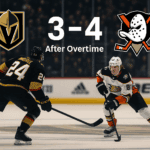
Vegas Golden Knights Fall 3-4 in Overtime as Anaheim’s Young Core Steals a Statement Win

Vegas Golden Knights Fall 3-4 in Overtime as Anaheim’s Young Core Steals a Statement Win

Date: November 9, 2025
Author: IHM Newsroom

Game Recap

Vegas Golden Knights Fall 3-4 in Overtime as Anaheim’s Young Core Steals a Statement Win

The Anaheim Ducks delivered another statement performance, outlasting the Vegas Golden Knights 3-4 in overtime inside T-Mobile Arena. What looked early like a routine home win for Vegas quickly unraveled into a showcase of Anaheim’s fast transition game and the dominance of their emerging core.

Vegas struck first when Brett Howden redirected a feed from Karlsson and Hanifin at 05:47 to make it 1-0. But Anaheim answered late in the period as Frank Vatrano finished a clean passing sequence from Zellweger and Trouba, leveling the score at 1-1.

Second Period: Ducks Surge Takes Control

The middle frame belonged entirely to Anaheim. The Ducks punished Vegas on every mistake, winning races, stacking possession time, and forcing the Golden Knights to defend for extended stretches.

Leo Carlsson took over the game with two goals – a quick one at 10:39 and another at 16:50 – both driven by Anaheim’s aggressive puck movement and elite zone entries. Vegas struggled with discipline, taking multiple penalties and losing structure in their breakouts.

Through 40 minutes, Anaheim led 1-3 and looked fully in control.

Third Period: Vegas Fights Back

Vegas responded with urgency. Pavel Dorofeyev cut the deficit to 2-3 at 03:56 on a power play, finishing after a slick setup from Jack Eichel. The arena lifted, momentum flipped, and Anaheim got pinned in their own end.

At 14:53, Kaedan Korczak tied the game 3-3 after a heavy shift by the Marner-Barbashev line. The Golden Knights pushed hard for the winner, generating rush chances and back-to-back looks for Eichel and Marner.

Anaheim held on and forced overtime.

Overtime: Ducks Close It Out

OT lasted only 4:28. A broken play turned into a 2-on-1 for Anaheim, and Jacob Trouba buried the game-winner off a perfect pass from Carlsson, sealing a dramatic 3-4 victory for the Ducks.


IHM Verdict

Anaheim Ducks: A resilient, structured, confident team. Their young group doesn’t blink under pressure, and their transition pace is elite. They continue to look like a legitimate top-3 Pacific team.

Vegas Golden Knights: The quality is there, but the discipline is not. Penalties, sloppy breakouts, and late neutral-zone turnovers cost them a winnable game. Even at home, control slipped quickly once Anaheim started dictating pace.


Questions & Answers | IHM Performance Metrics

Why did Anaheim control most of the second period?

Anaheim’s controlled exits and clean entries overwhelmed Vegas. With Zellweger and LaCombe driving tempo, the Ducks consistently attacked Vegas in motion and created mismatches inside the offensive zone.

What changed for Vegas in the third period?

Vegas simplified their approach – direct entries, more inside-lane pressure, and increased shot volume from the Eichel line. Their forecheck finally disrupted Anaheim’s rhythm, creating turnovers and rebound chances.

What was the biggest deciding factor in overtime?

Anaheim executed with precision. One broken puck battle turned into instant transition, and their young core read the 2-on-1 perfectly. Trouba’s finish was clinical, but Carlsson’s patience created the moment.

Did penalties affect the game flow?

Yes – significantly. Vegas took several momentum-killing minors, especially in the second period, giving Anaheim full control. Anaheim stayed composed and capitalized on the extra ice.

How important was Leo Carlsson to Anaheim’s win?

Carlsson was dominant – two goals, an OT assist, strong puck touches, and elite reads. He controlled tempo in key moments and outplayed Vegas’ top centers shift-for-shift.


Signature: IHM Newsroom - The Fastest, Sharpest Hockey Coverage Worldwide