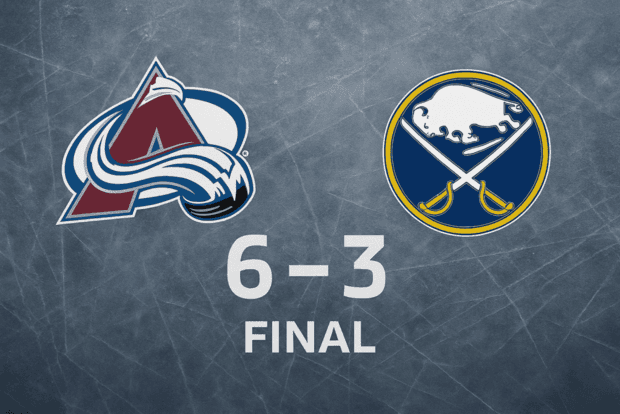
Colorado Avalanche 6-3 Buffalo Sabres: Necas Drives Avalanche Comeback Push
Date: 14 November 2025 | Author: IHM News
Martin Necas posted a multi-goal performance and Colorado turned a tense 3-3 game into a statement home win over Buffalo.
Colorado’s top offensive core needed a response night, and they delivered. After a wild first period in Denver that ended 3-2 for the Avalanche, the Sabres battled back to level the score in the second. In the final frame, however, Colorado’s depth and puck-movement finally broke Buffalo’s resistance, with Necas and captain Gabriel Landeskog finishing the job to secure a 6-3 victory.
Colorado came out flying, attacking off the rush and off offensive-zone faceoffs. Necas opened the scoring less than a minute into the game off a low slot feed from Cale Makar, immediately tilting the ice. Artturi Lehkonen then doubled the lead on another quick-strike sequence where the Avalanche recovered a dump-in, changed sides high in the zone, and hit Lehkonen in the soft ice between Buffalo’s weak-side defenseman and the slot defender.
Buffalo answered with pushback of their own. The Sabres used longer offensive shifts with layered support below the goal line, and they were rewarded when Brandon Byram jumped into the play to beat the coverage from the left circle. Even after Ben Nelson restored Colorado’s two-goal cushion with a middle-lane drive, Buffalo stayed in it, as Jordan Greenway cut the margin to 3-2 by winning inside position at the crease and jamming home a rebound.
The second period turned into more of a special-teams and details battle. Penalties on Colorado gave Buffalo repeated looks with the extra skater, and the Sabres finally converted when Tage Thompson ripped a power-play one-timer from the right flank to make it 3-3. Colorado answered quickly, though, as Gavin Brindley finished a well-executed delayed attack - the Avalanche worked the puck low-to-high, pulled Buffalo’s box apart, and Brindley arrived late on the weak side to beat Ukko-Pekka Luukkonen for 4-3.
In the third, Colorado shifted into a more controlled, veteran type of game. They tightened their gap control in the neutral zone, forcing Buffalo to chip pucks in and skate through contact rather than entering clean with possession. That structure created counter-attack windows; Necas capitalized again late in the period off a quick give-and-go with Nathan MacKinnon to push the lead to 5-3. With Buffalo’s net empty, Landeskog sealed the result, reading a Sabres D-to-D miscue at the blue line and sliding the puck the length of the ice into the open cage.
Key Numbers | IHM Performance Metrics
- Shots on goal: Colorado 33, Buffalo 22
- Shot attempts off target: Colorado 24, Buffalo 17
- Blocked shots: Colorado 11, Buffalo 12
- Goaltender saves: Colorado 19, Buffalo 27
- Penalty minutes: Colorado 8, Buffalo 4
At even strength, Colorado’s forecheck (pressure on the puck in the offensive zone) layered effectively, especially from the second period on, forcing Buffalo’s defense to move pucks under duress and limiting controlled exits.
Coach Mark comment
Colorado did an excellent job of correcting in-game issues after Buffalo’s power-play equalizer. The Avalanche tightened their neutral-zone spacing and stopped trading rushes, which is what allowed Necas and MacKinnon to attack in better, more controlled situations. If Colorado keeps this level of puck support through the middle, they will win a lot of these high-event games.
Questions & Answers | IHM Performance Metrics
How did Colorado create such a strong start offensively?
The Avalanche stacked speed through the middle and used early cross-ice passes at the blue line to disorganize Buffalo’s gap control. That generated inside-lane looks for Necas and Lehkonen before the Sabres could settle their defensive zone structure.
What changed after Buffalo tied the game 3-3?
Colorado shifted from run-and-gun to a more compact neutral-zone posture, using a tighter three-man layer between the red line and their own blue. That limited Buffalo’s controlled entries and turned the game into one of retrievals and wall battles, which favoured Colorado’s heavier, more experienced forwards.
How important was special-teams play?
Buffalo’s power-play goal from Thompson kept them in the game and briefly seized momentum, but Colorado’s penalty kill adjusted by tightening seams through the middle and forcing outside shots. On the other side, even when Colorado did not score on the man advantage, they generated enough zone time to tire out Buffalo’s key penalty killers.
Which Avalanche players stood out in terms of driving play?
Necas drove the attack with his puck-carrying and shot volume, Makar controlled breakouts and offensive-zone blue-line play, while MacKinnon dictated pace through the middle. Together, that trio consistently tilted the ice in Colorado’s favour in terms of zone time and quality looks.
What is the bigger takeaway for Buffalo from this loss?
The Sabres showed resilience by erasing a two-goal deficit and striking on special teams, but they struggled once Colorado raised the forecheck pressure. Cleaning up defensive-zone exits and limiting dangerous turnovers under pressure will be key if they want to close out similar games on the road.
More NHL coverage: Visit the NHL section on IHM for daily news, analysis and advanced breakdowns.