Tag: Pacific Division

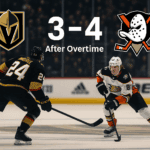
Vegas Golden Knights Fall 3-4 in Overtime as Anaheim’s Young Core Steals a Statement Win

Vegas Golden Knights Fall 3-4 in Overtime as Anaheim’s Young Core Steals a Statement Win

Date: November 9, 2025
Author: IHM Newsroom

Game Recap

Vegas Golden Knights Fall 3-4 in Overtime as Anaheim’s Young Core Steals a Statement Win

The Anaheim Ducks delivered another statement performance, outlasting the Vegas Golden Knights 3-4 in overtime inside T-Mobile Arena. What looked early like a routine home win for Vegas quickly unraveled into a showcase of Anaheim’s fast transition game and the dominance of their emerging core.

Vegas struck first when Brett Howden redirected a feed from Karlsson and Hanifin at 05:47 to make it 1-0. But Anaheim answered late in the period as Frank Vatrano finished a clean passing sequence from Zellweger and Trouba, leveling the score at 1-1.

Second Period: Ducks Surge Takes Control

The middle frame belonged entirely to Anaheim. The Ducks punished Vegas on every mistake, winning races, stacking possession time, and forcing the Golden Knights to defend for extended stretches.

Leo Carlsson took over the game with two goals – a quick one at 10:39 and another at 16:50 – both driven by Anaheim’s aggressive puck movement and elite zone entries. Vegas struggled with discipline, taking multiple penalties and losing structure in their breakouts.

Through 40 minutes, Anaheim led 1-3 and looked fully in control.

Third Period: Vegas Fights Back

Vegas responded with urgency. Pavel Dorofeyev cut the deficit to 2-3 at 03:56 on a power play, finishing after a slick setup from Jack Eichel. The arena lifted, momentum flipped, and Anaheim got pinned in their own end.

At 14:53, Kaedan Korczak tied the game 3-3 after a heavy shift by the Marner-Barbashev line. The Golden Knights pushed hard for the winner, generating rush chances and back-to-back looks for Eichel and Marner.

Anaheim held on and forced overtime.

Overtime: Ducks Close It Out

OT lasted only 4:28. A broken play turned into a 2-on-1 for Anaheim, and Jacob Trouba buried the game-winner off a perfect pass from Carlsson, sealing a dramatic 3-4 victory for the Ducks.


IHM Verdict

Anaheim Ducks: A resilient, structured, confident team. Their young group doesn’t blink under pressure, and their transition pace is elite. They continue to look like a legitimate top-3 Pacific team.

Vegas Golden Knights: The quality is there, but the discipline is not. Penalties, sloppy breakouts, and late neutral-zone turnovers cost them a winnable game. Even at home, control slipped quickly once Anaheim started dictating pace.


Questions & Answers | IHM Performance Metrics

Why did Anaheim control most of the second period?

Anaheim’s controlled exits and clean entries overwhelmed Vegas. With Zellweger and LaCombe driving tempo, the Ducks consistently attacked Vegas in motion and created mismatches inside the offensive zone.

What changed for Vegas in the third period?

Vegas simplified their approach – direct entries, more inside-lane pressure, and increased shot volume from the Eichel line. Their forecheck finally disrupted Anaheim’s rhythm, creating turnovers and rebound chances.

What was the biggest deciding factor in overtime?

Anaheim executed with precision. One broken puck battle turned into instant transition, and their young core read the 2-on-1 perfectly. Trouba’s finish was clinical, but Carlsson’s patience created the moment.

Did penalties affect the game flow?

Yes – significantly. Vegas took several momentum-killing minors, especially in the second period, giving Anaheim full control. Anaheim stayed composed and capitalized on the extra ice.

How important was Leo Carlsson to Anaheim’s win?

Carlsson was dominant – two goals, an OT assist, strong puck touches, and elite reads. He controlled tempo in key moments and outplayed Vegas’ top centers shift-for-shift.


Signature: IHM Newsroom - The Fastest, Sharpest Hockey Coverage Worldwide


IHM Performance Metrics Report: Why the Ducks and Utah Mammoth Suddenly Look Like Analytics Superpowers

IHM Performance Metrics Report: Why the Ducks and Utah Mammoth Suddenly Look Like Analytics Superpowers

Date: November 8, 2025 | Author: IHM News Analytics


Why the Ducks and Utah Mammoth suddenly look like analytics superpowers

A deep breakdown of two surprising engines of the 2025-26 NHL season

The first month of the season has delivered two unexpected machines of chaos: Anaheim Ducks, suddenly the brightest offensive show in the West, and Utah Mammoth, who instantly found an elite play-driver in Nick Schmaltz.

But behind the flurries of goals, comebacks and nightly highlights lies a far more revealing truth. This is an analytics-based evolution built on:

  • high-danger efficiency
  • elite transitional play
  • explosive speed clusters
  • possession metrics that indicate sustainability

IHM EDGE broke down both teams under the microscope – here’s what we found.


🦆 SECTION I – Anaheim Ducks: Inside the engine of a sudden powerhouse

1. High-danger ecosystem

Anaheim aren’t just scoring a lot – they are scoring the right way. The Ducks have already generated 28 high-danger goals, more than most of their division combined. Chris Kreider and Cutter Gauthier are currently among the top high-danger producers in the NHL.

Carlsson, Sennecke and Terry form a constant pressure triangle built on:

  • fast zone entries
  • short-link passing
  • finishes from the kill zone (2-4 meters)

This is not randomness - it’s a system. And it works.

2. Cutter Gauthier: The EDGE monster exceeding every projection

Gauthier is one of the most “unstoppable” analytical profiles in the league right now. His EDGE metrics look engineered:

  • average shot speed – 97th percentile
  • speed bursts – 97th percentile
  • hardest shot – 93rd percentile
  • mid-range goals – leads NHL
  • Goals Above Projected – +5.91 (1st in NHL)

He scores shots that models classify as low-probability. When a player beats the model itself – we’re dealing with elite talent.

3. Territorial control – Ice Tilt as a predictor of future success

Anaheim currently rank No. 1 in the NHL in first-period Ice Tilt advantage. This means they take control of rink territory and game tempo early.

Carlsson (+63) and Gauthier (+60) dominate 5v5 shot differential like established superstars – at age 20 and 21.

4. Goaltending stability

Dostal has quietly become a stabilizer:

  • elite mid-range SV%
  • 7-3-1 record
  • 5v5 save% above league average

For a team that has lacked a foundation in net for years, this is transformative.


🦬 SECTION II – Utah Mammoth: Schmaltz’s reinvention and the rise of a new top-six

Utah play fast, aggressive and structured – but their entire offensive shape is glued together by one player: Nick Schmaltz, the most underrated starter of the season.

1. Shot profile: dangerous from every lane

Schmaltz is one of the rare forwards producing elite volume from all three shot tiers:

  • high-danger – 96th percentile
  • mid-range – 95th percentile
  • long-range – 92nd percentile

42 shots in 12 games – the best pace of his entire career. Utah are top-two in shot differential, which confirms structure, not luck.

2. High-danger finishing touch

Five high-danger goals – fourth in the NHL. Two goals on deflections – placing him in rare company with Crosby and Miles Wood.

Schmaltz has long been a high-danger creator, but now he’s finishing at a career-high level.

3. Speed metrics: Utah = a missile

Schmaltz:

  • 20+ mph bursts – 84th percentile
  • total distance – 93rd percentile

Utah as a whole:

  • Cooley – second-fastest skater in the NHL
  • team – 4th in total speed bursts
  • shots allowed per game – 2nd fewest in NHL

This is a team that skates fast without losing structural discipline.

4. Chemistry: Keller – Schmaltz – Hayton

This long-developing trio finally has the personnel to play at full throttle. They drive Utah’s PP1 and tempo game, making possession swings almost automatic.


🚀 SECTION III – What Ducks and Mammoth have in common

Both teams:

  • dominate high-danger creation
  • apply speed as a core identity, not just a tool
  • are led by young stars who already think like veterans
  • show sustainable possession trends
  • benefit from EDGE-positive profiles across the top six
  • look structurally built, not statistically lucky

🎯 IHM VERDICT

Ducks:

Legitimate contenders for a top-2 finish in the Pacific Division. Their metrics match conference finalists – not pretenders.

Utah Mammoth:

Massively underrated playoff candidates. Their top-six is good enough to drag them into contention all season.


Questions & Answers | IHM Performance Metrics

Why are the Anaheim Ducks performing so well this season?

The Ducks rank among the NHL’s best teams in high-danger scoring, first-period territorial control (Ice Tilt) and 5-on-5 possession metrics. Their young core, led by Carlsson and Gauthier, drives elite shot volume and transition pace.

What makes Cutter Gauthier’s analytics profile elite?

Gauthier ranks in the 93rd-99th percentiles in shot power, speed bursts, midrange scoring and goals above expected. He consistently beats projected goal models.

Why is Nick Schmaltz breaking out for the Utah Mammoth?

Schmaltz produces high-volume shots from every scoring tier and ranks top-five in high-danger goals this season. His skating metrics and chemistry with Keller elevate Utah’s entire top six.

Are the Ducks and Mammoth legitimate playoff contenders?

Both teams show sustainable shot-differential and chance-generation metrics, suggesting long-term competitiveness rather than early-season variance.