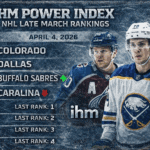
Tag: NHL Power Rankings

IHM POWER INDEX - NHL 1-32 Late March Rankings | IceHockeyMan

IHM POWER INDEX – NHL 1-32 Late March Rankings | IceHockeyMan

IHM POWER INDEX – NHL 1-32 Late March Rankings

Date: April 4, 2026

Author: IHM News

The Trade Deadline Edition on March 9 captured the league right after the roster reshaping phase. Since then, the board has tightened, some clubs have confirmed their rise, and others have shown that deadline posture does not always equal late-season control. This edition of the IHM POWER INDEX is built on current form, points pace, structural stability, playoff pressure, and whether a team actually looks sustainable heading into the final stretch.

For continuity, every club keeps a direct reference to the previous IHM ranking from March 9. This is the official Late March Edition of the IHM POWER INDEX, shaped by current points pace, recent trajectory, roster condition, and how convincing each team looks as the regular season moves toward the finish line.

And because this is the stretch-run edition, every team also gets one simple April Need – the one thing that matters most from now to the finish.


1. Colorado Avalanche

Previous IHM Rank (Mar 9): 1 · Movement:

Colorado remains at the top because the overall case is still the strongest in hockey. The pace is not quite as absurd as it was earlier, but the points percentage is elite, the roster depth still feels layered, and the Avs continue to look like the team most capable of winning in multiple styles. Whether the game opens up or tightens into playoff structure, Colorado still has the answers.

April Need: Preserve health and keep the engine sharp, because the top spot only matters if the core arrives intact.

2. Dallas Stars

Previous IHM Rank (Mar 9): 2 · Movement:

Dallas stays second and keeps pushing Colorado. The Stars do not always create the same visual chaos as the Avs, but their game remains one of the cleanest in the league. Their pace versus expectation is telling – this was supposed to be a slight step back season, and instead they accelerated. Dallas looks like a real heavyweight and nothing about the last stretch has weakened that read.

April Need: Keep pressure on Colorado while protecting structure, because Central control may matter more than people think.

3. Buffalo Sabres

Previous IHM Rank (Mar 9): 6 · Movement: ▲3

Buffalo jumps again and now enters the true upper tier of the board. This is no longer just a nice surprise story. The Sabres have one of the biggest positive gaps in the league between preseason expectation and current pace, and more importantly, they look like a team with real belief. The young talent is no longer floating inside chaos. It is finally operating inside something credible.

April Need: Prove this surge can survive pressure, because real respect comes when expectations get heavy.

4. Carolina Hurricanes

Previous IHM Rank (Mar 9): 3 · Movement: ▼1

Carolina slips one spot, but this is not a collapse. The Hurricanes are still one of the strongest structure teams in the league and their points pace remains elite. The reason Buffalo edges them here is not because Carolina stopped being dangerous. It is because Buffalo’s recent rise has been too loud to ignore. Carolina still looks like a division-winning machine. The real question, as always, is whether the spring ceiling matches the regular-season floor.

April Need: Carry a stable crease into playoff mode, because the five-man structure is already good enough.

5. Minnesota Wild

Previous IHM Rank (Mar 9): 4 · Movement: ▼1

Minnesota slides a slot but remains firmly elite. Their current pace is still strong, they are well above preseason expectation, and the identity still feels playoff-compatible. This is a team that can survive structured games without needing constant offensive fireworks. They remain one of the safest difficult-outs in the field.

April Need: Keep the defensive core healthy enough to protect the team’s structural identity.

6. Tampa Bay Lightning

Previous IHM Rank (Mar 9): 5 · Movement: ▼1

Tampa slips only because the teams above them kept accelerating. The Lightning are still on a strong pace, still outperforming expectations, and still look like the most playoff-literate team in Florida by a mile. They have restored enough rhythm to stay in the inner contender band.

April Need: Maintain lineup energy, because this group becomes dangerous quickly once rhythm locks in.

7. Pittsburgh Penguins

Previous IHM Rank (Mar 9): 8 · Movement: ▲1

Pittsburgh inches up again. This is one of the season’s most credible surprise teams and the board has to reward that. They have moved from dangerous-if-healthy territory into legitimate playoff-bound credibility. The structure still wobbles at times, but the overall story is now far stronger than anyone expected months ago.

April Need: Keep the late-game details clean, because that is where good seasons become real playoff seasons.

8. Montreal Canadiens

Previous IHM Rank (Mar 9): 7 · Movement: ▼1

Montreal drops one spot, mostly because Pittsburgh’s case strengthened. The Canadiens are still doing what they wanted to do this year: take a real step forward without pretending they are already finished. The pace is strong enough, the top-end pieces remain reliable, and the team looks more mature than it did earlier in the season.

April Need: Protect the team identity in tight games, because maturity matters most now.

9. New York Islanders

Previous IHM Rank (Mar 9): 10 · Movement: ▲1

The Islanders climb one spot and continue to be exactly what opponents hate: disciplined, annoying, and hard to drag out of their game. Matthew Schaefer has clearly changed the franchise’s outlook, and the team’s current pace backs up the feeling that they are more than just a spoiler.

April Need: More finishing support, because low-event hockey becomes dangerous when one mistake decides everything.

10. Boston Bruins

Previous IHM Rank (Mar 9): 11 · Movement: ▲1

Boston moves into the top ten because the recovery is now too real to ignore. They have already passed last season’s total and beaten the preseason line. This may not be an elite Bruins team by historic standards, but it is absolutely a serious one again.

April Need: Keep the goaltending form steady, because that remains the multiplier for the whole group.

11. Columbus Blue Jackets

Previous IHM Rank (Mar 9): 14 · Movement: ▲3

Columbus keeps rising. The Blue Jackets are no longer living off vibes or fun energy alone. The pace is now respectable, the structure is better, and they look like a team that has actually learned how to stay in the race. They are still not elite, but they are becoming credible.

April Need: Convert enough chances to reward the framework, because the team game is increasingly respectable.

12. Detroit Red Wings

Previous IHM Rank (Mar 9): 9 · Movement: ▼3

Detroit falls a bit because the teams around them tightened their case more effectively. The overall trajectory is still good, but the margin has become thinner than it looked a few weeks ago. The offensive talent remains enough to matter. The concern is whether the total team game is strong enough to support it under pressure.

April Need: Sharpen defensive suppression, because the offense deserves cleaner conditions in front of it.

13. Ottawa Senators

Previous IHM Rank (Mar 9): 17 · Movement: ▲4

Ottawa rises because the floor has become a little less fragile. They are roughly tracking preseason expectation, but the deeper issue is that other Eastern teams jumped higher. Even so, the Sens have enough raw talent to remain relevant, and the structure looks less chaotic than it did earlier.

April Need: Turn the talent into consistent five-on-five offense, because the names should produce more together.

14. Anaheim Ducks

Previous IHM Rank (Mar 9): 13 · Movement: ▼1

Anaheim slips one spot, but the read on them remains positive. This team has clearly jumped ahead of schedule and is now being judged like a real race team, not a cute young project. That is progress. The pressure games are real now, and that matters.

April Need: Learn to handle division pressure, because the youth no longer gets graded softly.

15. Utah Mammoth

Previous IHM Rank (Mar 9): 15 · Movement:

Utah stays right where it was. The pace is almost exactly in line with preseason expectation, but the bigger story is that Year 2 playoff-life is becoming increasingly believable. This still does not look like a finished contender, but it does look like a serious young club.

April Need: Find another scoring layer, because the overall process is strong enough to justify wanting more finish.

16. Edmonton Oilers

Previous IHM Rank (Mar 9): 16 · Movement:

Edmonton remains one of the hardest teams on the board to judge. The ranking stays the same because the contradiction stays the same. The elite star power still screams danger, but the pace is now well below preseason expectation and the Draisaitl absence only sharpens the discomfort. This is still a dangerous team. It is just not a trustworthy one.

April Need: Survive the injury drag without letting the season slip into wasted-star territory.

17. Vegas Golden Knights

Previous IHM Rank (Mar 9): 12 · Movement: ▼5

Vegas falls again. The Pacific noise is no longer theoretical. The Knights have drifted off their expected pace and no longer feel like a secure heavyweight. They still have enough experience and system intelligence to be annoying in spring, but the aura is not the same right now.

April Need: Reclaim lineup rhythm fast, because the conference is no longer waiting for Vegas to wake up.

18. Philadelphia Flyers

Previous IHM Rank (Mar 9): 20 · Movement: ▲2

Philadelphia gets a small bump because the overall mix is still promising. They are not fully there yet, but the NHL group plus the dynamic prospect pipeline make the future feel more dangerous than the current ranking suggests. This team still has identity, even if the finish is not complete.

April Need: Add enough offense to reward the structure, because the effort level is not the problem.

19. Washington Capitals

Previous IHM Rank (Mar 9): 18 · Movement: ▼1

Washington slides a slot and still feels like a team caught between eras. The current pace is underwhelming versus expectation, and the bigger issue remains clarity. Ovechkin still gives the team emotional gravity, but the overall long-view remains murky.

April Need: Pick a clean direction, because half-transition teams usually stay stuck.

20. Seattle Kraken

Previous IHM Rank (Mar 9): 19 · Movement: ▼1

Seattle stays in the same general band. The pace is improved enough from last season to keep them in the mix, but the team still does not feel fully trustworthy. They can complicate a race. They have not yet proven they can define one.

April Need: Night-to-night consistency, because the same issue keeps blocking real trust.

21. Los Angeles Kings

Previous IHM Rank (Mar 9): 23 · Movement: ▲2

Los Angeles gets a slight lift, not because the concerns vanished, but because teams below them feel even less complete. The Kings still look like a group trying to send Anze Kopitar out with one more relevant push. The structure is there in pieces. The offensive certainty still is not.

April Need: Find real scoring support, because the defensive template alone is not enough.

22. New Jersey Devils

Previous IHM Rank (Mar 9): 25 · Movement: ▲3

New Jersey climbs a bit, but this is more stabilization than revival. Injuries wrecked too much of the season for a clean recovery story, yet the roster still has enough underlying talent to sit above the true bottom group. This remains one of the league’s most frustrating teams.

April Need: Get the core healthy enough to reset the offseason conversation properly.

23. San Jose Sharks

Previous IHM Rank (Mar 9): 21 · Movement: ▼2

San Jose slips slightly, but the future-facing read remains positive. Macklin Celebrini has already become more than a prospect headline. He is a real NHL force. The issue is simply that the roster maturity may still be arriving a little too early for a full race breakthrough.

April Need: Add veteran calm around the young core, because the next phase deserves better insulation.

24. Florida Panthers

Previous IHM Rank (Mar 9): 24 · Movement:

Florida stays exactly where it was, and that says plenty. The injuries and long-cycle fatigue never really let this team become itself. Playing without Barkov all year and without Tkachuk for most of the first half destroyed too much of the foundation. This never looked like a real title defense.

April Need: Health and emotional reset, because reputation is no longer carrying the season.

25. Nashville Predators

Previous IHM Rank (Mar 9): 26 · Movement: ▲1

Nashville climbs a slot mostly because there is still enough pride and structure here to stay on the edge of the race. The offensive ceiling remains limited, but the season has unfolded close to expectation. That is not exciting. It is just stable enough to beat a few teams below them.

April Need: Finishers, because too much of the work still dies before reward arrives.

26. Winnipeg Jets

Previous IHM Rank (Mar 9): 27 · Movement: ▲1

Winnipeg rises one spot, though that does not make the picture comfortable. This is still a major drop from last season’s Presidents’ Trophy standard. The pace has collapsed relative to expectation, and the margin around the team has disappeared. They are still here mostly because the clubs below them remain more broken.

April Need: Recover defensive calm and top-end goaltending form, because otherwise the season never stabilizes.

27. Toronto Maple Leafs

Previous IHM Rank (Mar 9): 22 · Movement: ▼5

Toronto takes another real hit. The fall from last season’s division-champ profile to likely missing the postseason is too large to soften. The issue is not talent. It is total defensive order, game management and structural trust. The top six can still flash, but the team picture leaks too often.

April Need: Honest structural repair, because the summer questions are getting louder every week.

28. New York Rangers

Previous IHM Rank (Mar 9): 30 · Movement: ▲2

The Rangers get a minor lift, but the overall story remains ugly. The deadline already told us where this was going, and the pace confirms it. This is still a team that moved backward while expectations pointed the other way. Name value continues to outrun reality.

April Need: Full organizational honesty, because cosmetic fixes will not solve this version of the Blueshirts.

29. St. Louis Blues

Previous IHM Rank (Mar 9): 31 · Movement: ▲2

St. Louis rises a little because the ranking now better reflects the front-office logic. The current team is still weak, but the process at least makes sense. They are no longer pretending this is something it is not. That clarity matters, even if the on-ice product remains limited.

April Need: Patience and development focus, because this is clearly about the next phase now.

30. Chicago Blackhawks

Previous IHM Rank (Mar 9): 28 · Movement: ▼2

Chicago slips because the injuries stripped too much away from a season that had at least some early promise. Connor Bedard and Frank Nazar missing time changed the tone, and the points pace now reflects a team with future hope but very little present insulation.

April Need: Get the young core healthy again, because the long-term picture still depends on their growth runway.

31. Calgary Flames

Previous IHM Rank (Mar 9): 29 · Movement: ▼2

Calgary drops again, although the long-term read still makes sense. The current team is weak and the pace is poor, but Craig Conroy’s plan is at least coherent. That matters more than cosmetic respectability at this point. This is a futures-facing club now.

April Need: Keep building the pipeline correctly, because this phase is about what comes next.

32. Vancouver Canucks

Previous IHM Rank (Mar 9): 32 · Movement:

Vancouver remains last. Nothing in the current pace or overall direction changes that. The Quinn Hughes departure had already pushed the club into identity-collapse territory, and the later selling only confirmed the reset. This team is not searching for one adjustment. It is searching for a new backbone.

April Need: Time and a new structural center of gravity, because this reset is still only beginning.


Coach Mark Comment

Late-season power rankings are where people often make the wrong mistake. They fall in love with points, streaks and noise, but they ignore the much harder question: what kind of hockey actually survives when the season tightens and every shift starts carrying playoff weight?

That is why I never read the standings table as the full truth. A team can collect points in March and still look structurally soft. Another team can sit a little lower but already play the kind of detail that travels into heavy spring hockey. Those are not the same things.

At this stage of the season, I care less about who can overwhelm weak opponents on talent alone and much more about who can control difficult game states. Can the team protect a one-goal lead without panicking? Can it defend second efforts around the crease? Can it handle a forecheck that removes clean exits? Can it survive a flat first period and still re-establish structure by the second? That is real late-season credibility.

This is where Colorado continues to separate itself. They do not just have stars. They have solutions. If the game turns into pace, they can run. If it becomes territorial, they can still hold shape. If special teams decide the night, they have game-breakers. That kind of layered flexibility is what a true number-one team looks like.

Dallas belongs right there with them for a different reason. Their game is less explosive visually, but often more mature. The Stars understand spacing, patience and rhythm. They do not always need to prove they are the fastest or flashiest team. They play like a group that already understands the emotional temperature of spring hockey.

Buffalo is the most important riser on this board because their jump is not built on hype anymore. Earlier in the season, it was fair to ask whether they were just surfing talent and confidence. Now the answer looks different. They are defending with more purpose, reading pressure better and carrying themselves like a team that expects to matter. That is a serious developmental shift. It changes how opponents prepare for them.

Carolina remains one of the purest structure teams in the league. Their problem has never been system quality. Their problem is whether their spring ceiling fully matches their regular-season floor. They close space well, they pressure intelligently and they force opponents into uncomfortable areas. But at the highest playoff level, eventually structure alone needs a finishing layer behind it.

Then you have teams like Edmonton and Toronto, where the conversation becomes more uncomfortable. Star power can keep a team relevant for a long time. But star power without stable team behavior eventually creates false confidence. Edmonton still has enough elite talent to scare anyone. Toronto still has enough offensive skill to look dangerous in flashes. But if the defensive timing, puck management and support layers are not trustworthy, you are not looking at a contender. You are looking at a threat with visible fractures.

Vegas is another fascinating case. In previous years, the badge alone almost forced people to treat them like a locked-in heavyweight. But late in a season, reputation starts losing value. The league changes too quickly for that. If rhythm is gone, if injuries keep disrupting chemistry and if the pace drops below expectation, then the aura becomes memory instead of truth. That is where Vegas feels vulnerable now.

The middle of the board is where the most important work happens. Teams like Columbus, Ottawa, the Islanders, Montreal and Philadelphia are all trying to answer the same question in different ways: are we just alive, or are we actually becoming difficult? There is a huge difference between being in the race and being built for the race. One is about standings pressure. The other is about hockey identity.

That is why I respect teams that know exactly what they are. The Islanders may not overwhelm, but they can drag teams into their kind of game. Montreal may not dominate every night, but they look more emotionally organized than many more talented teams. Columbus has begun to replace loose energy with real structure. Those are signs of a club learning how to become serious.

At the bottom of the board, the key distinction is not talent. It is direction. A weak team with a clear plan is in a better place than a more talented team living in denial. Calgary at least knows this phase is about the future. St. Louis understands what has to be rebuilt. Vancouver, by contrast, still feels like a team that has lost not only players, but its center of emotional gravity. That is the hardest thing to repair.

Late-season hockey always strips away decoration. It exposes poor habits, punishes soft defensive layers and amplifies every weakness in roster construction. That is why this version of the IHM POWER INDEX matters more than a midwinter edition. At this point, you are no longer ranking just teams. You are ranking truth under pressure.

Coach Mark final verdict: In April, I trust teams that can defend without fear, attack without forcing, and recover their structure quickly when the game turns ugly. That is the real test. Talent starts the conversation. Playoff behavior finishes it.


Fan Pulse

Which team outside the current IHM top five is the most dangerous playoff problem right now?

  • Buffalo Sabres
  • Pittsburgh Penguins
  • Montreal Canadiens
  • Tampa Bay Lightning
  • Other – drop your pick in the comments

Second question: which team in the middle of the IHM board do you trust the least heading into the final push?

  • Edmonton Oilers
  • Vegas Golden Knights
  • Detroit Red Wings
  • Toronto Maple Leafs
  • Other – make your case

This is where real hockey debate begins: not just who has points, but who actually looks built to survive spring pressure.


IHM Q&A – Reading The Late March POWER INDEX

Why does Colorado remain number one?

Because no other team combines star power, layered depth, structural flexibility and current pace as cleanly as the Avalanche do. Even after cooling from an absurd early rate, they still look like the league’s most complete regular-season machine.

Who made the biggest move since the March 9 IHM board?

Buffalo. The Sabres climbed from No. 6 to No. 3 and now look like more than a nice story. Their current pace and overall credibility forced the board to elevate them into the real top tier.

Which team took the hardest new hit?

Vegas and Toronto both took notable drops in this edition. Vegas no longer looks like a secure Pacific heavyweight, while Toronto’s structural instability keeps dragging them lower despite the talent on paper.

Which middle-tier team is rising the most credibly?

Columbus. The Blue Jackets have moved beyond “interesting” and into “respectable.” The structure is better, the pace is real enough, and the team no longer feels easy to dismiss.

Who is the most misleading team on the board?

Edmonton. The stars still make them dangerous, but the current pace and injury pressure say incomplete. Their ceiling remains high. Their trust level does not.

Which team outside the top six feels most playoff-dangerous?

Pittsburgh. If the health holds and the late-game management stays clean enough, they have enough experience and enough emotional gravity to become a very uncomfortable matchup.

Why is Buffalo above Carolina now?

Because the Sabres’ surge has become impossible to treat as temporary. Carolina is still one of the strongest teams in the league, but Buffalo’s combination of pace, belief and overperformance versus expectation gave them the edge in this checkpoint.

Which lower-ranked teams at least have a clear long-term direction?

Calgary, St. Louis and Vancouver are all living in difficult present circumstances, but Calgary and St. Louis at least show organizational logic. Vancouver still feels the most emotionally and structurally broken of the three.

How should fans read movement in the IHM POWER INDEX?

Movement is not just about wins and losses. It reflects current form, points pace, roster health, schedule pressure, structural trust and whether a team actually looks sustainable as the season tightens.

When is the next full IHM POWER INDEX likely to come?

The next full 1-32 board should arrive at the final major regular-season checkpoint or just before the playoff field locks, with shorter IHM updates whenever injuries, streaks or major collapses force the board to react.


IHM POWER INDEX - NHL 1-32 Rankings

IHM POWER INDEX - NHL 1-32 Rankings

Date: March 9, 2026
Author: IHM News

IHM POWER INDEX - NHL 1-32 Trade Deadline Rankings

The Holiday Edition on December 21 captured the league before the winter grind and before the trade deadline chaos. Now the board has shifted again. Colorado still sits on top, but this version of the IHM POWER INDEX is shaped by deadline aggression, roster identity, Olympic aftershocks, and which teams look most sustainable for the final push into spring.

For continuity, every club keeps a direct reference to the previous IHM ranking from December 21. This is the official Trade Deadline Edition of the IHM POWER INDEX, built on form, IHM Metrics, injury context, deadline impact, star value, and how stable each team’s structure looks heading into the playoff race.

And because this is the deadline edition, every team also gets one simple March Need - the one thing that matters most for the stretch run.

1. Colorado Avalanche

Previous IHM Rank (Dec 21): 1 · Movement: -

Colorado stays on top of the IHM board. If anything, the deadline only strengthened their grip on the number one spot. Nathan MacKinnon is still driving the league’s most dangerous tempo, Cale Makar remains a game breaker from the back end, and the center depth now looks absurdly strong after the latest moves. The Avs do not just have top-end talent anymore. They have layers.

This is a team that can win through skill, speed, forecheck detail, or line matching. That combination is what keeps them above the rest of the field.

March Need: Health and rhythm, because the roster is now strong enough that the biggest threat is disruption, not weakness.

2. Dallas Stars

Previous IHM Rank (Dec 21): 2 · Movement: -

Dallas stays exactly where it was in the Holiday Edition, and that is not an insult. They remain one of the cleanest all-around teams in the league. The Stars do not always dominate the way Colorado does, but they manage game states like veterans who understand what spring hockey feels like.

Their structure is reliable, their top nine can hurt teams in waves, and the special teams remain dangerous. If Colorado did not exist, Dallas would have a real case for the top spot.

March Need: A hard edge in the Central race, because the path to the Cup may still run through Colorado.

3. Carolina Hurricanes

Previous IHM Rank (Dec 21): 3 · Movement: -

Carolina holds steady inside the top three. The formula has not changed. Five-man structure, suffocating blue-line pressure, disciplined layers, and enough goaltending to support it. The Hurricanes remain one of the most system-stable teams in the NHL.

They are not flashy every night, but they are always difficult. That reliability is exactly why they stay near the top of the IHM board.

March Need: A healthy, sharp crease, because the structure is already championship caliber.

4. Minnesota Wild

Previous IHM Rank (Dec 21): 4 · Movement: -

Minnesota remains in the elite tier. The Quinn Hughes effect is still real, Matt Boldy is playing some of the best hockey of his career, and the Wild look like a team that can beat opponents in different ways. They are more dynamic now than they were earlier in the season, but the core identity is still based on structure.

This is one of the few teams that can survive playoff-style games without needing chaos.

March Need: Defensive health, because losing too many minute-eaters could cut into their ceiling fast.

5. Tampa Bay Lightning

Previous IHM Rank (Dec 21): 7 · Movement: ▲2

Tampa climbs back into the top five. The Lightning still know how to build a season arc better than almost anyone. Even when the roster looks worn down, they find rhythm, keep scoring threats alive, and carry enough playoff intelligence to remain dangerous.

The latest stretch has reminded everyone that their window is not closed just because the rest of the Atlantic got louder.

March Need: Bodies. This remains a team that can contend if the injury card stops punishing them.

6. Buffalo Sabres

Previous IHM Rank (Dec 21): 25 · Movement: ▲19

Buffalo is the biggest climber on the board. This is not charity. This is recognition. They are finally behaving like a team rather than a collection of talent. The structure is sharper, the belief level is higher, and the playoff drought no longer feels like a permanent identity.

The trade deadline did not turn them into a finished product, but it confirmed that the league now has to take them seriously.

March Need: A true difference-maker on the blue line, because that is still the missing piece between good and dangerous.

7. Montreal Canadiens

Previous IHM Rank (Dec 21): 17 · Movement: ▲10

Montreal has turned into one of the most impressive risers in the Eastern Conference. The defensive game is more trustworthy, the offense still has enough top-six quality through Suzuki and Caufield, and the overall profile feels more mature than it did two months ago.

They do not dominate many games, but they have become a difficult out, and that matters a lot in March.

March Need: Clarity in goal, because the overall team structure deserves stable crease leadership.

8. Pittsburgh Penguins

Previous IHM Rank (Dec 21): 16 · Movement: ▲8

Pittsburgh climbs into the top eight. Even with Sidney Crosby injured, this group has kept fighting, and the goaltending story has become impossible to ignore. The Penguins still carry volatility, but their game looks more stable than it did in the Holiday Edition.

If Crosby returns on schedule, this is the kind of team nobody wants to see in a first-round matchup.

March Need: Clean late-game management, because too many good efforts still wobble in the final minutes.

9. Detroit Red Wings

Previous IHM Rank (Dec 21): 10 · Movement: ▲1

Detroit nudges upward. They remain one of the more interesting teams in the playoff race because their ceiling depends on whether the defensive structure can keep up with the offensive talent. Larkin, DeBrincat and the rest of the forward group still make them dangerous, but the margin for error is not huge.

They are not an elite team, but they are still a serious one.

March Need: Better defensive suppression, because the skill level deserves cleaner team defense in front of it.

10. New York Islanders

Previous IHM Rank (Dec 21): 11 · Movement: ▲1

The Islanders climb a slot and remain one of the league’s most quietly annoying opponents. The defensive spine is there, the younger pieces continue to grow, and they are staying relevant because they do not beat themselves often.

They are not built to overwhelm. They are built to drag teams into Islander hockey and make them live there.

March Need: More secondary finishing, because low-event hockey becomes dangerous when one bad bounce decides everything.

11. Boston Bruins

Previous IHM Rank (Dec 21): 12 · Movement: ▲1

Boston keeps moving in the right direction, but the deadline felt underwhelming relative to their opportunity. The structure is still solid, the special teams still matter, and Jeremy Swayman returning to form gives them real life. But they left some immediate help on the table.

That keeps them strong, but not fully maximized.

March Need: One real NHL-impact reinforcement, because the room earned more than minor side moves.

12. Vegas Golden Knights

Previous IHM Rank (Dec 21): 5 · Movement: ▼7

Vegas falls from the top tier into the lower edge of the playoff heavyweight group. That does not mean they are weak. It means the Pacific has become noisy, and Vegas has not looked as consistently convincing as earlier in the season. Injuries continue to complicate the picture.

Still, this is Vegas. Nobody is eager to draw them.

March Need: Lineup stability, because the system only looks truly elite when the core is intact.

13. Anaheim Ducks

Previous IHM Rank (Dec 21): 6 · Movement: ▼7

Anaheim remains a real playoff race factor, but they slide a bit because the conference around them got harsher and expectations are now higher. The John Carlson move was bold and sends a strong signal. The young core is no longer just interesting. It is relevant.

This group feels ahead of schedule, and that changes how we grade them.

March Need: Experience under pressure, because this is now a real games-that-matter environment.

14. Columbus Blue Jackets

Previous IHM Rank (Dec 21): 24 · Movement: ▲10

Columbus makes a serious jump. There is more structure in the game now, the young players are giving them identity, and they are no longer easy to dismiss as a fun-but-flawed team. They are still chasing, but they are in the mix because they skate fast and compete honestly.

They have become one of the more credible surprise threats in the East.

March Need: A little more finishing touch, because the framework is increasingly respectable.

15. Utah Mammoth

Previous IHM Rank (Dec 21): 21 · Movement: ▲6

Utah has real playoff-life energy. The market is buying in, the club has built more structure than most expansion-style teams ever manage this quickly, and the deadline did not kill that momentum. They are not a finished team, but they look more legitimate now than they did in December.

March Need: Top-end scoring punch, because the overall process is good enough to justify wanting more offense.

16. Edmonton Oilers

Previous IHM Rank (Dec 21): 13 · Movement: ▼3

Edmonton slips slightly, and the reason is straightforward. There is still McDavid. There is still Draisaitl. There is still offense. But the deadline did not do enough for a team with such a clear window. That matters.

The Oilers remain dangerous because elite star power can overwhelm almost anyone. But this was a chance to sharpen a contender, and instead they mostly managed around the edges.

March Need: True defensive and goaltending certainty, because McDavid’s window should not be handled cautiously.

17. Ottawa Senators

Previous IHM Rank (Dec 21): 23 · Movement: ▲6

Ottawa moves up into the upper-middle cluster because the raw talent still gives them life and there are signs that the team is stabilizing. They are not fully there, but they are less fragile than they were earlier. This still feels like a group that can rise fast if the confidence wave returns.

March Need: Five-on-five scoring that actually matches the names on the roster.

18. Washington Capitals

Previous IHM Rank (Dec 21): 8 · Movement: ▼10

Washington takes a hard fall. The John Carlson trade changed the emotional and structural picture at once. This is not just about one defenseman leaving. It is about what that move says about the present and future. Ovechkin is still there, Tom Wilson is still there, but the old core has one fewer pillar.

The team still competes, but the long-view feels heavier now.

March Need: A clear direction, because mixed messaging at this stage helps nobody.

19. Seattle Kraken

Previous IHM Rank (Dec 21): 29 · Movement: ▲10

Seattle climbs back into a more respectable zone after bottoming out in the Holiday Edition. They are still not stable enough to trust fully, but the board cannot ignore that they remain in the Pacific conversation and are capable of dragging other teams into ugly games.

The confidence level is still not what it was in the opening part of the season, but they are no longer freefalling.

March Need: Consistency. Nothing else matters until the same team starts showing up night to night.

20. Philadelphia Flyers

Previous IHM Rank (Dec 21): 9 · Movement: ▼11

Philadelphia drops hard from their December high. The defensive identity that fueled their rise is still there in pieces, but the overall push has slowed and the path now feels narrower. The Flyers are not broken, but the “major riser” energy is gone for the moment.

They need a fresh run soon or they will become a good story that faded too early.

March Need: Enough offense to reward the structure they still play with.

21. San Jose Sharks

Previous IHM Rank (Dec 21): 19 · Movement: ▼2

San Jose slips a little but remains one of the league’s most interesting build-ahead teams. Macklin Celebrini has become a true headline piece, and the Sharks are closer to relevance than they were supposed to be. The issue is that the playoff race may simply be arriving a bit too early for the roster’s full maturity.

Still, the direction is clear. That matters.

March Need: More veteran calm, because the young core is good enough to justify better support.

22. Toronto Maple Leafs

Previous IHM Rank (Dec 21): 20 · Movement: ▼2

Toronto slides slightly, and the post-Olympic struggles explain why. The issue is not just losing games. It is the way they lose them. Defensive sequencing, coverage timing, and overall team stability have looked fragile. The offensive talent can still flash, but the structure keeps leaking.

They remain alive, but not trustworthy.

March Need: Defensive order, because the top-six skill is pointless if the game keeps tilting the other way.

23. Los Angeles Kings

Previous IHM Rank (Dec 21): 15 · Movement: ▼8

The Kings continue to drift. There is still defensive identity here, but the scoring need has become too obvious to ignore, and the pressure of trying to send Anze Kopitar out the right way only increases the spotlight. They needed more offensive certainty entering this stretch, and the board still feels incomplete.

March Need: Scoring help with structure, because random offense is not enough for the way LA wants to play.

24. Florida Panthers

Previous IHM Rank (Dec 21): 14 · Movement: ▼10

Florida falls more than most expected two months ago, but that is what happens when injuries, fatigue, and long-cycle wear all hit at once. This still feels like a team that knows how to survive, but it no longer feels like a machine. There is more vulnerability here now than during their recent peak years.

March Need: A healthier roster and one last real surge, because reputation alone will not save this spring.

25. New Jersey Devils

Previous IHM Rank (Dec 21): 18 · Movement: ▼7

New Jersey remains frustrating. The attack still looks dangerous in flashes, but the overall stability is not there. The Jack Hughes health cloud changed everything, and the Devils have never fully recovered their clean identity. When they are right, they can fly. But “when they are right” has become too rare.

March Need: A healthy, uninterrupted stretch from their top-end talent.

26. Nashville Predators

Previous IHM Rank (Dec 21): 28 · Movement: ▲2

Nashville edges up a little. They are still living near the bottom of the rankings, but they are not totally lifeless. There is enough structure to compete and enough pride to spoil someone’s night. The bigger issue is that the offensive ceiling remains limited.

March Need: Finishers, because too much work still produces too little reward.

27. Winnipeg Jets

Previous IHM Rank (Dec 21): 26 · Movement: ▼1

The Jets stay near the same zone, but that is hardly comforting. The Hellebuyck situation and the overall instability have kept Winnipeg from recovering into something stronger. Without elite goaltending covering everything, the cracks look much larger.

March Need: Full Hellebuyck form and blue-line calm, because otherwise the ceiling remains modest.

28. Chicago Blackhawks

Previous IHM Rank (Dec 21): 27 · Movement: ▼1

Chicago stays in the lower tier, and the Connor Bedard issue remains central to everything. This is a team whose offensive identity is too tightly tied to one player’s gravity. The future is still clear enough, but the present remains thin.

March Need: A fully healthy Bedard and more support around him once he returns.

29. Calgary Flames

Previous IHM Rank (Dec 21): 31 · Movement: ▲2

Calgary rises slightly, not because the on-ice picture suddenly became strong, but because the front office finally committed to direction. Craig Conroy has embraced the rebuild route with more conviction than many teams ever manage. That deserves recognition.

The wins are not here yet, but the plan is becoming clearer.

March Need: Drafting and development to match the asset collection.

30. New York Rangers

Previous IHM Rank (Dec 21): 22 · Movement: ▼8

The Rangers fall sharply. The split-personality profile from earlier is gone now. This looks more like a team staring at the draft than a team trying to scrape into relevance. The name value still outshines the reality.

March Need: Honesty. That is what teams at this stage need most.

31. St. Louis Blues

Previous IHM Rank (Dec 21): 30 · Movement: ▼1

St. Louis stays near the basement, but there is at least logic to what they did. Doug Armstrong turned a weak season into meaningful return value, and that is the correct play. The problem is simple: this is still a bad team in the present, even if the future looks a bit cleaner.

March Need: Patience, because this phase is now about what comes next, not what remains.

32. Vancouver Canucks

Previous IHM Rank (Dec 21): 32 · Movement: -

Vancouver remains last. The Quinn Hughes trade already pushed them into identity crisis mode, and the deadline did nothing to lift that reality. This is still a team searching for a new backbone, a new defensive center of gravity, and frankly a new emotional direction.

The return pieces may age well. The current version still looks broken.

March Need: Time, because no quick fix is solving this version of the Canucks.

IHM Q&A - Reading The Trade Deadline POWER INDEX

Why does Colorado remain number one after the deadline?

Because they were already the strongest team on the board and then improved one of the only areas where contenders can separate further: center depth. Colorado now has top-end star power and layered roster strength.

Which team made the biggest positive move since the Holiday Edition?

Buffalo is the clearest riser on the full board. Montreal, Columbus and Tampa also gained ground, but Buffalo’s jump reflects a much bigger shift in credibility.

Which team fell the hardest since December 21?

Philadelphia, Washington and Florida all took major hits relative to where they stood in the Holiday Edition. In different ways, each one now looks less secure than it did in late December.

Who is the most dangerous team outside the true top tier?

Pittsburgh. If Crosby returns near full strength and the goaltending keeps holding, they have enough experience and enough structure to become a serious playoff problem.

Which deadline result changed the board the most?

Colorado’s continued strengthening at the top had the biggest contender impact, while Calgary’s commitment to a true rebuild changed the long-term reading of the bottom tier.

Who is the most misleading team in the middle of the rankings?

Edmonton. The star power says danger. The deadline says incomplete. They are still capable of a deep run, but they look less reinforced than a McDavid team should.

Which lower-ranked teams are at least moving in the right direction?

Calgary and St. Louis made moves that make more sense for the future than the present. That matters, even if the standings remain ugly right now.

How often will the IHM POWER INDEX be updated now?

The plan is to keep the full 1-32 board for major checkpoints like the trade deadline and late-season push, with shorter IHM updates when injuries, deadline fallout, or major streaks force meaningful changes.


IHM Power Index (Midseason) - Full 1-32 + MVP Tracker | Jan 19, 2026 | IHM News

IHM Power Index (Midseason) – Full 1-32 + MVP Tracker | Jan 19, 2026 | IHM News

IHM Power Index (Midseason) – Full 1-32 + MVP Tracker

Date: January 19, 2026
By: IHM News

Midseason is where the standings lie to you and the process tells the truth. At IHM, our Power Index is not a copy of the table. We blend points percentage, game control, structural stability, and direction to map who is actually sustainable heading into the second half.

This edition expands the format into a full 1-32 board and attaches an IHM MVP lens to every team. In IHM language, MVP is not “biggest name” and not “most points.” It is the player who most reliably shifts the game state in their team’s favor.
1) IHM Academy – Performance Metrics Master Lessons
2) IHM Knowledge Center – Rules of Ice Hockey

What this ranking is and how we treat “MVP” at IHM

The IHM MVP is the lever that prevents collapse and creates repeatable control: a goalie who stabilizes risk, a defense anchor who wins exits under pressure, or a center who forces matchup problems every night. We track direction, not one hot week.

Tier Read (IHM Snapshot)

Tier 1: Legitimate Cup posture
Tier 2: Dangerous if their top lever stays hot
Tier 3: Playoff level, but margin is fragile
Tier 4: Bubble and volatility zone
Tier 5: Transition, rebuild, or structural reset

IHM Power Index 1-32 (Midseason) + MVP Tracker

Tier 1 – Legitimate Cup posture

1) Colorado Avalanche
IHM MVP: Nathan MacKinnon
Colorado’s pace and layered transition game remain the benchmark. MacKinnon is still the engine that keeps them out of low-event traps.

2) Tampa Bay Lightning
IHM MVP: Andrei Vasilevskiy
Tampa’s ceiling rises and falls with goalie stability. When Vasilevskiy is elite, the Lightning can pressure without fear.

3) Dallas Stars
IHM MVP: Jason Robertson
Dallas is a control team that punishes mistakes. Robertson gives them consistent finishing without breaking structure.

4) Minnesota Wild
IHM MVP: Matt Boldy
Minnesota’s midseason identity is repeatable offense with two-way value. Boldy is the most consistent driver of that posture.

5) Carolina Hurricanes
IHM MVP: Sebastian Aho
Carolina’s system is pressure, but Aho turns pressure into points and keeps matchups stable through injuries.

Tier 2 – Dangerous if their top lever stays hot

6) Detroit Red Wings
IHM MVP: Moritz Seider
Heavy minutes and matchup value. Seider’s influence shows up when games get chaotic and Detroit stays shaped.

7) Montreal Canadiens
IHM MVP: Nick Suzuki
Montreal’s growth is driven by center stability and two-way responsibility. Suzuki keeps their style intact.

8) Vegas Golden Knights
IHM MVP: Jack Eichel
Vegas is rising again because the five-on-five execution is tightening. Eichel remains the lever that defines their ceiling.

9) New York Islanders
IHM MVP: Matthew Schaefer
Blue line impact is the identity. Schaefer’s ability to defend and drive play changes how the Islanders survive tough scripts.

10) Buffalo Sabres
IHM MVP: Mattias Samuelsson
Buffalo’s surge is foundation work. Samuelsson stabilizes the defensive details that stop momentum leaks.

Tier 3 – Playoff level, but margin is fragile

11) Washington Capitals
IHM MVP: Tom Wilson
Multi-layer value: production, physical edge, and matchup disruption. Wilson is the identity holder.

12) Pittsburgh Penguins
IHM MVP: Sidney Crosby
Crosby is still the control center. The Penguins do not drift because he prevents it.

13) Edmonton Oilers
IHM MVP: Connor McDavid
Edmonton’s margin comes and goes, but McDavid is still the league’s most direct ice-tilter.

14) Boston Bruins
IHM MVP: David Pastrnak
Boston wins with finishing and timely scoring runs. Pastrnak remains the primary scoring gravity.

15) Philadelphia Flyers
IHM MVP: Dan Vladar
When a team improves its baseline, it becomes relevant. Vladar’s value is raising Philly’s floor.

16) Florida Panthers
IHM MVP: Anton Lundell
Florida’s identity survives stress when the connective two-way pieces hold. Lundell has absorbed that load.

Tier 4 – Bubble and volatility zone

17) Toronto Maple Leafs
IHM MVP: Auston Matthews
Toronto’s volatility is real. Matthews keeps them dangerous even when the team game drifts.

18) New Jersey Devils
IHM MVP: Nico Hischier
Consistency matters in unstable seasons. Hischier keeps the Devils from slipping into chaos.

19) Ottawa Senators
IHM MVP: Jake Sanderson
Ottawa’s best hockey comes when the blue line holds shape. Sanderson is the stabilizer.

20) Los Angeles Kings
IHM MVP: Adrian Kempe
Two-way pressure plus physical scoring value. Kempe keeps the Kings competitive in close games.

21) Seattle Kraken
IHM MVP: Jordan Eberle
Seattle’s committee needs leadership and timing. Eberle brings both without breaking structure.

22) Utah Mammoth
IHM MVP: Mikhail Sergachev
Utah’s competitiveness is blue-line driven. Sergachev is the anchor that defines their posture.

23) Nashville Predators
IHM MVP: Roman Josi
Nashville stays afloat because the back end still drives possession and transition. Josi is the engine.

24) Anaheim Ducks
IHM MVP: Jackson LaCombe
A young team needs a reliable foundation defender. LaCombe’s value is repeatable minutes and structure.

Tier 5 – Transition, rebuild, or structural reset

25) Columbus Blue Jackets
IHM MVP: Zach Werenski
Werenski remains the true impact piece and the one lever that can tilt matchups.

26) San Jose Sharks
IHM MVP: Macklin Celebrini
San Jose’s future is already visible. Celebrini is the franchise driver in real time.

27) Calgary Flames
IHM MVP: Zach Whitecloud
Calgary is moving into asset and structure decisions. Whitecloud’s minutes and reliability matter in a reset phase.

28) Winnipeg Jets
IHM MVP: Kyle Connor
When the team margin slips, finishing becomes the lifeline. Connor is still the main finishing threat.

29) New York Rangers
IHM MVP: Mika Zibanejad
The Rangers need controlled offense and special teams leverage. Zibanejad is the primary lever.

30) St. Louis Blues
IHM MVP: Justin Faulk
The baseline has to hold somewhere. Faulk’s minutes and utility keep them functional.

31) Chicago Blackhawks
IHM MVP: Connor Bedard
The rebuild is clear. Bedard is the one player who changes outcomes and future timelines.

32) Vancouver Canucks
IHM MVP: Elias Pettersson
Vancouver’s season has become survival hockey. Pettersson remains the one consistent high-level driver.

Coach Mark Comment

Midseason is where structure becomes the real separator. Early in the year you can survive on emotion and finishing. By January, opponents have tape and they build counters. This is why the MVP on many teams is not the flashiest forward. It is the player who protects the system and preserves margin. Elite goaltending changes risk tolerance. A defenseman who wins exits under pressure changes transition. A true No. 1 center changes matchups because coaches cannot hide against him.

Q&A

What is the IHM Power Index MVP Tracker?

It is a midseason ranking lens that pairs a power list with the single most valuable driver for each team so far, based on repeatable impact and team stability.

Does “MVP” here mean the best player on the roster?

Not always. It means the player whose presence most directly changes outcomes. Sometimes that is a superstar scorer. Sometimes it is a goalie or a defense anchor who raises the baseline.

Why do goalies show up so often as MVPs?

Because elite goaltending changes how aggressively a team can play, how it handles mistakes, and how often it survives bad minutes. That can swing a season.

How should fans read these rankings?

As direction, not a final verdict. The second half is where depth, health, and special teams usually decide who stays elite and who fades.

IHM Newsroom
IceHockeyMan.com

IHM Power Index MVP Tracker (Midseason) - Super 16 Edition | IHM News

IHM Power Index MVP Tracker (Midseason) – Super 16 Edition | IHM News

IHM Power Index MVP Tracker (Midseason): Super 16 Edition

Date: January 8, 2026
By: IHM Newsroom

Midseason is where the standings lie to you and the process tells the truth. The NHL schedule may have technically crossed the midpoint earlier this month, but the real midseason checkpoint is when patterns become stable: special teams trends stop looking like noise, finishing talent shows up consistently, and goaltending either locks a team into contention or quietly erodes the margin night after night.

This IHM post is built in the spirit of our Power Index format, but with a twist: we are attaching a midseason “Most Valuable Player” lens to the Super 16. Not “best player on paper”, not “biggest name”, but the most valuable driver of results and stability for each ranked team right now. Value in January is a blend of production, usage, impact on team identity, and the ability to win the ugly minutes when the game tilts.

What this ranking is and how we treat “MVP” at IHM

In IHM language, “MVP” is not only goals and highlights. It is the player who most reliably shifts the team’s game state in their favor: turning low-event periods into manageable hockey, flipping momentum after a bad change, stabilizing the PK, or forcing matchups that break the opponent’s structure. Sometimes it is a superstar putting up elite numbers. Sometimes it is a goalie erasing defensive imperfections and letting the team play with confidence.

We also keep one constant rule: we do not overreact to a single week. We track direction. Who is rising because the underlying play finally matches the results. Who is falling because the margin has collapsed: injuries, depth scoring, special teams regression, or a system leak that opponents are now exploiting on tape.

Midseason Movers (IHM snapshot):
Up: Lightning, Islanders, Sabres, Kraken (new into the Super 16 conversation).
Down: Golden Knights, Oilers (not collapsing, but sliding relative to the top pack).

IHM Super 16: Midseason MVP Tracker

Below is our Super 16 lens for midseason. We keep the list order consistent with the current Super 16 structure, then add the IHM MVP driver for each team plus a short context note in our voice.

1) Colorado Avalanche

IHM MVP: Nathan MacKinnon

Colorado’s identity remains clear: pace, layers, and a transition engine that creates repeated second chances. MacKinnon is the center of gravity. Even when opponents try to slow the neutral zone, his ability to re-accelerate the game off one carry or one retrieval keeps the Avalanche from getting stuck in low-event hockey. At midseason, that is the difference between “good team” and “top seed threat.”

2) Tampa Bay Lightning

IHM MVP: Andrei Vasilevskiy

Tampa’s surge is not a mystery. When their goalie is elite, the Lightning can play a more aggressive puck-pressure game knowing the back end will not bleed soft goals. Vasilevskiy’s midseason form restores Tampa’s playoff ceiling. Kucherov remains the offensive conductor, but Vasilevskiy is the stability spine.

3) Minnesota Wild

IHM MVP: Matt Boldy

Minnesota’s “two-horse” conversation is real, but Boldy’s consistency and situational value has been a separator. He is not just scoring, he is driving sequences that end in possession and clean looks. At this point, that kind of repeatable offense is gold.

4) Dallas Stars

IHM MVP: Mikko Rantanen

Dallas has leaned into reliable point production with minimal cold stretches, and Rantanen is the cleanest example. Teams that win in April do not depend on perfect nights. They depend on stars who create value even in “quiet” games. Rantanen’s floor is extremely high.

5) Carolina Hurricanes

IHM MVP: Sebastian Aho

Carolina’s game is built around pressure and structure, but structure still needs a finisher and a connector. Aho is the link between system and scoreboard. When injuries hit, he is the player who keeps the line matchups stable and the possession advantage meaningful.

6) Detroit Red Wings

IHM MVP: Moritz Seider

Heavy minutes, every situation, and matchup deployments that allow Detroit to survive against top lines. Seider’s value is not only points. It is that the Red Wings can keep their shape when the game gets chaotic. That is midseason MVP value.

7) Montreal Canadiens

IHM MVP: Nick Suzuki

Montreal’s growth is not accidental. Suzuki’s usage, two-way responsibility, and ability to carry offensive sequences without breaking the team’s defensive discipline has been central. When you are building a contender, the first piece is always a center who can handle every script.

8) New York Islanders

IHM MVP: Matthew Schaefer

The Islanders’ rise is tied to blue line impact. When a defenseman can drive play, defend at a high level, and also add points without compromising structure, it changes the entire posture of the team. New York’s confidence is visible. That usually starts from the back.

9) Philadelphia Flyers

IHM MVP: Dan Vladar

Philly’s path to relevance this season runs through improved goaltending and fewer soft stretches. Vladar’s value is that he raises the baseline. When the baseline improves, the team can win games that would have been automatic losses in previous seasons.

10) Vegas Golden Knights

IHM MVP: Jack Eichel

Vegas has dipped, but a dip in January does not define a team. What matters is whether the primary engine returns to full influence. Eichel remains the most direct driver of their top-end ceiling. If Vegas re-stabilizes, it will start with his form and their five-on-five execution tightening.

11) Washington Capitals

IHM MVP: Tom Wilson

Physical edge, scoring, and a presence that changes how opponents manage puck battles. Wilson’s value is multi-layered: he is production, intimidation, and matchup disruption in one package. That is rare. That is why Washington’s identity holds even when the lineup gets stressed.

12) Buffalo Sabres

IHM MVP: Mattias Samuelsson

Buffalo’s surge has a clear narrative: something clicked, then the team stopped leaking momentum. Samuelsson’s value shows up in the defensive details that never trend on social media: blocks, retrievals, exits under pressure, and the ability to keep the team’s best attackers in favorable positions. When a team flips its season, it is often because someone quietly stabilizes the foundation.

13) Pittsburgh Penguins

IHM MVP: Sidney Crosby

There is not much debate. Crosby is still the control center. The Penguins can attempt a transition between eras, but he does not allow the team to drift into mediocrity. His impact is not nostalgia. It is still elite repeatable hockey.

14) Edmonton Oilers

IHM MVP: Connor McDavid

Edmonton has slipped in the weekly power conversation, but McDavid remains the defining game-breaker. Even when the Oilers are not clean defensively, he can tilt the ice so aggressively that opponents cannot survive long stretches without collapsing into their zone. Edmonton’s job is to rebuild the margin around him.

15) Florida Panthers

IHM MVP: Anton Lundell

When a top center is missing, teams usually lose their identity. Florida has not. Lundell’s value is that he has absorbed responsibilities that keep the Panthers’ style intact: defensive detail, PK work, and enough offense to prevent opponents from loading up on one line.

16) Seattle Kraken

IHM MVP: Jordan Eberle

Seattle’s entry into the Super 16 picture is about points and streaks, but also about rhythm. Eberle provides leadership and timely scoring without forcing the team out of its structure. When you win by committee, the “MVP” is often the veteran who keeps the committee organized.

Tier read: how IHM sees the board right now

Tier 1: Legitimate Cup posture
Colorado, Tampa Bay, Minnesota, Dallas, Carolina.

Tier 2: Dangerous if their top lever stays hot
Detroit, Montreal, Islanders, Flyers.

Tier 3: Talent heavy, currently searching for clean margin
Vegas, Washington, Buffalo, Pittsburgh, Edmonton, Florida.

Wildcard momentum team
Seattle.

This is why “midseason MVP” matters. At the top, the MVP is usually the player who turns dominance into points. In the middle, it is often the stabilizer: a defense anchor or goalie who makes a team reliable. In the lower part of the Super 16, it is frequently the star who prevents the team from falling out of the fight.

Coach Mark Comment

Midseason is the moment when structure becomes the real separator. Early in the year, you can survive on emotion and finishing. By January, opponents have tape and they build specific counters. This is why the MVP on many teams is not the most talented forward, it is the player who protects the system. A dominant goalie changes risk tolerance for the whole lineup. A defenseman who wins exits under pressure changes the entire transition profile. And a true No. 1 center changes matchups because coaches cannot hide against him. The teams that stay in the top tier after midpoint are the ones whose MVP gives them repeatable control, not just big nights.

Q&A

What is the IHM Power Index MVP Tracker?

It is a midseason ranking lens that pairs a power list with the single most valuable driver for each team so far, based on repeatable impact and team stability.

Does “MVP” here mean the best player on the roster?

Not always. It means the player whose presence most directly changes outcomes. Sometimes that is a superstar scorer. Sometimes it is a goalie or a defense anchor who prevents collapse and raises the baseline.

Why do goalies show up so often as MVPs?

Because elite goaltending changes how aggressively a team can play, how it handles mistakes, and how often it survives bad minutes. That can swing a season.

What is the biggest midseason trend in this Super 16?

Teams moving up are getting better structural stability: stronger goaltending, cleaner defensive detail, and more consistent special teams. Teams moving down are losing margin through injuries, regression, or inconsistent five-on-five execution.

How should fans read these rankings?

As direction, not a final verdict. The second half is where depth, health, and special teams usually decide who stays elite and who fades.

IceHockeyMan.com | IHM Newsroom


IHM POWER INDEX - NHL 1-32 Holiday Rankings | December 21, 2025 | IHM News

IHM POWER INDEX - NHL 1-32 Holiday Rankings | December 21, 2025 | IHM News

IHM POWER INDEX - NHL 1-32 Holiday Rankings

Date: December 21, 2025 · Author: IHM News

The first IHM Power Rankings on November 30 were our quarter season reset. Three weeks later the league looks the same only at the top. Underneath Colorado the board has shifted hard. This is the official IHM POWER INDEX Holiday Edition. It is based on form, IHM Metrics, injury context, star impact and how sustainable each team’s game looks for the next few months.

For continuity every club keeps a clear reference to the previous IHM ranking from November 30. And because it is holiday season, each team also gets one simple Holiday Gift - the thing that would help the most if it showed up under the rink-side tree tomorrow.

1. Colorado Avalanche

Previous IHM Rank (Nov 30): 1 · Movement: -

Colorado stays on top of the IHM board. Nathan MacKinnon is pushing MVP pace again, Cale Makar drives the back end and the supporting cast feels deeper than the 2022 Cup group. The Avs still control games through pace and puck touches in the middle and they are one of the few teams that can win playing fast or grinding down the clock.

Holiday Gift: A reinforced trophy cabinet for all the individual awards and another deep run that still feels very possible.

2. Dallas Stars

Previous IHM Rank (Nov 30): 3 · Movement: ▲1

Dallas climbs one spot and looks like the clear number two for now. The Stars do not always dominate shot volume but they control game states with veteran poise. Their power play punishes mistakes, their top nine can score in waves and the blue line group is more than good enough when they keep the game in structure.

Holiday Gift: A steel chair and extra edge for the spring when the Central turns into a cage match with Colorado and Minnesota.

3. Carolina Hurricanes

Previous IHM Rank (Nov 30): 2 · Movement: ▼1

Carolina slides one spot but stays in the inner circle of contenders. The five man structure is still one of the best in the league and Brandon Bussi has given them the stable goaltending they were missing. When they are on time with their forecheck and line changes they suffocate teams at the blue lines and live in the offensive zone.

Holiday Gift: A tour bus for the Bussi story because he has gone from waiver claim to rock star in the crease.

4. Minnesota Wild

Previous IHM Rank (Nov 30): 9 · Movement: ▲5

Minnesota is the big climber in the top tier. The Quinn Hughes trade changed their ceiling instantly. Hughes has stepped into their system like he has been there for years and the Hughes FOW at the top of the Wild power play gives them a new look that forces opponents to respect every seam.

Holiday Gift: A lightsaber for Quinn and the full Star Wars treatment now that “Quinn esota” is officially a thing.

5. Vegas Golden Knights

Previous IHM Rank (Nov 30): 5 · Movement: -

Vegas holds their ground inside the top five. They still look like a playoff team nobody wants in the first round. Even with key injuries they keep shots to the outside and their comeback numbers when trailing are among the best in the league.

Holiday Gift: A fresh pack of batteries so they can keep charging from behind when the game looks lost.

6. Anaheim Ducks

Previous IHM Rank (Nov 30): 7 · Movement: ▲1

Anaheim was already high in the first IHM list and they stay in the elite group. Leo Carlsson drives their offense like a true franchise piece. The rest of the young core feeds off his pace and confidence. There is still volatility in their own zone but the upside is obvious.

Holiday Gift: An endless stack of rookie cards with Carlsson’s name on them because this season is building his legend in real time.

7. Tampa Bay Lightning

Previous IHM Rank (Nov 30): 4 · Movement: ▼3

Tampa drops a little, mostly because other teams surged, not because the Lightning fell apart. The Battle of Florida has tilted toward the Panthers again and injuries are adding up, but this core still knows how to plot a full season arc and peak when it matters.

Holiday Gift: Bandages for a roster that keeps going through physical wars but refuses to accept a closed window narrative.

8. Washington Capitals

Previous IHM Rank (Nov 30): 12 · Movement: ▲4

Washington climbs into the top ten on the strength of a tightened defensive game and high level goaltending. Alex Ovechkin is still contributing, but the real difference this year is how organized they look without the puck and how much Logan Thompson has stabilized their results.

Holiday Gift: A Canadian snack pack for Thompson if he keeps pushing his way into Olympic conversations.

9. Philadelphia Flyers

Previous IHM Rank (Nov 30): 22 · Movement: ▲13

Philadelphia is one of the biggest movers on the entire board. The defensive identity that was just a theory a month ago is now showing up in the numbers every week. Goals against remain low, the penalty kill is dangerous and Dan Vladar has turned his chance into a real starter’s workload.

Holiday Gift: A reflex test stick for Trevor Zegras so he can keep adding to his ridiculous shootout highlight reel.

10. Detroit Red Wings

Previous IHM Rank (Nov 30): 10 · Movement: -

Detroit stays locked in at ten. The goal differential is still a concern but the overall structure under Todd McLellan looks more stable than in previous seasons. Larkin, DeBrincat and the young forwards give them real scoring depth and the Wings refuse to drop out of the Atlantic race.

Holiday Gift: A brick wall in front of their net to bring the goals against closer to their actual talent level.

11. New York Islanders

Previous IHM Rank (Nov 30): 17 · Movement: ▲6

The Islanders jump into the top half of the list. Their defensive backbone is still there and now the young wave is making a real commercial impact. Matthew Schaefer has become a minute eater on the blue line and his jersey is suddenly one of the hottest sellers on the Island.

Holiday Gift: Extra fours and eights for the jersey room before they run out of 48 again.

12. Boston Bruins

Previous IHM Rank (Nov 30): 21 · Movement: ▲9

Boston is one of the sharp risers. Marco Sturm has doubled down on a defense first blueprint and the Bruins are grinding points out of tight nights. Morgan Geekie’s breakout goal numbers give them a second scoring pillar behind David Pastrnak and the special teams remain a strength.

Holiday Gift: A Best Buy gift card for the “Geek Squad” that has suddenly turned into one of the most dangerous lines in the league.

13. Edmonton Oilers

Previous IHM Rank (Nov 30): 25 · Movement: ▲12

Edmonton rockets up the list after a rough earlier stretch. Leon Draisaitl’s 1000 point milestone is a reminder of how long this core has been driving elite offense. The trade for Tristan Jarry is a calculated risk in net and the room clearly believes the window is wide open again.

Holiday Gift: A lighter to match the iconic Draisaitl celebration photo and keep the fire under this core for another deep push.

14. Florida Panthers

Previous IHM Rank (Nov 30): 16 · Movement: ▲2

Florida is playing the long game again. Injuries have kept the lineup in constant flux but the underlying profile is still that of a playoff team. Once they are closer to full health, the mix of Marchand, Reinhart and Lundell can drive them back toward the top of the conference.

Holiday Gift: A health savings card to finally get a full roster on the ice at the same time.

15. Los Angeles Kings

Previous IHM Rank (Nov 30): 8 · Movement: ▼7

The Kings slide a bit but still sit in playoff position in the IHM view. Injuries in goal have forced them into short term fixes again and that has cost them some stability. The defensive identity is still there and when they get league average health they look more like a top ten team than a bubble group.

Holiday Gift: A sleigh for Pheonix Copley so he can keep shuttling wins from the North Pole to Los Angeles in December.

16. Pittsburgh Penguins

Previous IHM Rank (Nov 30): 11 · Movement: ▼5

Pittsburgh falls to the middle of the board after a run of blown leads that would test any dressing room. The structure is good for two periods but late game management and third period details keep letting teams back in. The IHM model still likes their talent, but the reliability score has dropped.

Holiday Gift: A bigger third period cushion and a reset button for the last ten minutes of games.

17. Montreal Canadiens

Previous IHM Rank (Nov 30): 15 · Movement: ▼2

Montreal slides slightly, but the arc is not negative. The three goalie rotation has created some awkward rhythm but the defensive play in front of them is trending up. Caufield and Suzuki keep the offense honest and the Habs are starting to feel more like a hard out than a free spot on the schedule.

Holiday Gift: A Sith robe for the crease so someone can finally claim the full time number one role.

18. New Jersey Devils

Previous IHM Rank (Nov 30): 6 · Movement: ▼12

New Jersey takes one of the bigger drops on the board. The underlying attack is still dangerous, but the lineup has been in flux and Jack Hughes’ situation continues to hang over everything. When he is healthy and rolling the Devils can climb fast, yet right now their profile looks more like a volatile middle team.

Holiday Gift: A fully healthy Jack Hughes and a long stretch where their top forwards can stay together.

19. San Jose Sharks

Previous IHM Rank (Nov 30): 23 · Movement: ▲4

San Jose remains one of the most interesting rebuild stories. Macklin Celebrini continues to live near the top of the scoring charts and the rest of the young core is starting to stack real NHL minutes. They are not a finished product, but the direction of travel is finally clear.

Holiday Gift: A bobblehead shelf big enough for all the Celebrini and Will Smith collectibles that are coming.

20. Toronto Maple Leafs

Previous IHM Rank (Nov 30): 26 · Movement: ▲6

Toronto moves up after a better stretch of late game execution and a stronger response to Craig Berube’s demands. The top six can still explode in short bursts and a couple of comeback wins reminded everyone how fast this roster can flip a script.

Holiday Gift: A permanent bench mic for Berube so every fiery speech ends up on a motivational reel.

21. Utah Mammoth

Previous IHM Rank (Nov 30): 19 · Movement: ▼2

Utah drifts slightly downward, mostly because of the Cooley injury that hit the middle of their lineup hard. The process is still solid at both blue lines and the goaltending has been good enough to keep them in most games, but the top end scoring punch is temporarily reduced.

Holiday Gift: A little luck and a healthy return for Cooley so the early season momentum does not fade.

22. New York Rangers

Previous IHM Rank (Nov 30): 24 · Movement: ▲2

The Rangers are one of the strangest splits in the league. On the road they look like a legit playoff team. At home the numbers crash. The defensive foundation under Mike Sullivan is solid, but Madison Square Garden has turned into a puzzle they still have not solved.

Holiday Gift: A long road trip and maybe a mental reset on home ice expectations.

23. Ottawa Senators

Previous IHM Rank (Nov 30): 14 · Movement: ▼9

Ottawa falls down the board after struggling to score at five on five. The defensive play improved earlier in the season, but now the goals that were supposed to arrive from the core have gone quiet for stretches and their margin for error is thin.

Holiday Gift: A full month where the even strength scoring finally matches the shot quality.

24. Columbus Blue Jackets

Previous IHM Rank (Nov 30): 28 · Movement: ▲4

Columbus climbs a little on the back of steady goaltending from Jet Greaves and better control of their own crease. The young forwards still make mistakes, but the transition speed from Marchenko and Fantilli gives them a clear identity.

Holiday Gift: A General Grievous action figure for Jet Greaves to match the nickname that is starting to stick.

25. Buffalo Sabres

Previous IHM Rank (Nov 30): 30 · Movement: ▲5

Buffalo gets a small boost in the IHM index. The front office change to Jarmo Kekalainen signaled a harder edge in how this team will be built. Results are still inconsistent, but the idea of tying a young offensive core to a more demanding internal standard makes sense.

Holiday Gift: A whiteboard for all the possible Lindy Ruff and John Tortorella combinations that fans are already debating.

26. Winnipeg Jets

Previous IHM Rank (Nov 30): 18 · Movement: ▼8

Winnipeg drops as the Hellebuyck situation and team form remain unstable. Without peak level goaltending their weaknesses are more exposed and the path back into a strong playoff position becomes much narrower.

Holiday Gift: A Vezina trophy replica and a fully healthy Hellebuyck to remind everyone how high their ceiling is when he is at his best.

27. Chicago Blackhawks

Previous IHM Rank (Nov 30): 20 · Movement: ▼7

Chicago’s position takes a hit after the Bedard injury news. The entire offensive identity is tied to his ability to drive play and without him the Hawks look much closer to a classic rebuilding group than a sneaky spoiler.

Holiday Gift: A bacta tank level rehab for Bedard so this becomes a short setback and not a lost step in his development curve.

28. Nashville Predators

Previous IHM Rank (Nov 30): 32 · Movement: ▲4

Nashville actually rises a few spots despite still living near the bottom of the standings. The Nick Saban ownership link and the identity off the ice have given the franchise some extra noise, but on the ice they still lack depth scoring and consistent puck movement.

Holiday Gift: Crimson tinted alternate jerseys and a few more high end finishers to pair with Forsberg.

29. Seattle Kraken

Previous IHM Rank (Nov 30): 13 · Movement: ▼16

Seattle suffers one of the biggest drops on the entire board. The strong start has been erased by a brutal stretch of results and the health card has not helped. Their defensive structure still shows up in pockets, but the confidence in their game has clearly taken a hit.

Holiday Gift: A rewind button for the opening ten games when they looked like a true top ten team.

30. St. Louis Blues

Previous IHM Rank (Nov 30): 29 · Movement: ▼1

St. Louis stays in the bottom three despite some excellent defensive metrics. They limit chances as well as many top teams, but the finishing talent still lags behind and the power play has not given them enough free offense.

Holiday Gift: Fresh milk and yogurt for a goaltending tandem that keeps them in games and deserves a little more scoring help.

31. Calgary Flames

Previous IHM Rank (Nov 30): 31 · Movement: -

Calgary remains stuck near the bottom of the table in results, even though the defensive profile is still surprisingly strong. They keep shots and chances against at reasonable levels but do not yet have the consistent high end playmaking to flip tight games in their favor.

Holiday Gift: Sunglasses and a hoodie for anyone in the front office taking trade calls and trying to decide between retool and full reset.

32. Vancouver Canucks

Previous IHM Rank (Nov 30): 27 · Movement: ▼5

Vancouver drops to the bottom in this edition of the IHM Power Index, mostly because of the Quinn Hughes trade and the time required to rebuild their identity. The return pieces are interesting and could age very well, but in the short term this is a roster searching for a new backbone on the back end.

Holiday Gift: A Magic 8 Ball to fast forward five years and see whether this trade ends up looking like a franchise turning point in a good way.

IHM Q&A - Reading The Holiday POWER INDEX

Why does Colorado still sit above Dallas and Carolina?
All three look like real contenders, but the Avs still combine the best top end duo in MacKinnon and Makar with a deeper, more balanced supporting cast than a year ago. Their style also travels well, which matters when projecting playoff rounds.

Which team made the biggest positive move since the November 30 IHM list?
Philadelphia, Edmonton and Boston are the clearest risers. The Flyers have locked in a defensive identity, the Oilers have stabilized after a chaotic start and Boston’s structure shift under Sturm is starting to show in the numbers and the standings.

Who is the most dangerous “middle of the pack” team right now?
Detroit and Pittsburgh still profile as clubs that can jump a full tier with one strong month. Detroit’s talent is obvious and the Penguins’ issues are more about game management than talent. Either one could look like a top eight team by mid January.

Which rebuilding teams feel closest to breaking out?
San Jose and Chicago both have elite young centers, improving goaltending and a clear front office vision. Utah also belongs in that conversation as an expansion market that already has credible structure and a fan base buying in.

How often will the IHM POWER INDEX be updated?
The plan is to update the full 1-32 board at key checkpoints like the holiday break and the trade deadline, with shorter IHM highlight updates in between when big moves or injuries change the picture.

IHM News · IHM POWER INDEX - Holiday Edition · December 21, 2025


IHM Newsroom · NHL Power RankingsPublished: November 30, 2025 | IHM News

IHM Newsroom · NHL Power RankingsPublished: November 30, 2025 | IHM News

IHM NHL Power Rankings 1-32: Our Own Order and One Reason for Hope for Every Team

Date: November 30, 2025 · Author: IHM News

The quarter mark of the season is always a perfect moment to reset the conversation. Instead of copying anyone else’s list, this is the official IHM Power Rankings - our own 1-32 view of the league right now, based on form, underlying numbers, star power and long-term outlook.

To keep the focus on optimism, every club also gets one clear “Reason for Hope” - something real that fans can point to when the schedule tightens and the standings compress.


1. Colorado Avalanche

Reason for hope: Nathan MacKinnon is again skating on a different level, and Cale Makar is playing like he wants another Norris Trophy - and maybe even a Hart vote or two. Around them, Colorado finally has a deeper supporting cast that chips in every night. The Avs look like the most complete team in the league and are on pace to flirt with one of the highest point totals of the modern era.

2. Carolina Hurricanes

Reason for hope: Rod Brind’Amour’s structure still suffocates opponents. The Hurricanes are built on defensive detail, but this season the attack has also exploded: Seth Jarvis is finishing, Sebastian Aho is driving play, Jordan Staal sets the tone down the middle and Pyotr Kochetkov has settled the net after a shaky start from Frederik Andersen. When Carolina is rolling, there are almost no easy chances for the other side.

3. Dallas Stars

Reason for hope: Dallas does not always dominate the chance count, but it rarely matters. Glen Gulutzan’s second stint behind the bench has produced a ruthless, efficient machine. The Stars own one of the best power plays in the league and sit near the top in goals per game, while their veteran core understands exactly how to manage tight, low-event games in the spring.

4. Tampa Bay Lightning

Reason for hope: Every year people wonder if the Lightning window has closed, and every year the core refuses to listen. Nikita Kucherov and Jake Guentzel are a vicious one-two punch up front, Victor Hedman still anchors a strong blue line, Anthony Cirelli eats the hard minutes in the middle and the penalty kill regularly tilts the ice. No matter what the season throws at them, Tampa finds a way to stay dangerous.

5. Vegas Golden Knights

Reason for hope: On paper, losing Alex Pietrangelo for a major stretch should have broken their defensive identity. In practice, it barely did. Vegas has kept its structure intact, ranking near the top of the league in shots generated while allowing very few high-danger looks against. When they’re healthy again on the back end, this still looks like a Cup-caliber roster.

6. New Jersey Devils

Reason for hope: New Jersey’s offense looks exactly as advertised. Jack Hughes, Jesper Bratt and Nico Hischier keep the attack humming, while Simon Nemec has taken a massive step by handling heavy minutes on defense. Veteran goaltender Jake Allen has quietly handled an increased workload with poise, giving the Devils enough stability to let their stars win games.

7. Anaheim Ducks

Reason for hope: Leo Carlsson is having the kind of season that can change the direction of a franchise. He is on pace to push past the 100-point mark; only Paul Kariya and Teemu Selanne have ever lived in that neighborhood in Ducks history. If Carlsson keeps this up, he will not just set records - he will redefine what Anaheim’s ceiling looks like for the next decade.

8. Los Angeles Kings

Reason for hope: Last spring’s collapse against Edmonton raised serious questions about the Kings’ ability to defend in big moments. So far this season, they’ve answered by tightening their structure and allowing among the fewest goals in the league. If that defensive identity holds, they will head into the playoffs far better equipped to protect a lead than a year ago.

9. Minnesota Wild

Reason for hope: The difference between last season and this one is simple: continuity. The Wild were wrecked by injuries a year ago, but now they are consistently iced by the same core group. Three of their top four defensemen in ice time haven’t missed a game, and the team’s overall play has looked far more organized as a result.

10. Detroit Red Wings

Reason for hope: This is the clearest version yet of Steve Yzerman’s long-term vision. Under Todd McLellan, Detroit combines a more disciplined defensive game with the high-end skill of Dylan Larkin and a rising group of young forwards. The Wings are limiting shots against while getting real contributions from rookies like Emmitt Finnie and Nate Danielson – a very healthy combination.

11. Pittsburgh Penguins

Reason for hope: First-year coach Dan Muse has unlocked a fresher, more aggressive version of the Penguins. They are giving up very few goals, scoring enough to sit in the top third of the league and operating with the NHL’s most efficient power play. Arturs Silovs has pushed the standard in net, and Tristan Jarry has responded with improved play of his own.

12. Washington Capitals

Reason for hope: Alex Ovechkin is still doing things forwards in their 40s are not supposed to do. He continues to pile up points and has already added another hat trick this season. Around him, Tom Wilson, John Carlson and Jakob Chychrun have all made heavy, positive impacts, and Logan Thompson has played like a bona fide No. 1 goaltender.

13. Seattle Kraken

Reason for hope: The Kraken have finally found real stability in the crease. Joey Daccord, Philipp Grubauer and Matt Murray have combined to deliver some of the best team save percentages in the league at both five-on-five and in all situations. Lane Lambert’s system keeps shots and scoring chances against under control, and the goaltending is rewarding that structure.

14. Ottawa Senators

Reason for hope: A shaky start forced Ottawa to double down on Travis Green’s defensive concepts, and that reset has paid off quickly. The Senators now sit near the top of the league in fewest shots allowed per game, while still getting steady production from Drake Batherson, Tim Stützle and Shane Pinto. Jake Sanderson’s all-around emergence on the back end is the kind of development that can anchor this core for years.

15. Montreal Canadiens

Reason for hope: Jakub Dobes has turned what looked like a stopgap opportunity into a full breakout. He has outplayed Sam Montembeault and given Montreal a calm, reliable presence in net. Combine that with tighter defensive play through the neutral zone and strong seasons from Cole Caufield and Nick Suzuki, and suddenly the Canadiens don’t feel like an easy two points anymore.

16. Florida Panthers

Reason for hope: Depth and experience. The Panthers are used to playing through adversity after back-to-back deep playoff runs, and they are doing it again. Brad Marchand is producing some of his best numbers in years, Sam Reinhart remains a constant threat and Anton Lundell continues evolving into a high-end two-way center. This group knows how to manage the long grind of a season.

17. New York Islanders

Reason for hope: The future on Long Island arrived quickly. Top pick Matthew Schaefer has stepped right into a big role on defense, routinely logging over 22 minutes per game and looking comfortable at both ends. Up front, Maxim Shabanov’s breakout three-point night on a recent 6-1-0 road trip hinted at a higher ceiling than just bottom-six depth.

18. Winnipeg Jets

Reason for hope: Even with Connor Hellebuyck facing a lengthy absence, the Jets are rarely out of games because they can score in waves. Multiple lines are capable of driving offense, and stars like Kyle Connor, Josh Morrissey and Mark Scheifele remain point-per-game threats. Their power play is elite, and over 82 games that usually pulls teams back into the race.

19. Utah Mammoth

Reason for hope: The Mammoth’s strong start does not look like a fluke. Their opening run of eight wins in 10 games showed a team that controls play at both blue lines, ranking high in goals for and among the league’s best in shots and goals allowed. That balance is exactly what expansion-market clubs normally need years to find.

20. Chicago Blackhawks

Reason for hope: Connor Bedard’s second act might be even more ridiculous than his rookie year. He is tracking toward a 116-point season – numbers that would put him in conversation with the greatest individual years in Blackhawks history. Meanwhile, improved goaltending has pushed Chicago’s team save percentage into the top tier of the league, giving them a chance most nights.

21. Boston Bruins

Reason for hope: Marco Sturm has leaned hard into a defense-first identity, and Boston has bought in. Nikita Zadorov brings edge and muscle on the blue line, Jeremy Swayman looks more like his peak form, and the Bruins still sit comfortably in the top 10 on both the power play and the penalty kill. As long as David Pastrnak is firing, they remain dangerous in tight, low-scoring games.

22. Philadelphia Flyers

Reason for hope: The Flyers have rediscovered an identity built on work ethic and structure. They hover near the top of the league in goals against per game, their penalty kill is a serious weapon and Dan Vladar has played his way into a true starter’s workload. Trevor Zegras and Travis Konecny provide enough offensive punch to make that defensive base matter.

23. San Jose Sharks

Reason for hope: For the first time since their last playoff run, there is legitimate excitement around San Jose’s offense. Macklin Celebrini is on pace to surpass Joe Thornton’s franchise record for points in a season if he maintains his current clip, and he may even force his way into Olympic conversation for Team Canada. Around him, William Eklund, Will Smith and Yaroslav Askarov are forming the core of the next competitive Sharks team.

24. New York Rangers

Reason for hope: The Rangers have quietly become one of the stingiest teams in the league under Mike Sullivan. They average well under three goals against per night, with Vladislav Gavrikov adding size and stability next to Adam Fox. In goal, the pairing of Igor Shesterkin and Jonathan Quick still gives New York a chance to steal games whenever they are outplayed.

25. Edmonton Oilers

Reason for hope: It is impossible to count a team out that features Connor McDavid and Leon Draisaitl both above a point per game. Evan Bouchard, Ryan Nugent-Hopkins and Jack Roslovic are contributing offensively as well, and this core has already shown that it can erase sluggish starts and still push all the way to the Stanley Cup Final.

26. Toronto Maple Leafs

Reason for hope: John Tavares has effectively turned back the clock. He and William Nylander are carrying much of the offensive load, combining for elite production at both even strength and on the power play. Nick Robertson has finally carved out a regular top-six role, and with Joseph Woll back as the No. 1, Toronto has a realistic path to a second-half surge.

27. Vancouver Canucks

Reason for hope: When Thatcher Demko is fully healthy, Vancouver’s ceiling rises instantly. Early in the year he again looked like the Vezina-finalist version of himself from 2023-24. Filip Chytil has shown he can handle top-six center responsibilities when rolling, and Kiefer Sherwood’s scoring outburst at the start of the season signaled that the Canucks’ middle six can be more dangerous than in recent years.

28. Columbus Blue Jackets

Reason for hope: Whatever happens this season, Columbus knows it can rely on Zach Werenski as a true franchise defenseman. He recently reached the 400-point mark and routinely plays close to half the game. Up front, Kirill Marchenko, Dmitri Voronkov and Adam Fantilli are already giving the Jackets one of the league’s more exciting young transition attacks, especially at five-on-five.

29. St. Louis Blues

Reason for hope: The standings might not show it yet, but the Blues quietly defend as well as almost anyone. They sit among the league’s best teams in limiting overall scoring chances and high-danger looks per 60 minutes. If they can find just a bit more finishing talent, those underlying numbers suggest a bounce-back is coming.

30. Buffalo Sabres

Reason for hope: The waiver claim of goaltender Colten Ellis already looks like a smart piece of business. He has stepped in and immediately steadied the crease, going 3-1-0 with strong save numbers in his first handful of appearances. Rookie forward Josh Doan has also fit seamlessly, logging significant minutes and adding much-needed depth scoring.

31. Calgary Flames

Reason for hope: For a team sitting near the bottom of the table, Calgary’s defensive profile is shockingly good. They rank near the top of the league in both scoring chances against and high-danger attempts against per 60 minutes. If management decides to retool rather than fully rebuild, that blue-line foundation will be a major reason why.

32. Nashville Predators

Reason for hope: It is a tough year in the standings, but the Predators still have legitimate building blocks. Filip Forsberg continues to add to his case as the greatest forward in franchise history, on pace for another 30-goal campaign, and Matthew Wood has played himself into All-Rookie Team and Calder Trophy conversations. If the prospect pipeline continues to hit, this downturn might not last long.


IHM Q&A – Making Sense of the IHM Rankings

Why Colorado over Carolina and Dallas?

All three look like serious contenders, but Colorado gets the edge because of the MacKinnon-Makar combo and a deeper supporting cast than in recent seasons. Their ceiling still feels a touch higher than anyone else’s.

Who looks like the most dangerous “middle of the pack” team?

Pittsburgh and Detroit both profile as clubs that could jump a full tier up the board with one strong month. Their underlying numbers, special teams and coaching all point in the right direction.

Which rebuilding team has the clearest identity?

San Jose and Chicago stand out. Both have elite young centers in Celebrini and Bedard, improved goaltending and a clear plan to build around their new stars.

Is any bottom-eight team a realistic playoff threat?

Vancouver and Toronto have the talent and goaltending to rip off a 10-2 stretch and suddenly look much more like top-16 teams. Their position in the standings feels more fragile than permanent.

What is the main takeaway from this IHM list?

The gap between tiers is smaller than it appears. Several clubs outside the top 16 have legitimately strong foundations, while some near the top are riding elite finishing or goaltending that could cool off. The next month is likely to reshuffle this board all over again.


IHM Performance Metrics Report: Why the Ducks and Utah Mammoth Suddenly Look Like Analytics Superpowers

IHM Performance Metrics Report: Why the Ducks and Utah Mammoth Suddenly Look Like Analytics Superpowers

Date: November 8, 2025 | Author: IHM News Analytics


Why the Ducks and Utah Mammoth suddenly look like analytics superpowers

A deep breakdown of two surprising engines of the 2025-26 NHL season

The first month of the season has delivered two unexpected machines of chaos: Anaheim Ducks, suddenly the brightest offensive show in the West, and Utah Mammoth, who instantly found an elite play-driver in Nick Schmaltz.

But behind the flurries of goals, comebacks and nightly highlights lies a far more revealing truth. This is an analytics-based evolution built on:

  • high-danger efficiency
  • elite transitional play
  • explosive speed clusters
  • possession metrics that indicate sustainability

IHM EDGE broke down both teams under the microscope – here’s what we found.


🦆 SECTION I – Anaheim Ducks: Inside the engine of a sudden powerhouse

1. High-danger ecosystem

Anaheim aren’t just scoring a lot – they are scoring the right way. The Ducks have already generated 28 high-danger goals, more than most of their division combined. Chris Kreider and Cutter Gauthier are currently among the top high-danger producers in the NHL.

Carlsson, Sennecke and Terry form a constant pressure triangle built on:

  • fast zone entries
  • short-link passing
  • finishes from the kill zone (2-4 meters)

This is not randomness - it’s a system. And it works.

2. Cutter Gauthier: The EDGE monster exceeding every projection

Gauthier is one of the most “unstoppable” analytical profiles in the league right now. His EDGE metrics look engineered:

  • average shot speed – 97th percentile
  • speed bursts – 97th percentile
  • hardest shot – 93rd percentile
  • mid-range goals – leads NHL
  • Goals Above Projected – +5.91 (1st in NHL)

He scores shots that models classify as low-probability. When a player beats the model itself – we’re dealing with elite talent.

3. Territorial control – Ice Tilt as a predictor of future success

Anaheim currently rank No. 1 in the NHL in first-period Ice Tilt advantage. This means they take control of rink territory and game tempo early.

Carlsson (+63) and Gauthier (+60) dominate 5v5 shot differential like established superstars – at age 20 and 21.

4. Goaltending stability

Dostal has quietly become a stabilizer:

  • elite mid-range SV%
  • 7-3-1 record
  • 5v5 save% above league average

For a team that has lacked a foundation in net for years, this is transformative.


🦬 SECTION II – Utah Mammoth: Schmaltz’s reinvention and the rise of a new top-six

Utah play fast, aggressive and structured – but their entire offensive shape is glued together by one player: Nick Schmaltz, the most underrated starter of the season.

1. Shot profile: dangerous from every lane

Schmaltz is one of the rare forwards producing elite volume from all three shot tiers:

  • high-danger – 96th percentile
  • mid-range – 95th percentile
  • long-range – 92nd percentile

42 shots in 12 games – the best pace of his entire career. Utah are top-two in shot differential, which confirms structure, not luck.

2. High-danger finishing touch

Five high-danger goals – fourth in the NHL. Two goals on deflections – placing him in rare company with Crosby and Miles Wood.

Schmaltz has long been a high-danger creator, but now he’s finishing at a career-high level.

3. Speed metrics: Utah = a missile

Schmaltz:

  • 20+ mph bursts – 84th percentile
  • total distance – 93rd percentile

Utah as a whole:

  • Cooley – second-fastest skater in the NHL
  • team – 4th in total speed bursts
  • shots allowed per game – 2nd fewest in NHL

This is a team that skates fast without losing structural discipline.

4. Chemistry: Keller – Schmaltz – Hayton

This long-developing trio finally has the personnel to play at full throttle. They drive Utah’s PP1 and tempo game, making possession swings almost automatic.


🚀 SECTION III – What Ducks and Mammoth have in common

Both teams:

  • dominate high-danger creation
  • apply speed as a core identity, not just a tool
  • are led by young stars who already think like veterans
  • show sustainable possession trends
  • benefit from EDGE-positive profiles across the top six
  • look structurally built, not statistically lucky

🎯 IHM VERDICT

Ducks:

Legitimate contenders for a top-2 finish in the Pacific Division. Their metrics match conference finalists – not pretenders.

Utah Mammoth:

Massively underrated playoff candidates. Their top-six is good enough to drag them into contention all season.


Questions & Answers | IHM Performance Metrics

Why are the Anaheim Ducks performing so well this season?

The Ducks rank among the NHL’s best teams in high-danger scoring, first-period territorial control (Ice Tilt) and 5-on-5 possession metrics. Their young core, led by Carlsson and Gauthier, drives elite shot volume and transition pace.

What makes Cutter Gauthier’s analytics profile elite?

Gauthier ranks in the 93rd-99th percentiles in shot power, speed bursts, midrange scoring and goals above expected. He consistently beats projected goal models.

Why is Nick Schmaltz breaking out for the Utah Mammoth?

Schmaltz produces high-volume shots from every scoring tier and ranks top-five in high-danger goals this season. His skating metrics and chemistry with Keller elevate Utah’s entire top six.

Are the Ducks and Mammoth legitimate playoff contenders?

Both teams show sustainable shot-differential and chance-generation metrics, suggesting long-term competitiveness rather than early-season variance.