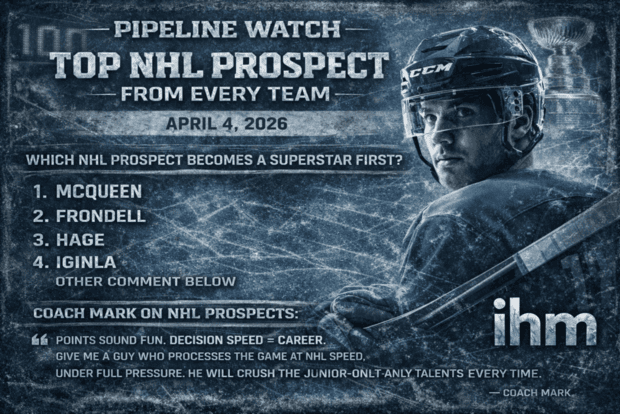
Top Prospect From Every NHL Team - Full 2026 Breakdown
Date: April 04, 2026
By IceHockeyMan
This is not hype. This is projection. Every NHL team has one player who can change its future - this is the real pipeline.
Selection Criteria
- Under 23 years old
- Not a full-time NHL player
- Impact projection > current production
- Role in future roster construction
Western Conference - Pipeline Leaders
Anaheim Ducks - Roger McQueen (C)
2025-26: 27 GP - 11 G - 16 A (NCAA)
6’5 center with elite puck control and two-way instincts. Wins battles, creates off the rush, and already processes at near-pro level. Projects as a first-line center if development stays on track.
Calgary Flames - Zayne Parekh (D)
World Juniors: 5 G - 13 P (record for D)
Elite offensive defenseman with deception and mobility. NHL struggles early, but ceiling remains PP quarterback / top-4 offensive D.
Chicago Blackhawks - Anton Frondell (F)
SHL: 20 G in 43 GP (age 18)
Physical winger with elite finishing. Strong off-puck IQ. Needs skating improvement to unlock top-line potential next to Bedard.
Colorado Avalanche - Gavin Brindley (F)
Profile: High-motor, defensive impact forward
Does everything right without the puck. Projects as a middle-six all-situations player.
Dallas Stars - Emil Hemming (F)
OHL: 62 P in 45 GP
Power forward with strong shot volume (~4 shots/game). Dallas needs internal scoring - Hemming is ключевой проект.
Edmonton Oilers - Isaac Howard (F)
AHL: 38 P in 36 GP | NHL: 5 P in 28 GP
Elite offensive instincts, finds soft ice. Ceiling - 30-goal winger next to McDavid/Draisaitl.
Los Angeles Kings - Carter George (G)
OHL: .908 SV% | 4 SO | 45 GP
High-IQ goalie, excellent tracking and puckhandling. Projects as future NHL starter.
Minnesota Wild - Charlie Stramel (C)
Size: 6’3, 216 lbs
Physical center with improving offense. Ceiling - 2nd-line two-way center, floor - strong bottom-six.
Nashville Predators - Brady Martin (F)
Elite forecheck + heavy physical play + playmaking vision. Ceiling depends on skating → top-six power forward.
San Jose Sharks - Igor Chernyshov (F)
AHL: 33 P in 41 GP | NHL: 12 P in 17 GP
Already producing vs pros. Size + skill combo. Part of Sharks’ future core.
Seattle Kraken - Jake O’Brien (C)
OHL: ~1.75 PPG
Elite playmaker. Power-play QB profile. Ceiling - top-line play-driving center.
St. Louis Blues - Justin Carbonneau (F)
Explosive scorer with inconsistent decisions. Boom/bust, but first-line upside is real.
Vancouver Canucks - Braeden Cootes (C)
Elite motor, strong transition play. Floor safe. Ceiling - matchup 2C (~65 pts).
Vegas Golden Knights - Trevor Connelly (F)
Elite skating + creativity. Needs decision consistency. Ceiling - dynamic top-six winger.
Utah Mammoth - Tij Iginla (F)
WHL: 1.93 PPG
Complete forward. Scoring + physicality + IQ. Один из самых надежных high-end prospects.
Winnipeg Jets - Brayden Yager (C)
Smart two-way center with NHL-level shot. Projects as middle-six scorer.
Eastern Conference - Pipeline Leaders
Boston Bruins - James Hagens (C)
Hockey East scoring leader
Elite processing + edgework. Projects as top-six center immediately.
Buffalo Sabres - Radim Mrtka (D)
Size: 6’6, 216 lbs
Rare mobility for size. Defensive impact already NHL-ready. Ceiling - shutdown top-pair D.
Carolina Hurricanes - Bradly Nadeau (F)
AHL: >0.5 goals/game
Pure scorer. Needs strength, but projects as top-six winger by 2026 playoffs.
Columbus Blue Jackets - Sergei Ivanov (G)
KHL: .927 SV% | 29 GP
Elite reflexes + competitiveness. Legit NHL starter upside.
Detroit Red Wings - Nate Danielson (C)
Strong skater, elite two-way awareness. Ceiling - 2C matchup player.
Florida Panthers - Jack Devine (F)
NCAA: 57 P in 44 GP
Underrated playmaker. High IQ + motor. Likely effective NHL contributor.
Montreal Canadiens - Michael Hage (C)
NCAA scoring leader tier
No weaknesses. Dynamic rush attacker. Could be NHL-ready next season.
New Jersey Devils - Anton Silayev (D)
Size: 6’7
Massive, mobile, aggressive. Ceiling - dominant shutdown defenseman.
New York Islanders - Victor Eklund (F)
SHL: 24 P in 43 GP
Relentless forecheck. High-energy winger with top-six impact.
New York Rangers - Liam Greentree (F)
OHL run: 25 P surge post-trade
Big body + scoring IQ. Skating determines ceiling.
Ottawa Senators - Carter Yakemchuk (D)
Offensive defenseman with heavy shot. Ceiling - PP quarterback.
Philadelphia Flyers - Porter Martone (F)
Size: 6’3, 208 lbs
Elite offensive IQ. Needs physical consistency. Ceiling - top-line winger.
Pittsburgh Penguins - Will Horcoff (C)
Strong defensive reads + size. Ceiling tied to skating development.
Tampa Bay Lightning - Conor Geekie (C)
AHL: 54 P in 40 GP
Big, skilled center. If skating improves → 60-point two-way center.
Toronto Maple Leafs - Ben Danford (D)
Physical shutdown defender. PK specialist. Ceiling - reliable top-4 defensive D.
Washington Capitals - Cole Hutson (D)
NCAA: 32 P in 35 GP
Elite offensive defenseman. PP weapon. Ceiling - game-breaking offensive D.
Key Trend Across NHL Pipelines
- Skating remains the #1 development factor
- Size without mobility = risk
- Two-way centers = safest projection
- Offensive defensemen = highest volatility
Coach Mark Lehtonen Comment
Prospect analysis is where most people get seduced by the wrong things.
They see highlights. They see open-ice skill. They see points against junior defenders who give up the blue line too easily, lose body position too early and make panic decisions once pressure arrives. Then they assume that production will transfer directly to the NHL. It usually does not.
The NHL is not a talent league first. It is a pressure league first.
At lower levels, a gifted player can survive on skill separation alone. In the NHL, the ice closes faster, the hands around you are stronger, the reads against you are sharper and your second option disappears half a second earlier than you expect. That is where careers are truly decided. Not by what a player can do with time. By what he can still do when time is removed.
That is why I always look beyond raw production and ask harder questions.
Can this player process the game fast enough to survive NHL pressure? Can he make the right play while absorbing contact? Can he protect the puck without slowing the entire sequence? Can he recognize the next layer of danger before it arrives? Can he stay useful when the game becomes ugly, heavy and territorial instead of clean and open?
That is the line between a prospect and a future NHL player.
For forwards, I look at three things immediately: decision speed, off-puck detail and pace sustainability. A player may have a great release, but if he cannot arrive in scoring areas on time against real NHL tracking pressure, the shot becomes irrelevant. A center may put up huge junior numbers, but if he cannot support underneath the puck, sort defensive layers and make quick plays through the middle, he will not be trusted where games are actually won.
For defensemen, the evaluation becomes even more brutal. Junior offense from the blue line can be misleading. A defenseman may look dynamic when opponents back off, but at pro level he has to beat pressure with deception, shoulder checks, retrieval timing and clean first-touch decisions. If he cannot manage gaps, kill entries and defend second efforts, his offense will not save him. In today’s NHL, a defenseman who creates but leaks chaos is a problem, not a solution.
Goaltenders are different again. Many people judge them only by save percentage and highlights. I care more about tracking discipline, recovery routes, post integration, emotional reset and whether the goalie controls the game or merely survives it. A young goalie who battles is interesting. A young goalie who reads the release early and gets set before panic begins is far more valuable.
What separates true top prospects from fantasy prospects is translatability.
Translatability means the core habits will still matter when the pace jumps, the forecheck gets violent, the walls get heavier and the game punishes hesitation. That is why some “boring” prospects become real NHL players and some electric junior stars fade the second structure tightens around them.
I would rather bet on a player with strong scanning habits, clean routes, competitive puck retrievals and reliable support detail than on a soft perimeter scorer who needs ideal spacing to look dangerous. The first player helps you win playoff shifts. The second player often disappears when playoff hockey begins.
And that brings us to the most important point of all: projection is not about dreaming. Projection is about surviving truth.
A real NHL projection asks what remains after the easy offense is stripped away. What remains after the player cannot hold the puck forever, cannot beat three defenders one-on-one and cannot recover from every bad read with pure talent. If the brain still works, if the habits still hold and if the compete level still drives the shift, then you have something real.
That is why the best prospect reports are never only about ceiling. Ceiling is the part fans love. Floor, adaptability and role translatability are what organizations get paid to understand.
Skill gets attention. Processing speed earns trust. Structure earns minutes. And once a player earns minutes, then the real NHL career begins.
Coach Mark final verdict: If a prospect can think fast, stay connected to the structure, handle pressure and still create offense without cheating the game, that player is worth building around. If he needs perfect conditions to look good, he is not a future pillar. He is only a highlight package waiting to be exposed.
Fan Pulse
Which prospect becomes a superstar first?
- McQueen
- Frondell
- Hage
- Iginla
- Other
Q&A: How to Judge NHL Prospects Properly
What actually makes a prospect elite?
An elite prospect is not just productive. He combines NHL-translatable skill, fast processing, reliable habits and the ability to stay effective when time and space disappear. Production matters, but projection matters more.
Why do some dominant junior stars fail at NHL level?
Because junior dominance can hide slow decisions, poor defensive detail and an overreliance on extra time with the puck. The NHL punishes hesitation much faster than junior hockey does.
What is more important: points or projection?
Projection. Points tell you what already happened. Projection tells you what is likely to survive in a harder league, against stronger players and inside a more structured tactical environment.
What is the single most important trait for a young forward?
Processing speed. A forward who reads pressure early, recognizes support options quickly and makes the next play on time has a far better chance of becoming an NHL contributor than a player who only looks dangerous with space.
Why is decision speed such a big deal in prospect evaluation?
Because the NHL is a league of compressed windows. Players do not fail only because they lack skill. They fail because the game moves faster than their brain can organize.
How do you evaluate whether a center can really play center in the NHL?
You look at his support routes, faceoff posture, defensive tracking, middle-lane awareness, puck distribution under pressure and his ability to stay inside the structure without drifting into soft areas. A junior center can score a lot and still project better as a winger in the NHL.
What separates a real top-six winger from a scoring junior winger?
A real top-six winger can create offense against organized defenders, make quick reads on retrievals, attack inside lanes and stay useful without the puck. A junior scorer who only thrives on rush chances or power-play touches is a much riskier projection.
How should fans judge offensive defense prospects?
With caution. Point totals from the blue line can be seductive, but the bigger question is whether that defenseman can retrieve pucks cleanly, escape forecheck pressure, defend entries and stay composed when play turns against him.
Why do offensive defensemen often take longer to develop?
Because the pro game exposes every defensive weakness. A young defenseman may be gifted offensively, but if his gap control, retrieval timing and risk management are not ready, coaches will not trust him with meaningful minutes.
What is a good sign that a defense prospect will translate well?
He shoulder-checks consistently, closes space under control, makes simple first passes when needed and understands when to attack and when to kill the play. Calm decisions are a strong translation signal.
How do you properly evaluate goalie prospects?
You look beyond raw save percentage. Read quality, angle management, rebound control, recovery structure, post play and emotional stability matter as much as athletic saves. A goalie who looks dramatic is not always the one most in control.
Why are goalie prospects so hard to project?
Because development is slower, confidence plays a major role and context can distort statistics. A goalie can look elite behind one defensive environment and average behind another.
Is size still important in NHL prospect evaluation?
Yes, but only when it works with mobility, awareness and puck skill. Big players who cannot process quickly or move cleanly become targets. Smaller players with elite timing and compete level can still succeed.
Can smaller prospects still become stars in the NHL?
Absolutely. But they need exceptional processing speed, agility, puck protection technique and competitive detail. Small without elite intelligence is dangerous. Small with elite timing can be a weapon.
Why do NHL teams value two-way centers so highly?
Because they help stabilize the game in all three zones. A true two-way center can support the defense, connect breakouts, manage transition and still contribute offensively. They are among the safest valuable bets in prospect development.
What is a red flag in a top prospect?
A player who needs ideal conditions to stand out. If he only creates with open ice, avoids contact, fades under forecheck pressure or loses defensive structure too easily, the projection becomes much more fragile.
What is a positive sign that a prospect is closer to NHL-ready than people think?
Strong off-puck detail. Players who track properly, arrive in support positions on time, read pressure well and compete consistently often earn coaches’ trust faster than flashier players.
Do World Juniors performances matter a lot?
They matter, but they should never be treated as the full answer. The event is useful for pressure evaluation, role observation and confidence reads, but it is still a short sample and should be weighed against league play.
How much should fans care about AHL production?
Quite a bit, especially for players close to the NHL. Strong AHL production against men is a meaningful signal, but context still matters: usage, linemates, power-play time and role all affect interpretation.
Why do some prospects with modest stats still rank highly?
Because scouts are projecting tools, habits and translatable strengths, not just current box-score output. Some players are clearly built for higher levels even before their raw production fully explodes.
How important is skating in modern prospect evaluation?
It is critical. A player does not need to be a burner, but he must be efficient enough to arrive on time, recover defensively, separate when needed and survive transition pace. Poor skating narrows the margin for everything else.
Can a prospect improve skating enough to change his ceiling?
Yes. Skating growth is one of the biggest swing factors in prospect development. Better balance, first-step pop and edge control can completely change whether a player becomes depth support or true top-six/top-four material.
How important is physicality for a young NHL prospect?
Physicality matters when it is functional. Heavy hits alone do not define value. Winning body position, surviving contact, recovering pucks and protecting space are more important than chasing highlight collisions.
What does “NHL translatable” really mean?
It means the core habits, tools and reads will still work when the pace rises, the physical pressure increases and tactical structure tightens. It is one of the most important concepts in scouting.
How should fans think about ceiling versus floor?
Ceiling is the dream outcome. Floor is the minimum useful version of the player. Smart evaluation respects both. Teams need upside, but they also need to know whether the prospect still has value if the ideal version never fully arrives.
Why do some teams mishandle elite prospects?
Bad deployment, rushed timelines, inconsistent roles and development that ignores the player’s actual needs can all slow or damage progress. Talent alone does not protect a player from poor development decisions.
When should a prospect stay in junior, college or Europe instead of jumping early?
When he still needs role volume, strength growth, puck-touch repetition or less chaotic minutes than the NHL would provide. A rushed arrival can make a talented player look behind when he simply is not ready yet.
How do playoff traits show up in prospect analysis?
Through puck retrievals, board work, middle-lane courage, defensive commitment and the ability to stay effective in heavy hockey. Playoff-value prospects are often less glamorous but more trustworthy.
Which prospect type is usually the safest bet?
Intelligent two-way centers and structured defensemen with mobility. They may not always have the loudest ceiling, but they usually give organizations useful NHL value more consistently.
Which prospect type is the most volatile?
Pure offensive players who rely on time, perimeter touches or power-play freedom without strong defensive habits or pace-translatable decisions. Their upside can be huge, but the miss rate is also high.
How should fans read a prospect ranking list like this one?
As a projection map, not as a promise. It shows who each franchise is most likely to build around next, where the upside sits and what traits could define the next wave of NHL impact.
What is the best final test for a real NHL prospect?
Ask one question: when the game gets faster, heavier and less forgiving, does more of his game survive than disappear? If the answer is yes, that prospect is real.