Category: Inside IHM

Explore the inside world of IceHockeyMan. Learn from Coach Mark’s Academy and follow the ideas that shape the future of global hockey analysis.

Carolina Hurricanes vs Washington Capitals - Match Preview - IHM

Carolina Hurricanes vs Washington Capitals – Match Preview

Date: 12.11.2025
Venue: Lenovo Center (Raleigh, NC)

The upcoming matchup in Raleigh brings together two teams, each carrying very different recent form and structural trends. Carolina continues to demonstrate one of the league’s most organized systems, relying on fast puck movement, strong retrieval habits, and high-quality offensive-zone rotations. Their play through the neutral zone has been especially sharp, allowing them to maintain territorial advantage for long stretches throughout recent games.

Washington approaches this meeting with several questions surrounding lineup stability and transition efficiency. In recent outings they have struggled with controlled exits, often being forced into dump-and-chase situations that limit their ability to sustain pressure. Defensive-zone rotations have also shown inconsistencies, particularly when opponents increase pace or attack through layered entries.

A key area to watch will be the midfield battle, where Carolina’s structured forecheck meets Washington’s attempts to generate speed through stretch outlets. Both teams have skaters capable of shifting momentum quickly, and special teams may play a significant role given the contrasting tactical approaches. Carolina tends to build pressure through cycling and inside-lane movement, while Washington continues to rely on perimeter puck control and point activation.

Goaltending matchups add another layer of intrigue. Carolina’s recent stability in net has contributed to their ability to close out tight periods, whereas Washington has faced inconsistency in rebound control and traffic management. With both teams playing on varied schedules, energy management and bench depth could influence the flow of the later stages.

In summary, this game offers an interesting clash between structural discipline and opportunistic playmaking. Both sides enter with distinct stylistic identities, and the tactical execution in the first 10-12 minutes may set the tone for the rest of the evening.


Note: our previous breakdown on the Anaheim game landed smoothly and without stress, as the team controlled the matchup from start to finish. Below is the full tactical analysis for tonight’s game, which you can review in detail here-


Tactical Breakdown

Anaheim approaches this matchup with their familiar layered 1-2-2 structure, a system built around disciplined puck support and rapid counterattacks. Their recent games show a strong emphasis on controlled exits, using their defensemen as the first activation point and attacking in waves through the neutral zone. The Ducks generate high-danger chances by rotating their wingers low and forcing opposing defenders into extended shifts.

Winnipeg enters with a more aggressive forecheck style, leaning heavily on their speed. Their 2-1-2 pressure has produced turnovers, but it also leaves gaps behind their forwards when the first wave is broken. Against Anaheim’s compact structure, these gaps could become liabilities in transition.
Advanced Metrics (Last 5 Games)

Anaheim Ducks: 5-0-0 record, allowing only 2.0 goals per game. Their expected goals against (xGA) is trending downward, sitting at 2.4 per 60. Offensive zone possession time increased by 11% over their previous 10-game average.
Winnipeg Jets: xG production remains respectable at 3.1 per 60, but their defensive numbers slipped, conceding 4+ goals in three of the last five. Their high-danger attempts allowed (HDCA) jumped noticeably due to inconsistent backchecking and fatigue on long shifts.

Line-Up & Usage Notes

Anaheim Injuries: Granlund (lower body), Gudas (lower body).
Winnipeg Injuries: Barron (injury), Perfetti (ankle), Samberg (wrist).
Anaheim’s first line continues to drive play with strong zone entries and effective east-west puck movement. Strome’s availability (questionable) will influence power-play structure. Ducks’ defensive core rotates efficiently, minimizing breakdowns.
Winnipeg relies on transition bursts but lacks depth support due to injuries. If their third line continues to struggle on defensive coverages, Anaheim’s forecheck may create sustained pressure.

Coach’s Verdict

This matchup brings together two teams on very different trajectories. Anaheim enters this game in strong form,
showing stability across all three zones and delivering consistent execution in transition play. Their recent stretch
of performances highlights excellent forecheck pressure and improved puck support, which reduces turnovers in the
neutral zone.

Winnipeg, despite sitting high in the standings earlier in the season, has recently shown vulnerability.
Their defensive structure has loosened, especially in the slot area, where they are allowing too many clean looks
on goal. Injuries to key depth players also affect their rotation and special teams efficiency.

Anaheim’s momentum, stronger current form (five consecutive wins), and home-ice advantage at Honda Center
make them the more reliable side here. Their offensive depth is balanced, and the team is creating a high number
of high-danger scoring chances.

Premium Pick - Anaheim Ducks - Win (Including Overtime)

Note: Our previous analysis on Philadelphia was extremely close, but the game slipped away in overtime - read yesterday’s recap for details.


IHM Academy · Defensive Zone Coverage-Lesson #3

IHM Academy · Defensive Zone Coverage-Lesson #3

Strong-Side Press & Weak-Side Collapse

Elite defensive teams win by applying pressure on the strong side while securing the middle and far post with a disciplined weak-side collapse. We attack the puck where it lives and protect the ice that matters. This lesson builds a repeatable framework: press hard without opening the slot, pass off checks early, and collapse from the weak side only when danger requires it.

Hockey defensive diagram showing strong-side pressure with F1 and D2, weak-side collapse from F3 and D1, and point denial from F2 in a structured D-zone system.

🎯 Objective

  • Create 2v1 pressure on the strong side (corner/wall) to force turnovers.
  • Keep inside body position and sticks in lanes through the slot.
  • Collapse weak-side support only on danger triggers (net drive, seam threat, backdoor).
  • Convert recoveries into clean exits with middle support.

🧠 Core Principles

  • Inside first: body between your check and the net; blades angle the seam.
  • Press to contain: F1 and D2 drive the puck to the wall, then seal; no fly-bys.
  • Weak-side anchor: D1 + F3 hold middle/backdoor; collapse only on a real threat.
  • Early talk: “Hold / Switch / Bump” – switch before you lose inside position.
  • Reload fast: after the press, F1/F2 recover to the top of the box; gaps stay tight.

🧩 Roles & Responsibilities

F1 – Strong-Side Press

  • Angle toward the wall; stick on puck, body on hands.
  • Drive the carrier into D2; press → contain; no chase behind the net without a call.
  • On chip/reverse: arrive first, then reload high to restore the box.

D2 – Strong-Side Corner/Wall

  • First contact; steer plays outside the dots.
  • Close the wall; ride-and-release on switch; never open the middle.
  • Head up for low-to-high – be ready to front shots or deny the point lane.

F2 – Strong-Side Support

  • Seal the inside lane above the battle; deny slot pops.
  • Be the second stick in the trap (F1+D2+F2 triangle).
  • First outlet after recovery if puck kicks up the wall.

D1 – Net-Side / Weak-Side Safety

  • Own the crease side; box out and tie up sticks.
  • Read for backdoor threats; collapse only when the far-post attacker becomes live.
  • On possession: middle support pass → quick up or reverse.

F3 – Weak-Side High Anchor

  • Protect middle seam and far-post lane.
  • Collapse on triggers (slot pop, net drive, diagonal seam) – otherwise hold high.
  • Be the first middle option for exit when we win it.

🔁 Collapse & Switch Triggers

  • Collapse: far-post net drive • slot pop into the dots • diagonal seam with time.
  • Switch: carrier crosses the back of the net • set pick/pinch on the wall • D2 is pinned and F1 arrives inside.
  • No-switch rule: never switch off a live net-front without inside coverage.

❌ Common Mistakes

MistakeWhy it breaks coverage
F1 over-pursues below goal lineTop of box opens; high slot shot
F3 collapses without a triggerDiagonal seam becomes available
D2 rides outside and releases lateInside lane opens to the net
No inside body on switchAttacker beats the hand-off to the crease
Weak-side watches puckBackdoor tap-in

🧪 Micro-Drills

  • 2v2 Wall Trap – F1 angle + D2 seal; F2 above; turnover → middle exit.
  • Weak-Side Read – coach activates far-post stick; F3 collapses on trigger, otherwise holds.
  • Switch Behind Net – ride-and-release on reverse; D1 holds net; rebuild box in two strides.

🧱 Summary

Strong-Side Press & Weak-Side Collapse lets you hunt the puck without surrendering the slot. Pressure where the puck is. Protect where goals are scored. Communicate early, keep inside, and reload together.

📣 Coach Mark Lehtonen says

Strong-side wins the puck; weak-side protects the game.
If you chase on the strong side and sink on the weak side, you give the slot for free.


❓ Q&A – Defensive Zone Coverage

When should the weak side collapse?

Only on danger triggers: a live far-post net drive, a slot pop inside the dots, or a diagonal seam with time. Otherwise F3 stays high to protect the middle.

Who calls the switch behind the net?

D1 is the primary voice near the crease; F1 or D2 can initiate, but the release happens only when the receiving player has inside position.

What is the difference between press and chase?

Press contains with inside body and stick-on-puck, steering into help. Chase follows the puck and loses the middle-don’t chase.

How do we avoid giving up the low-to-high shot?

F2 owns the strong-side point and seals the wall release; on kick-out, recover to the box and front the shot lane.

What is the first pass on recovery?

Middle support. If the middle is closed, reverse to the weak side; never force the strong-side rim under pressure.


IHM Academy · Defensive Zone Coverage-Lesson #2

IHM Academy · Defensive Zone Coverage-Lesson #2

Low-Zone Rotation & Switch Coverage

Elite defensive teams don’t chase they rotate. In the low zone, the puck moves quickly below the dots, the cycle attempts to drag defenders out of position, and the net becomes exposed when coverage breaks. Low-Zone Rotation & Switch Coverage is the pro solution: we keep inside position, pass off checks at the right time, and rotate as a unit so the slot stays protected while pressure remains active.

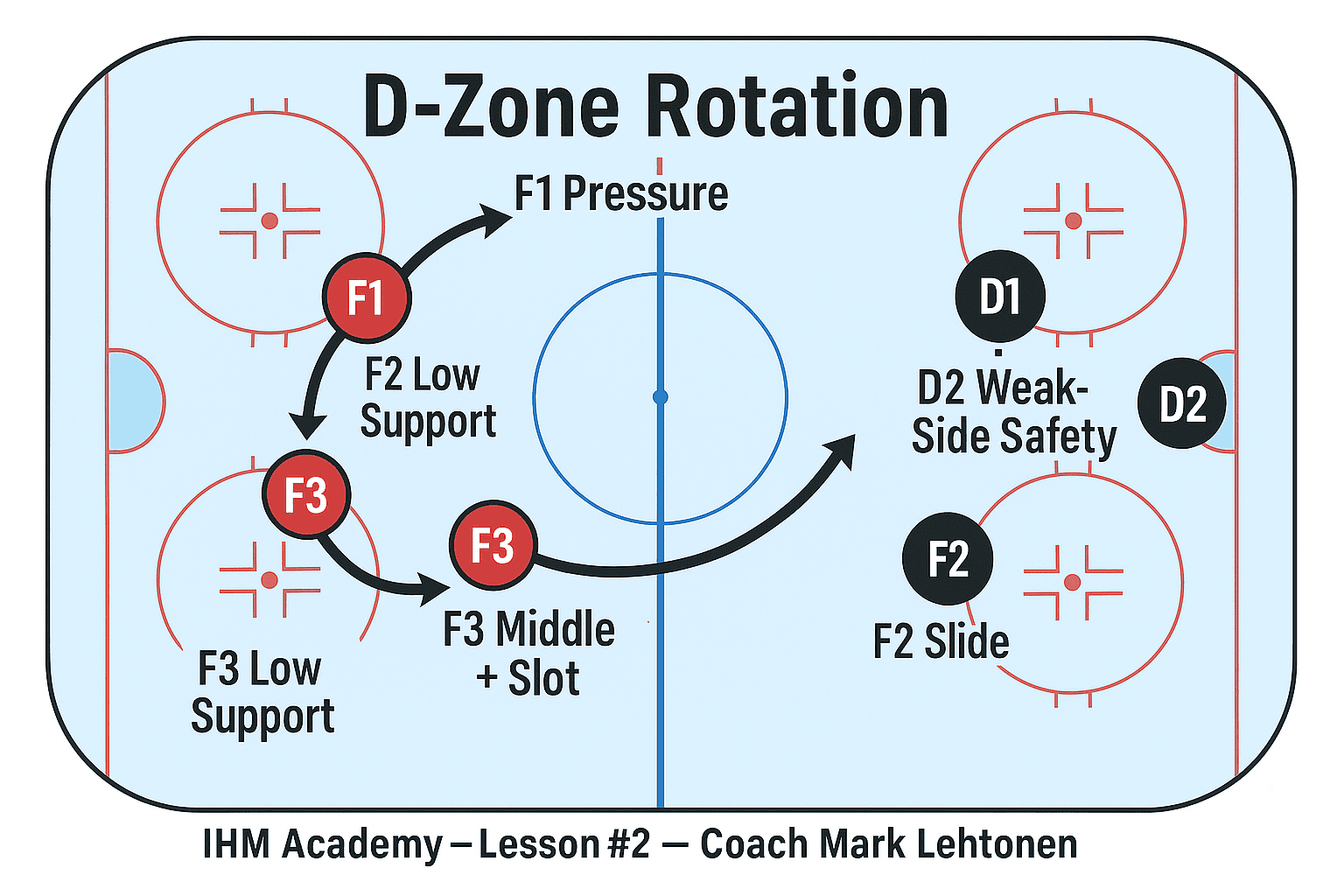
Defensive hockey diagram showing Low-Zone Rotation & Switch Coverage: D1 net-side, D2 strong-side corner pressure with F1 support, early switch behind the net, F2 sealing low-to-high, F3 anchoring weak-side inside dots; arrows illustrate ride-and-release and 5-man rotation.

🎯 Objective

  • Maintain inside body position and protect the slot at all times.
  • Apply controlled pressure on the puck without losing structure.
  • Use clean, early switches to avoid pick plays and chase patterns.
  • Rotate as a 5-man unit so gaps stay tight and lanes stay closed.

🧠 Core Principles

  • Inside first: body between man and net; sticks denying the middle.
  • Strong-side overload, weak-side anchor: pressure where the puck is, stability where it isn’t.
  • Talk early: switches are called, not guessed. “Mine / Yours / Switch”.
  • Skate through the hand-off: one defender arrives before the other leaves.
  • Head on a swivel: scan net-front every 1-2 seconds during rotations.

🧩 Roles in the Low Zone

D1 – Net-Side Defender

  • Own the crease side; box out; tie up sticks.
  • Primary communicator for switches below the hashmarks.
  • If the puck reverses behind the net, bump responsibility to the next defender and reset inside.

D2 – Corner/Strong-Side Defender

  • First contact on the cycle; steer plays outside the dots.
  • When puck is chipped past, ride and release to F1 or D1 on the call.
  • Never chase behind the net without a clear switch cue.

F1 – Low Support (+1)

  • Help close the strong-side wall; create 2v1 pressure with D2.
  • On reverse or pop, arrive first to eliminate time.
  • Reload to the top of the box when puck exits the corner.

F2 – Strong-Side High

  • Seal the strong-side point and deny low-to-high outlets.
  • Collapse to hashmarks when puck drops below the goal line.
  • First stick in the high seam on any slot threat.

F3 – Weak-Side High (Anchor)

  • Hold middle ice; protect backdoor and far-post seam.
  • Tracks the weak-side winger drifting into the slot.
  • First outlet on recovery: middle support for clean exit.

🔁 Switch Rules (Low-Zone Hand-Offs)

  1. Call it early: “Switch!” as the puck carrier crosses the back of the net or hits a pick/pinch point.
  2. Arrive before release: receiving defender must have inside position before the original checker lets go.
  3. Inside over speed: never cross outside the dots to chase – take the inside lane and meet.
  4. Net-front priority: if in doubt, don’t switch off net-front without coverage.
  5. Immediate reset: after switch, scan and rebuild the box; do not watch the puck.

📣 Bench/On-Ice Communication

  • “Hold / Switch / Bump” – universal triggers for all five players.
  • “Middle!” – F3 call identifying slot or back-post threat.
  • “Low-High!” – warning about a low-to-high play; F2 steps up.

❌ Common Mistakes

MistakeWhy it breaks coverage
Late or silent switchBoth chase; slot opens; free net-front touch
D2 chases behind the netLoss of strong-side, easy wrap or jam
F1 doesn’t reloadTop of box empty → high slot shot
Weak-side collapse by F3Backdoor seam available
No inside body on hand-offAttacker beats switch to the net

🧪 Micro-Drills

  • 2v2 Corner Cycle → Switch – D2 engages, F1 supports, call early switch behind net; D1 restores net-front.
  • Reverse Read Series – coach rims/reverses; team practices ride-and-release with inside lanes.
  • Low-to-High Denial – F2 seals point; on kick out, recover to box and block high seam.

🧱 Summary

Low-Zone Rotation & Switch Coverage keeps the puck to the outside, denies the slot, and shuts down the cycle without panic. We don’t chase-we pass off, we rotate, and we reset with five players connected inside the dots.

Coach Mark Lehtonen
Low-zone defense fails when players chase. It wins when players rotate. You don’t defend the puck – you defend the middle. If the slot stays protected, everything else becomes a battle we can live with.


❓ Q&A – Low-Zone Rotation & Switch Coverage

Q1: What is the main purpose of low-zone rotation?

A: To maintain inside positioning while applying pressure without chasing. Rotation keeps defenders connected, preserves the slot, and eliminates openings created by the cycle.

Q2: When should a switch be called below the goal line?

A: Early – as the puck carrier crosses behind the net or approaches a pick-point. Late switches create two-man chases and expose the middle.

Q3: Who initiates most low-zone switches?

A: D1 (net-side defender). D1 controls crease coverage and usually has the clearest view of incoming threats, reverses, and pick plays.

Q4: What is the biggest mistake forwards make in this system?

A: F1 failing to reload to the top of the box. When F1 stays too deep, the high slot becomes open for a shot or seam attack.

Q5: What is the weak-side forward’s primary job?

A: F3 protects the middle lane and far-post threat. F3 should never collapse without purpose – his job is to eliminate backdoor options.

Q6: How do you avoid getting picked or screened during switches?

A: Take inside routes, keep your stick pointed at the middle, and communicate early. “Inside first, body second” prevents attackers from using picks to create separation.

Q7: When does D2 join pressure instead of holding position?

A: Only when the puck is firmly on the strong-side and F3 has the middle lane sealed. If D2 jumps early, the weak side collapses and opens a backdoor threat.

Q8: What should the team do immediately after a successful switch?

A: Reset the box shape and scan. Players often relax after a switch – but the danger usually comes from the next play, not the first one.


Anaheim Ducks vs Winnipeg Jets - Match Preview

Anaheim Ducks vs Winnipeg Jets – Match Preview

Date: 10 November 2025 • Venue: Honda Center (Anaheim, CA)

Unfortunately, our previous analysis on the Flyers didn’t land. We were extremely close, but Philadelphia couldn’t finish it off in overtime. We move forward with today’s matchup, which promises a high-tempo and physical style from both sides.

Anaheim enters this game as one of the hottest teams in the league, riding an impressive winning streak and showing excellent structure in all phases of play. Their puck movement has been sharp, and their forecheck continues to be a major weapon against teams that struggle with controlled exits.

Winnipeg, meanwhile, has had a mixed run of form. After a strong early season, they’ve hit a rough stretch with defensive issues and several key injuries affecting their lineup depth. Their recent games show inconsistency in zone coverage and difficulties containing aggressive cycling teams.

The Honda Center atmosphere will add extra energy to Anaheim’s already confident group. Both teams possess dangerous offensive talent, but the contrasting forms and tactical tendencies set the stage for a fascinating contest. For the full premium analysis by Coach Mark Lehtonen, including the official pick, click below.

➡️ Read Full Premium Analysis


IHM Academy - Performance Metrics Masterclass • Lesson 1

IHM Academy – Performance Metrics Masterclass • Lesson 1

IHM Academy – Performance Metrics Masterclass • Lesson 1

Performance Metrics Masterclass – Lesson 1
High-Danger Goals, Goals Above Expected, Ice Tilt, Speed Bursts and Shot Differential

Date: November 8, 2025 | Series: IHM Academy – Performance Metrics Masterclass | Lesson: 1

Welcome to Lesson 1 of the IHM Academy Performance Metrics Masterclass. This module builds a working toolkit for coaches, analysts, and ambitious players. You will learn the five metrics that most reliably explain why teams sustain form across weeks, not just nights: High-Danger Goals, Goals Above Expected, Ice Tilt, Speed Bursts and Shot Differential. We define them, show how they are built, explain how to apply them in practice, and give you pro-level checklists, drills, and a repeatable workflow.


1) High-Danger Goals (HDG)

Definition. High-Danger Goals are goals scored from areas and situations with inherently higher scoring probability due to distance, lateral puck movement, traffic, and pre-shot actions (passes across the slot, rebounds, tips). Think inner slot, net-front, and east-west seams.

Why it matters. HDG is a strong signal of repeatable offense. Teams that consistently arrive in the interior create both primary shots and second-puck chaos. It scales with playoff hockey where space is compressed.

Analyst’s rule of thumb. Sustained contenders typically land in the top third of the league in HDG share. A sudden spike in HDG without a change in slot entries or low-to-high pass rate is usually noise.

Minimal model. Mark inner slot as a polygon bounded by the goal posts extended, hashmarks, and the mid-slot dot line. Tag a shot as “high danger” if any of the following occur within 3 seconds before release: (1) Royal-road pass (across center lane), (2) rebound, (3) deflection/tip within 10 feet, or (4) release location inside inner slot.

Pro example. Ducks opening month: 28 HDG (Top-2 league). The repeatable driver was net-front layering on P1 and a weak-side crash from P3 after low-to-high. When those layers show on video and the counts rise, the signal is genuine.


2) Goals Above Expected (GAX)

Definition. GAX = Actual Goals − Sum of expected goals (xG) on each qualifying attempt. It captures finishing above or below what shot quality predicts, adjusted by context like pass type and goalie set.

Why it matters. Positive GAX over meaningful volume can indicate elite shooting, deception, or shot preparation. It also flags unsustainable runs when driven by fluke bounces without process.

Computation sketch.

For each shot i:
  xG_i = f(distance, angle, pre-shot movement, shot type, traffic, goalie lateral set)
GAX = Σ(goals_i) − Σ(xG_i)

Pro example. Cutter Gauthier +5.91 Goals Above Expected early season. The video confirms: heavy mid-range velocity, one-touch releases, and layered net-front traffic. The metric aligns with tape – the strongest validation.


3) Ice Tilt

Definition. A time-weighted territorial control proxy describing how long a team spends pushing play in the offensive half relative to the opponent, often approximated by sustained possession and controlled entries leading to attempts.

Why it matters. Ice Tilt predicts streak stability. Teams that own the first period tend to dictate matchups and draw the game into their preferred structure.

Analyst’s cue. First-period Ice Tilt advantage is a leading indicator for multi-game form. Ducks led the league in first-period tilt during their surge; their game states favored front-foot hockey and early PP opportunities.


4) Speed Bursts (20+ mph) and Max Speed

Definition. Count of discrete skates exceeding 20 mph and the single-shift maximum speed. This is not a vanity metric – it’s a proxy for separation, retrieval pressure, and threat in transition.

Use correctly. Speed is only valuable when attached to route efficiency. Bursts that end on the outside wall without inside support are empty miles.

Pro examples. Logan Cooley at 23.97 mph (No. 2 league) translates directly to controlled entries and east-west pressure. Nick Schmaltz couples above-average burst count with high total distance, indicating repeatable pace over long shifts rather than single sprints.


5) Shot Differential (5-on-5)

Definition. Team shots on goal minus shots allowed at 5v5, game-normalized. It is a sturdy backbone metric: you rarely see long winning streaks from teams living in the red here.

Pro example. Utah Mammoth at +5.4 per game (No. 2 league). That is process-level dominance and matches video of their retrieval speed and interior reloads.


Case Study A – Anaheim Ducks: Why the Breakout Holds

  • Interior creation: 28 HDG early (Top-2). Net-front layering + quick seam passes.
  • Finishing over model: Gauthier at +5.91 GAX with mid-range velocity and one-touch mechanics.
  • Game state control: Best first-period Ice Tilt; they script starts and play ahead.
  • Depth threat: Multiple PPG producers and multi-goal game frequency signaling repeatable shot prep.

Applied coaching adjustments that keep it real

  1. Keep a weak-side crash rule after low-to-high. If F3 is late, HDG collapses.
  2. Preserve the net-front box-out culture on D. Don’t sacrifice interior to chase hits.
  3. On PP1, avoid static 1-3-1. Add slot interchange to preserve east-west velocity before the shot.

Case Study B – Utah Mammoth: Speed With Structure

  • Shot volume engine: +5.4 5v5 shot differential; most games outshooting opponents.
  • High-danger finishing: Nick Schmaltz 96th percentile high-danger shots; mix of tips and seam attacks.
  • Transition threat: Logan Cooley max 23.97 mph; drives controlled entries, inside lanes, and delay-pass options.
  • Defensive workload: 2nd fewest shots against; retrieval speed plus clean exits.

Coaching guardrails

  1. Build route discipline for fast wingers: speed burst must end inside dots or on a delay cut into support.
  2. Keep D hinge timing tight; exit under pressure into middle support to maintain shot differential.
  3. Protect Schmaltz’s interior routes with F3 high so tips are not one-and-done rushes.

Player Micro-Profiles

Cutter Gauthier – Why the Model Loves Him

  • Shot quality: Heavy mid-range, minimal dusting, one-touch habits increase xG and GAX.
  • Traffic literacy: Shoots through screens, not around them.
  • Action item: Keep a pre-shot “checklist”: seam, screen, stick down, release.

Nick Schmaltz – Interior Repeatability

  • High-danger shot mix: Rebounds, tips, center-lane cuts.
  • Pace sustainability: High total distance with maintained touch quality late in shifts.
  • Action item: Two-touch finishes at net-front; practice stick angle changes within 0.3 s.

Logan Cooley – Speed That Translates

  • Max speed with endpoints: Bursts end on inside ice, not glass.
  • Entry tree: Straight attack, delay cut, or drop as first three options.
  • Action item: 3-lane entry drill with inside shoulder check before blue line.

How to Build a Repeatable Analyst Workflow (Weekly)

  1. Collect. Export shot locations, pre-shot passes, rebounds, tips, and on-ice traffic flags. Tag your inner-slot polygon once and reuse.
  2. Compute. HDG, team xG, player xG, and GAX by game and rolling 5-game windows.
  3. Context. Overlay Ice Tilt by period and game state (tied vs trailing vs leading).
  4. Speed layer. Pair 20+ mph burst counts with entry outcomes (controlled vs dump vs turnover).
  5. Synthesize. Build a one-page: Top 5 drivers, risk flags, and one coaching adjustment.
  6. Validate with tape. Metric movement without video corroboration is a yellow flag.

Practice Drills That Drive the Metrics

Drill 1 – Royal-Road into Net-Front Chaos (HDG)

Set 3 forwards vs 2 D + goalie. Start from low-to-high, weak-side pop to bumper, force a seam pass, immediate shot. F3 crashes far post. Count only if release < 1.2 s after seam.

Drill 2 – One-Touch Mid-Range Release (GAX booster)

Feeder at the dot, shooter between circles. No stickhandling allowed. Add a screen and a late stick flash from defender to simulate traffic.

Drill 3 – Three-Lane Entry Speed Tree (Bursts that matter)

Winger gets timing pass entering at 20+ mph. Options: straight drive, delay to trailer, or drop to late F3. Score only when shot originates inside dots within 4 seconds after entry.

Drill 4 – Exit Under Pressure to Middle Support (Shot Differential)

D retrieval, shoulder check, hinge, middle support to C. Add backpressure timer. Missed middle support = turnover. Track successful exits vs fails.


Red Flags and How to Fix Them

  • HDG drops but xG stays flat: You are shooting from the outside. Add low-to-high to seam, commit F3 to far post crashes.
  • GAX negative run: Shooters are dusting pucks. Install one-touch rules for mid-slot reps.
  • Poor first-period Ice Tilt: Re-script first shift matchups and first two exits. Remove risky neutral-zone stretch for 10 minutes.
  • High burst count, low entries: Speed without routes. Force inside finish options on drills.
  • Shot differential negative: Retrieval gap. Cut D-to-D rim habits, increase middle exits and short support.

Quick Reference – Bench Cards

  • Interior Rule: If the shot is outside dots with no screen, we are off plan.
  • Speed Rule: Every burst ends inside dots or into a delay cut.
  • PP Rule: No static 1-3-1 for two consecutive entries. Interchange.
  • Exit Rule: First look is middle. If closed, hinge, then middle again.

Coach Mark comment

The metrics work when the routes are honest. Interior play creates scoring truth. Speed without an inside finish is decoration. Build layers at the net, protect the middle on exits, and the numbers will follow.


Glossary

  • xG (expected goals): Probability a shot becomes a goal based on context.
  • GAX: Goals Above Expected = Goals − ΣxG.
  • Ice Tilt: Time-weighted territorial control proxy by period and game state.
  • High-Danger: Inner-slot or preceded by rebound, tip, or royal-road seam.
  • 20+ mph burst: Discrete skate exceeding 20 mph, tied to a possession outcome.

Checklist – End of Lesson 1

  1. Tag inner-slot polygon and pre-shot events in your template.
  2. Compute HDG, xG, and GAX for team and top six forwards.
  3. Log Ice Tilt by period for last five games.
  4. Pair 20+ mph bursts with entry outcomes.
  5. Publish a one-page scoreboard with one tactical change.
  6. Run Drills 1-4 twice this week; re-measure next game.

Questions & Answers | IHM Performance Metrics

Why are the Anaheim Ducks performing so well this season?

The Ducks rank near the top of the league in high-danger scoring and first-period territorial control (Ice Tilt). Their young core led by Carlsson and Gauthier drives shot volume and transition pace, while special teams and goaltending have been good enough to protect leads.

What makes Cutter Gauthier’s analytics profile elite?

Gauthier combines heavy shot volume with elite shot quality. He leads the team in Goals Above Expected, sits in the top percentiles for average shot speed and high-danger attempts, and consistently attacks through the middle lanes where shooting percentage is highest.

What is Ice Tilt and why does it matter?

Ice Tilt measures which team controls the puck and zone time over stretches of play. Strong Ice Tilt early in games predicts shot advantage and helps teams draw penalties, stack offensive zone faceoffs, and protect expected-goals leads.

How does Goals Above Expected work?

Goals Above Expected is the difference between a player’s actual goals and the model’s expected total from all of his shots after accounting for location, pre-shot movement, traffic, and goalie positioning. Positive numbers signal finishing talent or superior shot selection.

Why are the Utah Mammoth trending up in our model?

Utah pairs a strong shot differential with top-end speed and a low shots-against profile. They outshoot opponents most nights, keep attempts to the outside, and convert off the rush through Cooley, Keller, and Schmaltz.

What do high-danger goals tell us about a team?

High-danger goals indicate repeatable process: inside-lane entries, net-front presence, and east-west puck movement. Teams that win the slot consistently sustain scoring even when power-play luck cools.

How should I read shot differential per game?

Shot differential per game is a clean proxy for five-on-five puck control. Positive numbers usually pair with favorable expected-goals share and correlate with standings over larger samples.

What stands out in Nick Schmaltz’s start?

Schmaltz is producing shots from every band of the rink and sits in the mid-90th percentiles for high-danger attempts. He also adds value with deflections and interior touches on the power play.

How fast is Logan Cooley and does top speed translate to goals?

Cooley’s top speed sits near the top of the league. More importantly, he stacks frequent 20+ mph bursts that pull defenders apart and create cross-slot passes, which lift expected-goals on his line.

Are the Ducks legitimate playoff contenders based on the metrics?

Yes. With top-tier high-danger creation, strong Ice Tilt to start games, and improving five-on-five possession, their profile matches recent conference finalists rather than early-season pretenders.


Performance Metrics Master Lessons | IHM Academy

Performance Metrics Master Lessons | IHM Academy

A pro-level module breaking down modern NHL analytics: shot-quality models, high-danger scoring, Ice Tilt momentum, speed tracking, projected goals, possession metrics and elite player evaluation. Lessons crafted in the signature coaching style of Mark Lehtonen for the IHM Academy.

IHM Academy · Performance Metrics - How Coach Mark Lehtonen Turns Performance Metrics Into Structured Match Verdicts

IHM Academy · Performance Metrics - How Coach Mark Lehtonen Turns Performance Metrics Into Structured Match Verdicts


  • IHM Academy - Performance Metrics Masterclass – Lesson 30

    IHM Academy – Performance Metrics Masterclass – Lesson 30

    Lesson 30 – Offensive Layering Index (OLI) & Secondary Threat Activation Date: 13 January Introduction Modern offensive hockey is no longer built around a single primary attack option. Elite teams consistently score because they operate in layers. The Offensive Layering Index (OLI) is designed to measure how effectively a team creates, maintains, and activates multiple…

  • IHM Academy – Performance Metrics Masterclass – Lesson 29

    IHM Academy – Performance Metrics Masterclass – Lesson 29

    Lesson 29 – Zone Entry Denial Efficiency (ZEDE) & Blue Line Standup Discipline Date: 13 January Lesson Focus: This lesson explains how teams suppress offense before it starts by denying controlled zone entries. We define Zone Entry Denial Efficiency (ZEDE), break down what it measures, how it appears on the ice, and how Coach Mark…

  • IHM Academy - Performance Metrics Masterclass – Lesson 28

    IHM Academy – Performance Metrics Masterclass – Lesson 28

    Lesson 28 – Transition Recovery Rate (TRR) & Structural Reset Speed Lesson Focus: This lesson explains how quickly and consistently a team restores its defensive and transitional structure after puck loss. We break down why recovery speed, spacing discipline, and first-read decisions define whether transitions become threats or are neutralized early. Extended Core Definition Transition…

  • IHM Academy - Performance Metrics Masterclass – Lesson 27

    IHM Academy – Performance Metrics Masterclass – Lesson 27

    Lesson 27 – Matchup Stress Index (MSI) & Exploiting Line Mismatches Lesson Focus: This lesson explains how coaching staffs and elite teams create controlled pressure by targeting unfavorable matchups, forcing specific lines, pairs, or individuals into sustained stress. We break down what MSI measures, how it shows up on the ice, and how Coach Mark…

  • IHM Academy - Performance Metrics Masterclass – Lesson 26

    IHM Academy – Performance Metrics Masterclass – Lesson 26

    Lesson 26 – Net-Front Control Differential (NFCD) & Slot Chaos Generation Extended Core Definition Net-Front Control Differential (NFCD) measures which team consistently controls the low-slot and crease area during live play. It evaluates positioning, stick dominance, body leverage, timing of box-outs, and the ability to either create or eliminate chaos directly in front of the…

  • IHM Academy - Performance Metrics Masterclass - Lesson 25

    IHM Academy – Performance Metrics Masterclass – Lesson 25

    Lesson 25 – Late-Shift Structural Collapse Probability (LSCP) & Fatigue Exposure Index Extended Core Definition Late-Shift Structural Collapse Probability (LSCP) measures the likelihood that a team’s defensive or transitional structure breaks down due to accumulated fatigue within extended or poorly managed shifts. Unlike basic time-on-ice metrics, LSCP focuses on structural degradation rather than physical exhaustion…

  • IHM Academy - Performance Metrics Masterclass – Lesson 24

    IHM Academy – Performance Metrics Masterclass – Lesson 24

    Lesson 24 – Reversal Suppression Index (RSI) & Forecheck Pressure Collapse Probability Extended Core Definition Reversal Suppression Index (RSI) measures how effectively a team prevents opponents from executing clean puck reversals during retrieval under pressure. A reversal is one of the safest and most effective escape mechanisms in modern hockey. RSI evaluates how quickly and…

  • IHM Academy - Performance Metrics Masterclass – Lesson 23

    IHM Academy – Performance Metrics Masterclass – Lesson 23

    Lesson 23 – Cross-Lane Activation Rate (CLAR) & East-West Threat Probability Extended Core Definition Cross-Lane Activation Rate (CLAR) measures how frequently a team triggers east-west puck movement inside the offensive zone with synchronized support layers. It evaluates timing, spacing, and the ability to stretch defensive shape horizontally, forcing goaltenders into lateral adjustments. High CLAR means…

  • IHM Academy - Performance Metrics Masterclass – Lesson 22

    IHM Academy – Performance Metrics Masterclass – Lesson 22

    Lesson 22 – Zone Exit Efficiency (ZEE) & Breakout Stability Under Pressure Extended Core Definition Zone Exit Efficiency (ZEE) measures how reliably a team moves the puck out of its defensive zone with control when under forecheck pressure. It is not only about leaving the zone; it is about how the puck leaves the zone:…

  • IHM Academy · Performance Metrics Masterclass - Lesson 21

    IHM Academy · Performance Metrics Masterclass – Lesson 21

    Lesson 21 – Bench Adaptation Index (BAI) & In-Game System Switching Extended Core Definition The Bench Adaptation Index (BAI) measures how effectively and rapidly a coaching staff modifies tactical systems when the original game plan fails. It reflects strategic intelligence, emotional control and structural flexibility of the bench. Hockey games are rarely won by original…

  • IHM Academy · Performance Metrics Masterclass - Lesson 20

    IHM Academy · Performance Metrics Masterclass – Lesson 20

    Lesson 20 – Pace Disruption Index (PDI) & Tempo Control Extended Core Definition The Pace Disruption Index (PDI) measures how effectively a team destroys the opponent’s preferred rhythm and forces the game into an uncomfortable tempo. It reflects the ability to reset flow through neutral zone pressure, stoppage creation, forecheck timing and line deployment. Tempo…

  • IHM Academy · Performance Metrics Masterclass – Lesson 19

    IHM Academy · Performance Metrics Masterclass – Lesson 19

    Lesson 19 – Defensive Compactness Ratio (DCR) & Slot Sealing Extended Core Definition DCR measures how tightly a defensive unit compresses space between the dots under sustained pressure. It reflects rotational discipline, net-front layering, and denial of inner-lane passes. Game Impact Map Tactical Layer Coaching Staff Layer DCR is drilled via net-front rotation systems and…

  • IHM Academy · Performance Metrics Masterclass - Lesson 18

    IHM Academy · Performance Metrics Masterclass – Lesson 18

    Lesson 18 – Transition Speed Index (TSI) & Counter-Attack Structure Extended Core Definition The Transition Speed Index (TSI) measures how quickly and efficiently a team converts a defensive recovery into an organized attacking threat. It does not describe raw skating speed. It measures structural decision velocity under pressure: retrieval, first pass, support, lane activation, and…

  • IHM Academy · Performance Metrics Masterclass – Lesson 17

    IHM Academy · Performance Metrics Masterclass – Lesson 17

    Lesson 17 – Shift Load & Fatigue Control The Hidden Physics of Winning Hockey Most fans watch the puck. Coaches watch oxygen debt. Fatigue management is the invisible layer of elite hockey control. 1. Average Shift Length (ASL) 2. High-Intensity Burst Count (HIBC) After the 4th full-speed burst, muscle efficiency drops by 22-28%. 3. Recovery…

  • IHM Academy · Performance Metrics Masterclass – Lesson 16

    IHM Academy · Performance Metrics Masterclass – Lesson 16

    Lesson 16 – Slot Dominance Index Why Games Are Won in Five Square Meters The slot is not a location. It is a battlefield. Over 70% of elite-level goals originate from the slot area. Control of this zone decides offensive lethality and defensive survival. 1. Slot Entry Frequency (SEF) 2. Slot Shot Conversion (SSC) Measures…


IHM Academy · Performance Metrics Masterclass - Lesson 5

IHM Academy · Performance Metrics Masterclass - Lesson 5


Performance Metrics Masterclass - Lesson 4: Zone Entries, Exits & Transition Speed

IHM Academy · Performance Metrics Masterclass - Lesson 4


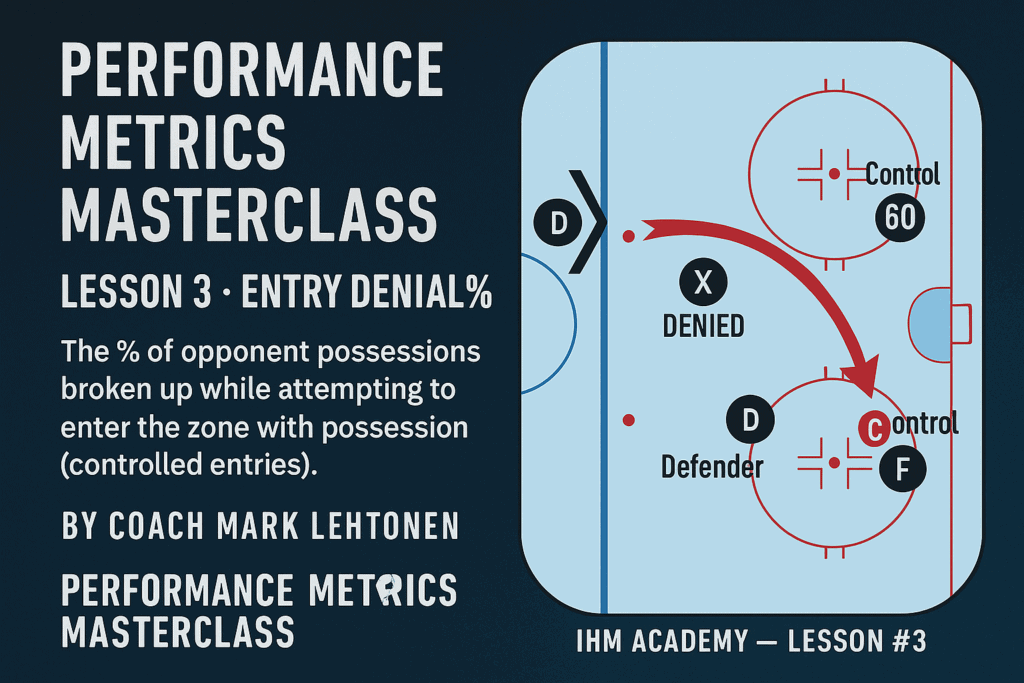
IHM Academy · Performance Metrics Masterclass - Lesson 3

Performance Metrics Masterclass - Lesson 3 : Zone Entry Efficiency & Controlled Breakout Success


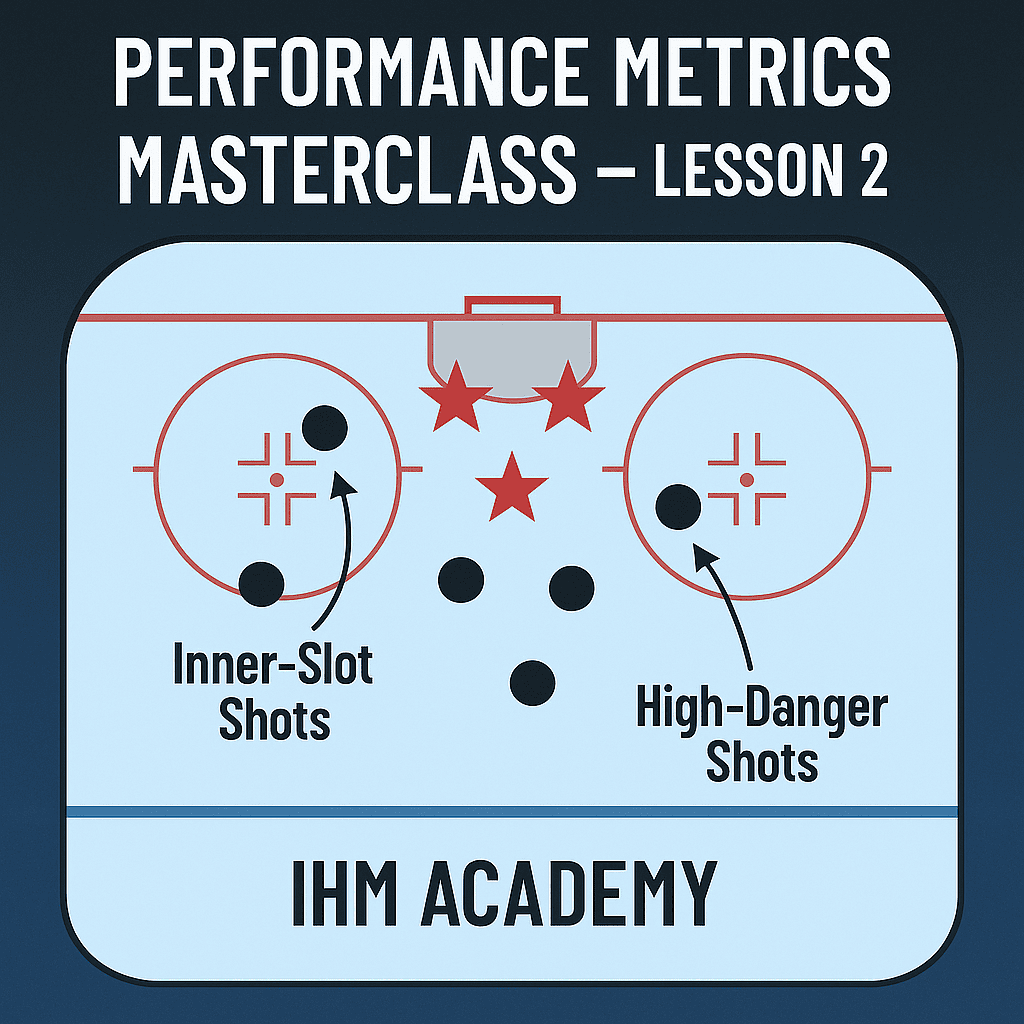
IHM Academy · Performance Metrics Masterclass - Lesson 2

IHM Academy · Performance Metrics Masterclass - Lesson 2


IHM Academy - Performance Metrics Masterclass • Lesson 1

IHM Academy - Performance Metrics Masterclass • Lesson 1


IHM Performance Metrics Report: Why the Ducks and Utah Mammoth Suddenly Look Like Analytics Superpowers

IHM Performance Metrics Report: Why the Ducks and Utah Mammoth Suddenly Look Like Analytics Superpowers

Date: November 8, 2025 | Author: IHM News Analytics


Why the Ducks and Utah Mammoth suddenly look like analytics superpowers

A deep breakdown of two surprising engines of the 2025-26 NHL season

The first month of the season has delivered two unexpected machines of chaos: Anaheim Ducks, suddenly the brightest offensive show in the West, and Utah Mammoth, who instantly found an elite play-driver in Nick Schmaltz.

But behind the flurries of goals, comebacks and nightly highlights lies a far more revealing truth. This is an analytics-based evolution built on:

  • high-danger efficiency
  • elite transitional play
  • explosive speed clusters
  • possession metrics that indicate sustainability

IHM EDGE broke down both teams under the microscope – here’s what we found.


🦆 SECTION I – Anaheim Ducks: Inside the engine of a sudden powerhouse

1. High-danger ecosystem

Anaheim aren’t just scoring a lot – they are scoring the right way. The Ducks have already generated 28 high-danger goals, more than most of their division combined. Chris Kreider and Cutter Gauthier are currently among the top high-danger producers in the NHL.

Carlsson, Sennecke and Terry form a constant pressure triangle built on:

  • fast zone entries
  • short-link passing
  • finishes from the kill zone (2-4 meters)

This is not randomness - it’s a system. And it works.

2. Cutter Gauthier: The EDGE monster exceeding every projection

Gauthier is one of the most “unstoppable” analytical profiles in the league right now. His EDGE metrics look engineered:

  • average shot speed – 97th percentile
  • speed bursts – 97th percentile
  • hardest shot – 93rd percentile
  • mid-range goals – leads NHL
  • Goals Above Projected – +5.91 (1st in NHL)

He scores shots that models classify as low-probability. When a player beats the model itself – we’re dealing with elite talent.

3. Territorial control – Ice Tilt as a predictor of future success

Anaheim currently rank No. 1 in the NHL in first-period Ice Tilt advantage. This means they take control of rink territory and game tempo early.

Carlsson (+63) and Gauthier (+60) dominate 5v5 shot differential like established superstars – at age 20 and 21.

4. Goaltending stability

Dostal has quietly become a stabilizer:

  • elite mid-range SV%
  • 7-3-1 record
  • 5v5 save% above league average

For a team that has lacked a foundation in net for years, this is transformative.


🦬 SECTION II – Utah Mammoth: Schmaltz’s reinvention and the rise of a new top-six

Utah play fast, aggressive and structured – but their entire offensive shape is glued together by one player: Nick Schmaltz, the most underrated starter of the season.

1. Shot profile: dangerous from every lane

Schmaltz is one of the rare forwards producing elite volume from all three shot tiers:

  • high-danger – 96th percentile
  • mid-range – 95th percentile
  • long-range – 92nd percentile

42 shots in 12 games – the best pace of his entire career. Utah are top-two in shot differential, which confirms structure, not luck.

2. High-danger finishing touch

Five high-danger goals – fourth in the NHL. Two goals on deflections – placing him in rare company with Crosby and Miles Wood.

Schmaltz has long been a high-danger creator, but now he’s finishing at a career-high level.

3. Speed metrics: Utah = a missile

Schmaltz:

  • 20+ mph bursts – 84th percentile
  • total distance – 93rd percentile

Utah as a whole:

  • Cooley – second-fastest skater in the NHL
  • team – 4th in total speed bursts
  • shots allowed per game – 2nd fewest in NHL

This is a team that skates fast without losing structural discipline.

4. Chemistry: Keller – Schmaltz – Hayton

This long-developing trio finally has the personnel to play at full throttle. They drive Utah’s PP1 and tempo game, making possession swings almost automatic.


🚀 SECTION III – What Ducks and Mammoth have in common

Both teams:

  • dominate high-danger creation
  • apply speed as a core identity, not just a tool
  • are led by young stars who already think like veterans
  • show sustainable possession trends
  • benefit from EDGE-positive profiles across the top six
  • look structurally built, not statistically lucky

🎯 IHM VERDICT

Ducks:

Legitimate contenders for a top-2 finish in the Pacific Division. Their metrics match conference finalists – not pretenders.

Utah Mammoth:

Massively underrated playoff candidates. Their top-six is good enough to drag them into contention all season.


Questions & Answers | IHM Performance Metrics

Why are the Anaheim Ducks performing so well this season?

The Ducks rank among the NHL’s best teams in high-danger scoring, first-period territorial control (Ice Tilt) and 5-on-5 possession metrics. Their young core, led by Carlsson and Gauthier, drives elite shot volume and transition pace.

What makes Cutter Gauthier’s analytics profile elite?

Gauthier ranks in the 93rd-99th percentiles in shot power, speed bursts, midrange scoring and goals above expected. He consistently beats projected goal models.

Why is Nick Schmaltz breaking out for the Utah Mammoth?

Schmaltz produces high-volume shots from every scoring tier and ranks top-five in high-danger goals this season. His skating metrics and chemistry with Keller elevate Utah’s entire top six.

Are the Ducks and Mammoth legitimate playoff contenders?

Both teams show sustainable shot-differential and chance-generation metrics, suggesting long-term competitiveness rather than early-season variance.


NHL Match Preview · Philadelphia Flyers vs Ottawa Senators

NHL Match Preview · Philadelphia Flyers vs Ottawa Senators

08 Nov 2025 · Philadelphia, PA

The Flyers return home to Xfinity Mobile Arena after a confident stretch of performances that strengthened their position in the Eastern Conference race. The team has increased its offensive consistency, improved puck movement through the neutral zone, and shown better support on quick transitions. Philadelphia continues to rely on strong forechecking pressure that disrupts opponents early in their breakout attempts.

Ottawa enters this matchup aiming to stabilize their game after a mixed sequence of recent results. The Senators still generate quality looks off the rush, but injuries to key players continue to influence their depth, especially without Brady Tkachuk who remains unavailable. Their defensive zone coverage has also shown vulnerabilities against teams that attack with speed and layered entries.

An important factor heading into this game is the physical battle on the boards. Philadelphia has been winning more puck battles lately, especially at home, while Ottawa has struggled at times to establish effective cycle play. Goaltending performance will likely play a major role as both clubs have had fluctuating results in recent weeks.

This matchup takes place at Xfinity Mobile Arena in Philadelphia, a building where the Flyers have traditionally performed well and maintained strong energy levels from the opening minutes. With both teams looking to secure vital standings points, the dynamics of special teams, forecheck pressure, and injury absences may define the flow of play.

Note: Coach Mark’s previous analysis on Boston Bruins (07 Nov 2025) was successful. For tonight’s Premium selection on Flyers vs Senators, visit the Premium section.

IHM Academy - Defensive Zone Coverage

IHM Academy – Defensive Zone Coverage

Defensive Zone Coverage

Welcome to the IHM Academy Defensive Zone Coverage module – a complete pro-level guide to modern NHL and European defensive structures. Here we break down rotations, responsibilities, pressure rules, net-front battles, low support, switch triggers, weak-side reads, and the tactical details that separate elite defensive teams from average ones. All lessons are authored in the signature style of Coach Mark Lehtonen.


  • IHM Academy · Defensive Zone Coverage-Lesson 6

    IHM Academy · Defensive Zone Coverage-Lesson 6

    By Coach Mark Lehtonen · IHM Academy · Defensive Zone Coverage IHM Academy – Defensive Zone Coverage · Lesson #6Weak-Side Awareness & Backdoor Protection The weak side decides games. Teams defend well on the puck side because it’s visible, loud, and instinctive. But goals are scored behind your structure – on delayed seams, weak-side pinches,…

  • IHM Academy · Defensive Zone Coverage-Lesson 5

    IHM Academy · Defensive Zone Coverage-Lesson 5

    IHM Academy – Defensive Zone Coverage · Lesson #5D-Zone Faceoff Coverage & Responsibilities Defensive-zone faceoffs decide momentum, possession, and scoring chances. A single blown assignment can turn a harmless draw into a Grade-A chance against. Elite teams treat D-zone faceoffs as structured mini-systems, with fixed roles, predictable rotations, and non-negotiable responsibilities. You don’t react in…

  • IHM Academy · Defensive Zone Coverage-Lesson 4

    IHM Academy · Defensive Zone Coverage-Lesson 4

    By Coach Mark Lehtonen · IHM Academy · Defensive Zone Coverage IHM Academy – Defensive Zone Coverage · Lesson 4: Net-Front Defense & Slot Protection The defensive zone does not break first on the boards – it breaks in the slot. Teams that lose the middle of the ice give up screens, tips, and rebounds…


IHM Academy · Defensive Zone Coverage-Lesson #3

IHM Academy · Defensive Zone Coverage-Lesson #3


IHM Academy · Defensive Zone Coverage-Lesson #2

IHM Academy · Defensive Zone Coverage-Lesson #2


IHM Academy D-Zone Box +1 Structure

IHM Academy · Defensive Zone Coverage-Lesson #1


IHM Academy- Learn the Game Like a Coach

IHM Academy- Learn the Game Like a Coach

IHM Academy- Learn the Game Like a Coach

IHM Academy is a professional hockey learning hub led by Coach Mark Lehtonen. Learn modern systems, structures and reads used in the NHL and top European leagues: offensive concepts, forecheck and neutral-zone tactics, special teams, and complete Defensive Zone Coverage. Each lesson includes a clear tactical breakdown, coaching language, a clean board diagram, and a cinematic banner - built to make you think like a coach and play with purpose.

Pro-level hockey academy by Coach: elite systems, special teams and D-zone coverage with clear diagrams and coach-grade explanations.

Systems Categories


Performance Metrics Master Lessons | IHM Academy

Performance Metrics Master Lessons | IHM Academy


IHM Academy - Defensive Zone Coverage

Defensive Zone Coverage


Elite Offensive Structure, Forecheck & Neutral Zone Systems

Elite Offensive Structure, Forecheck & Neutral Zone Systems