Low-Zone Rotation & Switch Coverage
Elite defensive teams don’t chase they rotate. In the low zone, the puck moves quickly below the dots, the cycle attempts to drag defenders out of position, and the net becomes exposed when coverage breaks. Low-Zone Rotation & Switch Coverage is the pro solution: we keep inside position, pass off checks at the right time, and rotate as a unit so the slot stays protected while pressure remains active.
🎯 Objective
- Maintain inside body position and protect the slot at all times.
- Apply controlled pressure on the puck without losing structure.
- Use clean, early switches to avoid pick plays and chase patterns.
- Rotate as a 5-man unit so gaps stay tight and lanes stay closed.
🧠 Core Principles
- Inside first: body between man and net; sticks denying the middle.
- Strong-side overload, weak-side anchor: pressure where the puck is, stability where it isn’t.
- Talk early: switches are called, not guessed. “Mine / Yours / Switch”.
- Skate through the hand-off: one defender arrives before the other leaves.
- Head on a swivel: scan net-front every 1-2 seconds during rotations.
🧩 Roles in the Low Zone
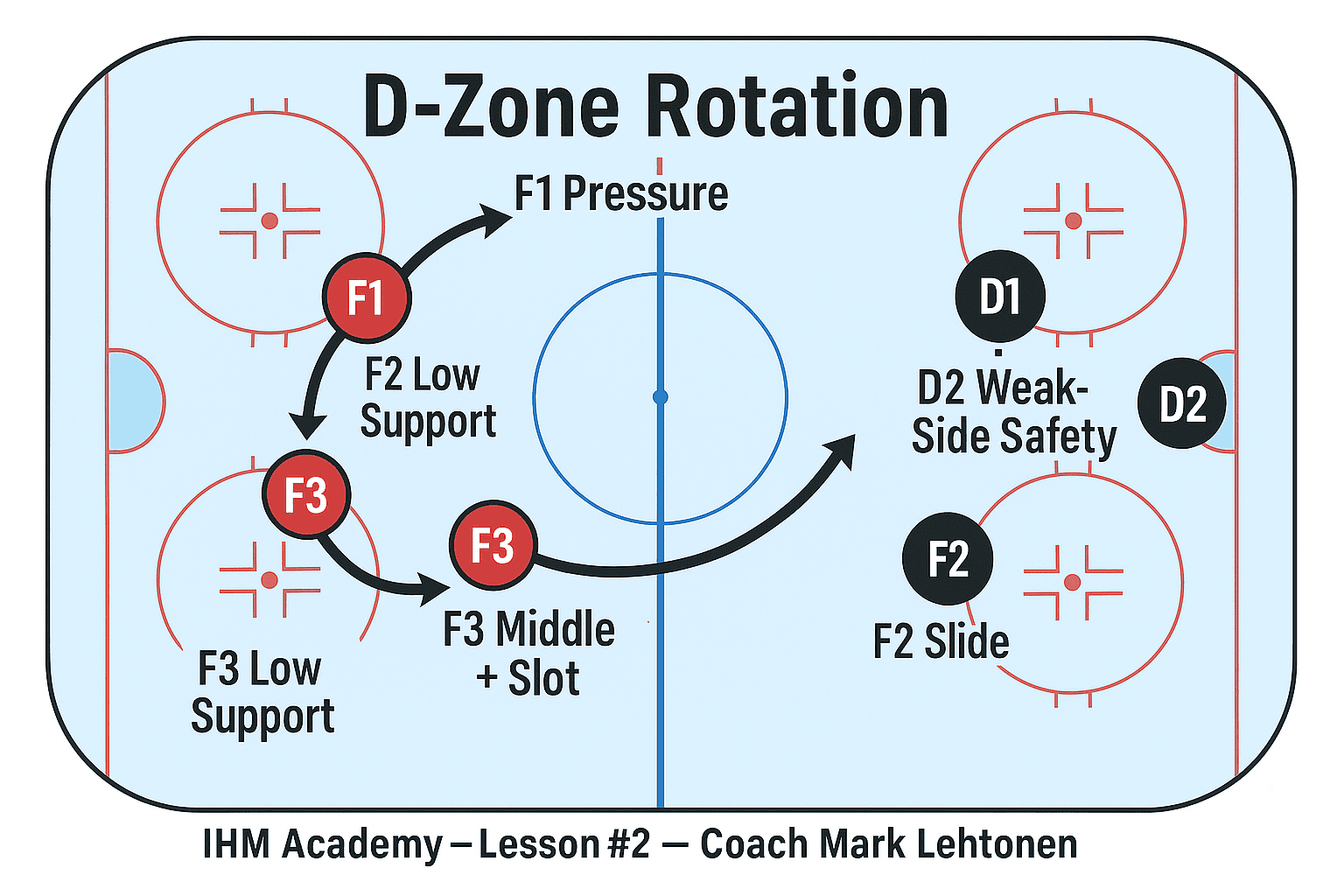
D1 – Net-Side Defender
- Own the crease side; box out; tie up sticks.
- Primary communicator for switches below the hashmarks.
- If the puck reverses behind the net, bump responsibility to the next defender and reset inside.
D2 – Corner/Strong-Side Defender
- First contact on the cycle; steer plays outside the dots.
- When puck is chipped past, ride and release to F1 or D1 on the call.
- Never chase behind the net without a clear switch cue.
F1 – Low Support (+1)
- Help close the strong-side wall; create 2v1 pressure with D2.
- On reverse or pop, arrive first to eliminate time.
- Reload to the top of the box when puck exits the corner.
F2 – Strong-Side High
- Seal the strong-side point and deny low-to-high outlets.
- Collapse to hashmarks when puck drops below the goal line.
- First stick in the high seam on any slot threat.
F3 – Weak-Side High (Anchor)
- Hold middle ice; protect backdoor and far-post seam.
- Tracks the weak-side winger drifting into the slot.
- First outlet on recovery: middle support for clean exit.
🔁 Switch Rules (Low-Zone Hand-Offs)
- Call it early: “Switch!” as the puck carrier crosses the back of the net or hits a pick/pinch point.
- Arrive before release: receiving defender must have inside position before the original checker lets go.
- Inside over speed: never cross outside the dots to chase – take the inside lane and meet.
- Net-front priority: if in doubt, don’t switch off net-front without coverage.
- Immediate reset: after switch, scan and rebuild the box; do not watch the puck.
📣 Bench/On-Ice Communication
- “Hold / Switch / Bump” – universal triggers for all five players.
- “Middle!” – F3 call identifying slot or back-post threat.
- “Low-High!” – warning about a low-to-high play; F2 steps up.
❌ Common Mistakes
| Mistake | Why it breaks coverage |
|---|---|
| Late or silent switch | Both chase; slot opens; free net-front touch |
| D2 chases behind the net | Loss of strong-side, easy wrap or jam |
| F1 doesn’t reload | Top of box empty → high slot shot |
| Weak-side collapse by F3 | Backdoor seam available |
| No inside body on hand-off | Attacker beats switch to the net |
🧪 Micro-Drills
- 2v2 Corner Cycle → Switch – D2 engages, F1 supports, call early switch behind net; D1 restores net-front.
- Reverse Read Series – coach rims/reverses; team practices ride-and-release with inside lanes.
- Low-to-High Denial – F2 seals point; on kick out, recover to box and block high seam.
🧱 Summary
Low-Zone Rotation & Switch Coverage keeps the puck to the outside, denies the slot, and shuts down the cycle without panic. We don’t chase-we pass off, we rotate, and we reset with five players connected inside the dots.
Coach Mark Lehtonen
Low-zone defense fails when players chase. It wins when players rotate. You don’t defend the puck – you defend the middle. If the slot stays protected, everything else becomes a battle we can live with.
❓ Q&A – Low-Zone Rotation & Switch Coverage
Q1: What is the main purpose of low-zone rotation?
A: To maintain inside positioning while applying pressure without chasing. Rotation keeps defenders connected, preserves the slot, and eliminates openings created by the cycle.
Q2: When should a switch be called below the goal line?
A: Early – as the puck carrier crosses behind the net or approaches a pick-point. Late switches create two-man chases and expose the middle.
Q3: Who initiates most low-zone switches?
A: D1 (net-side defender). D1 controls crease coverage and usually has the clearest view of incoming threats, reverses, and pick plays.
Q4: What is the biggest mistake forwards make in this system?
A: F1 failing to reload to the top of the box. When F1 stays too deep, the high slot becomes open for a shot or seam attack.
Q5: What is the weak-side forward’s primary job?
A: F3 protects the middle lane and far-post threat. F3 should never collapse without purpose – his job is to eliminate backdoor options.
Q6: How do you avoid getting picked or screened during switches?
A: Take inside routes, keep your stick pointed at the middle, and communicate early. “Inside first, body second” prevents attackers from using picks to create separation.
Q7: When does D2 join pressure instead of holding position?
A: Only when the puck is firmly on the strong-side and F3 has the middle lane sealed. If D2 jumps early, the weak side collapses and opens a backdoor threat.
Q8: What should the team do immediately after a successful switch?
A: Reset the box shape and scan. Players often relax after a switch – but the danger usually comes from the next play, not the first one.