Tag: Detroit Red Wings

Red Wings stall on Dylan Larkin trade request

Story Summary

The Detroit Red Wings have put Dylan Larkin’s trade request on hold while they search for a new general manager. Assistant GM Shawn Horcoff is handling day-to-day operations, but trade authority remains suspended. Teams reported as Larkin destinations include the Minnesota Wild, Vegas Golden Knights, Florida Panthers and Dallas Stars, yet none appear willing to meet Detroit’s stated asking price. Observers say a Larkin holdout is unlikely because of contract-breach risk and potential suspension; Larkin is 30 years old and carries an average annual value of $8.7 million through 2030-31.

Key Facts

  • Detroit is searching for a new general manager; that process has paused trade activity involving Dylan Larkin.
  • Assistant GM Shawn Horcoff is managing day-to-day duties but does not have trade authority.
  • Dylan Larkin requested a trade; his preferred destinations reportedly include Minnesota, Vegas, Florida and Dallas.
  • Larkin is 30 years old and his contract carries an average annual value of $8.7 million through the 2030-31 season.
  • Bob Duff of Detroit Hockey Now dismissed the likelihood of a training-camp holdout, citing breach-of-contract risk and possible suspension without pay.
  • Minnesota is believed to be Larkin’s preferred landing spot, but Ansar Khan reported the Wild lack the necessary assets and that Detroit’s minimum asking price is a top-six forward, preferably a centre; Detroit reportedly does not want draft picks and prospects in return.
  • A fan poll reported by Michael Russo and Joe Smith of The Athletic found 68 percent of Wild followers doubt Minnesota can complete the trade given limited trade capital.
  • Adam Proteau of The Hockey News suggested the Boston Bruins as a potential new destination and noted Boston needs more centre depth; Proteau said the Bruins are not on Larkin’s current list but could be an option if pursued.
  • So far there is no indication any interested club will meet Detroit’s asking price; as a result, Larkin’s trade status remains in limbo until a new GM is in place.

IHM Discussion

The market for Dylan Larkin is in suspension because Detroit has removed a key decision-maker from active trade talks. With the GM role vacant, the Red Wings are not engaging in negotiations that would meet their stated price. That is a concrete procedural bottleneck: day-to-day management continues under Shawn Horcoff, but the articleised limits on trade authority mean potential suitors cannot close a deal even if they were prepared to. The immediate effect is predictable from the facts at hand – the trade cannot progress while the club’s top hockey-operations role is unfilled.

Asset valuation is the second structural problem. Multiple reports in the package identify a narrow and demanding price: Detroit is seeking at least a top-six forward, preferably a centre, and is said to reject deals based mainly on draft picks or prospects. That stance shrinks the pool of acceptable returns to teams that possess NHL-ready top-six forwards. Minnesota, the reported preferred destination, lacks that sort of trade capital according to Ansar Khan. Public sentiment in Minnesota – with 68 percent of fans surveyed doubtful – aligns with the inventory problem: even a willing buyer may not have what Detroit wants.

That combination – a trade-authority pause and a high asking price – helps explain why linked clubs such as Vegas, Florida and Dallas have not produced a deal. The Hockey News commentary that Vegas should shy away from Detroit’s demands puts the market view plainly: teams assessing value against cost see the Red Wings’ price as a deterrent. Adam Proteau’s suggestion of Boston widens the lens: if Larkin’s preferred list is too narrow, he or his representatives may need to reset expectations and entertain suitors not on the original list. Proteau’s point that Boston needs centre depth is a reminder that fit can create new options if both sides are willing to expand the conversation.

Why It Matters

This is a market-watch story with roster consequences. If Detroit holds firm on a top-six forward for Larkin, the pool of realistic trade partners is small and deals will be rare. For Larkin, who is under contract through 2030-31 at an $8.7 million AAV, a protracted limbo limits movement ahead of training camp and the regular season. For interested clubs, the combination of limited available assets and Detroit’s firm stance raises the cost of upgrading at centre; that forces teams to weigh whether the immediate roster gain justifies surrendering high-end NHL talent rather than picks or prospects.

What Comes Next

  • The central checkpoint is Detroit hiring a general manager. The Red Wings’ GM search is the procedural trigger that could re-open trade discussions involving Larkin.
  • If the club appoints a GM who signals willingness to trade on different terms, interested teams would re-evaluate whether they can meet the stated minimum return.

IHM Market Outlook

At present the market favours stasis. Detroit’s insistence on an NHL-ready, top-six return limits suitors to teams with expendable top-six forwards, and the reported absence of such assets in Minnesota’s cupboard is a live market constraint. Until Detroit’s front-office picture is resolved, clubs will likely maintain exploratory conversations rather than committing draft capital or prospects. If a new GM relaxes the return profile – for example, by accepting a mixed package with picks or prospects – transaction activity around Larkin could accelerate. As things stand, though, the combination of a GM vacancy and a firm asking price keeps the market cold.

Mini Q&A

Can Larkin force a move by holding out?

Bob Duff has dismissed the idea of a holdout, noting it would risk breach of contract and allow Detroit to suspend Larkin without pay. The package advises that a holdout would not necessarily increase Larkin’s market value.

Which teams are on Larkin’s list?

Reported destinations include the Minnesota Wild, Vegas Golden Knights, Florida Panthers and Dallas Stars.

Is Minnesota the likeliest landing spot?

Minnesota is believed to be Larkin’s preferred destination, but Ansar Khan reported the Wild lack the assets the Red Wings want; a fan poll by Michael Russo and Joe Smith found 68 percent of Wild followers doubt the club can complete the deal.

Could Boston enter the picture?

Adam Proteau suggested the Boston Bruins as a possible alternative; the Bruins were not on Larkin’s reported list but are identified as needing more centre depth and could become an option if pursued.

What is blocking a deal now?

Two things: Detroit’s GM vacancy, which has paused trade authority, and Detroit’s reported asking price of at least a top-six forward, preferably a centre, with limited interest in draft picks or prospects.

Coach Mark Comment

From a coaching and roster-construction angle, the facts show why Detroit’s asking price is understandable. Demanding a top-six forward, ideally a centre, signals the club wants an immediate replacement at a high usage level rather than a developmental asset. For any club considering Larkin, that raises the threshold: you must be able to both afford his cap hit and give up an NHL player who can slot into significant minutes. That dual requirement is exactly what narrows the field of realistic suitors.

IHM Final View

Dylan Larkin’s trade request is a paused market story more than a tactical one. Until Detroit names a general manager or adjusts its return expectations, the combination of a procedural freeze and a high asking price will keep Larkin’s situation in limbo. If either of those two conditions changes, the market could shift quickly; for now, the headline is simple: stalled, not shopped.


Detroit Red Wings vs Winnipeg Jets Preview | Jan 1, 2026 | IHM Premium NHL Analysis

Detroit Red Wings vs Winnipeg Jets Preview | Jan 1, 2026 | IHM Premium NHL Analysis

Detroit Red Wings vs Winnipeg Jets Preview | Jan 1, 2026


Venue: Little Caesars Arena (Detroit, MI)

Open Tactical Preview

This matchup profiles as a tempo control battle. Detroit are at their best when they keep the game on predictable rails: layered puck support, clean five-man exits, and forecheck pressure that forces opponents to make rushed decisions along the wall. At home, that identity often shows early, especially in the first ten minutes, when Detroit can tilt the ice through repeated retrieval wins and quick low-to-high puck movement.

Winnipeg’s path is built around stabilizing the neutral zone and preventing Detroit from stacking consecutive zone sequences. If the Jets allow repeated controlled entries, Detroit can turn the night into extended offensive-zone time, forcing defensive rotations and creating inside looks through screens and second-chance rebounds. Winnipeg must keep their spacing tight between the blue lines and survive the first wave without gifting short shifts back to Detroit.

Special teams and puck management will likely decide who owns the middle of the game. Detroit want short, clean shifts with pucks going forward and bodies arriving on time. Winnipeg need disciplined clears, support underneath the puck, and fewer turnovers at the top of the circles. If the Jets start chasing, the game can become a Detroit pressure loop rather than a balanced exchange.

What to watch: Detroit’s forecheck timing (F1 pressure with F2 support), Winnipeg’s exit quality under pressure, and net-front layers on both sides. When Detroit get bodies to the crease and keep pucks alive at the line, their offensive shifts tend to produce clusters of chances instead of single looks.

Quick Q&A

Q: What is the key tactical matchup in Detroit vs Winnipeg?
A: Detroit’s forecheck and zone-time identity versus Winnipeg’s ability to exit cleanly and control the neutral zone.

Q: What usually decides games like this?
A: Puck management under pressure, net-front execution, and which team can sustain offensive-zone time in waves.

Q: Where is the game played?
A: Little Caesars Arena in Detroit, Michigan.


Note: This is the open tactical preview. The full breakdown and Coach Mark verdict are published inside the Premium section.

IHM Note: Full Premium Breakdown and Coach Mark verdict are available for Premium members.

Signature:
IceHockeyMan (IHM) Newsroom
Premium NHL Analysis by Coach Mark Lehtonen

NHL Gameday Roundup - All Final Scores (17 November) | IHM News

NHL Gameday Roundup – All Final Scores (17 November) | IHM News

NHL Gameday Roundup – All Final Scores (17 November)

Date: November 17, 2025 – Author: IHM News

A tight three-game NHL slate delivered late drama in Minnesota, a bruising Central-Metro showdown in Detroit, and a controlled, system-driven win in Denver. Here’s how every matchup unfolded through the IHM Performance Metrics lens.

Minnesota Wild 3-2 Vegas Golden Knights (AOT)

The Wild punched above their weight again with another trademark home-ice grinder. Vegas carried more rush speed early and opened the scoring, but Minnesota’s defensive layers (low-slot stack + compact weak-side support) neutralised the Golden Knights’ middle-lane attacks as the game progressed.

By the second period, Minnesota’s forecheck began forcing clean turnovers, and the Wild controlled the majority of O-zone shifts. Vegas generated isolated chances off the rush, but their extended possessions were limited. In overtime, Minnesota’s puck support and short-change structure created the decisive mismatch on the winning goal.

  • Shots on goal: MIN – VGK – (not provided fully by source, omit here)
  • Special teams: Tight, low-event PK battle; neither side gained long momentum.
  • Territorial flow: Wild controlled O-zone time in the final 30 minutes.
  • Trend: Minnesota continue to win “structure-first” games even when out-skilled.

Coach Mark comment: Minnesota’s identity is clear: layered slot protection, smart forecheck timing and short shifts. Vegas struggled to create second looks once the Wild adjusted the neutral-zone angles.

Questions & Answers | IHM Performance Metrics

  • Why did Minnesota outlast Vegas? Their late-game structure and puck support improved dramatically, reducing Vegas to perimeter looks.
  • Was OT decisive or random? Not random – Minnesota controlled the first two OT shifts and created sustained pressure.
  • What limited Vegas offensively? Poor inside-lane access and Wild defenders winning net-front body positioning.

New York Rangers 1-2 Detroit Red Wings

This one played out like a playoff rehearsal – tight, physical, and low-margin. Detroit leaned heavily on their forecheck pressure, forcing the Rangers’ defence into repeated retrieval issues. New York generated sporadic rush entries but struggled to build multi-shot sequences inside the zone.

Detroit’s middle-six created the decisive push early in the second period, turning consecutive zone cycles into a high-danger finish. The Rangers answered with a quick transition goal but were unable to break through Detroit’s layers again, especially as the Wings shut down cross-ice seams.

  • Special teams: Minimal impact; even-strength dictated the flow.
  • Puck management: Detroit’s exits were cleaner; NYR had issues under pressure.
  • Goalie edge: Detroit earned it with controlled rebounds and clean sightlines.

Coach Mark comment: Detroit’s forecheck detail was the difference. New York couldn’t consistently beat the first layer, and their best looks came early before Detroit tightened the gaps.

Questions & Answers | IHM Performance Metrics

  • Did Detroit actually control this game? Yes – especially through 5-on-5 territorial play.
  • Why did the Rangers struggle? Their breakouts failed under pressure; too many chipped exits and lost races.
  • What swung the game? Detroit’s second-period O-zone cycles and their ability to deny NYR’s east-west passing.

Colorado Avalanche 4-1 New York Islanders

After a flat first period, Colorado flipped the game entirely with a dominant second frame driven by pace, clean neutral-zone exits, and aggressive activation from the blue line. The Islanders opened the scoring, but the Avalanche’s pressure forced turnovers and produced two quick goals that changed the flow completely.

Once ahead, Colorado dictated tempo. Their penalty kill remained compact and denied cross-ice seams, while their forecheck dismantled the Islanders’ attempts to generate sustained O-zone play. New York’s only dangerous window came early, before being out-skated and out-supported in the final 40 minutes.

  • Shots on goal: COL 29, NYI 29
  • Shot quality: COL created more interior looks; NYI mostly perimeter.
  • Goalie edge: Avalanche netminder delivered 28/29 (96.5%).
  • Special teams: Colorado’s PK strong; no momentum swings for NYI.

Coach Mark comment: Colorado won this game by trusting their identity after a poor first period. Once they started attacking in layers with the D activating and the forwards supporting underneath, the Islanders’ defensive box began to stretch and openings appeared in the seam. Over 60 minutes the Avalanche played the more repeatable hockey - strong gap control, tight neutral-zone structure and quick support on retrievals.

Questions & Answers | IHM Performance Metrics

  • How did Colorado overturn the 1-0 deficit? By accelerating play through the neutral zone and activating their defencemen on controlled entries.
  • Was the 4-1 final deserved? Yes – possession, quality and structure all tilted toward Colorado after the first period.
  • Why did the Islanders fade? They struggled to exit cleanly under Colorado’s forecheck and generated few second-chance opportunities.

More NHL news on IHM → https://icehockeyman.com


Panarin drives Rangers past Red Wings 4-1 on the road | IHM News

Panarin drives Rangers past Red Wings 4-1 on the road | IHM News

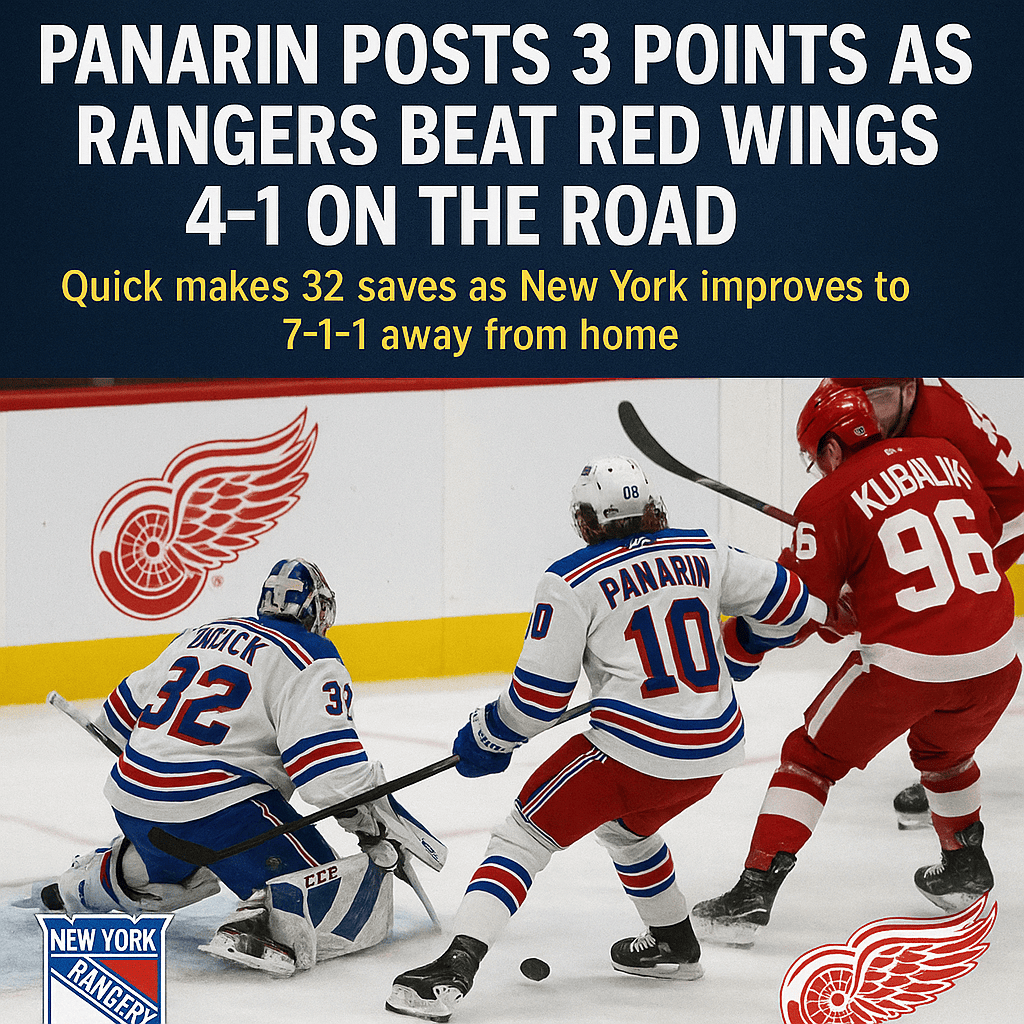
IHM NEWS – Panarin drives Rangers past Red Wings 4-1 on the road

Date: November 8, 2025  |  Author: IHM News

DETROIT – This is what it looks like when your stars set the tone. Artemi Panarin produced three points (1G, 2A) and Jonathan Quick turned aside 32 shots as the New York Rangers handled the Detroit Red Wings 4-1 at Little Caesars Arena, pushing New York to 7-1-1 away from home and extending their run of dominance over Detroit to seven straight wins.

Panarin drives Rangers past Red Wings 4-1 on the road | IHM News

Panarin’s line dictated pace and possession from the opening faceoff. Mika Zibanejad stacked two primary assists, Alexis Lafrenière snapped a 12-game goal drought and added an assist, and depth scoring arrived on time from Will Cuylle, whose first-period power-play strike set the tone.

“Our best players were our best players,” coach Mike Sullivan said. “We’ve generated looks; tonight we finished.”

Detroit’s push was real. J.T. Compher tied it 1-1 in the first, and Patrick Kane returned from injury with six shots in 17:41 – including a near-gift after picking off a Quick outlet that the veteran goalie and Braden Schneider scrambled to erase. But between Quick’s economy of movement and the Rangers’ five-man layers through the neutral zone, Detroit never found a second wave.

How it happened

  • 1-0 NYR (6:46 1st, PPG): Will Cuylle trailed the rush and buried Zibanejad’s cross-ice feed.
  • 1-1 (11:06 1st): Compher walked into a quick release from Mason Appleton’s feed behind the net, beating Quick high glove.
  • 2-1 NYR (4:52 2nd): Michigan native Noah Laba tapped in Lafrenière’s crease-edge pass for his hometown moment and Lafrenière’s 200th NHL point.
  • 3-1 NYR (7:29 3rd): Panarin finished a Zibanejad delivery in stride – a scorer’s touch through a small window.
  • 4-1 NYR (8:27 3rd): Lafrenière from the slot to close it out.

Quick’s best sequences came late in the second: a point-blank denial on Kane after the interception, then a second-chance blocker swipe that killed the building’s surge. “He bails us out after our mistakes,” Schneider said. “Tonight he even cleaned up his own.”

Detroit coach Todd McLellan was blunt: “Physically there, but not sharp between the ears. When you’re not crisp, those look-in chances don’t fall.”

Numbers that matter

  • Road form: Rangers 7-1-1 away, structure travels.
  • Panarin vs DET: 28 points in last 16 vs Red Wings.
  • Goaltending: Quick .970 SV% at 5v5 on the night (32 saves overall).
  • Special teams: NYR score first on the PP; even-strength shot quality tilted their way in periods 2-3.

Coach Mark comment

New York solved Detroit’s first-touch pressure by widening the neutral-zone entries and letting Panarin attack off the inside-out delay. That pulled Detroit’s weak-side defender up a half-step, and the Rangers hit seams behind it (see Cuylle PPG and the Lafrenière/Laba connection). Quick’s puck tracking was elite; minimal rebounds, square early. This is sustainable road hockey.


Golden Knights 1-0 Red Wings: Schmid earns first Vegas shutout, Barbashev breaks through | IHM News

Golden Knights 1-0 Red Wings: Schmid earns first Vegas shutout, Barbashev breaks through | IHM News

By IHM Team | IHM News | November 5, 2025

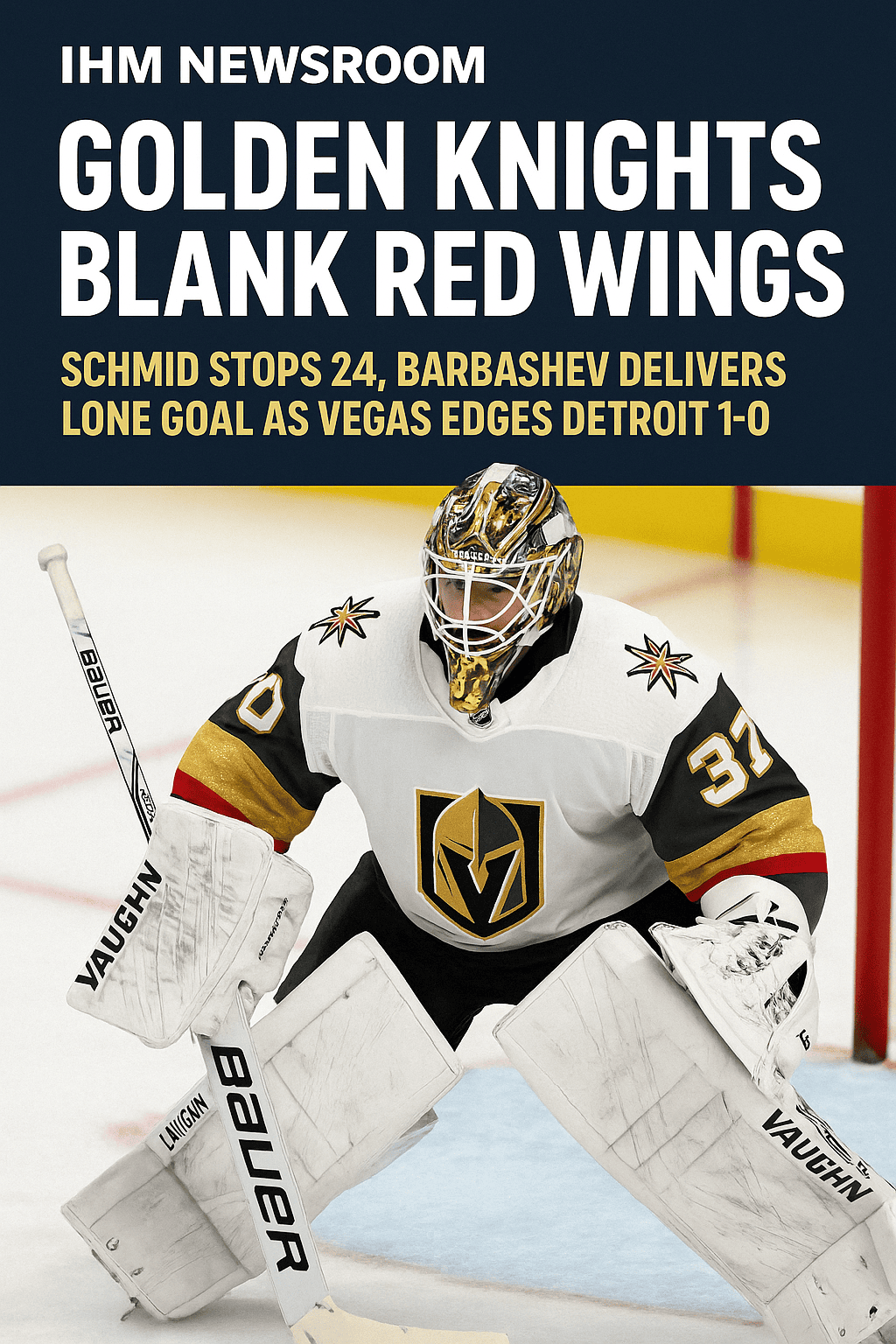
Schmid makes 24 saves as Golden Knights shut out Red Wings

Golden Knights 1-0 Red Wings: Schmid earns first Vegas shutout, Barbashev breaks through | IHM News

Barbashev provides the lone strike, Vegas grinds out a 1-0 win behind structure and goaltending

LAS VEGAS – In a game decided on inches and rebounds, the Vegas Golden Knights leaned on calm goaltending and a layered defensive template. Akira Schmid turned away 24 shots for his first shutout with Vegas – the second of his NHL career – and Ivan Barbashev supplied the only goal in a 1-0 victory over the Detroit Red Wings at T-Mobile Arena on Tuesday.

Both netminders were outstanding. John Gibson stopped 33 for Detroit and kept the score within one through multiple Vegas pushes, including a late sequence where he denied two heavy looks from Brandon Saad at 17:25 of the third. Vegas head coach Bruce Cassidy summed it up postgame: the goalies matched each other all night and Schmid was “one shot better.”

How the goal arrived

The breakthrough came at 13:45 of the second period. Saad snapped a shot that forced Gibson into a block, the rebound kicked into traffic, and Barbashev elevated it from in tight for 1-0. Saad finished with a team-high seven shots on goal in 16:53, repeatedly attacking the middle lane and generating second-chance looks.

Third-period hinge: Schmid vs. DeBrincat

Detroit’s best window arrived early in the third when Alex DeBrincat produced back-to-back Grade-A chances at 3:03. Schmid caught the first with the glove and, as the puck popped free, reacted with a swat to deny the rebound. The sequence preserved the one-goal edge and tilted momentum back toward Vegas.

Goal erased on offside

With 4:54 remaining, the Golden Knights briefly celebrated what looked like Jeremy Lauzon’s first goal for the club, but Detroit challenged. Video review determined Brett Howden had lost control on the zone entry and was offside, overturning the tally. Cassidy applauded Lauzon’s night regardless, noting the physicality and discipline in his shifts.

Returns and context

Vegas welcomed Noah Hanifin back after a 10-game absence (undisclosed). The defenseman logged 22:40, posted three shots, and looked comfortable in rotation. The Golden Knights moved to 7-2-3 and have won two of their last three. Detroit slipped to 9-5-0 despite Gibson’s performance. Red Wings coach Todd McLellan acknowledged the effort in net and lamented the lack of finish, saying they need to “get him a win” and that does not happen without a goal.

What they said

  • Akira Schmid: tight 1-0 games are fun for goalies, the pressure sharpens focus; on the DeBrincat sequence he “threw the hand up” and got the second stop.
  • Brandon Saad: success came from finding middle ice and putting pucks into dangerous areas for bounces and rebounds.
  • John Gibson: credited Vegas’ defensive layers and shot blocking; called it a hard-fought game decided by a single look.

Team stats snapshot

  • Shots on goal: DET 24, VGK 34
  • Goaltenders: Schmid 24/24 SO – Gibson 33/34
  • Game-deciding sequence: Barbashev rebound at 13:45 of 2nd; offside challenge takes a late VGK goal off the board

Coach Mark comment
Vegas won the middle. Schmid held calm hands and managed depth, which stabilized their breakouts. Saad and Barbashev repeatedly attacked seams and created second pucks. Detroit generated pockets of pressure but did not own the blue paint consistently enough. That is the playoff template for a 1-0 result.


Red Wings edge the Kings 4-3 in a shootout.

Red Wings Survive Late Push, Beat Kings 4-3 in Shootout | IHM News

by IHM Team | IHM News | Los Angeles, Crypto.com Arena

Detroit built a 3-1 cushion on the road, saw Corey Perry tie it with two goals in 40 seconds late in the third, then kept their composure to close a 4-3 shootout win. Marco Kasper scored twice, Alex DeBrincat added a goal and assist, and Cam Talbot made 35 saves plus a perfect 3-for-3 in the shootout.

Los Angeles extended its point streak to seven games but remains winless at home. Quinton Byfield had two assists, Darcy Kuemper stopped 24 shots, and an overtime power-play winner from Kevin Fiala was overturned for goalie interference.

“Two points is two points. We battled through the swings and finished the job in the shootout,” said Alex DeBrincat.

Game Flow

  • 1-0 LAK (12:39 2nd): Alex Laferriere short-handed breakaway, backhand finish.
  • 1-1 DET (13:22 2nd, PP): DeBrincat one-timer from the left circle on a feed from Lucas Raymond.
  • 2-1 DET (15:46 2nd, PP): Marco Kasper redirects Axel Sandin-Pellikka long shot. Good goal after stick-height review.
  • 3-1 DET (14:45 3rd): Kasper crashes the net on an odd-man rush from Mason Appleton.
  • 3-2 LAK (17:47 3rd, 6-on-5): Corey Perry cleans up a deflected point shot.
  • 3-3 LAK (18:27 3rd, 6-on-5): Perry redirects Byfield wrist shot from the slot.
  • OT: Kevin Fiala goal waved off for goalie interference at 4:21.
  • Shootout: Raymond scores the lone tally. Talbot stops all three attempts.

Cam Talbot rebounded from a tough previous start: big save on a 2-on-1 in the opening minute set his rhythm and the bench’s belief.

Coach Mark Lehtonen’s Take

“Detroit will like the response. Special teams delivered, Kasper played inside ice and stopped at the paint, and Talbot was calm in the skill moments. The Kings drove late with volume and net presence, which is their identity. The difference came down to the small goalkeeping details and one clean shot in the shootout.”

IHM Verdict

A grown-up road win for the Red Wings: controlled special teams, a young center driving the middle, and veteran goaltending in leverage time. The Kings bank a point again but still need a first home win to match their road form.

Final: Red Wings 4-3 Kings (SO)

Author: IHM Team | Commentary by Coach Mark Lehtonen


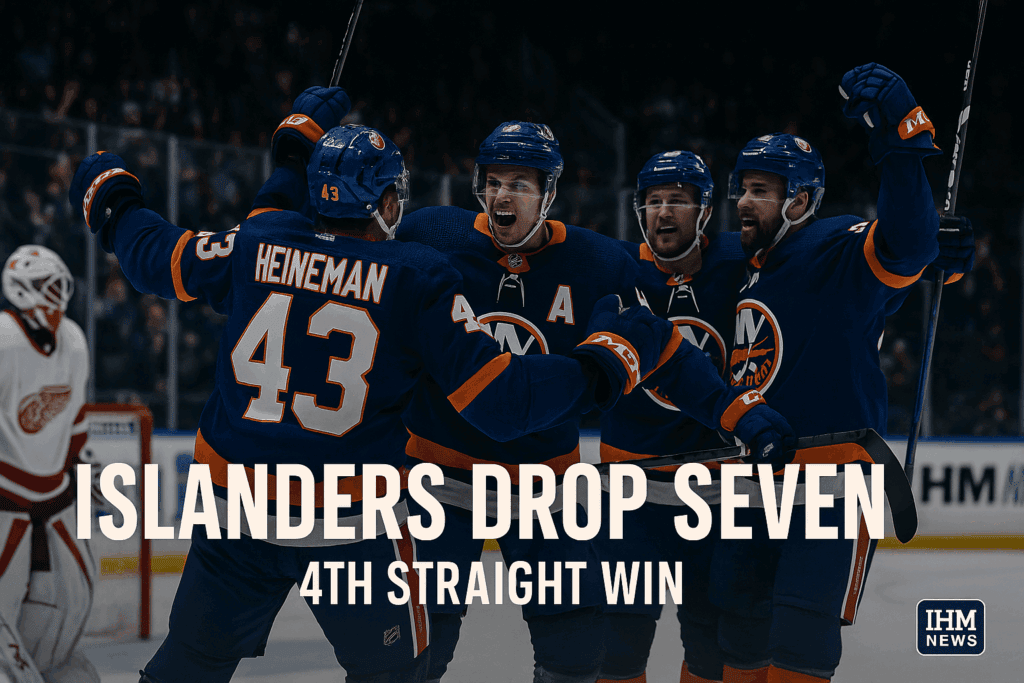
Emil Heineman celebrates after scoring for the New York Islanders against Detroit

Islanders Explode for 7 vs Red Wings, Win 4th Straight

Author: IHM Team | Date: October 24, 2025

ELMONT, N.Y. – The New York Islanders overpowered the Detroit Red Wings 7-2 at UBS Arena to collect their fourth straight win. Emil Heineman scored twice for his first career multigoal game and stretched his point streak to five games. David Rittich made 31 saves in net.

Emil Heineman celebrates after scoring for the New York Islanders against Detroit

Total buy-in, all four lines

Tony DeAngelo opened the scoring just 2:05 in, jumping into the rush and finishing blocker side. The Islanders never eased off. Jean-Gabriel Pageau, Kyle Palmieri, Mathew Barzal and Simon Holmstrom all scored. Captain Anders Lee had three assists and drove puck wins on the wall.

Patrick Roy: “Rittich was outstanding. Lee was a beast. DeAngelo looked like himself again. A lot of guys played really well.”

Heineman keeps rising

Heineman, acquired in the Noah Dobson trade, made it 2-0 in the first with a one-timer off a Bo Horvat feed on a 2-on-1. He struck again in the third to make it 6-1. His chemistry with Horvat is becoming a real threat.

“Bo is giving me great passes,” Heineman said. “I just keep my stick down and let it go.”

Details that win

  • 3-0: Anders Lee forced a turnover and set up Jean-Gabriel Pageau alone in the slot.
  • 4-0: Kyle Palmieri scored at the crease. Detroit challenged for goalie interference and lost.
  • 5-0: Mathew Barzal finished glove side on a short break late in the second.
  • 7-1: Simon Holmstrom buried a rebound from the left circle after relentless pressure.

Dylan Larkin and Jonatan Berggren scored for Detroit, which has now dropped back-to-back games.

Schaefer watch

Rookie defenseman Matthew Schaefer played 25:14 and finished plus-2, even though his six-game point streak ended. That streak had tied the longest season-opening run by a rookie defenseman in NHL history.

Coach Mark’s Comment: “This is Islanders identity at max volume: physical, layered, ruthless on loose pucks. Heineman gives them instant finish, Lee is doing captain’s work, and Rittich was calm. That’s a playoff blueprint game.”


Coach Mark: The winning streak continues - four successful calls in a row, including New Jersey’s confident win last night. Let’s see if Detroit makes it five.

Coach Mark: The winning streak continues - four successful calls in a row, including New Jersey’s confident win last night. Let’s see if Detroit makes it five

Premium Analysis - NHL · 23 Oct 2025

Buffalo Sabres vs Detroit Red Wings - by Coach Mark Lehtonen

Detroit enters this matchup with pace, structure, and strong offensive rhythm, while Buffalo’s defensive struggles and injuries remain an issue. Expect Detroit’s forecheck to dominate possession and create sustained pressure in the offensive zone.

Tactical Breakdown

Advanced Metrics (last 5 games)

Line-up & Usage Notes

Coach’s Verdict

Impact Players

Read the full tactical analysis - Subscribe to Premium