Tag: nhl highlights

Watch the best NHL highlights featuring top plays, goals, saves, and game-changing moments. Relive the excitement of the National Hockey League with expert breakdowns and analysis of key plays.

Washington Capitals 3-5 Tampa Bay Lightning - NHL Game Recap | IHM News

Washington Capitals 3-5 Tampa Bay Lightning – NHL Game Recap | IHM News

Washington Capitals 3-5 Tampa Bay Lightning

A four-goal first period drives Tampa Bay’s road win

Date: November 23, 2025 Author: IHM News

Tampa Bay opened this road matchup with ruthless finishing touch, striking four times in the opening twenty minutes and forcing Washington to chase the game from the start. Despite a determined push in the second and third periods, including a late surge led by Frank and Chychrun, the Capitals could not dig out of the early deficit. Tampa imposed pace, controlled most special-teams moments and punished every defensive lapse in the high slot and weak-side seams.

Game Flow

Tampa Bay’s explosive first frame was the story. After Washington opened scoring through Sourdif at 1:06, the Lightning responded immediately with a shorthanded equalizer from Hagel, then layered two clinical power-play executions and an even-strength finish from Kucherov to lead 1-4 after twenty.

The second period slowed substantially as Washington attempted to stabilize defensively, holding Tampa off the board and cutting the deficit early through Chychrun. Physicality escalated late in the period with multiple minors and a fighting sequence driven by Wilson and Douglas.

The third period tightened further. Frank capitalized on sustained zone time to bring Washington within one, but Tampa iced it with a controlled breakout sequence ending in Cirelli’s 3-5 goal at 15:51. Tampa’s disciplined third-period structure protected the middle of the ice and choked Washington’s comeback window.

Tampa Bay goalie play proved decisive late, standing tall against a heavy volume surge.

Numbers Box

  • Shots on goal: Washington 34, Tampa Bay 16
  • Shooting %: Washington 8.82%, Tampa Bay 31.25%
  • Goalie saves: Washington 11, Tampa Bay 31
  • Blocked shots: Washington 21, Tampa Bay 13
  • Power Play: Washington – 0 goals; Tampa Bay – multiple conversions
  • PIM: Washington 11, Tampa Bay 27
  • Streaks: Kucherov extends multi-point trend

Coach Mark comment

Tampa’s first period showed elite execution and puck movement. Washington improved defensively afterward, but the damage was done early. Tampa managed momentum better and protected the interior in the third.

Questions & Answers | IHM Performance Metrics

What changed the game most decisively?Tampa’s four-goal first period created scoreboard control and dictated pace and structure the rest of the way.

Why did Washington struggle despite outshooting Tampa? Tampa’s shot quality was significantly higher. Their best chances came from prime interior ice, while Washington generated volume but less net-front efficiency.

How impactful was special teams play? Tampa punished penalties ruthlessly early. Washington failed to convert on their power plays.

What was the key late-game separator? Tampa’s controlled exits and disciplined third-period structure prevented extended Washington cycles.

More NHL news on IHM.


NHL Game Day Recap - Four-Game Slate Closes With Dramatic Overtime Finish | IHM News

NHL Game Day Recap – Four-Game Slate Closes With Dramatic Overtime Finish | IHM News

Date: November 22, 2025 Author: IHM News

The Story of the Night

Four matchups delivered a diverse slate of storylines across the NHL on night. Buffalo’s offensive explosion stole the headlines, Carolina executed a clinical late push in Winnipeg, Minnesota showed defensive suffocation at home, while Boston survived a tactical chess match in Los Angeles and claimed the points in overtime. Each contest revealed meaningful trends in special teams, late-game management and depth scoring – themes that continue to define this phase of the season.


Buffalo Sabres 9-3 Chicago Blackhawks

Buffalo produced a devastating offensive performance and never took their foot off the pedal. The Sabres punished every Chicago mistake in transition, feasted below the dots and converted nearly every high-danger touch inside the slot. Chicago struggled to stem momentum swing after momentum swing and paid for repeated defensive collapses.

Numbers Box

  • Special teams: Buffalo dominant in rhythm + sustained O-zone time
  • Momentum notes: Buffalo controlled pace wire-to-pace
  • Streaks: Sabres offense red hot entering December window

Pittsburgh Penguins 0-5 Minnesota Wild

Discipline and structure defined Minnesota’s shutout win. The Wild suffocated Pittsburgh’s zone entries, cut off the middle lane and eliminated second-chance looks at the net front. Their forecheck repeatedly pinned the Penguins deep, creating long shifts and momentum swings that gradually broke down Pittsburgh’s defensive structure.

Numbers Box

  • Goaltending: Minnesota steady, composed, efficient tracking
  • Identity marker: textbook defensive domination

Winnipeg Jets 3-4 Carolina Hurricanes

Carolina overturned a difficult start and leaned on their transition game late. Power-play execution in the second period was the fulcrum that flipped control, and disciplined puck movement in the final frame secured the road comeback. Winnipeg’s early structure failed to translate into third-period control as Carolina’s speed dictated late possession.

Numbers Box

  • Shots on goal: WPG 27 - CAR 28
  • Shooting %: WPG 11.11% - CAR 14.29%
  • Saves %: WPG 85.71% - CAR 88.89%
  • PIM: WPG 8 - CAR 8
  • Turning point: special-teams in period two

Los Angeles Kings 1-2 Boston Bruins (OT)

Boston leaned on goaltending excellence and late-game resilience to silence Los Angeles in overtime. The Bruins struggled at even strength in stretches, but they neutralized the Kings’ shot volume with layers of interior coverage, holding LA to one goal despite extended O-zone time. The overtime sequence showcased composure and execution under pressure.

Numbers Box

  • Shots on goal: LAK 32 – BOS 26
  • Blocked shots: LAK 23 – BOS 12
  • Goalie saves: LAK 24 – BOS 31
  • Saves %: LAK 92.31% – BOS 96.88%
  • PIM: LAK 4 – BOS 20
  • Winner: OT – Geekie

Coach Mark Comment

Boston showed control in crisis moments. Carolina managed the puck better late and deserved the comeback. Minnesota built a defensive clinic, while Buffalo showed ruthless efficiency. Each win came from strong structural habits, not luck.


Questions & Answers | IHM Performance Metrics

Which win demonstrated the strongest tactical identity over 60 minutes?

Minnesota’s shutout. Their layered structure, neutral-zone control and possession sequencing stood out the entire night.

What was the defining difference in Winnipeg?

Carolina’s power-play rhythm and controlled zone entries mid-game flipped momentum and dictated the final frame.

Which offensive output carries sustainability signs?

Buffalo – because the goals came from repeatable offensive patterns, not isolated individual plays.

Did goaltending decide any matchup decisively?

Boston’s 96.88% save performance carried heavy weight, especially with LA firing 32 shots.

Read more NHL news on IHM.


Los Angeles Kings 1-2 Boston Bruins (OT) - Bruins Steal Defensive Duel in LA | IHM News

Los Angeles Kings 1-2 Boston Bruins (OT) – Bruins Steal Defensive Duel in LA | IHM News

November 22, 2025 – Author: IHM News

Los Angeles Kings 1-2 Boston Bruins (OT)

Morgan Geekie’s overtime winner capped a grinding road effort for Boston, who survived a third-period shorthanded equaliser and heavy Kings shot volume to take two points out of LA.

In Los Angeles, two teams that usually lean on pace and offence played a tense, low-scoring chess match instead. The Boston Bruins edged the Kings 1-2 in overtime, weathering long stretches of pressure and a pronounced shot deficit but winning the special-teams and goaltending battle when it mattered. Boston finally broke through in the third period on a power-play strike from Morgan Geekie, only to see Joel Armia answer with a shorthanded goal that flipped the momentum and ignited the home crowd. Overtime reset the board, and the Bruins’ structure reasserted itself-Geekie struck again in the extra frame to silence Crypto.com Arena and bank a classic “road patience” win.

Game Flow

The opening twenty minutes were all about discipline and defensive layers. Los Angeles pushed the tempo early and generated the better looks off the rush, but Boston’s box-plus-one defensive-zone structure kept most pucks to the outside. Both teams traded minor penalties as they tried to establish inside positioning, yet neither power play found enough clean seam passes to break the deadlock. After one period it was still 0-0, with the Kings slightly ahead on the shot clock but unable to solve the Bruins’ shot-blocking lanes.

The second period settled into an even tighter pattern. LA continued to drive volume from the points and cycle game, while Boston focused on quick exits and short changes to avoid extended defensive-zone shifts. The Bruins’ penalty kill stayed sharp, denying controlled entries and forcing the Kings to repeatedly dump pucks in. Physicality ramped up around the net fronts, but both goaltenders tracked the puck cleanly and rebound control remained strong. Through forty minutes the game still had a playoff feel: lots of traffic, lots of contact, and no scoring.

The breakthrough finally arrived early in the third. On a Bruins power play, they tilted the ice with a high umbrella set, moving the puck through the half-wall and bumper to stretch LA’s penalty killers. Morgan Geekie found a soft pocket in the right-side slot, took a feed from below the goal line and ripped home the 0-1 marker to give Boston the first lead of the night. Instead of folding, the Kings responded with an aggressive kill of their own later in the period-Joel Armia jumped on a loose puck while short-handed, attacked with speed and finished a transition chance to tie the game 1-1 and reignite the building.

Overtime brought more open ice but the same underlying themes. The Kings tried to leverage their extra-skill forwards in 3-on-3, rotating high in the offensive zone and chasing mismatches. Boston stayed patient, protecting the middle of the ice and waiting for a turnover. When LA mismanaged a puck at the offensive blue line, the Bruins transitioned quickly, created a short 2-on-1 look and once again found Geekie, who buried the game-winner to seal a disciplined 1-2 road victory.

Behind the scenes, Boston’s blue line quietly did heavy lifting. Despite being outshot, the Bruins limited true high-danger slot touches and trusted their goaltender to handle perimeter volume. The Kings’ defensive core, meanwhile, paid the price in blocked shots and heavy minutes, but could not convert their territorial advantage into enough quality to beat an in-form Boston netminder twice at 5-on-5.

Numbers Box

  • Final score: Los Angeles Kings 1, Boston Bruins 2 (OT)
  • Shots on goal: Kings 32, Bruins 26
  • Shots off target: Kings 19, Bruins 21
  • Shooting percentage: Kings 3.13% (1/32), Bruins 7.69% (2/26)
  • Blocked shots: Kings 23, Bruins 12
  • Goalkeeper saves: Kings 24, Bruins 31
  • Save percentage (SV%): Kings 92.31%, Bruins 96.88%
  • Penalties: Kings 2, Bruins 6
  • Penalty minutes (PIM): Kings 4, Bruins 20
  • Special teams highlights: Geekie power-play goal; Armia shorthanded equaliser; Geekie overtime winner at 3-on-3.

Team Notes

For Los Angeles, this loss will sting because the process looked right for long stretches. Outshooting and out-blocking Boston while controlling most of the 5-on-5 possession usually leads to points, but the Kings lacked a finishing touch from their top-six forwards. Their late push and Armia’s shorthanded strike are positive signs, yet the power play’s inability to break through in a low-event game will be a focus in video review.

Boston, on the other hand, will be thrilled with how their defensive identity travelled. They accepted playing without the puck, trusted their structure in the defensive zone and leveraged special teams plus elite goaltending to squeeze out a result. Geekie’s two-goal night underlines the value of depth scoring, especially in games where the usual headliners are bottled up.

Coach Mark comment

From a coaching angle, this is a textbook example of how a road team can win without dominating the shot clock. Boston stayed inside the dots, protected the slot and refused to chase hits or stretch plays through the neutral zone. When they finally earned their looks on special teams, they executed with pace and purpose, while the Kings were just one more clean touch away from turning pressure into goals.

Questions & Answers | IHM Performance Metrics

Why did Boston win despite being outshot?

The Bruins controlled the middle of the ice and quality, not volume. Their defensive box stayed tight, they limited seam passes and allowed their goalie to see most pucks from distance, which pushed Los Angeles into a low-conversion shot profile.

What was the key tactical swing in the third period?

Boston’s power-play structure finally stretched LA’s penalty kill and created the first Geekie goal from the slot. Even though the Kings replied shorthanded, that stretch showed the Bruins could dictate tempo when given set possession.

How did the Kings’ penalty kill shape influence the game?

For most of the night, LA’s pressure-focused kill (aggressive on the half-walls, with a rotating high forward) disrupted Boston’s entries. But on the decisive third-period power play, they overcommitted to the puck side, leaving a soft pocket for Geekie to exploit.

Which performance metric best explains the Kings’ frustration?

Shot volume combined with a very low shooting percentage is the story. Generating 32 shots but scoring only once suggests too many attempts came from the outside or under heavy pressure, rather than from clean slot looks.

What should both teams carry forward from this matchup?

Los Angeles can build on their ability to drive play and win the territorial battle, but they need sharper execution on the power play. Boston should be confident that their defensive template and depth scoring can win tight, playoff-style games away from home.

For more recaps, analysis and IHM Performance Metrics breakdowns from around the league, visit our NHL news section on IceHockeyMan.

More NHL news on IHM.


NHL Recap - Winnipeg Jets 3-4 Carolina Hurricanes | IHM News

NHL Recap – Winnipeg Jets 3-4 Carolina Hurricanes | IHM News

Winnipeg Jets 3-4 Carolina Hurricanes -Game Recap

Date: November 22, 2025 Author: IHM News

Carolina’s structure survives Winnipeg’s push

The Hurricanes leaned on their trademark layered defensive structure and timely special teams execution to secure a gritty 3-4 road win in Winnipeg. Despite the Jets generating sustained pressure – especially from the Morrissey-Scheifele-Connor trio – Carolina controlled the key moments, flipping the game through transition efficiency and disciplined puck support in the middle of the ice.

How the game unfolded

First Period:
Carolina struck just 16 seconds in through Jordan Staal, setting an early tone of direct net play. Winnipeg responded with a Morrissey wrister for 1-1, then Gabriel Vilardi cashed in on a power play to give the Jets a 2-1 lead. Physicality escalated late with roughing minors on both sides.

Second Period:
The period belonged to Carolina. Staal tied the game early by attacking the slot off a clean zone entry, and Seth Jarvis scored shorthanded – exploiting a rare Winnipeg PP misread – to push the Canes ahead 3-2. Winnipeg struggled to exit cleanly as Carolina’s 1-1-3 neutral-zone look (trap variant) choked off rush attempts.

Third Period:
Another special teams moment widened the gap: Andrei Svechnikov hammered a power-play goal for 2-4. Vilardi answered late to cut it to 3-4, but Carolina’s collapse-and-protect structure inside the dots prevented the Jets from generating a last-minute high-danger look.

Numbers Box

  • Shots on goal: Winnipeg 27, Carolina 28
  • Shots off target: Winnipeg 13, Carolina 16
  • Shooting percentage: WPG 11.11%, CAR 14.29%
  • Blocked shots: WPG 9, CAR 20
  • Goalie saves: WPG 24, CAR 24
  • Penalty minutes: WPG 8, CAR 8
  • Key trend: Carolina generated 2 goals directly off structural breakdowns.

Coach Mark comment

Carolina won this game in the details. Their puck support on exits was excellent, and the Staal line dictated matchups at 5-on-5. Winnipeg created enough looks to tie it late, but their power play shape flattened at key moments. Structurally, Carolina was simply tighter.

Questions & Answers | IHM Performance Metrics

Which sequence shifted the game’s momentum?
Jarvis’s shorthanded goal in the second period broke Winnipeg’s rhythm. The Jets PP stretched too wide, and Carolina countered instantly through the middle.

Why did Winnipeg struggle to generate clean entries late?
Carolina used a tight 1-1-3, forcing dump-ins and denying controlled entries. Without layered support from the Jets’ forwards, retrievals weren’t clean enough.

Who was the most efficient player in terms of impact-per-touch?
Jordan Staal. Beyond scoring twice, he won middle-ice battles and neutralized Winnipeg’s top rush threats by controlling the defensive tempo.

What does this matchup tell us about both teams?
Winnipeg’s top-six can score against anyone, but their in-zone defensive rotations still collapse under lateral plays. Carolina remains elite when the game becomes tactical and structured.

What should fans watch next from these teams?
Winnipeg must sharpen its special teams consistency. Carolina will continue to test teams with disciplined, suffocating structure – especially on the road.

More NHL news on IHM.


Anaheim Ducks 2-3 Ottawa Senators | NHL Game Recap | IHM News

Anaheim Ducks 2-3 Ottawa Senators | NHL Game Recap | IHM News

Date: November 21, 2025 Author: IHM News

Ottawa survived a heavy second-period push and closed out the night with a poised third-period winner from Drake Batherson.

In Anaheim, the Senators delivered a composed, structured road performance to edge the Ducks 3-2 in a game defined by special-teams swings and disciplined defensive layers. Ottawa struck first, absorbed Anaheim’s momentum through the second, then reset in the third to regain control. The Ducks generated volume through rushes and middle-lane drives but couldn’t consistently break Ottawa’s net-front protection, especially as the Senators’ penalty kill tightened late. Key contributions from depth forwards and the blue line secured the victory, while Anaheim’s lack of finishing beyond its mid-game burst proved costly.

Game Flow

1st Period – Ottawa strikes first

Anaheim’s early penalties disrupted their rhythm, and Ottawa capitalized on late-period structure. At 16:39, Cousins opened the scoring off a clean low-cycle feed from Jensen and Cozens, giving the Senators a 1-0 lead. Ducks’ zone exits faltered through the first 20 minutes.

2nd Period – Ducks push back, special teams swing

Anaheim flipped the tempo. At 13:08, B. Sennecke tied it 1-1 on a net-front touch from Gauthier and Carlsson, followed by McTavish at 14:34 finishing a crease battle to make it 2-1.
Ottawa answered late: at 19:02, Pinto hammered a power-play equalizer (2-2) set up by Halliday and Perron. Heavy penalties on both sides shaped the middle frame, but Ottawa’s transition game remained dangerous.

3rd Period – Sanderson restores the lead

At 18:02, with pressure building, Batherson jumped into the half-wall seam and buried a cross-ice feed from Sanderson and Spence, giving Ottawa a 3-2 advantage that held to the final horn. Anaheim generated late looks but never solved Ottawa’s collapsing box.

Numbers Box
• Shots on Goal: ANA 26 – OTT 25
• Shots Off Target: ANA 16 – OTT 13
• Blocked Shots: ANA 11 -OTT 18
• Goalie Saves: ANA 22 – OTT 24
• Penalty Minutes: ANA 6 – OTT 4
• Saves %: ANA 88% – OTT 92.31%

Coach Mark Comment

Ottawa played a smart road game. Their neutral-zone layers forced Anaheim wide, and they won most of the net-front battles late. Ducks had momentum in the second but couldn’t convert territorial pressure into enough high-danger looks. Bathersons’s timing on the winner was elite.

Questions & Answers | IHM Performance Metrics

Q1: Why did Anaheim lose despite more possession?
Because Ottawa controlled the slot. Anaheim’s rush-game worked, but interior access stayed limited.

Q2: What was Ottawa’s biggest tactical edge?
Their penalty-kill spacing and quick puck distribution after retrievals.

Q3: Who influenced the game most?
Batherson – defensive workload plus the decisive 3-2 goal.

Q4: Did special teams decide the game?
Yes. Ottawa’s late second-period power-play marker reset momentum.

Q5: What metric stands out most?
Ottawa’s 18 blocked shots – they sealed the house extremely well.


Utah Mammoth 1-4 Vegas Golden Knights | NHL Game Recap | IHM News

Utah Mammoth 1-4 Vegas Golden Knights | NHL Game Recap | IHM News

November 21, 2025  |  Author: IHM News

Utah Mammoth 1-4 Vegas Golden Knights

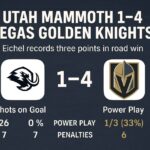
Vegas leaned on star power and structure, riding a Jack Eichel brace, a deep defensive rotation and Logan Thompson’s 25-save performance to a controlled 1-4 win in Utah.

In their expansion home rink, the Utah Mammoth ran into a Vegas Golden Knights team that looked very much like a seasoned contender. Vegas absorbed an early wave of energy, won the special-teams battle and gradually tightened the screws in a 1-4 victory that never felt out of hand once the Knights found their rhythm. Utah generated volume, but Vegas dictated where those attempts came from, keeping most of the traffic to the outside and trusting Thompson to clean up the rest.

The result underlines the gap in execution between a maturing contender and a still-learning newcomer. Utah’s discipline wobbled in the second period, their shooters could not solve Thompson’s controlled positioning, and their own netminder was left exposed on a series of high-quality looks from the slot and weak-side seams.

First period: feeling-out stretch and rising temperature

The opening twenty minutes were scoreless but hardly quiet. Utah pushed pace with an aggressive F1-F2 forecheck, trying to pin Vegas in its own zone and force rushed exits. The Mammoth created a handful of point shots through traffic, yet Vegas’ defensive layers stayed compact, keeping sticks in lanes and limiting clean looks from the middle.

Physically, the tone escalated early. Scrums around both creases and a cluster of minor penalties foreshadowed the emotional second period to come. For Utah, it was energy without finish; for Vegas, it was the groundwork for exploiting special teams once the whistles really started to pile up.

Second period: Vegas punishes mistakes

The game flipped in the second. Utah’s penalty trouble opened the door and Vegas walked straight through it, taking control with a pair of quick strikes. Eichel finally broke the deadlock on a structured power-play look, drifting into the bumper lane to redirect a seam pass past a screened goaltender. Less than a minute later, a clean neutral-zone transition and layered entry led to the 0-2 goal, with Vegas’ middle lane drive pulling Utah’s coverage apart.

Utah briefly clawed back life when Schmidt jumped into the rush and finished a trailing play to make it 1-2, rewarding one of the few Mammoth sequences where they connected cleanly through the neutral zone. Any momentum disappeared late in the frame, though, as Eichel struck again off sustained zone time, wiring a shot through traffic to restore a two-goal cushion and silence the building heading into intermission.

Third period: professional close-out

Up 1-3, Vegas shifted into a classic road lock-down template. If they can layer in better puck support on exits and build more structured offensive-zone rotations, the foundation of work ethic is already there.

Coach Mark Comment

Vegas executed a mature road game. Their transition defense forced Utah into low-percentage looks all night, and the Golden Knights won every key moment. Utah needs more interior play to stay competitive against structured teams.


Questions & Answers | IHM Performance Metrics

Q1: What was Utah’s biggest issue in this matchup?
Utah failed to generate high-danger opportunities and relied heavily on perimeter shooting, leading to a 3.85% shooting percentage.

Q2: How did Vegas control the neutral zone?
They layered their forecheck, used tight 1-1-3 looks, and forced Utah to dump pucks rather than attack with control.

Q3: Did special teams influence the result?
Indirectly yes - even without power-play goals, Utah’s penalty issues handed Vegas momentum and zone time in crucial sequences.

Q4: Why did Utah collapse defensively in the second period?
Penalty trouble created mismatches, Vegas attacked quickly off set plays, and Utah never reset their defensive spacing.

Q5: What stands out most analytically for Vegas?
Their defensive efficiency - allowing only 26 SOG while producing a 96% save performance suggests elite puck control and goalie stability.

For more NHL insights, systems breakdowns and nightly recaps, visit the IceHockeyMan homepage and follow our dedicated NHL section.


Colorado Avalanche 6-3 New York Rangers - IHM Recap

Colorado Avalanche 6-3 New York Rangers – IHM Recap | IHM News

November 21, 2025 – Author: IHM News

Colorado Avalanche 6-3 New York Rangers


Colorado turned a tight game into a statement win with a dominant third-period surge and three goals from their elite core.

Lead:
In Denver, the Colorado Avalanche delivered one of their sharpest third-period pushes of the season, transforming a tense 2-2 matchup into a convincing 6-3 victory over the New York Rangers. Colorado’s transition pace, heavy shot volume (35 SOG), and the MacKinnon-Makar-Necas engine line proved decisive, overwhelming a Rangers team that struggled with puck management and discipline late in the game. New York opened the scoring early and stayed competitive through forty minutes, but the Avalanche’s wave-after-wave forecheck and clinical finishing – including two empty-netters – shut the door on any comeback attempt.

Game Flow

1st Period
New York struck first on a power-play finish from Miller, but Colorado equalized late when MacKinnon buried a feed from Necas and Girard. The period stayed fast, physical, and heavily special-teams driven, with both teams exchanging penalty calls.

2nd Period
The Rangers regained the lead early through Edström, but again the Avalanche answered. Makar jumped into the rush at 17:15, scoring a balanced-zone strike assisted by Necas and MacKinnon. Colorado started to tilt the ice, generating longer offensive-zone cycles and stretching New York’s defensive structure.

3rd Period
Colorado took control for good. Nelson scored on the power play to make it 3-2, and although the Rangers responded with another Miller PPG, the Avalanche ran away from that point on.
MacKinnon converted a rebound at 10:48 to make it 4-3, followed by empty-net goals from Makar and Colton. New York’s discipline collapsed, taking three penalties and allowing Colorado to dictate pace and positioning.

Numbers Box
• Shots on goal: COL 35, NYR 18
• Shots off target: COL 18, NYR 11
• Blocked shots: COL 25, NYR 13
• Goalies:
• COL: 15 saves on 18 shots (83.33%)
• NYR: 29 saves on 33 shots (87.88%)
• PIM: COL 4, NYR 12
• Key streak: MacKinnon adds multi-point night; Makar with 3-point performance.

Team Notes
• Colorado’s elite puck-moving defense overwhelmed the Rangers’ forecheck.
• New York’s defensive rotation broke down repeatedly in the third period.
• Necas continues to show strong chemistry with Colorado’s first line.
• Rangers penalty trouble tilted the final twenty minutes heavily.

Coach Mark comment

Colorado controlled every key momentum swing and played with perfect vertical speed. Their top guys were relentless, and the Rangers simply couldn’t match the transition tempo. This was a complete third-period takeover by a contender-level team.

Questions & Answers | IHM Performance Metrics

Q: What tilted the game in Colorado’s favor?
A: Third-period pace, cleaner exits, and two elite finishers taking over high-danger space.

Q: Why did New York fade late?
A: Too many penalties, loss of defensive shape, and struggles handling Colorado’s high-cycle pressure.

Q: Which metric best explains the result?
A: Shot volume and blocks – 35 SOG and 25 blocks show Colorado controlled zone time.

Q: Did goaltending decide the game?
A: Not directly, but Colorado’s structure made their goalie’s workload far easier than New York’s.

Q: Is this win repeatable for Colorado?
A: Yes. Their transition mechanics and first-line chemistry are sustainable strengths.

More NHL news and analysis on IHM.


Anaheim Ducks 4-3 Boston Bruins - Physical battle in Anaheim | IHM News

Anaheim Ducks 4-3 Boston Bruins – Physical battle in Anaheim | IHM News

November 20, 2025 – Author: IHM News

Anaheim Ducks 4-3 Boston Bruins

Anaheim survived a heavy Boston shot volume to claim a 4-3 home win, with Scott Moore burying the late game-winner after a night full of hits, blocked shots and special-teams swings.

In Anaheim, the Ducks leaned into a classic underdog template: fast start, physical edge and a goaltender ready to absorb a barrage. Despite being outshot 39-33, Anaheim turned opportunistic offense and a committed shot-blocking effort into two points against a Bruins team that pushed hard in all three periods. The Ducks built an early 2-0 cushion, survived multiple Boston responses and finally sealed it when Scott Moore converted late in regulation, capping one of Anaheim’s grittiest wins of the young season.

First period – Ducks punch first, Bruins answer late

Anaheim came out sharp and direct. Just 2:29 into the opening frame, Jansen Harkins made it 1-0 Ducks, finishing a quick sequence after sustained forecheck pressure with help from Riley Johnston and Nikita Nesterenko. A few minutes later, the building erupted again when veteran defender Radko Gudas jumped into the rush and pushed the lead to 2-0 at 6:29, converting a feed from Mason McTavish with Benoit Sennecke also drawing an assist.

Boston slowly settled into its game, using controlled entries and point shots to tilt the ice. The Bruins were rewarded on the power play when Morgan Geekie struck at 14:58, ripping home a one-timer on the man advantage with Hampus Lindholm and Pavel Zacha picking up the helpers to cut the deficit to 2-1.

The tone turned nasty late in the frame as Frank Vatrano and Alex Steeves dropped the gloves at 19:32, a full-on heavyweight bout that underlined just how physical this matchup had become. Anaheim carried a 2-1 lead and plenty of emotion into the first intermission.

Second period – disallowed goal and traded blows

Boston thought it had its equalizer early in the second period when McTavish appeared to extend Anaheim’s advantage, but video review wiped the goal off the board for interference, giving the Bruins a lifeline.

The Ducks regrouped and re-established control on special teams. At 13:47, Ryan Strome restored a two-goal cushion on the power play, cashing in from the bumper spot with McTavish and Colton Gauthier providing the setup for a 3-1 lead.

Boston refused to go away. The Bruins continued to drive pucks from the points and funnel traffic to the crease. Their persistence paid off at 18:27 when Michael Eyssimont made it 3-2, finishing off a greasy net-front sequence after Nikita Zadorov kept the play alive at the blue line. The goal ensured the Bruins would head into the third within a single shot despite chasing most of the night.

Third period – Bruins rally, Moore wins it late

The final frame opened with more nastiness as Gudas and Truchon-Viel squared off in another fight at 2:13, with the Bruins forward also tagged for an instigator minor and a misconduct. That sequence gave Anaheim another chance on special teams, but Boston’s penalty kill held firm and kept the game within one.

The Bruins kept pushing and eventually tied it through special teams again. On a third-period power play, Geekie delivered his second of the night at 7:39, wiring home a quick release off a cross-seam feed from David Pastrnak with Lindholm collecting another assist to level the score at 3-3.

Instead of folding, Anaheim responded with a composed final stretch. The Ducks absorbed Boston’s rushes, blocked lanes in the neutral zone and waited for their moment. It arrived at 16:25 when Scott Moore jumped into a broken play, receiving a feed from Elias Carlsson and Trevor Terry before beating the Bruins goaltender for the 4-3 game-winner. Anaheim then locked down the final minutes, leaning on their structure and a locked-in goaltender to secure a statement victory.

Numbers box

  • Shots on goal: Anaheim 33, Boston 39
  • Shooting percentage: Anaheim 12.12% (4/33), Boston 7.69% (3/39)
  • Blocked shots: Anaheim 21, Boston 18
  • Goaltender saves: Anaheim 36/39, Boston 29/33
  • Penalties: Anaheim 4, Boston 6
  • Penalty minutes (PIM): Anaheim 14, Boston 26
  • Key performers: Geekie (2 G, PP threat), Moore (GWG), Gudas (goal and physical edge), Strome (PPG)

Coach Mark comment

Anaheim followed a perfect home-ice blueprint. They started on time, won the trench battles and used structure to survive Boston’s talent. When you get that level of commitment to blocking shots and winning second pucks, you give your scorer a chance to be the hero, and Moore finished the job.

Questions & Answers | IHM Performance Metrics

How did Anaheim win despite being outshot?

The Ducks protected the middle of the ice, blocked 21 shots and forced Boston into a lot of low-percentage looks. Their goaltender handled the rest with a 92.31% save percentage.

What role did special teams play?

Both teams scored key power-play goals, but Anaheim’s timing was better. Strome’s second-period PPG restored control for the Ducks, while the Bruins’ units were chasing the game to pull even.

Who set the physical tone?

Gudas, Vatrano and Steeves turned this into a grinding, playoff-style game with their fights and heavy hits. That physical tone suited Anaheim’s identity and helped slow Boston’s skill through the neutral zone.

What does this result mean for Boston?

The Bruins generated enough volume to earn a point, but their game management in the first period and late-game defending cost them. It is a reminder that shot totals alone do not guarantee results when you lose the slot and net-front battles.

Did Anaheim find a repeatable formula?

Yes. Strong starts, hard forecheck pressure, disciplined layers in the defensive zone and a direct power play are all sustainable habits, especially at home where they control matchups and last change.

For more NHL recaps, tactical breakdowns and IHM Performance Metrics features, visit the main NHL section on IceHockeyMan.com. More NHL news on IHM.


Minnesota Wild 4-3 Carolina Hurricanes (SO): Wallstedt Steals the Points | IHM News

Minnesota Wild 4-3 Carolina Hurricanes (SO): Wallstedt Steals the Points | IHM News

November 20, 2025 – Author: IHM News

Minnesota Wild 4-3 Carolina Hurricanes (SO)

Filip Wallstedt turned aside 42 of 45 shots and Mats Zuccarello delivered the shootout winner as Minnesota survived a heavy Carolina push to claim a 4-3 victory.

In Saint Paul, the Minnesota Wild were out-shot, hemmed in and pushed to the limit, but they left the rink with two points after a 4-3 shootout win over the Carolina Hurricanes. Minnesota built an early 2-0 cushion, lost control of the game as Carolina’s forecheck tilted the ice, and still found a way to finish on top thanks to elite goaltending and a clutch performance from their veterans in the skills competition. For the Hurricanes, it was a frustrating night where territorial dominance and a 45-19 shots-on-goal edge did not translate into a road win.

Wild strike early, ride special teams jolt

Minnesota could not have scripted a better start. On their first real push of the night, defenseman Brock Faber jumped into the rush and opened the scoring just 1:54 into the first period, finishing off a clean east-west sequence started by Mats Zuccarello and young forward Danila Yurov. The goal immediately loosened up the Wild bench and put Carolina on the back foot.

Midway through the frame, the Wild added a dagger on special teams. Matt Boldy read a loose puck high in the defensive zone, turned it into a shorthanded breakaway and beat the goaltender low blocker for a 2-0 lead. That shorthanded strike punished a sloppy Hurricanes power-play entry and gave Minnesota breathing room despite spending long stretches defending in their own zone.

Carolina’s pushback reshapes the game

The Hurricanes gradually imposed their signature aggressive forecheck and layered offensive-zone pressure. Late in the second period they finally broke through, as Jack Blake slipped into a soft pocket between the circles and buried a feed to cut the deficit to 2-1. From that point on, Carolina largely dictated pace and puck possession, forcing the Wild to collapse around their crease and live off counterattacks.

Early in the third, Minnesota briefly restored control. Zuccarello finished a quick-touch play off a Kaprizov-Yurov cycle just 15 seconds into the period, pushing the score to 3-1. But the Hurricanes answered with the type of surge that has become their identity. Sebastian Aho struck from the slot to make it 3-2, and Blake added his second of the night late in regulation, wiring a shot through traffic to tie the game 3-3 and send it beyond sixty minutes.

Goalies carry the extra session, Zuccarello closes the shootout

Overtime showcased goaltending and structure more than chaos. Carolina continued to own the puck, but Wallstedt tracked every east-west pass and managed the Wild’s defensive rebounds, refusing to allow the Hurricanes the backdoor look they were hunting. At the other end, Minnesota generated one dangerous rush off a controlled three-on-three entry, but the visiting netminder held firm.

In the shootout, patience and touch made the difference. After early attempts were traded, Zuccarello came in with his trademark slow approach and out-waited the goalie before snapping the puck upstairs. Wallstedt then closed the door on Carolina’s final shooter, sealing a gritty 4-3 victory for a Wild team that found a way in a game they spent mostly without the puck.

Key Numbers | IHM Performance Metrics

  • Shots on goal: Wild 19, Hurricanes 45
  • Goalkeeper saves: Wild 42, Hurricanes 16
  • Shooting percentage: Wild 15.8% (3/19), Hurricanes 6.7% (3/45)
  • Blocked shots: Wild 4, Hurricanes 25
  • Penalty minutes: Wild 4, Hurricanes 2
  • Clutch scoring: Zuccarello with 1+1 in regulation plus the shootout winner

Team Notes

Minnesota’s defensive core logged heavy minutes, with Faber leading the blue line and showing strong puck-moving decisions under pressure. The Wild still spent far too much time in their zone, but their collapse-and-protect strategy around the crease worked because Wallstedt controlled rebounds and froze pucks at the right moments.

For Carolina, the loss will sting given the territorial dominance. Their five-on-five play generated layers of traffic and second-chance looks, but their finishing around the net was inconsistent and the power play never fully punished Minnesota’s penalties. The underlying volume will still please the coaching staff, yet this is the kind of game that highlights the need for elite finishing in tight playoff-style contests.

Coach Mark comment

Minnesota won this game in the crease. Wallstedt was technically sharp and mentally locked in, and the Wild’s skaters protected the middle even when they were under siege. Carolina played the “right” way for long stretches, but when a goalie reads the rush that cleanly and your shooters keep missing the upper corners, you leave the door open for skill players like Zuccarello to steal it in the shootout.

Questions & Answers | IHM Performance Metrics

Why did the Wild win despite being badly out-shot?

Goaltending and interior defense swung the metrics. Wallstedt’s high save count, combined with Minnesota’s ability to keep most rebounds away from the slot, neutralised Carolina’s volume advantage. The Wild turned a low-possession game into a goalie-driven win.

What stood out about Minnesota’s offensive structure?

Minnesota relied on quick-strike offense rather than sustained zone time. Their goals came off rush plays, a shorthanded counter and a well-timed third-period set-piece off the opening draw, showing good execution on pre-scouted patterns rather than long cycle shifts.

How effective was Carolina’s forecheck in this game?

The Hurricanes’ layered forecheck (F1 pressure, F2 support below the goal line, F3 high in the slot) consistently trapped Minnesota in their zone and created extended possession. From an IHM Performance Metrics view, Carolina clearly won the “ice tilt” battle, but poor finishing reduced the impact of that advantage.

What does this result mean for both teams going forward?

For the Wild, it is a confidence-building win that reinforces belief in their goaltending and veteran leadership, even on nights when the process is messy. For the Hurricanes, it is a reminder that shot volume needs to be paired with better net-front presence and power-play execution to convert dominance into points.

More NHL news on IHM


Buffalo Sabres 2-6 Calgary Flames - NHL Game Recap | IHM News

Buffalo Sabres 2-6 Calgary Flames – NHL Game Recap | IHM News

Buffalo Sabres 2-6 Calgary Flames

Date: November 20, 2025 Author: IHM News

Calgary erupts for four in the third to crush Buffalo

The Calgary Flames delivered one of their most complete road performances of the season, storming past the Buffalo Sabres 6-2 thanks to a dominant third-period surge. Calgary controlled the interior lanes, won the majority of board battles, and repeatedly punished Buffalo’s turnovers with clean north-south transitions. The Sabres briefly tied the game late in the second period, but structural breakdowns in the third – especially on defensive rotations – allowed the Flames to seize total control. Calgary’s top six dictated the pace, while the blue line pushed play forward with layered support.

Game Flow

1st Period: Calgary set the tone early with two organized rush attacks. Andersson opened the scoring from the right circle, followed by Farabee finishing a perfectly timed weak-side slide. Buffalo’s only real push came through isolated entries that were quickly absorbed by Calgary’s tight F1-F2 pressure.

2nd Period: Buffalo responded with far better structure, capitalizing on a long shift in the offensive zone to cut the lead through Samuelsson. Thompson later tied the game 2-2 with a well-read slot release after Dahlin froze the defense high. The Flames, however, maintained shot volume and forced extended defensive time for Buffalo.

3rd Period: Calgary completely took over. Frost restored the lead early, Backlund extended it on a quick-strike counter, Farabee added his second with a deceptive curl-and-drag release, and Coronato capped the night moments later. Buffalo’s defensive gaps widened, coverage switches failed, and the Sabres could not regain structure once momentum shifted.

Numbers Box

  • Shots on goal: Buffalo 30, Calgary 34
  • Shots off target: Buffalo 13, Calgary 14
  • Shooting %: Buffalo 6.67% (2/30), Calgary 17.65% (6/34)
  • Blocked shots: Buffalo 16, Calgary 25
  • Goaltender saves: Buffalo 28, Calgary 28
  • PIM: Buffalo 2, Calgary 6
  • Streaks: Farabee – 2 goals; Frost – 1G, 1A

Team Notes

Buffalo Sabres: The Sabres generated decent volume but lacked slot penetration. Defensive rotation mistakes in the third proved decisive.

Calgary Flames: Fast transition game, strong puck support in all three zones, and excellent execution off turnovers drove the win.

Coach Mark Comment

Calgary managed the game with maturity. Their third-period push came from disciplined structure, not chaos. Buffalo struggled with defensive reads and allowed far too many middle-lane entries. Flames executed exactly the type of road performance coaches want.

Questions & Answers | IHM Performance Metrics

Q: What was the turning point of the game?
A: Calgary’s early third-period goal by Frost – it immediately shifted momentum and exposed Buffalo’s defensive instability.

Q: Why did Buffalo’s offense stall after tying the game?
A: They were forced into outside shooting lanes and couldn’t re-establish controlled zone time.

Q: Which metric best explains Calgary’s dominance?
A: Blocked shots (25). It reflected their defensive commitment and ability to dictate shot quality.

Q: How did Calgary generate four goals in one period?
A: Speed through the neutral zone, strong puck retrievals, and exploiting Buffalo’s delayed defensive switches.

More NHL news on IHM