November 20, 2025 – Author: IHM News
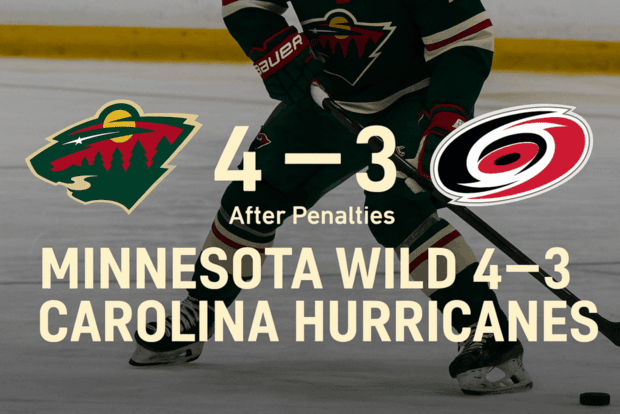
Minnesota Wild 4-3 Carolina Hurricanes (SO)
Filip Wallstedt turned aside 42 of 45 shots and Mats Zuccarello delivered the shootout winner as Minnesota survived a heavy Carolina push to claim a 4-3 victory.
In Saint Paul, the Minnesota Wild were out-shot, hemmed in and pushed to the limit, but they left the rink with two points after a 4-3 shootout win over the Carolina Hurricanes. Minnesota built an early 2-0 cushion, lost control of the game as Carolina’s forecheck tilted the ice, and still found a way to finish on top thanks to elite goaltending and a clutch performance from their veterans in the skills competition. For the Hurricanes, it was a frustrating night where territorial dominance and a 45-19 shots-on-goal edge did not translate into a road win.
Wild strike early, ride special teams jolt
Minnesota could not have scripted a better start. On their first real push of the night, defenseman Brock Faber jumped into the rush and opened the scoring just 1:54 into the first period, finishing off a clean east-west sequence started by Mats Zuccarello and young forward Danila Yurov. The goal immediately loosened up the Wild bench and put Carolina on the back foot.
Midway through the frame, the Wild added a dagger on special teams. Matt Boldy read a loose puck high in the defensive zone, turned it into a shorthanded breakaway and beat the goaltender low blocker for a 2-0 lead. That shorthanded strike punished a sloppy Hurricanes power-play entry and gave Minnesota breathing room despite spending long stretches defending in their own zone.
Carolina’s pushback reshapes the game
The Hurricanes gradually imposed their signature aggressive forecheck and layered offensive-zone pressure. Late in the second period they finally broke through, as Jack Blake slipped into a soft pocket between the circles and buried a feed to cut the deficit to 2-1. From that point on, Carolina largely dictated pace and puck possession, forcing the Wild to collapse around their crease and live off counterattacks.
Early in the third, Minnesota briefly restored control. Zuccarello finished a quick-touch play off a Kaprizov-Yurov cycle just 15 seconds into the period, pushing the score to 3-1. But the Hurricanes answered with the type of surge that has become their identity. Sebastian Aho struck from the slot to make it 3-2, and Blake added his second of the night late in regulation, wiring a shot through traffic to tie the game 3-3 and send it beyond sixty minutes.
Goalies carry the extra session, Zuccarello closes the shootout
Overtime showcased goaltending and structure more than chaos. Carolina continued to own the puck, but Wallstedt tracked every east-west pass and managed the Wild’s defensive rebounds, refusing to allow the Hurricanes the backdoor look they were hunting. At the other end, Minnesota generated one dangerous rush off a controlled three-on-three entry, but the visiting netminder held firm.
In the shootout, patience and touch made the difference. After early attempts were traded, Zuccarello came in with his trademark slow approach and out-waited the goalie before snapping the puck upstairs. Wallstedt then closed the door on Carolina’s final shooter, sealing a gritty 4-3 victory for a Wild team that found a way in a game they spent mostly without the puck.
Key Numbers | IHM Performance Metrics
- Shots on goal: Wild 19, Hurricanes 45
- Goalkeeper saves: Wild 42, Hurricanes 16
- Shooting percentage: Wild 15.8% (3/19), Hurricanes 6.7% (3/45)
- Blocked shots: Wild 4, Hurricanes 25
- Penalty minutes: Wild 4, Hurricanes 2
- Clutch scoring: Zuccarello with 1+1 in regulation plus the shootout winner
Team Notes
Minnesota’s defensive core logged heavy minutes, with Faber leading the blue line and showing strong puck-moving decisions under pressure. The Wild still spent far too much time in their zone, but their collapse-and-protect strategy around the crease worked because Wallstedt controlled rebounds and froze pucks at the right moments.
For Carolina, the loss will sting given the territorial dominance. Their five-on-five play generated layers of traffic and second-chance looks, but their finishing around the net was inconsistent and the power play never fully punished Minnesota’s penalties. The underlying volume will still please the coaching staff, yet this is the kind of game that highlights the need for elite finishing in tight playoff-style contests.
Coach Mark comment
Minnesota won this game in the crease. Wallstedt was technically sharp and mentally locked in, and the Wild’s skaters protected the middle even when they were under siege. Carolina played the “right” way for long stretches, but when a goalie reads the rush that cleanly and your shooters keep missing the upper corners, you leave the door open for skill players like Zuccarello to steal it in the shootout.
Questions & Answers | IHM Performance Metrics
Why did the Wild win despite being badly out-shot?
Goaltending and interior defense swung the metrics. Wallstedt’s high save count, combined with Minnesota’s ability to keep most rebounds away from the slot, neutralised Carolina’s volume advantage. The Wild turned a low-possession game into a goalie-driven win.
What stood out about Minnesota’s offensive structure?
Minnesota relied on quick-strike offense rather than sustained zone time. Their goals came off rush plays, a shorthanded counter and a well-timed third-period set-piece off the opening draw, showing good execution on pre-scouted patterns rather than long cycle shifts.
How effective was Carolina’s forecheck in this game?
The Hurricanes’ layered forecheck (F1 pressure, F2 support below the goal line, F3 high in the slot) consistently trapped Minnesota in their zone and created extended possession. From an IHM Performance Metrics view, Carolina clearly won the “ice tilt” battle, but poor finishing reduced the impact of that advantage.
What does this result mean for both teams going forward?
For the Wild, it is a confidence-building win that reinforces belief in their goaltending and veteran leadership, even on nights when the process is messy. For the Hurricanes, it is a reminder that shot volume needs to be paired with better net-front presence and power-play execution to convert dominance into points.