Tag: Montreal Canadiens

Hurricanes Blank Canadiens In Game 4 | IHM

Hurricanes Blank Canadiens In Game 4 | IHM

Hurricanes Blank Canadiens In Game 4, Move One Win From Stanley Cup Final

Date: May 28, 2026

By IceHockeyMan Newsroom

Carolina is no longer just winning playoff games.

The Hurricanes are controlling them.

In Game 4 of the Eastern Conference Final, Carolina delivered one of its most complete performances of the postseason, shutting out Montreal 4-0 at Bell Centre and moving within one victory of reaching the Stanley Cup Final for the first time since 2006.

The scoreboard was clear. The tactical picture was even clearer.

Carolina’s forecheck, defensive spacing and early execution completely took the Canadiens out of rhythm before Montreal could ever settle into the game.


Carolina Took Control In The First Period

The game changed in less than three minutes late in the opening period.

Sebastian Aho opened the scoring on the power play, Jordan Staal followed with a net-front deflection, and Logan Stankoven finished a 2-on-1 rush to build a 3-0 Carolina lead before the first intermission.

That sequence effectively broke Montreal’s structure.

The Canadiens were suddenly chasing the game against one of the hardest teams in the NHL to chase.

IHM Tactical Signal:
Falling behind Carolina early is extremely dangerous because the Hurricanes can immediately shift into layered pressure and possession control.


Montreal Could Not Escape Carolina’s Forecheck

The Canadiens struggled badly with zone exits throughout the game.

Carolina repeatedly forced rushed passes, weak clears and uncontrolled puck decisions along the boards.

Montreal’s top players rarely received the puck with speed through the neutral zone.

Instead, most Canadiens attacks began from static positions or broken retrievals, making them easy for Carolina to close down.

By the third period, the pressure had fully taken effect.

Montreal managed only three shots in the final 20 minutes.


Frederik Andersen Delivers Another Playoff Shutout

Frederik Andersen did not face massive volume, but he delivered exactly what Carolina needed.

He stayed calm, controlled rebounds and avoided giving Montreal any emotional opening.

The shutout was his third of these playoffs and another example of how stable Carolina looks when its defensive system protects the middle of the ice.

Andersen has now become one of the quietest but most important pieces of the Hurricanes’ playoff run.


Aho, Staal And Stankoven Set The Tone

Carolina’s opening-period surge showed the variety inside its attack.

Aho scored through clean special-teams execution.

Staal scored through hard net-front positioning.

Stankoven scored through speed, timing and a perfect rush finish.

That diversity makes Carolina difficult to defend.

The Hurricanes are not relying on one scoring pattern. They can punish opponents through power play structure, forecheck pressure, net-front traffic and transition attacks.


Stankoven Keeps Rising In The Playoffs

Logan Stankoven continues becoming one of Carolina’s most important postseason forwards.

His Game 4 goal was his team-leading eighth of the playoffs and again showed why his timing around offensive chances has become so dangerous.

He does not need many looks to change a game.

That type of efficiency becomes extremely valuable late in the playoffs.


Montreal’s Offensive Problems Are Becoming Serious

Montreal has survived earlier rounds through resilience, goaltending and opportunistic scoring.

Against Carolina, that formula is becoming harder to maintain.

The Canadiens are not generating enough sustained possession.

They are not creating enough second-chance pressure.

And their offensive-zone decisions are becoming rushed under Carolina’s defensive pressure.

The Bell Centre crowd eventually started urging Montreal to shoot, but the real issue was deeper than shot volume.

The Canadiens were not getting into dangerous enough positions consistently.


Game 5 Becomes Montreal’s Final Stand

Carolina now leads the series 3-1 and can win the Eastern Conference title at home in Game 5.

For Montreal, the task is brutally simple but extremely difficult.

They must solve Carolina’s pressure before the Hurricanes dictate the game again.

If Montreal falls behind early in Raleigh, the series may end quickly.

IHM Series Signal:
Montreal needs a fast start, cleaner exits and more direct shooting mentality. Without that, Carolina’s structure will suffocate the game again.


Coach Mark Comment

This was Carolina playoff hockey at its clearest. They scored early, locked the neutral zone, forced Montreal into bad exits and never allowed the Canadiens to build rhythm. The most impressive part is not the shutout. It is how little panic Carolina creates inside its own game. They look like a team that knows exactly who they are.


Fan Pulse

Are the Hurricanes now the most complete team left in the Stanley Cup Playoffs?


Q&A: Hurricanes vs Canadiens Game 4

Who won Game 4?
The Carolina Hurricanes defeated the Montreal Canadiens 4-0.

What is the series score?
Carolina leads the Eastern Conference Final 3-1.

Who had the shutout?
Frederik Andersen made 18 saves for Carolina.

Why did Montreal struggle offensively?
Carolina’s forecheck disrupted exits and limited sustained possession.

What happens next?
Carolina can clinch the Eastern Conference title in Game 5 at home.


Sabres Crush Canadiens To Force Game 7 | IHM

Sabres Crush Canadiens To Force Game 7 | IHM

Sabres Crush Canadiens To Force Game 7 | IHM

Date: May 17, 2026

By IceHockeyMan Newsroom

The Buffalo Sabres refused to let their playoff run die.

Facing elimination inside one of the loudest environments in hockey, Buffalo responded with its most explosive offensive performance of the postseason, storming back from an early deficit to crush the Montreal Canadiens 8-3 at Bell Centre and force a decisive Game 7.

The emotional and tactical heartbeat of the comeback was captain Rasmus Dahlin, who produced one of the greatest playoff performances ever by an NHL defenseman.

Dahlin finished with five points, completely taking over the game after Buffalo fell behind 3-1 in the opening period.

From that moment forward, the Sabres looked faster, more aggressive and mentally stronger than Montreal in every zone of the ice.


Montreal Started Fast Before Buffalo Took Control

The game initially looked like a potential Canadiens series-clincher.

After Dahlin opened scoring only 32 seconds into the first period, Montreal immediately answered with three straight goals through Arber Xhekaj, Ivan Demidov and Jake Evans.

The Bell Centre exploded with energy as Buffalo suddenly looked overwhelmed defensively.

Jake Evans’ short-handed goal at 10:14 forced Lindy Ruff to make a critical early goaltending change, replacing Alex Lyon after three goals on only four shots.

That moment completely changed the direction of the game.


Luukkonen Stabilized Everything

Ukko-Pekka Luukkonen entered under enormous pressure and immediately settled Buffalo down.

The Sabres suddenly regained structure through the neutral zone, defended rush entries far more aggressively and started controlling puck retrievals.

Luukkonen stopped all 18 shots he faced and gave Buffalo exactly what it desperately needed - calmness.

IHM Tactical Signal:
The goalie change completely reset Buffalo emotionally. The Sabres immediately started playing downhill instead of reacting defensively.


Rasmus Dahlin Delivered A Historic Performance

This was not simply a strong playoff game from Dahlin.

This was a franchise-defining captain performance.

The Buffalo defenseman finished with one goal and four assists while controlling pace, offensive movement and power-play structure throughout the night.

He became the first defenseman in NHL history to record five points in an elimination game.

More importantly, Dahlin completely changed Buffalo’s emotional intensity after the early collapse.

Every offensive sequence started running through him.

Every Montreal defensive breakdown became amplified by Buffalo’s aggressive puck movement.

IHM Insight:
Dahlin did not only produce offense. He controlled the emotional recovery of the entire team.


Buffalo’s Power Play Destroyed Montreal

The Canadiens completely lost control of Buffalo’s puck movement on special teams.

Jack Quinn scored twice on the power play while Buffalo finished with four power-play goals overall.

Montreal repeatedly failed to close shooting lanes, protect the weak side and pressure passing rotations quickly enough.

Once Buffalo established offensive-zone possession, the Canadiens struggled badly defending east-west puck movement.

  • Buffalo power-play goals: 4
  • Jack Quinn power-play goals: 2
  • Dahlin power-play orchestration: elite
  • Montreal penalty kill structure: collapsed repeatedly

Tage Thompson Quietly Controlled The Pace

While Dahlin grabbed headlines, Tage Thompson quietly dominated the flow of play offensively.

Thompson finished with four points and constantly created matchup problems through size, puck protection and offensive-zone pressure.

His ability to extend possession cycles forced Montreal defenders into exhaustion and scrambling coverage shifts.

Buffalo’s attack became overwhelming once Thompson started controlling possession below the circles.


Canadiens Completely Lost Defensive Structure

After the strong opening period, Montreal gradually became disconnected defensively.

The Canadiens struggled handling Buffalo’s aggressive transition pace and failed repeatedly to protect the middle of the ice.

Lane Hutson openly admitted after the game that Montreal became disconnected positionally and allowed Buffalo too much freedom with the puck.

The Bell Centre atmosphere disappeared quickly once Buffalo gained momentum through the second period.


Game 7 Now Becomes Pure Pressure Hockey

Momentum has now completely shifted entering Game 7 in Buffalo.

The Sabres suddenly carry emotional confidence, while Montreal must mentally recover after allowing seven unanswered goals in an elimination opportunity.

Game 7 now becomes less about tactics and more about composure under extreme pressure.

IHM Signal:
The opening 10 minutes of Game 7 may decide everything. Buffalo now believes it can overwhelm Montreal physically and emotionally.


Coach Mark Comment

This was the type of playoff game that changes organizational belief. Buffalo looked dead early, but instead of panicking, they increased pace and aggression shift after shift. Dahlin delivered a true captain performance, while Montreal completely lost defensive control once Buffalo established offensive pressure. Game 7 now becomes a massive psychological test for both teams.


Fan Pulse

After this collapse, who handles Game 7 pressure better: Buffalo or Montreal?


Q&A: Sabres vs Canadiens

Who forced Game 7?
The Buffalo Sabres.

Who was the best player in Game 6?
Rasmus Dahlin with five points.

How many unanswered goals did Buffalo score?
Seven straight goals.

Who stabilized Buffalo in goal?
Ukko-Pekka Luukkonen.

What was the biggest difference in the game?
Buffalo’s aggressive puck movement and dominant power play.


Canadiens survive Game 7 shock vs Lightning

Canadiens survive Game 7 shock vs Lightning

Canadiens Survive Game 7 Chaos, Eliminate Lightning

Date: May 4, 2026
By IceHockeyMan Newsroom


Game Context

The Montreal Canadiens delivered one of the most unusual Game 7 victories in modern NHL playoff history, defeating the Tampa Bay Lightning 2-1 despite generating only 9 total shots on goal.

This was not dominance. This was survival hockey at its purest level - structure, patience and one decisive moment.


Decisive Moment

With the game tied 1-1 in the third period, Alex Newhook produced the defining play of the series.

Positioned behind the net, he reacted to a rebound off the boards and redirected the puck off Andrei Vasilevskiy and into the net at 11:07 - a chaotic, instinct-driven goal that ultimately ended Tampa’s season.

It wasn’t pretty. It wasn’t clean. But it was playoff hockey.


Game Flow Breakdown

  • 1st Period: Montreal opens scoring through Nick Suzuki
  • 2nd Period: Canadiens record ZERO shots, Lightning dominate possession
  • PP Goal: Tampa ties via Dominic James
  • 3rd Period: Newhook delivers the series winner

Montreal went 26:55 without a shot on goal, including an entire shotless second period - something never seen before in franchise playoff history.


IHM Tactical View

This game is a textbook example of playoff compression:

  • Montreal collapsed defensively and protected the slot
  • Tampa controlled puck possession but struggled to generate elite finishing chances
  • Game shifted from skill execution to moment execution

When space disappears, volume becomes irrelevant. Timing decides everything.


Coach Factor

Head coach Martin St. Louis played a critical psychological role.

After a lifeless second period, his intermission reset reframed the situation: a 1-1 Game 7, nothing more, nothing less. That mental reset allowed Montreal to stabilize and survive the final stretch.

Postgame, his emotional locker room speech reflected a team that believes it is ahead of schedule.


Goaltending Layer

Despite the loss, Andrei Vasilevskiy was not the problem.

The difference came down to one unpredictable bounce - the type that often defines playoff elimination games.

Montreal, meanwhile, managed the game in front of their goaltender with disciplined defensive layers and shot blocking.


What This Means

Montreal advances to face the Buffalo Sabres in the Eastern Conference Second Round.

Key takeaway:

  • They can win without offense
  • They trust their structure under pressure
  • They are extremely dangerous in low-event hockey

But this approach carries risk - against Buffalo, they will need more puck control and offensive generation.


Coach Mark Comment

This is not luck. This is playoff discipline. People will say Montreal got lucky with nine shots, but what they actually did was control the type of game. They forced Tampa into a structure battle, not a skill game. When you do that, one bounce is enough. That’s playoff hockey.


Fan Pulse

Was this Montreal win elite playoff execution or pure luck?


Q&A: Canadiens vs Lightning Game 7

How many shots did Montreal have?
Only 9 shots on goal.

Who scored the game-winner?
Alex Newhook.

Why is this game unusual?
A team rarely wins Game 7 with such low shot volume.

Who do Canadiens face next?
Buffalo Sabres.

Biggest takeaway?
Playoff hockey is decided by moments, not volume.


Lightning Respond in OT - Moser Lifts Tampa in Game 2 | IHM

Lightning Respond in OT - Moser Lifts Tampa in Game 2 | IHM

Lightning Respond in OT - Moser Breaks Through in Game 2

Date: April 22, 2026
By IceHockeyMan Newsroom

This was not just an overtime win. It was a pressure reset.

After struggling in overtime situations, Tampa Bay finally broke through, defeating Montreal 3-2 and leveling the series. But the real story is how the Lightning slowly took control of the game after losing momentum.


⚡ MOSER’S GOAL - SIMPLE EXECUTION, PERFECT TIMING

J.J. Moser’s overtime winner came off a clean faceoff sequence and quick recognition of space. Instead of forcing a play, he carried the puck into an opening lane and released a decisive shot.

This is playoff hockey at its core:

  • Win the draw
  • Recognize space immediately
  • Shoot without hesitation

IHM Signal:
Overtime goals are rarely complex. They are about speed of decision, not creativity.


🔁 TAMPA BAY SHIFTED MOMENTUM IN THE THIRD

Montreal controlled large parts of the first two periods, playing with composure and structure. But the third period belonged to Tampa Bay.

Key change:

  • More aggressive forecheck
  • Higher shot volume
  • Better puck retrieval off rebounds

Kucherov’s equalizer was a direct result of that pressure - not a random bounce, but sustained offensive work.

IHM Insight:
Games often flip not on one play, but on a shift in pressure over 5-10 minutes.


🎯 HAGEL AND KUCHEROV - EMOTION + EXECUTION

Brandon Hagel set the tone early with energy and physical presence, while Kucherov delivered the technical finish when the game required it.

This balance matters:

  • Hagel drives intensity
  • Kucherov controls execution

Together, they create a layered offensive threat that is difficult to manage defensively.


⚠️ MONTREAL - STRONG STRUCTURE, BUT FADED LATE

The Canadiens did many things right:

  • Controlled puck play early
  • Created clean scoring chances
  • Stayed structured defensively

But in the third period, their game shifted into defensive survival mode.

That is where problems begin:

  • Less puck control
  • More time spent defending
  • Increased pressure on the goalie

IHM Signal:
If a team stops playing with the puck in playoffs, it eventually loses control of the game.


🥅 VASILEVSKIY VS DOBES

Both goalies delivered strong performances, but the difference was situational control.

Vasilevskiy:

  • Stayed composed under late pressure
  • Helped stabilize Tampa’s defensive play

Dobes:

  • Handled high shot volume well
  • Eventually exposed by sustained pressure

📊 SERIES SHIFT

The series is now 1-1, but the psychological balance has changed.

Tampa Bay:

  • Breaks overtime losing streak
  • Regains confidence

Montreal:

  • Missed chance to take 2-0 lead
  • Must reset quickly at home

IHM Insight:
Series tied does not mean equal. Momentum now slightly favors Tampa Bay.


🧠 Coach Mark Comment

This was a typical playoff adjustment game. Montreal controlled the game early, but Tampa Bay adapted and increased pressure at the right time. The difference was not talent, but timing. Tampa chose the moment to push, and Montreal did not respond quickly enough. That is why this series is now open again.


🔥 Fan Pulse

Who takes control now - Tampa with momentum, or Montreal at home in Game 3?


❓ Q&A: Lightning vs Canadiens Game 2

Why was this win important for Tampa?
It resets the series and breaks their overtime struggles.

What changed the game?
Tampa’s pressure in the third period.

Did Montreal play badly?
No, but they lost control late in the game.

What is key in Game 3?
Which team controls puck possession under pressure.

Who has the advantage now?
Slight edge to Tampa due to momentum.


Devils rally late, defeat Canadiens 4-3 in OT to stay perfect at home | IHM News

Devils rally late, defeat Canadiens 4-3 in OT to stay perfect at home | IHM News

Date: November 7, 2025 | Author: IHM News

Devils stun Canadiens late, stay perfect at home with 4-3 OT win

Devils rally late, defeat Canadiens 4-3 in OT to stay perfect at home | IHM News

Bratt wins it on a breakaway in OT, Meier ties it with 1:07 left, New Jersey becomes first team to reach 10 wins

NEWARK, N.J. – The New Jersey Devils proved again why they’re one of the toughest teams in the league to close out. Down 3-2 late in the third, they surged back behind Timo Meier’s clutch equalizer with just 1:07 remaining, then sealed a dramatic 4-3 OT victory over the Montreal Canadiens when Jesper Bratt scored on a breakaway at 1:33 of overtime.

New Jersey moved to 10-4-0, becoming the first team in the NHL to hit 10 wins this season. They also remain perfect at home (6-0-0). Bratt finished with one goal and one assist, and Jack Hughes added two assists. Jacob Markstrom made 16 saves.

“Coming in with speed, trying to read the goalie – that’s my comfort zone,” Bratt said.

Montreal pushes back but falters late
Rookie goalie Jakub Dobes made 24 saves but was emotional postgame, blaming himself for the loss. Noah Dobson defended him, calling him a competitor with high battle level. Montreal goals came from Kirby Dach, Jake Evans, and Oliver Kapanen.

Key moments
– 1:53: Cody Glass opened scoring for New Jersey with a far-side wrister. – 2:59: Montreal tied it 1-1 on a deflection off Dach. – 8:05: Ondrej Palat scored his first of the season on a setup by Simon Nemec. – Early 3rd: Evans and Kapanen scored to make it 3-2 Montreal. – 18:53: Meier tied it from a crease scramble. – OT: Bratt scored the winner on a breakaway.

Coach Mark comment
New Jersey’s resilience is tactical, not lucky. Their recovery shifts were disciplined, their neutral-zone spacing tightened throughout the game, and their puck pressure late in the third overwhelmed Montreal’s exits. Bratt’s OT goal came from layered speed and perfect read on the goalie. This is a team that understands momentum and seizes it.


Flyers outlast Canadiens 5-4 in shootout after blowing 3-0 start | IceHockeyMan

Flyers outlast Canadiens 5-4 in shootout after blowing 3-0 start | IHM News

By IHM Team | IHM News | November 5, 2025

Flyers survive Montreal rally and win 5-4 in shootout

Brink scores twice, Zegras decides the tiebreaker, Suzuki point streak reaches 12

MONTREAL Philadelphia rode a blistering start, absorbed a furious response, and still left Bell Centre with two points. The Flyers built a 3-0 cushion on their first six shots, saw the Canadiens answer with four consecutive goals in a wild second period, and ultimately prevailed 5-4 in a shootout.

Bobby Brink provided two goals including a net-front redirection and a rebound put-back, Cam York added a 5-on-3 strike, and playmakers Trevor Zegras and Travis Konecny each registered two assists. In the skills contest, Zegras delivered the only conversion to seal it. Dan Vladar made 16 saves for Philadelphia, steady in the third and in overtime after the game tilted.

Montreal clawed back behind Kirby Dach’s brace and a power-play surge driven by Nick Suzuki and Ivan Demidov. Suzuki’s second-period one-timer extended the longest point streak in the league this season to 12 games with 19 points over that span. Rookie winger Nikita Grebenkin added a composed third-period finish from the high slot for his first NHL goal, tying the game 4-4 at 10:51.

The opening frame belonged to the Flyers. At 1:56, Brink angled a Travis Sanheim point shot with his backhand for 1-0. On a two-man advantage at 7:07, York hammered Zegras’s backhand feed from the right circle. Just 43 seconds later, Brink jumped on a rebound for 3-0 and Philadelphia’s second straight power-play goal.

Montreal responded immediately in the second. Dach cut the deficit to 3-1 at 3:12 by slamming a lively carom off the end boards. Suzuki made it 3-2 at 4:15 with a clean one-timer into an open side after a cross-ice pass from Demidov. The building surged, and the Canadiens kept pressing. Dach knotted it 3-3 at 13:28 on a quick feed from Lane Hutson below the goal line. At 15:57, Demidov gave Montreal a 4-3 lead with a high-glove wrist shot from the right dot on the power play.

Philadelphia steadied in the third, tightened the neutral-zone gaps, and forced overtime where Zegras’s creativity mattered most. His lone tally in the tiebreaker, paired with Vladar’s stops, delivered the extra point.

Scoring summary

  • 1st, 1:56 PHI – Brink, backhand deflection of Sanheim shot, 1-0
  • 1st, 7:07 PHI 5-on-3 – York, one-timer from right circle (Zegras), 2-0
  • 1st, 7:50 PHI PP - Brink, rebound at the crease, 3-0
  • 2nd, 3:12 MTL – Dach, rebound from low right circle, 3-1
  • 2nd, 4:15 MTL PP – Suzuki, one-timer from left side (Demidov), 3-2
  • 2nd, 13:28 MTL – Dach, feed from Hutson below the line, 3-3
  • 2nd, 15:57 MTL PP – Demidov, wrist shot high glove from right dot, 4-3
  • SO PHI – Zegras, winner

Goaltenders

PHI: Vladar 16 saves on 20. MTL: Montembeault 38 saves on 42, resilient after early barrage.

Team notes

  • Zegras and Konecny drive pace with east-west touches and inside-lane entries.
  • Suzuki extends franchise best since Pierre Turgeon’s 13-game run in April 1995.
  • Grebenkin records first NHL goal in his 16th career game.

Coach Mark comment
Philadelphia responded to momentum loss with smarter puck management and shorter shifts. Montreal’s second-period push was elite with Hutson activating below the goal line and Suzuki commanding the weak side. The difference came from special teams execution and one extra play in the shootout.


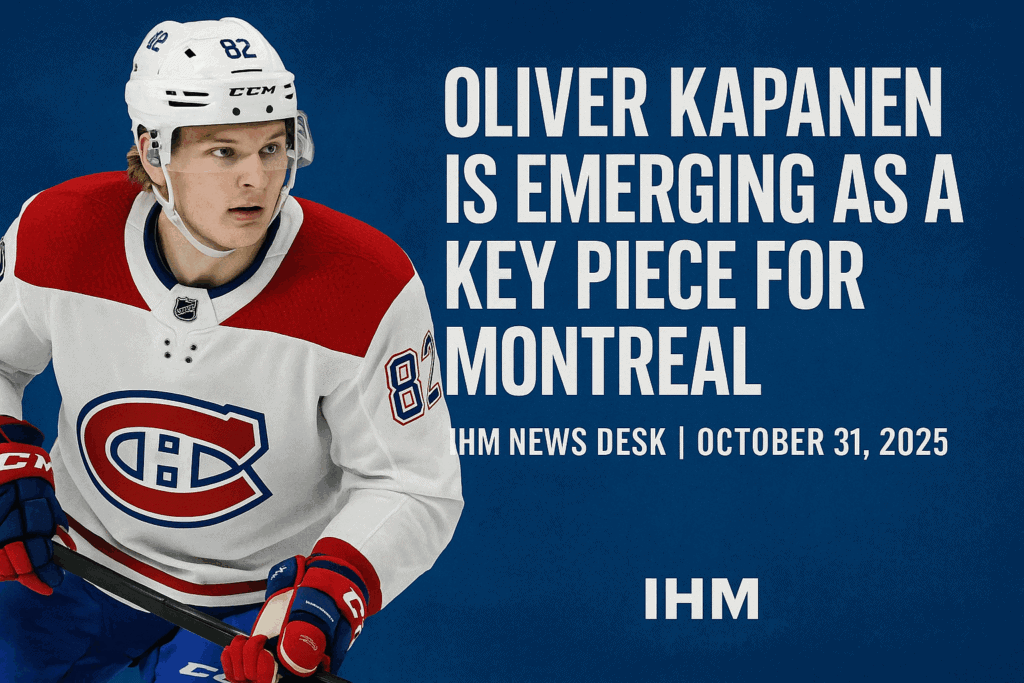
Oliver Kapanen is earning trust, minutes, and delivering results - 4 goals, 3 assists, and hard defensive work that coaches love.

Oliver Kapanen is Emerging as a Key Two Way Piece for Montreal | IHM News

IHM News Desk | November 01, 2025

Oliver Kapanen is Emerging as a Key Piece for Montreal

Oliver Kapanen is earning trust, minutes, and delivering results - 4 goals, 3 assists, and hard defensive work that coaches love.

Oliver Kapanen’s arrival in the NHL has not been loud or flashy, but it has been effective, disciplined and very Montreal. The 22 year old centre opened the season fighting for minutes and has quickly carved out a defined role in the Canadiens bottom six, delivering mature, structured hockey far beyond his age.

Kapanen’s foundation was built in Finland, where discipline and two way awareness is the core of development. Add in time in Sweden, strong NHL bloodlines and a calm decision making presence, and Montreal suddenly has a centre who looks tailor made for Martin St. Louis modern system.

A Patient Climb Built the Right Way

Kapanen’s journey was not instant. He bounced between Europe, Laval and Montreal last season, earning his ice time and learning the North American pace. Instead of trying to force offense, he built trust by winning small battles, supporting the puck and staying reliable without it.

Now, that patience is paying dividends. Through seven games he has already produced four goals and three assists, complimenting that with strong penalty killing work and physical engagement. His scoring has not come from highlight plays, but from reading situations early and getting to the right pockets of ice.

A Third Line Centre Growing Fast

The Canadiens continue to construct a competitive identity and Kapanen fits it perfectly: calm, efficient, responsible. His decision making under pressure has impressed the coaching staff, and his ability to quietly tilt shifts in Montreal’s favour is becoming noticeable.

Against Nashville, he delivered a composed late equalizer. Against Buffalo, he opened the scoring. And versus Edmonton he distributed well, picking up two assists. For a player many expected to simply compete for depth minutes, he is performing like a long term middle six solution.

A Feel Good Development Story in Montreal

Kapanen is not here to place himself on highlight reels. He is here to play winning hockey. Montreal fans have seen many prospects arrive with hype and fade. Kapanen has arrived with calm, substance and steadily rising influence.

He is proving that not every breakout needs hype. Some players grow shift by shift, building trust and then adding production. That is Kapanen – and his blend of Finnish detail and quiet confidence is turning into something real.

IHM Team Verdict

The Canadiens are not complete yet, but pieces like Kapanen accelerate the build. If he continues at this pace, he becomes a long term stabilizing centre with penalty kill value, secondary scoring threat and playoff style habits.

He might never be a superstar, and that is perfectly fine. Montreal needs players who do the right things consistently – and Kapanen looks like that player.

For Canadiens fans: enjoy this one. A quietly emerging two way centre with real hockey intelligence does not come along often.

Coach Mark Reaction

“I like the kid’s habits. Nothing forced, nothing rushed. He supports plays the right way, makes smart reads off the puck and understands spacing. That is coaching gold. If he keeps maturing like this, Montreal has a very reliable piece down the middle for years.”


NHL Season Preview by Mark Lehtonen

NHL 2025-26: Season Preview

By Mark Lehtonen · 7 October 2025

The puck drops on 7 October as the NHL returns for another thrilling season. With 32 teams lining up, it’s time to take a closer look at who might surprise, who could disappoint, and which storylines are set to define the year ahead.

Washington Capitals: Ovechkin’s new target

Alex Ovechkin keeps rewriting the book. After 44 goals last term despite a broken leg and 17 games missed, the focus now is a tidy milestone: 40 goals at 40 years old, taking him to 937 career goals.

The Capitals remain a balanced outfit, with depth throughout the roster and a reliable system that has kept them competitive.

Tampa Bay Lightning: regular-season machine

The core of Andrei Vasilevskiy, Victor Hedman, Nikita Kucherov and Brayden Point still screams elite. Tampa topped the league in goals scored last season and ranked fourth in defence.

With rivals in the Atlantic Division showing inconsistency, Tampa have every chance to claim top spot again. Expected finish: around 109 points and first place in the division.

Chicago Blackhawks: lessons through setbacks

The rebuild is real, and it hurts. With heavy minutes for youngsters, losses are part of the process. A few prospects will pop, most will need time.

Expected finish: bottom of the table but strong odds for a top draft pick in 2026.

Minnesota Wild: time for a step forward

Injuries to Kirill Kaprizov and Joel Eriksson Ek skewed last season. Healthy, the Wild looked like a top-five team in the West. The roster is settled, there’s cap breathing room, and youngsters are coming.

Expected finish: ~100 points and a first series win since 2015.

Boston Bruins: caught between eras

Last season’s slide was a warning. The post-Marchand attack lacks top-end punch, and Jeremy Swayman still has to meet the standard of his contract.

Expected finish: bubble team, roughly 95-97 points, margin for error thin in the Atlantic.

New York Rangers: careful adjustments

Mike Sullivan replaces Peter Laviolette and Vladislav Gavrikov bolsters the blue line, but losing Chris Kreider and K’Andre Miller could bite more than expected.

It hinges on Igor Shesterkin rediscovering peak form. Expected finish: ~100 points, steady rather than spectacular.

Edmonton Oilers: all eyes on Connor

Connor McDavid isn’t going anywhere. The only debate is short-term flexibility vs a longer commitment. Either way, with McDavid on the ice, the ceiling is sky-high.

Expected finish: 109-111 points and among the West’s top contenders.

Florida Panthers: wear and tear showing

Three straight Finals have a cost. Florida still have the star power and structure, but after so much hockey the edges dull.

Expected finish: ~104 points and a safe play-off place, but repeating deep runs is a big ask.

Montreal Canadiens: steady climb

Nick Suzuki’s 89 points, Cole Caufield’s 37 goals and growth from Juraj Slafkovsky set the platform. With added balance from Noah Dobson and Zach Bolduc, Montreal look more complete.

Expected finish: a meaningful step forward, firmly in the play-off conversation.

Philadelphia Flyers: Michkov’s moment

Matvei Michkov posted 63 points as a rookie. With greater trust and freedom, the next leap is on.

Expected finish: around 40 goals and confirmation as Philadelphia’s new star.

Pittsburgh Penguins: the captain stays

Sidney Crosby intends to see out his deal in Pittsburgh through 2027. Evgeni Malkin could explore a move for one last big push, but the bond with the Penguins stays strong.

Stanley Cup Final Prediction: Carolina vs Vegas

If there’s a team built for the decisive moment, it’s the Carolina Hurricanes - elite leaders in Sebastian Aho and Seth Jarvis, true depth, young legs, and cap space to strengthen late in the season.
The most likely opponent: the Vegas Golden Knights.

Prediction: Carolina will win the Stanley Cup.

Written by Mark Lehtonen · 7 October 2025