Tag: nhl prospects

Tij Iginla, Viggo Bjorck Eye Opening Night Roster

By IceHockeyMan Editorial Team | August 25, 2026

Story Summary

Several highly regarded prospects will enter NHL training camps with realistic opportunities to earn opening-night roster spots. Utah Mammoth winger Tij Iginla, who recorded 90 points in 48 OHL games last season, is expected to begin his professional career in either the AHL or NHL.

Winnipeg Jets prospect Viggo Bjorck has reportedly been discussed by coaches and management as a candidate to make the NHL immediately. Other players competing for opportunities include Caleb Desnoyers, Viktor Eklund, Cole Hutson, Andrew Cristall, David Reinbacher and Quentin Musty.

Key Facts

  • Tij Iginla scored 90 points in 48 OHL games last season and is 20 years old.
  • Iginla is expected to play professional hockey this season in either the AHL or NHL.
  • He could initially be considered for a third- or fourth-line role before competing for greater responsibility.
  • Winnipeg coaches and management have reportedly discussed Viggo Bjorck as a candidate to make the NHL roster immediately.
  • A possible second-line centre role for Bjorck has also been discussed.
  • Bjorck impressed at the World Championship and during the latter part of Djurgården’s SHL season.
  • Caleb Desnoyers is a playmaking two-way centre, although Utah’s additions of Anders Lee and Vincent Trocheck have made his path more difficult.
  • Viktor Eklund followed a strong SHL campaign with encouraging performances for the Islanders’ AHL affiliate.
  • Cole Hutson earned NHL minutes with Washington late last season and displayed strong puck-moving ability alongside some defensive inconsistency.
  • Andrew Cristall recorded 60 points in 72 AHL games last season.
  • David Reinbacher is a mobile, defensively minded right-shot defenceman who could compete with Jayden Struble and Arber Xhekaj for a bottom-pairing role in Montreal.
  • Quentin Musty completed a solid rookie AHL season but faces competition within San Jose’s deep prospect pool.
  • Gavin McKenna and Ivar Stenberg are considered strong candidates for opening-night places, while Porter Martone and Anton Frondell are also expected to compete for immediate NHL roles.

IHM Discussion

The prospects closest to NHL duty generally combine recent production against strong competition with a visible opening inside their organisation. Iginla’s 90-point OHL season provides a compelling offensive case, but his first professional training camp will determine whether Utah believes he is ready for NHL minutes or would benefit from starting in the AHL.

Bjorck presents a different profile. His performances against experienced players at the World Championship and in the SHL have reportedly placed him in Winnipeg’s immediate roster discussions. A second-line centre assignment would be an ambitious introduction, so his work without the puck and ability to manage NHL pace will be central to that decision.

Washington has two skilled candidates in Hutson and Cristall. Hutson already received NHL minutes and demonstrated his ability to move the puck, while Cristall’s 60-point AHL season strengthens his case as an offensive playmaker. Both must show that their strengths can translate into dependable NHL contributions.

Reinbacher and Musty face different forms of competition. Reinbacher must win a place within Montreal’s defensive group, while Musty is competing against several prospects in a deep San Jose system. Their opportunities will depend as much on roster availability and positional need as on individual performance.

Why It Matters

A rookie capable of holding an NHL position gives a club greater roster and salary-cap flexibility. If Iginla earns a lower-line role and gradually moves upward, Utah can add scoring potential without relying on another external acquisition.

If Bjorck proves ready for a middle-six centre role, Winnipeg would gain another option through the middle of the ice. Washington, Montreal and San Jose could similarly address roster needs through internal development rather than trades or free-agent signings.

IHM Development Outlook

Iginla and Eklund arrive with strong offensive production, but both must demonstrate that their skill can survive against faster, stronger and more experienced opponents. Training camp will test their decision-making, defensive responsibility and ability to create offence with less time and space.

Desnoyers faces a more crowded Utah roster following the arrivals of Lee and Trocheck. Eklund must compete with players including Emil Heineman and Mattias Maccelli, while Musty’s route is complicated by San Jose’s prospect depth.

Hutson, Cristall and Reinbacher have clearer positional cases, but none is guaranteed a permanent role. Their development will depend on consistency and whether coaches trust them in the situations required by their respective teams.

Mini Q&A

Which prospects appear closest to opening-night roster spots?

Gavin McKenna and Ivar Stenberg are considered particularly strong candidates. Porter Martone and Anton Frondell are also expected to compete for immediate NHL places after receiving late-season opportunities last year.

Does Tij Iginla have a realistic chance to begin the season in the NHL?

Yes. Iginla recorded 90 points in 48 OHL games and is expected to play professionally this season. Whether he starts in the NHL or AHL will depend on his training-camp performance and Utah’s roster decisions.

How seriously are the Jets considering Viggo Bjorck?

Winnipeg’s coaches and management have reportedly discussed Bjorck as a candidate to make the NHL roster immediately, including the possibility of competing for a second-line centre role.

Which defensive prospects could earn NHL positions?

Cole Hutson and David Reinbacher are among the leading candidates. Hutson received NHL minutes with Washington late last season, while Reinbacher could compete for a bottom-pairing position with Montreal.

Coach Mark Comment

Young players benefit from clearly defined responsibilities. Iginla should initially receive a manageable role that allows him to use his offensive instincts without carrying excessive defensive responsibility. If he adjusts quickly, his role can expand naturally.

Bjorck’s situation requires careful judgement because playing centre in the NHL involves considerable two-way responsibility. Winnipeg should evaluate his decision-making, positioning and ability to handle pressure before determining where he fits.

For all these prospects, consistency matters more than isolated highlights. Coaches need to see whether a player can repeat good decisions throughout practices and pre-season games before committing to an opening-night role.

What Comes Next

NHL training camps and pre-season games will provide the next evaluation period. Clubs will then decide which prospects have earned opening-night roster positions and which players should begin the season in the AHL or another development league.

IHM Final View

Several prospects have credible paths to NHL roles, but production alone will not determine the final decisions. Positional need, roster competition and the ability to perform consistently against NHL opposition will decide which young players remain when training camps end.

How Should NHL Prospects Be Valued in Dynasty Leagues?

How Should NHL Prospects Be Valued in Dynasty Leagues?

How Should NHL Prospects Be Valued in Dynasty Leagues? Learn how long-term value, keeper cost, dynasty timelines, auction economics, replacement level, and league governance should shape the decision.

Editor: Coach Mark • Updated: August 22, 2026

Short Answer

NHL prospects should be valued through talent, development path, organisational depth, projected role, timeline, position, and the probability of becoming a fantasy-relevant NHL player.

Full Explanation

NHL Prospects Be Valued in Dynasty Leagues is an advanced fantasy decision because value extends beyond current-season points. Keeper and dynasty formats add time, auction formats add price, and commissioner settings determine the environment in which every asset is valued.

The same player can be worth very different amounts depending on retention cost, competitive window, roster depth, age, future role, available budget, and the quality of realistic replacement options.

Main Factors

  • Talent
  • Development path
  • Organisational depth
  • Projected role
  • Timeline

How It Changes Long-Term Fantasy Value

Long-term value rises when current production, future role, age, scarcity, cost efficiency, and trade liquidity align. It falls when managers pay too much for declining production, uncertain roles, difficult contracts, or assets that cannot help the team’s competitive timeline.

How to Make the Decision

  • Define the league’s scoring, keeper, salary, and roster rules.
  • Separate current production from future asset value.
  • Measure cost against realistic replacement level.
  • Match the decision to the team’s competitive window.
  • Preserve flexibility when uncertainty is high.

Decision & Controversy

Advanced fantasy formats create legitimate disagreements because managers optimise for different timelines. A rebuilding team and a contender can assign opposite values to the same veteran, prospect, or draft pick and both can be rational.

Edge Case

An elite real-life player can become a poor keeper or auction asset when his retention cost removes all surplus value, while a lower-ranked player can become extremely valuable when he is cheap, young, scarce, or locked into a growing role.

IHM Signal System: NHL Prospects Be Valued in Dynasty Leagues

  • Cost signal: What draft, salary, or keeper price must be paid?
  • Timeline signal: Does the asset fit the team’s competitive window?
  • Scarcity signal: How difficult is the role or position to replace?
  • Liquidity signal: How easily can the asset be traded later?
  • Governance signal: Do the league rules support a fair and stable market?

Trigger-level rule: If talent or another critical cost, timeline, scarcity, budget, governance, or replacement-value signal is unclear, do not treat the asset or league setting as having fixed value.

IHM Insight: NHL Prospects Be Valued in Dynasty Leagues

Advanced fantasy hockey is asset management. Points matter, but cost, time, scarcity, flexibility, and league structure determine how efficiently those points are acquired.

The strongest managers understand not only who is valuable, but why the market should value that asset differently in their specific league.

Mini Q&A

How Should NHL Prospects Be Valued in Dynasty Leagues?
NHL prospects should be valued through talent, development path, organisational depth, projected role, timeline, position, and the probability of becoming a fantasy-relevant NHL player.

What should be checked first?
Talent.

Can the same player have different keeper or dynasty value in two leagues?
Yes. Retention cost, league depth, scoring, roster rules, and competitive timeline can materially change long-term value.

Should commissioners change rules to fix one bad result?
Usually no. Rule changes should solve structural problems and be applied consistently rather than react to one manager or one outcome.

What is the IHM trigger-level rule?
If talent or another critical cost, timeline, scarcity, budget, governance, or replacement-value signal is unclear, do not treat the asset or league setting as having fixed value.

Why This Concept Exists

Keeper, dynasty, auction, salary-cap, and commissioner formats extend fantasy hockey beyond one season. They create long-term markets in which player value, draft capital, budget, league rules, and future opportunity interact.

Key Takeaways

  • NHL prospects should be valued through talent, development path, organisational depth, projected role, timeline, position, and the probability of becoming a fantasy-relevant NHL player.
  • Talent is a primary advanced-strategy factor.
  • Current points and long-term asset value are not the same.
  • Keeper and auction cost can create or destroy surplus value.
  • Competitive timeline should shape dynasty decisions.
  • Replacement level provides the correct baseline.
  • Stable league governance protects strategic value.
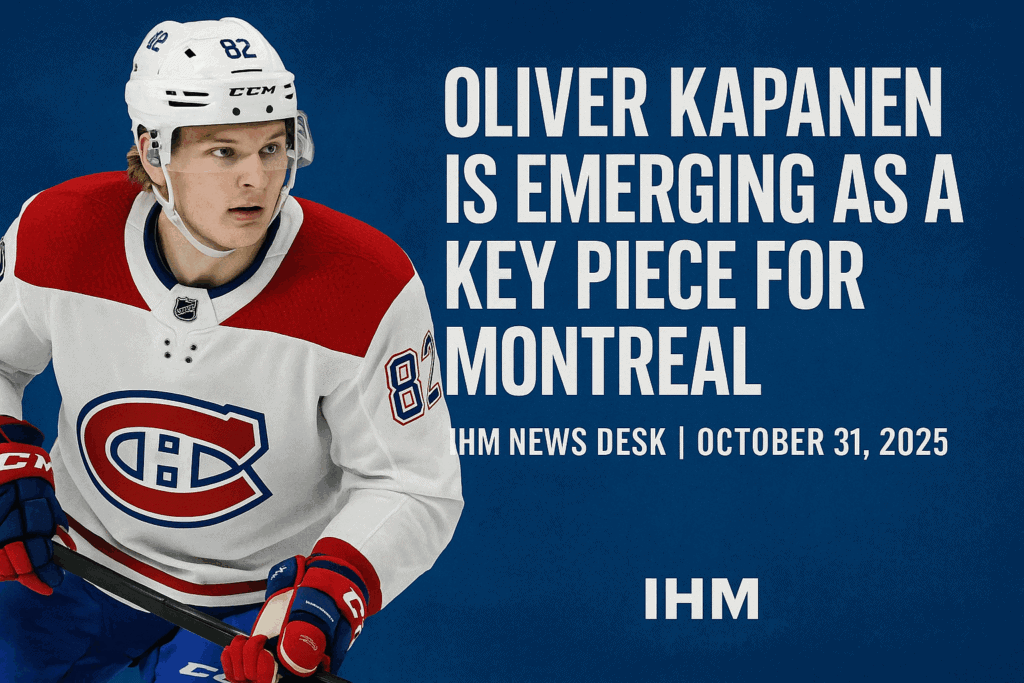
Oliver Kapanen is earning trust, minutes, and delivering results - 4 goals, 3 assists, and hard defensive work that coaches love.

Oliver Kapanen is Emerging as a Key Two Way Piece for Montreal | IHM News

IHM News Desk | November 01, 2025

Oliver Kapanen is Emerging as a Key Piece for Montreal

Oliver Kapanen is earning trust, minutes, and delivering results - 4 goals, 3 assists, and hard defensive work that coaches love.

Oliver Kapanen’s arrival in the NHL has not been loud or flashy, but it has been effective, disciplined and very Montreal. The 22 year old centre opened the season fighting for minutes and has quickly carved out a defined role in the Canadiens bottom six, delivering mature, structured hockey far beyond his age.

Kapanen’s foundation was built in Finland, where discipline and two way awareness is the core of development. Add in time in Sweden, strong NHL bloodlines and a calm decision making presence, and Montreal suddenly has a centre who looks tailor made for Martin St. Louis modern system.

A Patient Climb Built the Right Way

Kapanen’s journey was not instant. He bounced between Europe, Laval and Montreal last season, earning his ice time and learning the North American pace. Instead of trying to force offense, he built trust by winning small battles, supporting the puck and staying reliable without it.

Now, that patience is paying dividends. Through seven games he has already produced four goals and three assists, complimenting that with strong penalty killing work and physical engagement. His scoring has not come from highlight plays, but from reading situations early and getting to the right pockets of ice.

A Third Line Centre Growing Fast

The Canadiens continue to construct a competitive identity and Kapanen fits it perfectly: calm, efficient, responsible. His decision making under pressure has impressed the coaching staff, and his ability to quietly tilt shifts in Montreal’s favour is becoming noticeable.

Against Nashville, he delivered a composed late equalizer. Against Buffalo, he opened the scoring. And versus Edmonton he distributed well, picking up two assists. For a player many expected to simply compete for depth minutes, he is performing like a long term middle six solution.

A Feel Good Development Story in Montreal

Kapanen is not here to place himself on highlight reels. He is here to play winning hockey. Montreal fans have seen many prospects arrive with hype and fade. Kapanen has arrived with calm, substance and steadily rising influence.

He is proving that not every breakout needs hype. Some players grow shift by shift, building trust and then adding production. That is Kapanen – and his blend of Finnish detail and quiet confidence is turning into something real.

IHM Team Verdict

The Canadiens are not complete yet, but pieces like Kapanen accelerate the build. If he continues at this pace, he becomes a long term stabilizing centre with penalty kill value, secondary scoring threat and playoff style habits.

He might never be a superstar, and that is perfectly fine. Montreal needs players who do the right things consistently – and Kapanen looks like that player.

For Canadiens fans: enjoy this one. A quietly emerging two way centre with real hockey intelligence does not come along often.

Coach Mark Reaction

“I like the kid’s habits. Nothing forced, nothing rushed. He supports plays the right way, makes smart reads off the puck and understands spacing. That is coaching gold. If he keeps maturing like this, Montreal has a very reliable piece down the middle for years.”