Tag: Mark Lehtonen

Expert hockey insights and analysis from former coach Mark Lehtonen. Covering team strategies, player performance, and tactical breakdowns to give fans a deeper understanding of the game.

NHL Roundup: Busy November 19 slate delivers overtime drama and statement wins | IHM News

NHL Roundup: Busy November 19 slate delivers overtime drama and statement wins | IHM News

NHL Roundup: Detroit, Tampa and Chicago roll while Sharks and Knights win thrillers in overtime

Date: November 19, 2025   |   Author: IHM News

Eight games on Wednesday’s NHL slate brought a bit of everything: heavy forecheck pressure from Detroit, another Tampa Bay scoring surge, clutch overtime finishes in Toronto, San Jose and Vegas, plus statement nights from Connor Bedard and Macklin Celebrini.

Detroit Red Wings 4-2 Seattle Kraken

Detroit set the tone early at home, playing downhill through the neutral zone and forcing Seattle to defend long shifts in its own end. The Red Wings’ top six consistently created layered traffic in front of the net, and their defense joined as the second wave to keep plays alive at the blue line. Seattle managed to answer with transition looks, but the Kraken spent too much of the night chasing the puck.

As the game settled, Detroit’s puck management stood out. They limited east-west turnovers, funneled pucks deep, and cycled until the Kraken structure broke. Seattle’s push in the third period generated some zone time, yet Detroit’s backchecking forwards collapsed hard to the middle and protected the dangerous ice in front of the crease.

Special teams were a quiet but important separator. Detroit’s power play moved the puck crisply through a 1-3-1 look, stretching the Kraken penalty kill laterally and opening seams through the bumper. On the other side, the Red Wings’ penalty kill stayed tight in a compact box, forcing Seattle to the outside for low-percentage one-timers.

  • Key numbers (Detroit vs. Seattle)
  • Territorial edge: Detroit controlled most offensive zone time after the first 10 minutes.
  • Special teams: Red Wings win the special-teams battle with more efficient puck movement on the PP.
  • Game state: Detroit never trailed after taking the early lead.

Tampa Bay Lightning 5-1 New Jersey Devils

Tampa Bay’s skill game was on full display in a convincing win over New Jersey. The Lightning broke the game open with quick strike attacks off controlled exits, turning simple defensive stops into odd-man rushes the other way. Their top line repeatedly attacked New Jersey’s gap control, entering the zone with speed and forcing the Devils’ defense to back in.

Once Tampa built the lead, their puck management became clinical. Defensemen walked the blue line under control, getting pucks through traffic for high-tip opportunities, while the forwards layered screens in front of the Devils’ goalie. New Jersey generated some push on the rush, but too many of their looks came from the outside lanes with no second chances in front.

Special teams added to the margin. Tampa’s power play snapped the puck around in a classic 1-3-1 set, hammering one-timers from the flank and working low-high plays from below the goal line. New Jersey’s man advantage, by contrast, struggled to enter cleanly against Tampa’s aggressive neutral-zone kill that used a “wedge-plus-one” (pressing the puck carrier while stacking the blue line).

  • Key numbers (Tampa Bay vs. New Jersey)
  • Scoreline: Lightning score five times for one of their most decisive wins of the month.
  • Momentum swings: Tampa scores in all three periods and never lets New Jersey back within one.
  • Special teams: Lightning decisively win the special-teams battle on both PP and PK.

Toronto Maple Leafs 3-2 St. Louis Blues (OT)

Toronto and St. Louis played one of the tighter games of the night, with the Maple Leafs finally solving it in sudden death. The Leafs’ puck movement through the middle of the ice was sharp, but the Blues answered with their usual heavy, layered forecheck, forcing Toronto’s defense into some uncomfortable retrievals. The game flowed in waves, with each team spending stretches locked in the offensive zone.

The Blues did a good job collapsing to the slot and blocking attempts from the top, but Toronto’s patience eventually paid off. Rather than forcing pucks through shin pads, the Leafs worked plays down low, using quick give-and-go actions behind the net to create seam passes into the slot. St. Louis answered with timely rush chances generated from strong middle-lane drives.

In overtime, Toronto’s skill advantage in open ice finally showed. With more space, they stretched the Blues with a controlled three-man weave, pulling defenders to one side before cutting back across the grain for the game-winner. It was a textbook example of how elite puck handlers can dictate tempo in 3-on-3.

  • Key numbers (Toronto vs. St. Louis)
  • Result: Maple Leafs win it in overtime after the Blues force extra time with a third-period push.
  • Shot quality: Toronto generates the better looks from the inner slot despite similar shot volume.
  • Overtime control: Leafs own most of the puck in 3-on-3, leading to the decisive chance.

Dallas Stars 2-3 New York Islanders

In Dallas, the Islanders ground out a disciplined road victory built on structure and counter-attack hockey. The Stars carried stretches of possession, but New York stayed compact in a tight five-man unit, protecting the middle of the ice and funneling shots from the outside. When Dallas did break through, the Islanders’ goaltending answered with clean first saves and controlled rebounds.

New York’s offense didn’t rely on long cycles as much as quick strikes off turnovers. They capitalized when Dallas overextended in the offensive zone, turning broken plays into odd-man rushes and late-trailer chances. The Islanders’ middle six played a key role, winning battles along the wall and moving pucks quickly into space.

The Stars made a push in the third period, activating both defensemen and running more aggressive pinches to keep pucks alive. That opened transition lanes the other way, and New York punished a couple of those gambles. In the final minutes, the Islanders closed it out with a classic 1-1-3 neutral-zone look (trap variant), steering Dallas to the boards and denying controlled entries.

  • Key numbers (Dallas vs. New York Islanders)
  • Game state: Islanders hold the lead through most of the second half, forcing Dallas to chase.
  • Discipline: New York limits unnecessary penalties and keeps special-teams minutes manageable.
  • Execution: Islanders convert on their best rush looks, turning few chances into three goals.

Winnipeg Jets 5-2 Columbus Blue Jackets

Winnipeg delivered a powerful home performance, overwhelming Columbus with pace and layered pressure through the neutral zone. The Jets’ forwards attacked with speed on every shift, stretching the Blue Jackets’ gaps and forcing their defense to retreat deep into its own zone. That time-and-space advantage translated into a steady stream of clean entries and controlled possessions.

Offensively, Winnipeg mixed east-west puck movement with simple, heavy hockey at the net front. Defensemen walked the line to change shooting angles, while the forwards were relentless on rebounds and second touches. Columbus generated some offense on the rush, but too many of their attacks finished with one-and-done perimeter shots and no net-front presence.

The Jets’ penalty kill also quietly controlled the night. Using an aggressive diamond, they pressured the Blue Jackets’ half-boards, forced hurried decisions, and cleared pucks early in shifts. That combination of pace, physicality and special-teams execution made the 5-2 final feel fully deserved.

  • Key numbers (Winnipeg vs. Columbus)
  • Goals: Jets hit five, continuing a strong offensive stretch on home ice.
  • Territory: Winnipeg wins the battle of controlled zone entries and offensive zone time.
  • Momentum: Jets answer quickly whenever Columbus threatens to close the gap.

Chicago Blackhawks 5-2 Calgary Flames

Chicago’s 5-2 win over Calgary turned into a showcase for Connor Bedard and for the Blackhawks’ power play. The game opened with a tight first period, but once Chicago settled into its puck-support structure, the ice tilted. Bedard’s shot threat from the high slot forced Calgary’s penalty kill to collapse, opening seams to the flanks and creating rebound chaos around the crease.

The middle frame was where the Blackhawks truly separated. Bedard struck again, attacking downhill off a controlled entry and using a quick release through a moving screen. Chicago’s transition game improved as the night went on; their defense activated as the second wave, closing gaps early and turning Flames’ dump-ins into immediate exits.

Calgary’s frustration boiled over in the third period. After the Flames briefly pulled within one, Chicago responded with a composed push: a quick strike from the slot, then Bedard’s empty-netter to complete a hat trick and lock in the 5-2 scoreline. A flurry of misconduct penalties in the final minute underlined how thoroughly Chicago had taken control of the game’s emotional temperature.

  • Key numbers (Chicago vs. Calgary)
  • Shots on goal: Chicago 23, Calgary 20.
  • Discipline: 10-minute misconducts pile up for Calgary as frustrations spill over late.
  • Star power: Bedard scores three times and drives the Blackhawks’ offense at even strength and on the PP.

San Jose Sharks 3-2 Utah Mammoth (OT)

San Jose’s overtime win over Utah was driven by Macklin Celebrini, who authored a hat trick and dominated the puck in key moments. The Sharks exploded out of the gate, with Celebrini striking twice in the opening six minutes as San Jose repeatedly won races to loose pucks and attacked the middle lane with speed. Utah looked a step slow early but gradually adjusted its neutral-zone posture.

The Mammoth clawed back with a strong third period, tightening their gaps and turning Sharks turnovers into quick counter-attacks. Their forecheck forced San Jose into more glass-and-out clears, and Utah’s net-front traffic finally broke through for two goals to tie the game. For a stretch, the Sharks were on their heels, leaning heavily on their goaltender and shot-blocking from the back end.

In overtime, however, Celebrini took over again. After Utah was whistled for too many men on the ice, San Jose’s power play went to work. Celebrini found a soft seam on the weak side, received a cross-seam feed and ripped home the winner, finishing a three-goal night and delivering one of the most impressive rookie performances of the season so far.

  • Key numbers (San Jose vs. Utah)
  • Shots on goal: Sharks 23, Mammoth 27.
  • Special teams: San Jose converts the overtime power play for the decisive goal.
  • Star watch: Celebrini records a hat trick, including the OT winner.

Vegas Golden Knights 3-2 New York Rangers

In Vegas, the Golden Knights edged the Rangers in a fast, tactical game that showcased both teams’ special teams and defensive depth. Vegas built a multi-goal cushion with a pair of power-play strikes, using their familiar low-high movement and bumper support to pull New York’s penalty kill out of its structure. Their five-on-five play featured the usual heavy forecheck and layered support from the blue line.

The Rangers refused to go away. They tightened up their breakout, used quick middle-lane pops to exit pressure, and found a way to chip into the deficit with a second-period goal. In the third, New York’s top players pushed the pace, attacking wide and then cutting back through the inside lanes to generate quality chances.

Ultimately, Vegas’ early work held up. The Knights managed the clock well in the final minutes, shortening shifts, stacking the blue line and forcing the Rangers to dump pucks rather than carry them. Their goaltender closed the door with composed saves under traffic, preserving a 3-2 victory that felt like a playoff-style win against a top Eastern opponent.

  • Key numbers (Vegas vs. New York Rangers)
  • Shots on goal: Golden Knights 26, Rangers 19.
  • Special teams: Vegas scores twice on the power play, the decisive edge in a one-goal game.
  • Discipline: Only a small number of penalties called, but the Knights maximize their opportunities.

Coach Mark comment

This slate underlined how dangerous true elite talent is when supported by structure. Bedard and Celebrini both changed their games almost single-handedly, but their teams also defended the middle and managed the puck at a high level. At the same time, road wins by the Islanders and Rangers’ narrow loss in Vegas showed that playoff-style details – line changes, neutral-zone gaps, and smart pinches – already matter in November.

Questions & Answers | IHM Performance Metrics

How did Chicago tilt the game so heavily in its favor against Calgary?

Chicago’s top line drove the game with repeated controlled entries and middle-lane drives. Once the Blackhawks established the lead, they tightened their gaps, forced Calgary into low-percentage dump-ins and then capitalized on Flames penalties. Bedard’s shot threat on the power play pulled the entire PK unit toward him, opening space for back-door and rebound plays.

Was San Jose’s 3-2 OT win over Utah backed up by the underlying metrics?

Utah actually edged the Sharks in raw shot volume and generated plenty of looks in the third period, but the quality of San Jose’s chances – especially those created by Celebrini from the inner slot – balanced the ledger. The Sharks also owned most of the puck during overtime and cashed in on their high-danger look with the man advantage.

What separated Vegas from the Rangers in such a tight 3-2 game?

Special teams were the key divider. Vegas turned limited power-play minutes into two goals by executing quickly off set entries. At five-on-five, the expected-goals profile was closer, but the Knights’ ability to finish on the PP and then close the neutral zone late gave them the edge.

Did the Islanders’ road win in Dallas come down more to goaltending or structure?

Both mattered, but the foundation was structure. New York kept the middle of the ice sealed, filtered shots from the perimeter and forced Dallas into predictable routes on entries. Their goalie then handled the first shots cleanly, which allowed the Islanders’ defense to box out rebounds and quickly transition to offense.

Which performance metrics should fans track after a night like this?

Look beyond the final score to high-danger chances, special-teams efficiency, and offensive-zone time. On this slate, Chicago and Winnipeg owned the inner slot, Tampa Bay and Vegas crushed on the power play, and San Jose’s and Toronto’s stars decided games in overtime when given extra space.

More NHL news on IHM: For daily recaps, deeper IHM Performance Metrics breakdowns and Academy lessons from Coach Mark Lehtonen, visit our NHL news hub at IceHockeyMan.com.

NHL Roundup - Full Game Recaps for November 18 | IHM News

NHL Roundup – Full Game Recaps for November 18 | IHM News

NHL Roundup – Full Game Recaps for November 18

Date: November 18, 2025 Author: IHM News


Boston Bruins 1-3 Carolina Hurricanes

Relentless forecheck buries injury-hit Boston

Carolina handled a depleted Boston lineup with a composed, methodical road performance. The Hurricanes controlled possession for long stretches, drove play through layered entries, and took full advantage of Boston’s missing top defensemen. The Bruins had pushback in spurts but lacked their usual breakout precision, especially without McAvoy. Carolina’s transition game repeatedly tilted the ice and dictated pace from start to finish.

Game Flow

Carolina opened scoring early off a clean east-west sequence that stretched Boston’s coverage. The Bruins equalized in the second on a net-front rebound, but Carolina regained control shortly after with a power-play strike created through rapid puck rotation. The third period belonged fully to the Hurricanes – they closed the neutral zone, won wall battles, and sealed the game with an empty-netter.

Coach Mark comment

Carolina’s pressure layers were outstanding – two-man traps wide, constant reloads, and excellent puck security. Boston battled, but without their top defensive structure, they couldn’t break Carolina’s cycle rhythm.

Questions & Answers | IHM Performance Metrics

How did Carolina control the game? Through superior pace, layered forechecking and extended zone time.

Why did Boston struggle in transition? Missing key puck-movers weakened both exits and controlled entries.

What was the biggest special-teams difference? Carolina’s PP movement; Boston’s PK collapsed too early in sequences.

Which line tilted the ice most? Carolina’s top unit – heavy on controlled entries and east-west passing.


Buffalo Sabres 5-1 Edmonton Oilers

Buffalo overwhelms Edmonton with pace and depth scoring

Buffalo delivered one of its most complete performances of the month, dismantling the Oilers across all phases. Their tempo, east-west puck touches and shot volume forced Edmonton into defensive spirals. The Oilers generated isolated chances but lacked sustained possession and repeatedly lost middle-ice battles.

Game Flow

Buffalo scored twice in the opening period by attacking Edmonton’s weak side coverage. A third-period surge, featuring heavy forecheck pressure and multi-shot sequences, put the game fully out of reach. Edmonton’s lone marker came on a broken transition play late.

Coach Mark comment

Buffalo’s width and puck support were excellent. Edmonton couldn’t manage their cycle rotations or keep pace through the neutral zone.

Questions & Answers | IHM Performance Metrics

What allowed Buffalo to dominate? Superior puck support and wide-lane attacks that stretched Edmonton’s gaps.

Was Edmonton competitive? In moments – but lacked any sustained multi-shift momentum.

How big was special-teams impact? Meaningful – Buffalo’s PP movement was crisp while the Oilers’ PP lacked pace.


Florida Panthers 8-5 Vancouver Canucks

Florida wins 13-goal track meet in wild offensive display

A chaotic, high-tempo clash turned into a scoring festival. Florida’s rush pressure and aggressive D-activation overwhelmed Vancouver early, but the Canucks struck back with their own speed-based entries. The third period became a trading-chances marathon, with the Panthers’ depth lines ultimately deciding the game.

Game Flow

Florida jumped out quickly with layered net-drives and weak-side attacks. Vancouver clawed back with three goals in a five-minute stretch in the second. The Panthers, however, stormed back with a four-goal third period that broke the game open.

Coach Mark comment

Florida dictated pace – constant middle-lane drives and excellent pass timing. Vancouver’s defensive gaps widened late, and the Panthers punished them repeatedly.

Questions & Answers | IHM Performance Metrics

Why was this game so high-scoring? Both teams leaned heavily into transition pressure and early shooting.

What made Florida’s offense unstoppable? Layered rushes and support triangles entering the zone.


Washington Capitals 2-1 Los Angeles Kings

Defensive structure and timely goaltending carry Washington

Washington executed a disciplined, low-event game that funneled LA to the perimeter. The Kings out-shot the Capitals in stretches but rarely penetrated high-danger areas. Washington’s counterattack created both goals – controlled, simple, and efficient.

Coach Mark comment

Washington’s layers were perfect – tight neutral zone, controlled risk, and excellent goalie reads.


Columbus Blue Jackets 4-3 Montreal Canadiens

Columbus prevails in pressure-filled finish

Montreal pushed pace early, but Columbus controlled the final 40 minutes with better slot presence and sustained cycle pressure. The game tightened late with Montreal hunting an equalizer, but Columbus’ defensive core held firm.

Coach Mark comment

Columbus’ puck support under pressure was the difference – quick bump passes, smart rotations, disciplined layers.


Anaheim Ducks 3-2 Utah Mammoth (OT)

Zellweger wins it in overtime after Utah’s late push

Anaheim controlled the first period through heavy forecheck pressure and structured exits. Utah responded well in the second and third, capitalizing on rebound pressure and extended zone time. OT was brief – Anaheim secured possession off the draw, executed a perfect overload rotation, and Zellweger hammered home the winner.

Numbers Box

  • Shots: ANA 26, UTA 18
  • Goalie saves: ANA 16, UTA 22
  • Shooting pct: ANA 12%, UTA 11.1%
  • Blocked shots: ANA 15, UTA 12

Coach Mark comment

Anaheim used intelligent layers in the neutral zone and activated their defense at the right times. Utah’s young core showed great structure, but the Mammoth struggled to exit cleanly under pressure in the final five minutes. Anaheim’s depth lines made the difference.

Questions & Answers | IHM Performance Metrics

Why did Anaheim control most of the possession?
Their forecheck sequencing (F1 pressure, F2 support, D activation) consistently forced turnovers and denied Utah’s stretch-pass game.

What changed after Utah took a 2-1 lead?
Anaheim increased tempo, shifted to more middle-lane drives and used quicker weak-side support, creating more rebound opportunities.

Was the 3-2 scoreline reflective of the underlying quality?
Yes. The Ducks held the edge in high-danger looks and blocked more attempts, while Utah relied heavily on transition bursts.

How did Anaheim handle Utah’s speed?
By tightening their gap control and forcing wide entries, reducing Utah’s ability to cut inside off the rush.

What was Utah’s biggest issue?
Clean breakouts. Their exits broke down under pressure, especially late, leading directly to Anaheim’s tying goal.


Anaheim Ducks 3-2 Utah Mammoth (OT) - Full Game Recap | IHM News

Anaheim Ducks 3-2 Utah Mammoth (OT) – Full Game Recap | IHM News

Anaheim Ducks 3-2 Utah Mammoth (OT)

Date: November 18, 2025 – Author: IHM News

Ducks survive late scare and win it in overtime

Anaheim Ducks 3-2 Utah Mammoth (OT) - Full Game Recap | IHM News

Anaheim grabbed two points in dramatic fashion, rallying from a late deficit and outlasting the Utah Mammoth 3-2 in overtime. The Ducks controlled long stretches of the game with puck pressure, neutral-zone layers and a steady flow of cycle shifts, but Utah repeatedly countered with structured rushes and opportunistic shooting from the slot. Anaheim’s bench stayed patient, and the comeback surge paid off when Trevor Zegras’ line generated the key momentum swing before Olen Zellweger finished the job in OT. The Ducks improve to 10-8-2, while Utah collect a valuable point but will regret missed chances on transition plays and two late defensive breakdowns.

How the game unfolded

1st period: Anaheim opened with strong forecheck layers and drew early penalties through pace and puck touches. Jamie LaCombe capitalized at 15:52, burying a low release after a clean slot feed from Strome and Killorn, giving Anaheim a deserved 1-0 lead. The period featured plenty of physicality, including simultaneous fighting majors for Johnston and O’Brien.

2nd period: Utah answered through Dylan Guenther at 18:14, finishing a controlled zone entry and a crisp east-west setup. The Mammoth tightened their rush defense and disrupted Anaheim’s middle-lane attacks, shifting momentum heading into the third.

3rd period: Logan Cooley gave Utah its first lead at 09:19 on a quick-release finish from the right dot after a forced turnover. Anaheim refused to fold. Trevor Terry tied it 2-2 at 19:55, jumping on a rebound generated by forechecking pressure from Kreider and Gauthier.

Overtime: Anaheim needed just 1:50 to complete the comeback. Zellweger jumped into the play, received a perfect lateral pass from Sennecke and ripped home the winner for a 3-2 final.

Numbers Box

  • Shots on goal: ANA 25, UTA 18
  • Shots off target: ANA 19, UTA 13
  • Blocked shots: ANA 15, UTA 12
  • Saves: ANA 16, UTA 22
  • Save percentage: ANA 88.89%, UTA 88%
  • Penalties: ANA 3, UTA 3
  • PIM: ANA 9, UTA 9
  • Key moment: Terry’s late equalizer at 19:55 of the third.

Coach Mark comment

Anaheim used intelligent layers in the neutral zone and activated their defense at the right times. Utah’s young core showed great structure, but the Mammoth struggled to exit cleanly under pressure in the final five minutes. Anaheim’s depth lines made the difference.

Questions & Answers | IHM Performance Metrics

Why did Anaheim control most of the possession?
Their forecheck sequencing (F1 pressure, F2 support, D activation) consistently forced turnovers and denied Utah’s stretch-pass game.

What changed after Utah took a 2-1 lead?
Anaheim increased tempo, shifted to more middle-lane drives and used quicker weak-side support, creating more rebound opportunities.

Was the 3-2 scoreline reflective of the underlying quality?
Yes. The Ducks held the edge in high-danger looks and blocked more attempts, while Utah relied heavily on transition bursts.

How did Anaheim handle Utah’s speed?
By tightening their gap control and forcing wide entries, reducing Utah’s ability to cut inside off the rush.

What was Utah’s biggest issue?
Clean breakouts. Their exits broke down under pressure, especially late, leading directly to Anaheim’s tying goal.

More NHL news on IHM

Visit IHM for more NHL coverage


NHL Recap - Three Games, Two Overtimes, One Shootout | IHM News

NHL Recap – Three Games, Two Overtimes, One Shootout | IHM News

NHL Recap: Islanders survive Utah push, Hurricanes win OT thriller, Flyers rally for wild SO victory

Date: November 15, 2025 – Author: IHM News

Three games, three dramatic finishes – two in overtime, one in a shootout.

It was a night defined by pressure moments and elite execution. Utah and the Islanders pushed each other to the absolute limit in a structured, defense-heavy game settled only in extra time. In Raleigh, two high-pace clubs produced a tactical track meet that ended with Sebastian Aho’s brilliant overtime finish. And in St. Louis, the Flyers mounted one of the wildest third-period comebacks of the season, erasing multiple deficits before sealing it in a shootout.


Utah Mammoth 2-3 New York Islanders (OT)

Subhead: Islanders win after Utah’s heavy forecheck generated long stretches of momentum.

The Islanders controlled the crucial late moments and escaped Utah with a 2-3 overtime win. Utah struck first through Dylan Guenther’s power-play finish and held the pace for extended sequences, but the Islanders responded with disciplined defensive layers and strong O-zone rotations. Jonathan Drouin tied the game in the third before Marcus Schaefer buried the OT winner at 62:06 after a clean breakout and cross-slot feed.

Flow of the Game

Utah’s early energy – built on board pressure and quick puck recovery – earned them a 2-1 lead after Guenther and Peterka found space inside the dots. The Islanders countered with structured neutral-zone traps and line matching built around Barzal’s speed. Utah’s penalties in the second period opened windows for New York, who slowly shifted momentum, culminating in the Drouin equalizer. In OT, one controlled entry was all the Islanders needed.

Numbers Box

  • Shots on goal: Utah 29, NYI 22
  • Blocked shots: Utah 11, NYI 20
  • Saves: Vejmelka 19/22 (86.3%), Rittich 27/29 (93.1%)
  • Special teams: Utah PP 1/?, NYI PP ?/?
  • Key moment: Schaefer OT winner (Barzal + Horvat)

Coach Mark comment: Utah had the structure to win this game, but discipline destroyed their flow. New York showed veteran composure - they managed fatigue well and executed their systems during key moments. Utah’s special teams need to settle down; the base is strong.


Carolina Hurricanes 4-3 Vancouver Canucks (OT)

Subhead: Aho finishes it with 31 seconds remaining as Carolina’s top unit dominates possession.

Carolina leaned on their elite offensive core and shot volume to overcome Vancouver 4-3 in overtime. Andrei Svechnikov delivered a three-point night with two heavy one-timers, while Shayne Gostisbehere orchestrated the attack with three assists. Sebastian Aho’s decisive snap shot – created off his own faceoff win – completed a relentless performance where Carolina dictated pace and controlled the majority of territorial play.

Flow of the Game

Vancouver opened with a transition goal from Max Sasson, but Carolina responded immediately as Jarvis and Aho combined to set up Svechnikov. A short-handed strike from Elias Pettersson briefly flipped momentum before Conor Garland’s power-play one-timer put Vancouver ahead 3-2. A third-period push by Carolina, crowned by Taylor Hall’s birthday equalizer, forced OT – where volume, speed, and execution sealed it for the Hurricanes.

Numbers Box

  • Shots on goal: CAR heavy advantage (Kochetkov faced only 14)
  • Aho: 1G, 1A – OT winner
  • Svechnikov: 2G, 1A
  • Gostisbehere: 3A (4A in two games since return)
  • Pettersson: 1G, 1A (short-handed goal)

Coach Mark comment: Carolina’s offensive zone layers were elite tonight. Their spacing and puck speed overloaded Vancouver. Aho’s OT sequence shows pure hockey IQ – win the draw, create space, finish with precision.


Philadelphia Flyers 6-5 St. Louis Blues (SO)

Subhead: Philadelphia erases two separate two-goal deficits and wins the shootout behind Zegras.

The Flyers delivered one of the wildest rallies of the season, coming back from 3-1 and 5-3 holes to defeat St. Louis in a 6-5 shootout. Trevor Zegras had two goals and an assist, added the only goal of the shootout, and nearly ended it earlier on an overtime penalty shot. Owen Tippett (1G, 3A) and Christian Dvorak (2G, 1A) powered the comeback, while the Blues rode goals from Robert Thomas, Jordan Kyrou, Jimmy Snuggerud, Dylan Holloway, and Justin Faulk.

Flow of the Game

Kyrou opened scoring off a neutral-zone interception before the teams traded special-teams and rush-chance goals. St. Louis looked in control after Holloway and Thomas pushed the lead to 5-3 early in the third, but Philadelphia responded with aggressive forecheck layers and faster middle-lane support. Dvorak capitalized on a turnover to make it 5-4, and Tippett tied the game with a top-corner finish off a Zegras feed. In the shootout, Zegras was the only scorer.

Numbers Box

  • Zegras: 2G, 1A + SO winner
  • Tippett: 1G, 3A
  • Dvorak: 2G, 1A
  • Blues goals: Kyrou, Snuggerud, Thomas, Holloway, Faulk
  • Goalies: Ersson 12 saves; Binnington 25

Coach Mark comment: Philadelphia played with real urgency after falling behind. Their activation from the weak side created lane after lane. Zegras was the difference – skilled, confident, and decisive.


Questions & Answers | IHM Performance Metrics

Q1: Which team produced the strongest territorial control?
Carolina – their puck-possession profile and O-zone density were elite.

Q2: Which comeback was most impressive?
Philadelphia – two different two-goal deficits erased on the road.

Q3: Which game had the highest tactical discipline?
Utah vs Islanders – structured, low-risk, detail-heavy hockey.

Q4: Who delivered the top individual performance?
Svechnikov (CAR) and Zegras (PHI) share the crown – both changed momentum on multiple shifts.

Q5: What’s the key coaching takeaway?
OT execution is about spacing and patience. Both OT winners (Aho & Schaefer) came from controlled setups.

More NHL coverage and daily recaps available at IceHockeyMan.com.


Vegas Golden Knights 3-4 New York Islanders (OT) | NHL Game Recap | IHM News

Vegas Golden Knights 3-4 New York Islanders (OT) | NHL Game Recap | IHM News

Vegas Golden Knights 3-4 New York Islanders (OT)

November 14, 2025 – Author: IHM News

The Islanders survived a third-period push from Vegas and won 3-4 in overtime on a shorthanded strike from Jean-Gabriel Pageau, capping a night where special teams and discipline dictated momentum.

Game summary

New York started the night by doing exactly what road teams want in Vegas: taking the crowd out of it early. Elliot Heineman opened the scoring in the first period, finishing a clean east-west sequence after Horvat and DeAngelo moved the puck through the seam. Later in the frame, the Islanders doubled their lead on the power play when Schaefer jumped into the left circle and hammered home a one-timer for a 0-2 advantage.

Vegas slowly rebuilt their game through the second period. The Golden Knights generated more controlled entries and finally broke through late in the frame when Shea Theodore joined the rush as the fourth man and buried a low shot to cut the deficit to 1-2 heading into the intermission. It was the kind of activation from the back end that has long been part of Vegas’ identity.

The third period turned into a track meet. Tomas Hertl tied the game 2-2 early in the frame, cleaning up a rebound in the blue paint after extended zone time. Vegas then grabbed their first lead when Reilly Smith found soft ice in the slot and ripped home a 3-2 marker, turning T-Mobile Arena into a noise wall and putting the Islanders briefly on their heels.

New York answered with composure. Mathew Barzal, who had been quietly driving entries all night, struck late in regulation, stepping in off the right wall and beating the goalie with a quick release to make it 3-3 and force overtime. That goal reset the momentum and exposed some fatigue in the Golden Knights’ defensive rotations after a heavy special-teams workload.

In overtime, discipline became the story. A too-many-men penalty against Vegas gifted the Islanders an opportunity, and Pageau delivered the dagger while shorthanded, jumping on a broken play and finishing in close for the 3-4 winner. For Vegas, it was a missed chance after out-shooting the Islanders overall; for New York, it was a textbook road win built on patience, timely scoring and opportunistic special-teams play.

Key numbers | IHM Performance Metrics

  • Shots on goal: Vegas 29, New York 24 – the Golden Knights owned the volume but not the final detail.
  • Blocked shots: Vegas 13, New York 11 – both teams sacrificed to collapse the slot in 5-on-5 play.
  • Goaltender saves: Vegas 20, New York 26 – the Islanders’ netminder faced the heavier push late and held his ground.
  • Penalty minutes (PIM): 10 each – but Vegas’ timing on infractions (too many men, extended pressure against) hurt more.
  • Momentum swings: Islanders led 0-2, then trailed 3-2 before winning 3-4 in OT – a full three-phase game in terms of scoreboard control.

Coach Mark comment

Vegas will hate the tape on this one. When you climb back from 0-2 down and build a 3-2 lead at home, you must manage the puck above the tops of the circles and stay out of the box. The Islanders did a better job recognising score and situation: Barzal took over late, and Pageau punished a coverage lapse when Vegas’ PK over-pursued the puck carrier in overtime.

Questions & Answers | IHM Performance Metrics

Q: What was the biggest tactical difference between the teams?
A: New York were more clinical on structured possessions, especially off set plays. Their first-period goals came from designed entries and targeted seam passes, while Vegas relied more on broken plays and net-front chaos to score.

Q: How did special teams influence the result?
A: The Islanders scored early on the power play to build a 0-2 cushion and then won the game with Pageau’s shorthanded strike in overtime. Vegas’ penalties at key moments – including too many men – tilted momentum away from them despite reasonable PK structure.

Q: Did the Golden Knights generate enough quality looks at 5-on-5?
A: Yes in spurts. They out-shot New York 29-24 and created good interior chances when defensemen like Theodore and Makar stepped into the rush. However, they left goals on the table by missing the net from prime areas and not converting on extended O-zone cycles in the second period.

Q: What should fans take away regarding each team’s trajectory?
A: For Vegas, this is a reminder that game management late in periods and in overtime still needs polish. For the Islanders, it reinforces that their identity – patient structure, strong goaltending and star-driven finishing from Barzal and Pageau – travels well against elite opponents.

Q: Which line drove the key minutes for New York?
A: The Barzal line carried most of the high-leverage situations, handling defensive zone draws and then flipping the ice with controlled exits and entries. Barzal’s late 3-3 goal was the perfect example of that dual-role usage.

More NHL coverage

For more NHL recaps, advanced metrics and Coach Mark’s tactical breakdowns, visit the IHM Newsroom on IceHockeyMan.com.


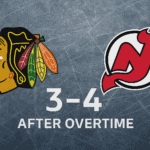
Chicago Blackhawks 3-4 New Jersey Devils (OT) - IHM Match Recap IHM

Chicago Blackhawks 3-4 New Jersey Devils (OT) – IHM Match Recap IHM

Chicago Blackhawks 3-4 New Jersey Devils (OT)

November 13, 2025Author: IHM News

Simon Nemec completed a statement night from the blue line with the overtime winner, lifting the New Jersey Devils to a 3-4 comeback victory over the Chicago Blackhawks.

In a game where Chicago held three separate one-goal leads, New Jersey’s puck pressure and blue-line production eventually overwhelmed the hosts. The Devils generated a heavy 20-37 advantage in shots on goal and leaned on their top skill to claw back in the third period before Nemec finished the job in overtime.

Connor Bedard opened the scoring late in the first period on a power play, but from there Chicago were forced to defend for long stretches. New Jersey’s forecheck and quick neutral-zone transitions (fast counter-attacks off turnovers) slowly tilted the ice, and the Blackhawks’ defensive structure started to crack under volume.

Game Flow

Chicago struck first at 18:35 of the opening frame. Bedard found a soft spot in the right circle on the man advantage and one-timed a feed from Teuvo Teravainen, beating the goalie high glove for a 1-0 lead.

The Devils answered late in the second period. After sustained zone time, Nemec jumped into a shooting lane at the top of the umbrella and wired a low shot through traffic to tie the game 1-1 at 19:45. That goal came after New Jersey had already piled up a big shot edge but repeatedly missed on second-chance looks.

The third period turned into trading punches. Luke Slaggert restored Chicago’s lead at 3:05, finishing a rebound at the top of the crease for 2-1. Dawson Mercer responded at 10:13 when Jack Hughes attacked the middle, kicked the puck wide and Mercer ripped a shot short side to make it 2-2.

Sam Lafferty pushed the Blackhawks in front again at 13:34, converting a net-drive play for 3-2, but New Jersey would not go away. Nemec struck for his second of the night at 16:13, walking the blue line and snapping a shot through a layered screen to level things at 3-3 and force overtime.

In the extra frame, the Devils controlled most of the 3-on-3 possession. On the winning sequence, Hughes and Jesper Bratt circled high in the zone to draw coverage, slipped the puck back to Nemec in stride and the defenseman hammered home the OT winner at 3:26 for a 3-4 New Jersey victory and a hat trick from the back end.

Numbers & IHM Performance Metrics

  • Shots on goal: Blackhawks 20, Devils 37
  • Shooting percentage: Blackhawks 15% (3/20), Devils 10.81% (4/37)
  • Blocked shots: Blackhawks 7, Devils 13
  • Goaltender saves: Blackhawks 33 on 37 shots, Devils 17 on 20 shots
  • Penalties: Blackhawks 1 minor (2 PIM), Devils 3 minors (6 PIM)
  • Special teams: Chicago struck on the power play; New Jersey generated key momentum and at least one goal with the extra skater.
  • Ice tilt: Long stretches of 5-on-5 zone time for New Jersey, especially from late first period onward.

Team Notes

For Chicago, the positive is the finishing touch from their top forwards in limited looks, but the concern is how quickly they were pushed back into a passive defensive shell. The Blackhawks protected the middle of the ice for most of two periods, only to sag deeper in the third and allow too many point shots with traffic.

New Jersey will be very happy with the response from the back end. Nemec’s three-goal night underlines how comfortable the Devils are letting their defensemen activate in a modern four-man rush (four skaters jumping into offense). Hughes quietly drove the attack with multiple primary setups, and the Devils’ forecheck kept Chicago changing in its own zone.

Coach Mark comment

Chicago played a brave game but could not handle the Devils’ pace for 60 plus minutes. When you get outshot this badly, every breakdown becomes costly. New Jersey trusted their structure, kept feeding pucks back to the blue line and eventually their quality on the back end decided the game.

Questions & Answers | IHM Performance Metrics

Q: Why did Chicago lose despite leading three times in the game?
A: The Blackhawks were heavily outshot 20-37 and spent long shifts in their own zone. As fatigue set in, they started giving up clean looks from the points and failed to clear rebounds, which New Jersey converted late in the third period and in overtime.

Q: What was the key tactical edge for the Devils?
A: Their aggressive 5-man attack with defensemen joining the rush. Nemec repeatedly found space at the top of the zone, and New Jersey’s forwards did a good job screening and recovering loose pucks to extend possessions.

Q: How did special teams influence the result?
A: Chicago’s early power-play goal gave them momentum, but the Devils’ discipline improved after the first period. New Jersey’s own power-play execution and the pressure it created helped tilt the shot count and kept the Blackhawks on the back foot.

Q: What do the IHM Performance Metrics say about goaltending in this game?
A: Chicago’s goalie faced the heavier workload, stopping 33 of 37 shots, while New Jersey’s netminder made 17 saves on 20 attempts. The quality of chances was higher against Chicago, especially with layered screens and back-door threats, so the stat line is harsher on the home goalie than the raw save percentage suggests.

Q: What is the main takeaway for both teams going forward?
A: Chicago must find a way to manage the puck better when holding a lead and avoid slipping into a passive box in their own zone. New Jersey can build confidence from a comeback win driven by their blue line and should continue to lean on this high-tempo, possession-based style.

More NHL news on IHM


NHL Status Report: Key Injury Updates Across the League,IHM News

NHL Status Report: Key Injury Updates Across the League

Date: November 8, 2025 | Author: IHM News

The NHL’s weekly status window opened with a wave of significant medical updates that will influence lineups across both conferences. From long-term absences in Pittsburgh to short-term concerns in Vancouver and major returns expected in Edmonton, teams are adjusting on the fly as they navigate the early stretch of the season.

Vancouver Canucks

The Canucks are monitoring the status of starter Thatcher Demko, who is considered questionable for this weekend due to what head coach Adam Foote described as “preventative maintenance.” Demko is 5-4-0 with a .912 save percentage and has been handling a heavy workload.

“He’s such a strong leader. If he feels he needs a couple days to reset, we trust him,” Foote said.

Vancouver recalled goaltender Jiri Patera from Abbotsford under emergency conditions ahead of matchups with Columbus and Colorado.

New York Rangers

Center Vincent Trocheck traveled with the team to Detroit but missed his 13th straight game while continuing to skate in a non-contact jersey. Trocheck remains eligible to come off long-term injured reserve and is considered day-to-day.

Defenseman Urho Vaakanainen remains sidelined with a lower-body issue.

Forward Jaroslav Chmelar made his NHL debut Friday, logging 6:27 of ice time against Detroit.

Carolina Hurricanes

Defenseman Shayne Gostisbehere has been placed on injured reserve retroactive to Oct. 28. After returning briefly for a game against Vegas, he exited after the first period and has missed the last four contests. Rod Brind’Amour confirmed the injury is located in the midsection.

San Jose Sharks

Rookie forward Michael Misa was placed on injured reserve and is officially week-to-week with a lower-body injury. Misa has missed San Jose’s last two games, including their recent 2-1 win over Winnipeg. The 2025 No. 2 draft pick has three points in seven appearances, though his early NHL journey has already included healthy scratches and lineup experimentation.

San Jose also moved William Eklund to injured reserve and recalled forward Zack Ostapchuk from AHL affiliate San Jose. The Sharks continue their homestand Saturday against the Florida Panthers.

Edmonton Oilers

Forward Zach Hyman will not dress for Saturday’s clash with the Colorado Avalanche but is expected to make his season debut within the next week, according to head coach Kris Knoblauch. Hyman has been ramping up his on-ice work since late October and appears close to a full return from the wrist dislocation suffered during last season’s Western Conference Final.

Knoblauch also noted that Mattias Janmark is nearing a return as well, potentially “within days.” The Oilers anticipate both forwards rejoining the squad over the upcoming seven-game road stretch.

New Jersey Devils

Defenseman Dougie Hamilton remains under evaluation for a lower-body injury sustained in Thursday’s overtime win against Montreal. Hamilton exited in the second period and did not return.

New Jersey is already without defenseman Brett Pesce, who has missed five games with an upper-body issue. Brenden Dillon acknowledged the challenge:

“Guys are going to get more minutes, more responsibility. These stretches test your blue line.”

Colton White skated on the third pair during practice and is an option for Saturday’s game against Pittsburgh.

Pittsburgh Penguins

The Penguins absorbed a major blow with the announcement that forward Filip Hallander will miss a minimum of three months after being diagnosed with a blood clot in his leg. Hallander had produced four points (1 goal, 3 assists) in 13 games and was off to one of the most confident starts of his NHL career.

Head coach Dan Muse addressed the media with a somber tone.

“This goes beyond hockey. We’re just grateful the medical staff identified the issue quickly. Now the priority is his long-term health.”

Hallander will remain under the care of the team’s medical department and specialists from the University of Pittsburgh Medical Center.

Coach Mark Comment

Injury waves tilt the season fast. The teams that manage depth and rotation survive November with real momentum. Pittsburgh losing Hallander is tough, but their structure can absorb minutes if they stay disciplined through the middle third. Vancouver’s handling of Demko is smart load management. Edmonton getting Hyman back is the biggest needle-mover of all. His timing and net-drive reshape their offensive layers.


Panarin drives Rangers past Red Wings 4-1 on the road | IHM News

Panarin drives Rangers past Red Wings 4-1 on the road | IHM News

IHM NEWS – Panarin drives Rangers past Red Wings 4-1 on the road

Date: November 8, 2025  |  Author: IHM News

DETROIT – This is what it looks like when your stars set the tone. Artemi Panarin produced three points (1G, 2A) and Jonathan Quick turned aside 32 shots as the New York Rangers handled the Detroit Red Wings 4-1 at Little Caesars Arena, pushing New York to 7-1-1 away from home and extending their run of dominance over Detroit to seven straight wins.

Panarin drives Rangers past Red Wings 4-1 on the road | IHM News

Panarin’s line dictated pace and possession from the opening faceoff. Mika Zibanejad stacked two primary assists, Alexis Lafrenière snapped a 12-game goal drought and added an assist, and depth scoring arrived on time from Will Cuylle, whose first-period power-play strike set the tone.

Our best players were our best players,” coach Mike Sullivan said. “We’ve generated looks; tonight we finished.”

Detroit’s push was real. J.T. Compher tied it 1-1 in the first, and Patrick Kane returned from injury with six shots in 17:41 – including a near-gift after picking off a Quick outlet that the veteran goalie and Braden Schneider scrambled to erase. But between Quick’s economy of movement and the Rangers’ five-man layers through the neutral zone, Detroit never found a second wave.

How it happened

  • 1-0 NYR (6:46 1st, PPG): Will Cuylle trailed the rush and buried Zibanejad’s cross-ice feed.
  • 1-1 (11:06 1st): Compher walked into a quick release from Mason Appleton’s feed behind the net, beating Quick high glove.
  • 2-1 NYR (4:52 2nd): Michigan native Noah Laba tapped in Lafrenière’s crease-edge pass for his hometown moment and Lafrenière’s 200th NHL point.
  • 3-1 NYR (7:29 3rd): Panarin finished a Zibanejad delivery in stride – a scorer’s touch through a small window.
  • 4-1 NYR (8:27 3rd): Lafrenière from the slot to close it out.

Quick’s best sequences came late in the second: a point-blank denial on Kane after the interception, then a second-chance blocker swipe that killed the building’s surge. “He bails us out after our mistakes,” Schneider said. “Tonight he even cleaned up his own.”

Detroit coach Todd McLellan was blunt: “Physically there, but not sharp between the ears. When you’re not crisp, those look-in chances don’t fall.”

Numbers that matter

  • Road form: Rangers 7-1-1 away, structure travels.
  • Panarin vs DET: 28 points in last 16 vs Red Wings.
  • Goaltending: Quick .970 SV% at 5v5 on the night (32 saves overall).
  • Special teams: NYR score first on the PP; even-strength shot quality tilted their way in periods 2-3.

Coach Mark comment

New York solved Detroit’s first-touch pressure by widening the neutral-zone entries and letting Panarin attack off the inside-out delay. That pulled Detroit’s weak-side defender up a half-step, and the Rangers hit seams behind it (see Cuylle PPG and the Lafrenière/Laba connection). Quick’s puck tracking was elite; minimal rebounds, square early. This is sustainable road hockey.


By IHM Team | IHM News | November 5, 2025 Kochetkov makes 25 saves as Hurricanes shut out Rangers at MSG Carolina suffocates New York as Rangers fall to 0-5-1 at home NEW YORK Carolina Hurricanes goaltender Pyotr Kochetkov delivered a 25-save shutout in his first NHL start of the season, leading a 3-0 win over the New York Rangers and handing New York its sixth consecutive home loss to open the season. The Rangers generated 13 shots in the opening 8:40, including clear looks for Artemi Panarin, J.T. Miller, and Jonny Brodzinski, but Kochetkov turned all of them aside and Carolina controlled play from that point forward. Nikolaj Ehlers scored his first goal with the Hurricanes on a first-period power play through a screen, Sean Walker added another late in the second off a face-off sequence, and Seth Jarvis sealed the win with an empty-netter. New York recorded only 12 shots in the final 51 minutes and just one in the third period. Carolina improved to 8-4-0 while the Rangers fell to 0-5-1 at MSG and 6-6-2 overall. Coach Mark comment Kochetkov played with patience and strong interior positioning. Carolina protected the slot, cleared lanes, and managed their exits with purpose. New York had early looks but once Carolina controlled the walls and middle lane entries, the flow tilted decisively.

Kochetkov Shuts Out Rangers in Season Debut | IHM News

By IHM Team | IHM News | November 5, 2025

Kochetkov makes 25 saves as Hurricanes shut out Rangers at MSG

Carolina suffocates New York as Rangers fall to 0-5-1 at home

By IHM Team | IHM News | November 5, 2025 Kochetkov makes 25 saves as Hurricanes shut out Rangers at MSG Carolina suffocates New York as Rangers fall to 0-5-1 at home NEW YORK Carolina Hurricanes goaltender Pyotr Kochetkov delivered a 25-save shutout in his first NHL start of the season, leading a 3-0 win over the New York Rangers and handing New York its sixth consecutive home loss to open the season. The Rangers generated 13 shots in the opening 8:40, including clear looks for Artemi Panarin, J.T. Miller, and Jonny Brodzinski, but Kochetkov turned all of them aside and Carolina controlled play from that point forward. Nikolaj Ehlers scored his first goal with the Hurricanes on a first-period power play through a screen, Sean Walker added another late in the second off a face-off sequence, and Seth Jarvis sealed the win with an empty-netter. New York recorded only 12 shots in the final 51 minutes and just one in the third period. Carolina improved to 8-4-0 while the Rangers fell to 0-5-1 at MSG and 6-6-2 overall. Coach Mark comment Kochetkov played with patience and strong interior positioning. Carolina protected the slot, cleared lanes, and managed their exits with purpose. New York had early looks but once Carolina controlled the walls and middle lane entries, the flow tilted decisively.

NEW YORK Carolina Hurricanes goaltender Pyotr Kochetkov delivered a 25-save shutout in his first NHL start of the season, leading a 3-0 win over the New York Rangers and handing New York its sixth consecutive home loss to open the season.

The Rangers generated 13 shots in the opening 8:40, including clear looks for Artemi Panarin, J.T. Miller, and Jonny Brodzinski, but Kochetkov turned all of them aside and Carolina controlled play from that point forward.

Nikolaj Ehlers scored his first goal with the Hurricanes on a first-period power play through a screen, Sean Walker added another late in the second off a face-off sequence, and Seth Jarvis sealed the win with an empty-netter.

New York recorded only 12 shots in the final 51 minutes and just one in the third period. Carolina improved to 8-4-0 while the Rangers fell to 0-5-1 at MSG and 6-6-2 overall.

Coach Mark comment
Kochetkov played with patience and strong interior positioning. Carolina protected the slot, cleared lanes, and managed their exits with purpose. New York had early looks but once Carolina controlled the walls and middle lane entries, the flow tilted decisively.


Oilers Reportedly Open to Trading Stuart Skinner | IHM News

Oilers Reportedly Open to Trading Stuart Skinner | IHM News

By IHM Team | IHM News | November 5, 2025

Insiders: Oilers Evaluate Future in Goal, Reportedly Open to Stuart Skinner Trade

Oilers Reportedly Open to Trading Stuart Skinner | IHM News

EDMONTON The Edmonton Oilers are keeping all options open in net as they continue to assess goaltender Stuart Skinner early in the 2025-26 season. According to multiple insiders, the organization would consider a trade if the right opportunity emerges, signaling a subtle shift in stance regarding the 27-year-old’s long-term role.

Skinner has shown improvement but has not fully reached elite form. Through nine games, he has recorded a 4-5-0 record, one shutout, a 2.52 goals-against average, a .900 save percentage, and a +2.1 goals-saved-above-expected. Edmonton acquired Connor Ingram from Utah to bolster depth, though he remains an AHL option at the moment.

On Oilers Now, insider Ryan Rishaug noted that Edmonton has a structured plan in place should the club decide to act. He added that general manager Stan Bowman may eventually be pushed toward a move if inconsistency returns.

Potential trade routes

  • Columbus Blue Jackets – Possible framework involving Elvis Merzlikins, salary considerations likely.
  • Pittsburgh Penguins – Tristan Jarry scenario depending on standings near deadline.
  • Buffalo Sabres – Devon Levi or Ukko-Pekka Luukkonen, but Oilers seeking a clear upgrade.
  • Long shots – Ilya Sorokin or Juuse Saros (major cost and trade restrictions).

Executives around the league believe patience remains the Oilers’ priority unless an obvious top-tier target becomes available.

Coach Mark comment
Edmonton is being methodical, not emotional here. Skinner has improved his scan habits and post integration, but the consistency layer still is not fully locked. Timing matters with goalie decisions when you are built to win now.