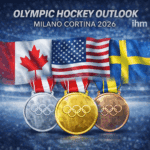
Tag: Team Canada

NHL SHORT ICE | Olympic | Feb 17

NHL SHORT ICE | Olympic | Feb 17

IHM NHL SHORT ICE

Olympic Edition | February 17, 2026

Date: 17 February 2026
By IceHockeyMan Newsroom

Qualification round clarity. Quarterfinal picture sharpening.

Germany Advances Behind Draisaitl

Leon Draisaitl recorded three points as Germany eased past France to advance. Philipp Grubauer delivered 30 saves in a composed performance, securing a quarterfinal matchup against Slovakia.

Why it matters: Germany’s top-line efficiency combined with structured defensive layers makes them a dangerous elimination opponent.

Switzerland Eliminates Italy

Switzerland shut out Italy to move on, with Nico Hischier contributing a goal and two assists. Leonardo Genoni handled 20 shots cleanly in the victory.

Why it matters: Switzerland now face Finland in what projects to be a structured, low-event quarterfinal battle.

Canada Health Watch

Brad Marchand and Josh Morrissey could return for Canada in the quarterfinals after missing the past two games. Canada enter knockouts with a largely healthy roster and veteran stability.

Why it matters: Depth restoration before elimination rounds significantly reduces defensive matchup risk.

Finland Boost

Anton Lundell is expected to be available for Finland’s quarterfinal after illness, restoring forward depth ahead of the Switzerland clash.

Why it matters: Finland rely on four-line balance to sustain pressure without overloading top units.

Goalie Watch - Qualification Round

Projected starters include Jacob Markstrom for Sweden, Elvis Merzlikins for Latvia, Frederik Andersen for Denmark, Lukas Dostal for Czechia, and Julian Junca for France.

Why it matters: In elimination-format hockey, goaltending stability often overrides offensive pace.

Coach Mark Insight

Once qualification rounds end, tactical margin shrinks dramatically. Defensive spacing, faceoff execution and disciplined line changes decide quarterfinals more than highlight-reel plays.

Q&A

Q1: Why are qualification games so volatile?
Teams balance aggression with survival, which creates transitional openings.

Q2: Does returning from minor injury affect rhythm?
Timing and defensive reads may lag slightly, but experience offsets risk.

Q3: What defines a strong quarterfinal team?
Depth scoring, special teams efficiency and composed goaltending.


IceHockeyMan Newsroom

NHL SHORT ICE Olympic Edition - Top 24 hrs Hockey Stories in Minutes | February 13, 2026 | IHM News

NHL SHORT ICE Olympic Edition - Top 24 hrs Hockey Stories in Minutes | February 13, 2026 | IHM News

IHM NHL SHORT ICE

🏒 NHL SHORT ICE - Olympic Edition | Top 24 hrs Hockey Stories in Minutes

February 13, 2026 | IHM News

Short hockey news for busy professionals who want to stay informed without reading long articles.

🔥 Top Results and Momentum

Nelson scores twice as United States pulls away from Latvia in opener
Team USA turned a competitive start into a controlled finish, with Brock Nelson scoring twice to power a statement win. The Americans tightened their five-man spacing, reduced Latvia’s clean entries, and stretched the game with depth execution once the forecheck began sealing the walls.

Germany handles Denmark behind Stutzle, Draisaitl, and Grubauer
Tim Stutzle scored twice as Germany opened with a composed, structured win. Leon Draisaitl added a goal and an assist, and Philipp Grubauer provided stability with 37 saves. Germany’s neutral-zone management and quick support on exits prevented Denmark from building sustained pressure.

McDavid sets Olympic tone as Canada finds rhythm with speed and layers
Connor McDavid drove early tempo in his long-awaited Olympic debut, impacting the game through pace and playmaking, finishing with three assists. Canada’s attack leaned on fast lane changes and weak-side options that forced defensive collapses and opened clean looks through the slot.

📰 Top Headlines

Hughes brothers and USA skill group control distribution lanes
Playmaking volume mattered as much as finishing. The Hughes brothers, Matthew Tkachuk, and Jack Eichel each collected two assists, repeatedly creating inside access through quick touch support and controlled secondary options.

Sweden’s lineup choices draw attention, veterans back the staff
Sweden’s selections became part of the conversation, but the messaging stayed consistent: team structure first. Filip Forsberg and Oliver Ekman-Larsson supported the coaching decisions publicly, reinforcing clarity and buy-in.

Keller embraces the Olympic stage despite early setback
Even in defeat, the Olympic environment delivered a clear reminder: the tournament punishes transition mistakes. Teams that protect line changes and manage puck routes are surviving the early rounds with fewer stress shifts.

🔁 Status Report and Tactical Notes

What is separating teams early
The first games have rewarded clean exits, layered neutral-zone tracking, and disciplined line changes. Star power helps, but structure under pressure is deciding momentum swings and limiting the underdog’s counterpunch chances.

IHM Tactical Take
Early Olympic hockey is being won by five-man units, not highlight plays. When teams compress the middle, deny controlled entries, and keep support close on retrievals, they tilt the ice without taking unnecessary risk. The nations that manage pace and spacing will control the group stage.


❓ IHM Q&A - NHL Short Ice (Olympic Edition) | 13 February 2026

Why did USA’s win over Latvia feel decisive late
Because Team USA tightened spacing and reduced Latvia’s clean entries. Once the Americans started sealing the walls and stacking the middle, the game became a controlled possession and depth battle.

What was the biggest driver for Germany vs Denmark
Structure plus goaltending. Germany managed the neutral zone well, and Grubauer held firm under volume, which allowed Germany to stay patient and strike on cleaner looks.

What did McDavid’s Olympic debut show in practical terms
Tempo control. He did not just create points, he forced defenders to react earlier, which opens weak-side options and makes secondary attacks more dangerous.

Why are lineup decisions becoming a storyline for Sweden
Because Olympic games compress time and margin for error. When a staff chooses a specific look, the team’s buy-in and messaging matter. Veteran support keeps the room aligned.

What is the most repeatable edge in the early Olympic round
Clean exits and disciplined line changes. Teams that avoid transition giveaways and protect the middle are limiting chaos and winning the momentum minutes.

Does early momentum matter in a short tournament
Yes. Early confidence often shapes game management, and game management is a major separator when pressure rises and opponents are unfamiliar.

What should fans watch beyond goals and assists
Neutral-zone posture and retrieval support. When defenders get quick help and forwards track back with purpose, the game becomes predictable and harder to steal.


IHM NHL SHORT ICE - Top NHL Stories | February 12, 2026

IHM NHL SHORT ICE - Top NHL Stories | February 12, 2026

🏒 NHL SHORT ICE - Olympic Edition - Key Updates in Minutes

February 12, 2026 | IHM News

All essential Olympic hockey developments in one structured, professional digest. Trade moves, lineup confirmations, performance signals and tactical trends - condensed and clean.


🔁 Trade Update Before the Freeze

Devils acquire Nick Bjugstad before Olympic roster freeze
New Jersey finalized a trade with St. Louis to add forward Nick Bjugstad just before the Olympic transaction freeze. The timing matters. The Devils reinforce depth and physical presence down the middle while keeping flexibility intact. This is a stabilizing move rather than a headline gamble.


🥇 Olympic Tournament Momentum

Canada and USA begin gold pursuit
Both North American powers opened their Olympic campaigns carrying chemistry from recent international tournaments. Familiarity between core players may shorten adaptation time, especially in special teams structure and bench rotations.

Nylander breaks tie as Sweden holds off Italy
William Nylander delivered the key goal in the second period, while Mika Zibanejad and Rasmus Dahlin each posted three-point performances. Sweden controlled puck possession, but Italy’s resilience and goaltending effort kept the margin competitive until late.

Slafkovsky drives Slovakia again
Juraj Slafkovsky continues to elevate his international profile. Two goals and an assist underline his confidence in high-pressure environments. His speed through the neutral zone and power-play presence remain major offensive drivers.

Hlavaj makes statement performance
The Slovak goaltender delivered 39 saves in a defining performance. In short tournaments, one elite goaltending display can completely shift bracket projections.

Josi captaincy celebrated by Nashville
Roman Josi officially leads Switzerland. Leadership stability and puck-moving control from the back end remain Switzerland’s foundation.

Italy earns respect despite loss
Though falling to Sweden, Italy demonstrated structure and discipline. Forward Frigo highlighted how competitive identity matters as much as final score in Olympic group play.


📊 Performance & Player Notes

IHM metrics highlight Slafkovsky breakout
Advanced tracking continues to show Slafkovsky’s acceleration and finishing efficiency trending upward. His goal-location diversity makes him harder to neutralize.

Injury watch
Damian Clara exited with a right leg injury. Jacob Markstrom did not start for Sweden as initially projected. Monitoring goaltending rotations will be critical moving forward.

Olympic leadership spotlight
Coaches emphasized familiarity as a strategic edge. Canada and USA both benefit from existing chemistry blocks, reducing system-learning friction.


🧠 Tactical Snapshot

Early Olympic games show a clear pattern: teams prioritizing middle-lane denial, structured neutral-zone entries, and controlled second chances are separating quickly. Goaltending timing remains the decisive tournament variable.


❓ IHM Q&A - Olympic Edition (12 February 2026)

Why was the Bjugstad trade timing important?
Because the Olympic freeze restricts roster flexibility. Completing the move beforehand ensures depth continuity during the break.

What makes short Olympic tournaments different from NHL regular season play?
Minimal recovery time and single-game momentum swings. Teams must adapt quickly without extended sample sizes.

How valuable is existing chemistry for Canada and USA?
Extremely. Reduced adjustment time improves special teams efficiency and defensive rotations.

Why is Slafkovsky’s performance significant?
He combines size, speed and finishing under pressure. That blend shifts defensive matchups immediately.

What role does goaltending timing play?
Tournament success often hinges on one or two elite saves at key moments rather than overall shot volume.

Is Sweden’s approach sustainable?
If Gustavsson stabilizes rebound control and Nylander maintains transition speed, Sweden remains structurally sound.

What is Switzerland’s identity under Josi?
Calm puck movement from the back end and disciplined defensive spacing.


IHM NHL SHORT ICE - Top NHL Stories | February 11, 2026

IHM NHL SHORT ICE - Top NHL Stories | February 11, 2026

🏒 NHL SHORT ICE - Olympic Edition - All Key Stories in Minutes

February 11, 2026 | IHM News

Short Olympic hockey news for busy professionals who want the key tournament signals fast, with clean context and zero noise.

🔥 Top Olympic Stories and Momentum

Slovakia opens with a statement win over Finland
Slovakia’s 4-1 upset of Finland set the tone early. Juraj Slafkovsky scored twice and drove the emotional edge, but the real separator was structure. Slovakia protected the middle, forced wide entries, and turned a few high-quality looks into a decisive result.

Team Canada offers support to Tumbler Ridge
Canada publicly acknowledged and supported the community of Tumbler Ridge, showing unity beyond the rink. Inside the group, the focus remains sharp, and emotional resilience often becomes a hidden advantage in short international tournaments.

DeBoer embraces a unique assistant role for Canada
Peter DeBoer is relishing the “short-term assistant” assignment, emphasizing details, matchup planning, and tournament-ready structure. In Olympic hockey, small tactical edges such as neutral-zone spacing and special teams triggers can decide medal paths.

Josi named Team Switzerland captain
Roman Josi wearing the “C” is a major clarity signal for Switzerland. His puck-moving control and calm under pressure will be central to Switzerland’s identity, especially in games where they need to survive momentum swings and manage puck risk.

Sweden update: Nylander cleared, Gustavsson gets the start
William Nylander is good to go, adding elite finishing and separation speed. Filip Gustavsson in goal suggests Sweden is prioritizing stability and rebound control early, a classic tournament approach.

Latvia ready for the big stage
Elvis Merzlikins frames Latvia’s approach as fearless underdog hockey. In practice terms, Latvia’s path is disciplined layers, contested entries, and goaltending that can steal a period when the opponent pushes.

Czechia facing the toughest early test vs Canada
Czechia’s opening challenge against Canada is being framed as the “toughest start” scenario. The teams that survive early pressure without taking penalties often gain tournament confidence fast.

🧠 Coach Mark Takeaway

Olympic hockey is about clarity and adaptation. With limited preparation time, teams that simplify their neutral-zone structure, avoid low-percentage puck plays, and win special teams minutes separate quickly. Talent matters, but bench switching and in-game adjustments decide the close ones.


❓ IHM Q&A - NHL Short Ice Olympic Edition (11 February 2026)

Why did Slovakia’s win over Finland matter beyond the score?
Because it showed tournament-ready structure. When a team protects the middle and forces low-danger volume, it can beat deeper rosters through discipline and timing.

What is the biggest early Olympic advantage?
Special teams efficiency. Power-play conversion and penalty discipline swing outcomes faster in short events than in long league seasons.

Why does leadership feel louder at the Olympics?
Because the margin is smaller. Captains and veteran leaders stabilize the bench when momentum spikes, and one calm shift can reset an entire game.

How does a coach like DeBoer impact a short tournament?
Through details. Matchup planning, neutral-zone spacing, and bench adjustments can win a single elimination game even when talent is close.

What does Josi’s captaincy signal for Switzerland?
Identity. Switzerland will lean on puck control from the blue line, clean exits, and calm decision-making when the game gets fast.

What should Sweden focus on with Nylander available?
Transition efficiency. If Sweden can create clean entries and reduce wasted possessions, Nylander’s finishing becomes a direct weapon.

How can Latvia realistically upset a top nation?
By limiting second chances, blocking the middle, and getting elite save timing. Underdogs rarely win on volume, they win on structure plus goaltending.


IHM NHL SHORT ICE - Top NHL Stories | February 10, 2026

IHM NHL SHORT ICE - Top NHL Stories | February 10, 2026

🏒 NHL SHORT ICE - All Key Stories in Minutes

February 10, 2026 | IHM News

Short hockey news for busy professionals who want Olympic insight, roster context, and competitive signals without the noise.

🔥 Olympic Spotlight and Momentum

Celebrini set for a major role with Team Canada
Canada is preparing to lean heavily on Macklin Celebrini, signaling trust in high-end skill under pressure. This is not a sheltered role. It is responsibility hockey.

Slavin gets hometown sendoff before Milan
Jaccob Slavin’s departure for the Olympics comes with community support and respect, reflecting the value placed on elite defensive reliability in short tournaments.

Olympic Village mindset emphasized by Brodeur
Martin Brodeur highlights the off-ice element of the Games, noting that immersion and shared experience often sharpen competitive edge rather than distract from it.

Bellemare reaches Olympic milestone
Pierre-Edouard Bellemare will captain Team France in his first Olympic appearance, a career-defining moment built on longevity, discipline, and trust.

Pastrnak stays loose ahead of pressure matchups
David Pastrnak enters the tournament relaxed but focused, a balance often seen in players accustomed to carrying offensive expectation on the biggest stages.

Draisaitl named Germany’s captain
Leon Draisaitl takes on the captaincy for Team Germany, cementing his status as the country’s central competitive driver.

Canadian goalies embracing the challenge
Binnington, Kuemper, and Thompson enter the tournament eager to reset narratives and prove consistency in a best-on-best environment.

MacKinnon all business for Canada
Nathan MacKinnon arrives with a clear tone. This is not a celebration tour. It is mission-focused hockey.

Landeskog healthy and grateful with Sweden
Gabriel Landeskog’s return adds leadership and physical presence, key traits for Sweden’s structure-based approach.

Team Finland goalie picture taking shape
Finland’s Olympic hopes will hinge on disciplined defensive layers and timely saves rather than volume scoring.

Switzerland confident entering Group A
Switzerland arrives believing this is their window, fueled by recent international results and strong roster cohesion.

📰 Around the Game

NHL leadership energized by best-on-best return
League officials emphasize momentum from recent international tournaments, viewing the Olympics as a platform to reinforce elite competitive identity.

Young talent continues to surface
Rookie contributions across leagues underline a broader trend: organizations are trusting first-year players in meaningful roles earlier than before.


❓ IHM Q&A - NHL Short Ice (10 February 2026)

Why is role clarity so important at the Olympics?
Because preparation time is limited. Players who know their exact responsibilities adapt faster and execute under pressure.

What separates successful Olympic teams from talented ones?
Structure and discipline. Talent opens doors, but systems and buy-in keep teams alive in elimination games.

Why does captain selection matter more internationally?
Captains control bench tone, referee communication, and emotional swings, all magnified in short tournaments.

Is goaltending still the main variable?
Yes. Save timing often matters more than save percentage. One key stop can flip a medal path.

What early Olympic signal should fans watch?
Special teams efficiency. Power-play conversion and penalty discipline quickly separate contenders from pretenders.

How does Olympic focus affect NHL clubs?
It shifts priorities toward health management and simplified systems, especially for teams sending multiple players overseas.


Milano Cortina 2026 Hockey Expert Outlook by Coach Mark: Editorial Outlook Leans Toward Canada, Sees USA as Gold Contender | IHM News

Milano Cortina 2026 Hockey Expert Outlook by Coach Mark: Staff Favors Canada, Backs USA Gold | IHM News

Date: February 5, 2026
By IceHockeyMan Newsroom | Updated: February 5, 2026


The Milano Cortina 2026 Olympic men’s hockey tournament marks the return of NHL-level rosters to the Olympic stage for the first time in more than a decade. With elite talent concentrated across all twelve participating nations, the competitive balance is tighter than ever.

The tournament format amplifies volatility: each team plays three group-stage games before advancing into a single-elimination playoff. In this structure, one poor period, one special-teams lapse, or one goaltending swing can completely reshape the medal picture.

As the tournament opens, the early medal outlook centers around three nations: Canada, the United States, and Sweden. Each enters with a distinct roster profile, tactical identity, and path to the podium.


Group Outlook

Group A - Canada

Canada enters Group A with its traditional strengths intact: elite forward depth, championship-tested leadership, and an ability to control games through puck possession and transition speed. Their challenge will not be talent, but margin management in short-form competition.

Group B - Sweden

Sweden remains one of the most structurally reliable teams in international hockey. Defensive layers, five-man connectivity, and disciplined neutral-zone play make them exceptionally difficult to break down over sixty minutes.

Group C - United States

The United States brings arguably its most complete Olympic roster in decades. High-tempo transition play, mobile defensemen, and multiple scoring lines give this group matchup flexibility against any opponent in the field.


Medal Outlook

  • Gold Medal: United States
  • Silver Medal: Sweden
  • Bronze Medal: Canada

Coach Mark Lehtonen Verdict

From a coaching perspective, this Olympic tournament is not about reputation, but adaptability. Canada remains the deepest roster on paper, but short tournaments punish predictability. Their success will depend on how quickly they adjust to elimination pressure.

The United States, however, enters with the most adaptable profile. Their ability to attack through pace, activate the blue line, and maintain defensive recovery speed gives them answers in multiple game states. This is the most structurally balanced U.S. Olympic team in modern history.

Sweden’s medal projection is rooted in execution. They may not overwhelm opponents with raw offense, but their consistency in defensive zone exits, layered coverage, and situational discipline makes them exceptionally dangerous in knockout games.

Canada’s placement on the podium remains highly likely, but the margin between gold and bronze is thinner than at any previous Olympic cycle. Goaltending performance and special teams efficiency will ultimately define their ceiling.

Overall, Milano Cortina 2026 sets up as one of the most open Olympic hockey tournaments on record. The United States holds the highest tactical ceiling, Sweden offers the safest structural floor, and Canada remains the ultimate test of championship execution under pressure.


Q&A: Milano Cortina 2026 Olympic Hockey

Q: Why is the tournament considered wide open?
A: All teams advance to elimination rounds, reducing the margin for error and amplifying game-to-game variance.

Q: What gives the United States an edge?
A: Depth across all four lines, mobile defensemen, and transition speed.

Q: Can Sweden realistically win gold?
A: Yes. Their structure and discipline translate extremely well in short tournaments.

Q: Is Canada still a favorite?
A: Canada remains a top contender, but execution will matter more than pedigree.

Q: What will decide medal outcomes?
A: Goaltending consistency, special teams efficiency, and situational discipline.


Olympic Hockey 2026: Top 50 NHL Players Ranked, With Coach Mark’s Tournament Take | IHM News

Olympic Hockey 2026: Top 50 NHL Players Ranked, With Coach Mark’s Tournament Take | IHM News

Olympic Hockey 2026: Top 50 NHL Players Ranked, With Coach Mark’s Tournament Take

Date: 27 January 2026
By: IHM News

For busy hockey fans: one clean, tournament-ready ranking of the Top 50 Olympic NHL players, grouped by impact tiers, plus a coach-level breakdown of what actually decides medals.


How IHM Built This Ranking

The 2026 Winter Olympics mark the return of NHL players to the Games for the first time since 2014, and for many stars this will be their first true Olympic spotlight. Two weeks, single-elimination pressure, unfamiliar ice dimensions and national-team chemistry create a very different environment than an 82-game NHL marathon.

To keep the ranking grounded in on-ice value, the baseline idea behind this list mirrors a modern all-in-one approach like Goals Above Replacement (GAR). The purpose is simple: measure a player’s total impact across offense, defense, and goaltending relative to a replacement-level option at the same position. Production is also balanced by role the way real hockey value works: forwards drive most of the offense, defensemen drive a huge share of transition and suppression, and goaltenders can swing single games.

From there, we use a three-season performance blend to avoid overreacting to short stretches. The concept is “recent, but not fragile”: weight the current season most heavily, then the previous seasons progressively less, while still protecting true late risers so the ranking does not punish breakouts.


TIER 1: Franchise Game Changers (1 to 5)

These are the players most capable of deciding the medal picture by themselves. If they get rolling early, entire tournaments bend around them.

  1. Nathan MacKinnon, C, Canada
    IHM take: Pure pace plus separation. In short tournaments, burst speed is a cheat code because systems have less time to adjust. If Canada wants a statement game, MacKinnon is the fastest way to it.
  2. Cale Makar, D, Canada
    IHM take: The modern defenseman who turns exits into offense without gambling away structure. He can dominate minutes without looking like he is forcing anything, which is exactly what wins in Olympic-style hockey.
  3. Connor McDavid, C, Canada
    IHM take: The best transition weapon on Earth. Even if a team tries to “trap” him, one broken layer and it becomes a backcheck drill for everyone else.
  4. Leon Draisaitl, C, Germany
    IHM take: Consistency is rare at the top end. Germany will lean on him for every high-leverage shift, and he is built for it: power play, late-game faceoffs, and controlled zone time.
  5. David Pastrnak, RW, Czechia
    IHM take: The most dangerous pure scoring winger in the field. Olympic games often swing on one unstoppable release, and Pastrnak has that “no warning” shot.

TIER 2: Olympic Difference Makers (6 to 15)

These players are not just stars. They are the ones who change matchups, tilt special teams, and win the tight games that decide medals.

  1. Connor Hellebuyck, G, United States
    IHM take: Even with an uneven stretch, elite goalies can “arrive” in a tournament. If the USA wins gold, there will be at least one game where Hellebuyck steals it.
  2. Zach Werenski, D, United States
    IHM take: A transition driver who can play heavy minutes. On bigger ice, his ability to move pucks under pressure becomes even more valuable.
  3. Martin Necas, C, Czechia
    IHM take: Speed plus confidence is a tournament recipe. If Czechia wants an upset, Necas is the breakaway threat that forces opponents to back off.
  4. Mikko Rantanen, RW, Finland
    IHM take: Not always at peak form, but still a nightmare matchup. He wins pucks, protects space, and turns small advantages into high-danger chances.
  5. Macklin Celebrini, F, Canada
    IHM take: The “young factor” that can change energy. In short events, a fearless creator can tilt momentum faster than a veteran grinder line.
  6. Jack Eichel, C, United States
    IHM take: Built for this format: responsible, fast, two-way, and strong in the middle lane. Coaches trust him in every score state.
  7. Kyle Connor, LW, United States
    IHM take: Quiet elite finishing. If you lose track of him for one shift, the puck is behind your goalie.
  8. Josh Morrissey, D, Canada
    IHM take: Stabilizer. Canada’s stars can fly because someone like Morrissey keeps the game clean when it gets messy.
  9. Logan Thompson, G, Canada
    IHM take: Real starter potential. If Canada chooses the hot hand, Thompson is a legitimate “win the room” option.
  10. Brandon Hagel, LW, Canada
    IHM take: Tournament glue. He drives pressure, draws mistakes, and gives top players extra possessions without demanding the puck.

TIER 3: High-Impact Core Players (16 to 30)

This tier is loaded with medal-winning ingredients: elite brains, special teams weapons, and players who can elevate their line mates instantly.

  1. Sidney Crosby, C, Canada
    IHM take: Less about dominance now, more about control. In Olympic hockey, control is gold.
  2. William Nylander, C, Sweden
    IHM take: Open-ice danger. Sweden’s attack looks different when Nylander is feeling it.
  3. Sam Reinhart, C, Canada
    IHM take: A system scorer who still finishes like a star. Perfect for structured tournament hockey.
  4. Jake Guentzel, C, United States
    IHM take: Smart routes, quick decisions, elite support play. He makes lines work.
  5. Mitch Marner, RW, Canada
    IHM take: Creativity that can break tight boxes, but he needs the right structure around him.
  6. Auston Matthews, C, United States
    IHM take: Ceiling is outrageous. If he starts hot, opponents must change their plan immediately.
  7. Filip Gustavsson, G, Sweden
    IHM take: A goalie who can run a streak. That is often the difference in Olympics.
  8. Quinn Hughes, D, United States
    IHM take: Skating and puck movement scale up on big ice. He can dictate pace.
  9. Sebastian Aho, C, Finland
    IHM take: Tactical, efficient, and hard to take away. Finland lives on players like this.
  10. Nick Suzuki, C, Canada
    IHM take: Reliable center value. He wins small battles that decide tight games.
  11. Matt Boldy, LW, United States
    IHM take: Under-the-radar impact. He can swing a matchup without headlines.
  12. Tage Thompson, C, United States
    IHM take: Size plus shot becomes a special teams nightmare. Keep him out of rhythm or pay for it.
  13. Mark Stone, RW, Canada
    IHM take: If healthy, he is an X-factor on both sides of the puck and in net-front details.
  14. Lucas Raymond, LW, Sweden
    IHM take: Continues rising. Sweden needs his pace and his willingness to attack inside.
  15. Brayden Point, C, Canada
    IHM take: Built for pressure hockey. His playoff-style game translates perfectly.

TIER 4: Depth That Wins Tournaments (31 to 50)

These are the names that do not always lead highlight reels, but they win shifts, special teams minutes, and late-game details. That is how medals are earned.

  1. Clayton Keller, C, United States
    IHM take: Skill and pace that can punish tired defenses in back-to-back spots.
  2. Jake Sanderson, D, United States
    IHM take: Modern two-way defense. Great for closing games with structure.
  3. Shea Theodore, D, Canada
    IHM take: Smooth puck mover who helps teams escape pressure cleanly.
  4. Dylan Larkin, C, United States
    IHM take: A tournament engine. Speed down the middle changes matchups.
  5. Tim Stutzle, LW, Germany
    IHM take: If Germany has a “chaos creator,” it is him. He can manufacture offense.
  6. Tom Wilson, RW, Canada
    IHM take: Heavy game, net-front, intimidation. Short events reward controlled physicality.
  7. Adrian Kempe, LW, Sweden
    IHM take: Direct attacker. Sweden needs finishers and Kempe is one.
  8. Roope Hintz, LW, Finland
    IHM take: Two-way pace that fits Finland’s identity perfectly.
  9. Brock Nelson, C, United States
    IHM take: Reliable center depth. Coaches love predictable, mistake-free shifts.
  10. Jesper Wallstedt, G, Sweden
    IHM take: Big upside. If he gets hot, Sweden’s ceiling rises instantly.
  11. Brad Marchand, LW, Canada
    IHM take: Edge and timing. In tournaments, one drawn penalty can be the whole game.
  12. Nikolaj Ehlers, LW, Denmark
    IHM take: Denmark’s threat in transition. He can create moments out of nothing.
  13. Jake Oettinger, G, United States
    IHM take: A goalie built for big stages. If he is in form, USA can beat anyone.
  14. Philipp Grubauer, G, Germany
    IHM take: Germany needs saves to survive. Grubauer’s best games are still high level.
  15. Jeremy Swayman, G, United States
    IHM take: Athletic, sharp, and capable of a tournament run. Goalie depth is real power.
  16. Rasmus Dahlin, D, Sweden
    IHM take: If Sweden wants to play faster, Dahlin is the accelerator from the back end.
  17. Darcy Kuemper, G, Canada
    IHM take: Calm presence. In tournaments, calm is a weapon when games tighten.
  18. Tomas Hertl, C, Czechia
    IHM take: Strong interior game. Czechia needs net-front and puck protection, he brings both.
  19. Filip Forsberg, C, Sweden
    IHM take: When he is on, Sweden’s scoring looks effortless. A classic tournament scorer profile.
  20. Moritz Seider, D, Germany
    IHM take: The kind of defenseman that can play any role. Germany will lean on him endlessly.

Summary line: These are not just “depth players.” These are shift-winners, penalty-kill lifelines, net-front specialists, and late-game stabilizers. That is how medals are secured.


Other Notables: Why Some Big Names Sit Lower

Some star names land lower than fans expect. In most cases, it is not about talent. It is about availability, recent missed time, or value dips that matter when you blend multiple seasons.

  • Jack Hughes – elite ceiling, but injury-limited stretches reduce the three-year profile.
  • Victor Hedman – still a top name, but recent impact does not match peak seasons.
  • Mika Zibanejad – production fluctuations and role value changes show up in blended metrics.
  • Brady Tkachuk – a massive tournament presence, but recent injury context matters.
  • Matthew Tkachuk – elite when active, but missed time pushes him down.
  • Jordan Binnington – a single great tournament does not always align with recent NHL value trends.

Coach Mark Comment

Coach Mark: The Olympics are not an NHL season. That is the first mistake fans make, and sometimes teams make it too. In a short tournament, you do not “build over time.” You must arrive ready. The entire event is about details that look boring on TV but decide medals: line matching, special teams discipline, and protecting the middle of the ice when legs get heavy.

People talk about star power, and yes, stars matter. But tournament hockey is where stars are often neutralized by structure. Coaches will build layers against the top line and dare secondary players to beat them. That is why I always look at two things first: who can win without the puck, and who can win on special teams. If your best forwards do not reload above the puck, you will lose one shift in the third period and the tournament ends.

Big ice or slightly different rink dimensions change spacing. That rewards elite skating defensemen and fast centers because the neutral zone becomes more like a chessboard. You need defenders who can close gaps without chasing, and who can move pucks under pressure in one touch. If you cannot exit cleanly, you cannot attack. Clean exits are the real “offense” in tournaments, because you face disciplined opponents almost every night.

Now about goaltending. In the NHL you can survive a bad goalie week if your team scores. In the Olympics, one bad game is goodbye. That is why the goalie tier in this ranking is not just a footnote. A goalie who gets hot can carry a team to a medal, even if that team is not top five on paper. Also, coaches must be brave: if the starter is not sharp, switch early. Do not wait until the last ten minutes of a knockout game.

The second biggest separator is special teams. Olympic refereeing tends to be inconsistent game to game, and teams that panic when a penalty is called lose control. Your power play must be simple: win the faceoff, get set, attack the seams, and recover pucks. Your penalty kill must protect the slot first, then the seam, and accept that you will allow perimeter shots. I would rather give up ten low-danger shots than one slot pass that becomes a tap-in.

Finally, leadership matters differently here. It is not speeches. It is composure after a bad bounce, after a goal review, after a crowd surge. Veterans who can keep a bench calm are worth more than their box score. That is why players like Crosby types still matter, even if they are not the fastest anymore. They bring “game management” that reduces chaos, and chaos is what kills teams in tournaments.

If I had to give one simple prediction without naming a winner: the gold medal will go to the team that stays structured when tired. Not the team with the best highlight reel. When the third game in four nights hits, the team that still reloads, still blocks lanes, still clears rebounds, and still wins the faceoff detail will be the team holding the medal.


IHM Q&A

Why do short tournaments feel different from the NHL season?

Because there is no long runway to recover from one bad night. Coaching becomes about immediate adjustments, special teams precision, and lineup fit rather than long-term development.

What usually decides Olympic hockey games?

Special teams, disciplined defensive structure, and goaltending timing. One elite power play shift or one soft goal can end a medal run.

Do advanced stats like GAR matter in international play?

They matter as a baseline for total impact, but tournament context matters too. Coaches must weigh chemistry, role fit, and special teams value, not just raw production.

Which player types gain value on bigger ice?

Elite skating defensemen, fast two-way centers, and wingers who can create separation in transition. Spacing increases, so speed and puck movement become even more decisive.


Signature:
IHM News Team
IceHockeyMan.com