Tag: Team Sweden

IHM NHL SHORT ICE - Top NHL Stories | February 12, 2026

IHM NHL SHORT ICE - Top NHL Stories | February 12, 2026

🏒 NHL SHORT ICE - Olympic Edition - Key Updates in Minutes

February 12, 2026 | IHM News

All essential Olympic hockey developments in one structured, professional digest. Trade moves, lineup confirmations, performance signals and tactical trends - condensed and clean.


🔁 Trade Update Before the Freeze

Devils acquire Nick Bjugstad before Olympic roster freeze
New Jersey finalized a trade with St. Louis to add forward Nick Bjugstad just before the Olympic transaction freeze. The timing matters. The Devils reinforce depth and physical presence down the middle while keeping flexibility intact. This is a stabilizing move rather than a headline gamble.


🥇 Olympic Tournament Momentum

Canada and USA begin gold pursuit
Both North American powers opened their Olympic campaigns carrying chemistry from recent international tournaments. Familiarity between core players may shorten adaptation time, especially in special teams structure and bench rotations.

Nylander breaks tie as Sweden holds off Italy
William Nylander delivered the key goal in the second period, while Mika Zibanejad and Rasmus Dahlin each posted three-point performances. Sweden controlled puck possession, but Italy’s resilience and goaltending effort kept the margin competitive until late.

Slafkovsky drives Slovakia again
Juraj Slafkovsky continues to elevate his international profile. Two goals and an assist underline his confidence in high-pressure environments. His speed through the neutral zone and power-play presence remain major offensive drivers.

Hlavaj makes statement performance
The Slovak goaltender delivered 39 saves in a defining performance. In short tournaments, one elite goaltending display can completely shift bracket projections.

Josi captaincy celebrated by Nashville
Roman Josi officially leads Switzerland. Leadership stability and puck-moving control from the back end remain Switzerland’s foundation.

Italy earns respect despite loss
Though falling to Sweden, Italy demonstrated structure and discipline. Forward Frigo highlighted how competitive identity matters as much as final score in Olympic group play.


📊 Performance & Player Notes

IHM metrics highlight Slafkovsky breakout
Advanced tracking continues to show Slafkovsky’s acceleration and finishing efficiency trending upward. His goal-location diversity makes him harder to neutralize.

Injury watch
Damian Clara exited with a right leg injury. Jacob Markstrom did not start for Sweden as initially projected. Monitoring goaltending rotations will be critical moving forward.

Olympic leadership spotlight
Coaches emphasized familiarity as a strategic edge. Canada and USA both benefit from existing chemistry blocks, reducing system-learning friction.


🧠 Tactical Snapshot

Early Olympic games show a clear pattern: teams prioritizing middle-lane denial, structured neutral-zone entries, and controlled second chances are separating quickly. Goaltending timing remains the decisive tournament variable.


❓ IHM Q&A - Olympic Edition (12 February 2026)

Why was the Bjugstad trade timing important?
Because the Olympic freeze restricts roster flexibility. Completing the move beforehand ensures depth continuity during the break.

What makes short Olympic tournaments different from NHL regular season play?
Minimal recovery time and single-game momentum swings. Teams must adapt quickly without extended sample sizes.

How valuable is existing chemistry for Canada and USA?
Extremely. Reduced adjustment time improves special teams efficiency and defensive rotations.

Why is Slafkovsky’s performance significant?
He combines size, speed and finishing under pressure. That blend shifts defensive matchups immediately.

What role does goaltending timing play?
Tournament success often hinges on one or two elite saves at key moments rather than overall shot volume.

Is Sweden’s approach sustainable?
If Gustavsson stabilizes rebound control and Nylander maintains transition speed, Sweden remains structurally sound.

What is Switzerland’s identity under Josi?
Calm puck movement from the back end and disciplined defensive spacing.

IHM NHL SHORT ICE - Top NHL Stories | February 11, 2026

IHM NHL SHORT ICE - Top NHL Stories | February 11, 2026

🏒 NHL SHORT ICE - Olympic Edition - All Key Stories in Minutes

February 11, 2026 | IHM News

Short Olympic hockey news for busy professionals who want the key tournament signals fast, with clean context and zero noise.

🔥 Top Olympic Stories and Momentum

Slovakia opens with a statement win over Finland
Slovakia’s 4-1 upset of Finland set the tone early. Juraj Slafkovsky scored twice and drove the emotional edge, but the real separator was structure. Slovakia protected the middle, forced wide entries, and turned a few high-quality looks into a decisive result.

Team Canada offers support to Tumbler Ridge
Canada publicly acknowledged and supported the community of Tumbler Ridge, showing unity beyond the rink. Inside the group, the focus remains sharp, and emotional resilience often becomes a hidden advantage in short international tournaments.

DeBoer embraces a unique assistant role for Canada
Peter DeBoer is relishing the “short-term assistant” assignment, emphasizing details, matchup planning, and tournament-ready structure. In Olympic hockey, small tactical edges such as neutral-zone spacing and special teams triggers can decide medal paths.

Josi named Team Switzerland captain
Roman Josi wearing the “C” is a major clarity signal for Switzerland. His puck-moving control and calm under pressure will be central to Switzerland’s identity, especially in games where they need to survive momentum swings and manage puck risk.

Sweden update: Nylander cleared, Gustavsson gets the start
William Nylander is good to go, adding elite finishing and separation speed. Filip Gustavsson in goal suggests Sweden is prioritizing stability and rebound control early, a classic tournament approach.

Latvia ready for the big stage
Elvis Merzlikins frames Latvia’s approach as fearless underdog hockey. In practice terms, Latvia’s path is disciplined layers, contested entries, and goaltending that can steal a period when the opponent pushes.

Czechia facing the toughest early test vs Canada
Czechia’s opening challenge against Canada is being framed as the “toughest start” scenario. The teams that survive early pressure without taking penalties often gain tournament confidence fast.

🧠 Coach Mark Takeaway

Olympic hockey is about clarity and adaptation. With limited preparation time, teams that simplify their neutral-zone structure, avoid low-percentage puck plays, and win special teams minutes separate quickly. Talent matters, but bench switching and in-game adjustments decide the close ones.


❓ IHM Q&A - NHL Short Ice Olympic Edition (11 February 2026)

Why did Slovakia’s win over Finland matter beyond the score?
Because it showed tournament-ready structure. When a team protects the middle and forces low-danger volume, it can beat deeper rosters through discipline and timing.

What is the biggest early Olympic advantage?
Special teams efficiency. Power-play conversion and penalty discipline swing outcomes faster in short events than in long league seasons.

Why does leadership feel louder at the Olympics?
Because the margin is smaller. Captains and veteran leaders stabilize the bench when momentum spikes, and one calm shift can reset an entire game.

How does a coach like DeBoer impact a short tournament?
Through details. Matchup planning, neutral-zone spacing, and bench adjustments can win a single elimination game even when talent is close.

What does Josi’s captaincy signal for Switzerland?
Identity. Switzerland will lean on puck control from the blue line, clean exits, and calm decision-making when the game gets fast.

What should Sweden focus on with Nylander available?
Transition efficiency. If Sweden can create clean entries and reduce wasted possessions, Nylander’s finishing becomes a direct weapon.

How can Latvia realistically upset a top nation?
By limiting second chances, blocking the middle, and getting elite save timing. Underdogs rarely win on volume, they win on structure plus goaltending.


Milano Cortina 2026 Hockey Expert Outlook by Coach Mark: Editorial Outlook Leans Toward Canada, Sees USA as Gold Contender | IHM News

Milano Cortina 2026 Hockey Expert Outlook by Coach Mark: Staff Favors Canada, Backs USA Gold | IHM News

Date: February 5, 2026
By IceHockeyMan Newsroom | Updated: February 5, 2026


The Milano Cortina 2026 Olympic men’s hockey tournament marks the return of NHL-level rosters to the Olympic stage for the first time in more than a decade. With elite talent concentrated across all twelve participating nations, the competitive balance is tighter than ever.

The tournament format amplifies volatility: each team plays three group-stage games before advancing into a single-elimination playoff. In this structure, one poor period, one special-teams lapse, or one goaltending swing can completely reshape the medal picture.

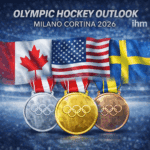
As the tournament opens, the early medal outlook centers around three nations: Canada, the United States, and Sweden. Each enters with a distinct roster profile, tactical identity, and path to the podium.


Group Outlook

Group A - Canada

Canada enters Group A with its traditional strengths intact: elite forward depth, championship-tested leadership, and an ability to control games through puck possession and transition speed. Their challenge will not be talent, but margin management in short-form competition.

Group B - Sweden

Sweden remains one of the most structurally reliable teams in international hockey. Defensive layers, five-man connectivity, and disciplined neutral-zone play make them exceptionally difficult to break down over sixty minutes.

Group C - United States

The United States brings arguably its most complete Olympic roster in decades. High-tempo transition play, mobile defensemen, and multiple scoring lines give this group matchup flexibility against any opponent in the field.


Medal Outlook

  • Gold Medal: United States
  • Silver Medal: Sweden
  • Bronze Medal: Canada

Coach Mark Lehtonen Verdict

From a coaching perspective, this Olympic tournament is not about reputation, but adaptability. Canada remains the deepest roster on paper, but short tournaments punish predictability. Their success will depend on how quickly they adjust to elimination pressure.

The United States, however, enters with the most adaptable profile. Their ability to attack through pace, activate the blue line, and maintain defensive recovery speed gives them answers in multiple game states. This is the most structurally balanced U.S. Olympic team in modern history.

Sweden’s medal projection is rooted in execution. They may not overwhelm opponents with raw offense, but their consistency in defensive zone exits, layered coverage, and situational discipline makes them exceptionally dangerous in knockout games.

Canada’s placement on the podium remains highly likely, but the margin between gold and bronze is thinner than at any previous Olympic cycle. Goaltending performance and special teams efficiency will ultimately define their ceiling.

Overall, Milano Cortina 2026 sets up as one of the most open Olympic hockey tournaments on record. The United States holds the highest tactical ceiling, Sweden offers the safest structural floor, and Canada remains the ultimate test of championship execution under pressure.


Q&A: Milano Cortina 2026 Olympic Hockey

Q: Why is the tournament considered wide open?
A: All teams advance to elimination rounds, reducing the margin for error and amplifying game-to-game variance.

Q: What gives the United States an edge?
A: Depth across all four lines, mobile defensemen, and transition speed.

Q: Can Sweden realistically win gold?
A: Yes. Their structure and discipline translate extremely well in short tournaments.

Q: Is Canada still a favorite?
A: Canada remains a top contender, but execution will matter more than pedigree.

Q: What will decide medal outcomes?
A: Goaltending consistency, special teams efficiency, and situational discipline.