Tag: Olympics 2026

Slovakia Shocks Finland 4-1 | First Major Upset of Milano Cortina 2026 | IHM News

Slovakia Shocks Finland 4-1 | First Major Upset of Milano Cortina 2026 | IHM News

Slovakia Shocks Finland 4-1 in Olympic Opener | First Major Upset of Milano Cortina 2026

Date: 11 February 2026

By IceHockeyMan Newsroom | Updated: 11 February 2026


Olympic hockey returns – and delivers instant drama

The first men’s hockey game of the Milano Cortina 2026 Olympic tournament delivered exactly what international best-on-best competition promises: volatility, emotion, and immediate pressure.

Slovakia defeated Finland 4-1 in the opening Group B matchup, stunning one of the tournament’s projected medal contenders and rewriting expectations before the bracket has even begun to form.

This was not just a win. It was a message.


Slafkovsky announces himself again

Juraj Slafkovsky, who scored twice in his Olympic debut four years ago, once again opened the scoring – this time in a completely different emotional context.

Early in the first period, he drove through Finland’s defensive structure and slipped the puck past Juuse Saros to give Slovakia a 1-0 lead. That early strike shifted psychological momentum immediately.

Later, with Slovakia already ahead, Slafkovsky wired a power-play shot past Saros and celebrated with visible release – a moment that symbolized the underdog’s belief taking over the arena.

Dalibor Dvorsky added the go-ahead goal in the third period, and Adam Ruzicka sealed the result into an empty net.


The goaltending difference

Statistically, Finland controlled the game.

  • Shots on goal: Finland 40 - Slovakia 25
  • Save percentage: Hlavaj 97.5% - Saros 87.5%
  • First-period shots: Finland 18 - Slovakia 5

But hockey is not decided by shot totals – it is decided by quality and composure.

Samuel Hlavaj stopped 39 of 40 shots and was the foundation of Slovakia’s structure. Rebound control, crease tracking, and composure under layered offensive pressure defined his performance.

Finland generated volume. Slovakia generated precision.


Why this result matters

Finland entered the tournament with one of the most NHL-heavy rosters in the field. Slovakia dressed only seven NHL players.

On paper, the gap was significant.

On Olympic ice, it disappeared.

Finland now faces Sweden next, and pressure shifts instantly inside Group B. Olympic tournaments do not allow slow starts. One early loss changes tactical planning for the entire preliminary phase.


Sweden survives early scare

In the same session, Sweden avoided its own potential shock, defeating host Italy 5-2 after a tense opening phase.

Italy briefly led and matched Sweden’s pace before depth and shot volume (60-22) eventually overwhelmed resistance. William Nylander’s late second-period goal restored control, and Sweden closed the game efficiently.

The Olympic theme of the day was clear: no game comes easy.


Coach Mark Lehtonen Verdict

I will be honest. This one is unpleasant for me.

I am Finnish.

And I expected more structure and emotional control from Finland in this opener.

Finland dominated shot count but failed to dominate high-danger areas. Too many perimeter attempts. Not enough interior traffic. Slovakia collapsed into a tight defensive box and protected the slot with discipline.

Olympic tournaments punish inefficiency. When you shoot 40 times and score once, the problem is not luck – it is shot quality and execution timing.

Slovakia played with urgency. Finland played with expectation.

That difference decides short tournaments.

This is the first real shock of Milano Cortina 2026. And it will change the psychological map of Group B immediately.


Q&A: Slovakia vs Finland - Olympic Opener

Was this the first major upset of the tournament?
Yes. Based on roster depth and pre-tournament projections, Slovakia’s 4-1 win qualifies as the first significant surprise.

What was the key statistical difference?
Goaltending efficiency. Hlavaj’s 97.5% save rate versus Saros’ 87.5% created the decisive gap.

Did Finland control possession?
Yes. Finland outshot Slovakia 40-25 and led faceoff percentage, but lacked conversion in high-danger zones.

Why is this result important for Group B?
It places immediate pressure on Finland before facing Sweden and shifts momentum toward Slovakia in the qualification race.

What does this tell us about Olympic tournaments?
Short formats reward discipline, goaltending peaks, and emotional sharpness. Depth alone does not guarantee control.
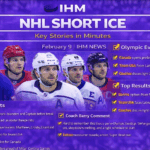


IHM NHL SHORT ICE - Top NHL Stories | February 9, 2026

IHM NHL SHORT ICE - Top NHL Stories | February 9, 2026

🏒 NHL SHORT ICE - All Key Stories in Minutes

February 9, 2026 | IHM News

Short hockey news for busy professionals who want Olympic and NHL updates fast, with clean context and zero noise.

🔥 Top Results and Momentum

Capitals get key returns before the break
Washington welcomes back Pierre-Luc Dubois and Logan Thompson, adding immediate stability down the middle and in net. This kind of timing matters because teams reset identity right before an international pause.

Devils add Bjugstad right before the roster freeze
New Jersey makes a last-moment depth move by acquiring Nick Bjugstad. The message is simple: strengthen matchup minutes, faceoff utility, and late-game defensive reliability.

📰 Olympic Pulse

Jarvis replaces Point for Team Canada
Canada adjusts quickly, inserting Seth Jarvis for the injured Brayden Point. Jarvis brings pace and detail, and his game scales well into short, high-pressure tournaments.

Team USA leadership: Matthews named captain
Auston Matthews takes the captain role, setting a clear hierarchy for a team built around elite finishing and high-end puck touches.

Landeskog cleared and named Sweden captain
Gabriel Landeskog’s availability is a major boost. Beyond scoring, his value is forecheck tone, net-front presence, and calming playoff-level leadership.

Crosby captains Canada again
Sidney Crosby leads Canada as captain, with a leadership group built to control tempo and protect structure when games tighten.

Granlund named Finland captain
Mikael Granlund’s selection signals trust in two-way intelligence and composure. Finland often wins by structure and patience more than raw star power.

Jack Hughes trending ready for Team USA
Jack Hughes returns to practice and is expected to be available, a crucial development for U.S. transition speed and controlled entries.

Switzerland confidence rising
Switzerland enters with belief after recent international momentum, and their medal pathway is tied to defensive layers, goaltending, and special teams detail.

🏒 Around the League

Olympic focus changes the NHL rhythm
As teams enter the break, the pattern becomes clear: protect health, manage workloads, and keep systems simple. The clubs that return sharp usually keep their structure intact rather than chasing style.

Seattle cross-sport moment hits the timeline
The Kraken amplify a city-wide sports surge with a Super Bowl shoutout, a small but real indicator of how franchises build community presence beyond the rink.


❓ IHM Q&A - NHL Short News (9 February 2026)

Why do returns like Dubois and Thompson matter right before the break?
Because the final game before an international pause often sets the emotional baseline. Getting key players back stabilizes roles and reduces lineup chaos heading into the restart.

What does Bjugstad add to New Jersey in real hockey terms?
Matchup minutes. He can take hard draws, defend leads, and give coaches flexibility when they need a safer line against top opposition.

Is Jarvis a like-for-like replacement for Point?
Not identical, but functionally strong. Jarvis brings speed, pressure, and finishing, and his game translates well to short tournament windows.

Why is captain selection important in international tournaments?
Because leadership affects bench calm, line communication, and emotional control. In single-game swings, composure is a weapon.

What is the biggest Olympic storyline theme right now?
Availability. Health decisions, late replacements, and readiness levels are shaping projections more than hype or reputation.

What should fans watch in the first Olympic games?
Special teams and transition pace. The teams that control entries and deny clean looks usually dictate tournament momentum early.


NHL Stars Set for Olympic Return as Milan Ice Issues Resolved | IHM News

NHL Stars Set for Olympic Return as Milan Ice Issues Resolved | IHM News

NHL Stars Head for Olympic Gold as Milan Ice Issues Are Finally Resolved

February 1, 2026
By IceHockeyMan Newsroom

With just weeks remaining before the opening faceoff of the 2026 Winter Olympics in Milan-Cortina, the final obstacle standing between the world’s best hockey players and Olympic ice has been removed. After months of scrutiny and concern surrounding rink construction, ice quality, and playing dimensions, organizers have confirmed that the competition surface is now fully approved.

This clears the way for National Hockey League stars to return to Olympic competition for the first time since 2014. Following extensive coordination between the NHL, NHL Players Association, and Olympic organizers, a mid-season league shutdown was formally approved, allowing elite players to represent their countries on hockey’s biggest international stage.

The Santagiulia Arena in Milan was the focal point of most concerns, particularly due to ongoing construction and questions about rink dimensions. While the playing surface is slightly shorter than standard NHL rinks, officials confirmed that it matches the dimensions used during the Beijing 2022 Olympics and has already been tested in high-level international competition. Any potential impact on game flow was deemed minimal.

During a January test event, a minor imperfection in the ice surface briefly surfaced, but it was quickly addressed and classified as part of the normal ice-testing process. After further inspections and refinements, ice specialists signed off on the surface, expressing full confidence in its readiness for Olympic play.

With logistical and technical hurdles now behind them, attention shifts back to the sport itself. The 2026 tournament is expected to feature the strongest Olympic hockey field in over a decade, combining NHL superstars, elite European talent, and national pride in a compact, high-stakes format.


Coach Mark Comment

From a hockey perspective, the rink discussion is far less dramatic than many believe. Players adjust faster than fans expect. What matters most is ice consistency, not a few feet of length. If the ice holds temperature, remains hard, and allows predictable puck behavior, elite players will thrive.

What excites me most is tactical diversity. Olympic hockey forces NHL stars out of their comfort zones. Shorter tournaments punish mistakes, goaltending becomes decisive, and coaches lean heavily on matchup management. This environment exposes real hockey intelligence, not just star power.

For younger players, this tournament will accelerate maturity. For veterans, it may be the final chapter of their international careers. Expect disciplined systems, reduced risk, and a premium on transition efficiency. This will not look like an NHL All-Star event. It will look like playoff hockey with national flags.


Q&A: NHL Players at the 2026 Winter Olympics

Will NHL players officially participate in the 2026 Olympics?

Yes. The NHL and NHL Players Association have approved player participation following confirmation that rink and ice conditions meet international standards.

Why were there concerns about the Milan ice rink?

Concerns focused on construction timelines, ice quality consistency, and rink size. These were resolved through testing events and final inspections in January.

Is the Olympic rink smaller than NHL rinks?

Slightly, but it matches the dimensions used in the 2022 Beijing Olympics and several recent international tournaments, limiting any tactical disruption.

Will rink size affect scoring or game style?

Minimal impact is expected. Teams will emphasize structure, quick transitions, and disciplined zone coverage rather than open-ice offense.

Why is this Olympic tournament so significant?

It marks the return of NHL players to Olympic hockey after a 12-year absence, creating the strongest international field since 2014.


Olympic Ice Hockey 2026 Explained - Format, Teams, Favorites | IHM News

Olympic Ice Hockey 2026 Explained - Format, Teams, Favorites | IHM News

Everything You Need to Know About Olympic Ice Hockey at Milano-Cortina 2026

By: IHM News
Date: January 2026

For the first time in more than a decade, Olympic ice hockey returns to its purest form. At the 2026 Winter Games in Milan-Cortina, the world will finally see true best-on-best competition again, with NHL players back on the men’s side for the first time since 2014.

The tournament is more than just a sporting event. It is a collision of generations, systems and philosophies, where national identity meets professional excellence under the most intense pressure hockey can offer.


When Do the Tournaments Begin?

Olympic hockey will unfold over 18 intense days. The women’s tournament opens first, beginning on February 5 with round-robin play running through February 10.

The men’s competition starts on February 11 and continues with group-stage games until February 18. From there, knockout rounds take over, leading to medal games that will define careers and legacies.

  • Women’s medal games: February 19 (bronze and gold)
  • Men’s medal games: February 21 (bronze), February 22 (gold)

Which Countries Are Competing?

Men’s Tournament

Twelve nations will compete in the men’s tournament. Finland enters as the defending Olympic champion after its historic gold medal in 2022.

Men’s Groups:

  • Group A: Canada, Switzerland, Czechia, France
  • Group B: Finland, Sweden, Slovakia, Italy
  • Group C: United States, Germany, Latvia, Denmark

Canada remains the most decorated nation in Olympic men’s hockey history, but the competitive balance in 2026 may be the deepest it has ever been.

Women’s Tournament

Ten nations will participate in the women’s competition, which has been dominated historically by Canada and the United States.

  • Group A: Canada, United States, Finland, Czechia, Switzerland
  • Group B: Japan, Sweden, Germany, Italy, France

While North America remains the benchmark, Europe continues to close the gap, particularly Finland and Czechia.


Why NHL Participation Changes Everything

The return of NHL players is the single most important storyline of the 2026 Olympics. After absences in 2018 and 2022 due to financial disputes and COVID concerns, the NHL and NHLPA are fully aligned on participation.

This restores the Olympic tournament’s identity as hockey’s highest international test, rather than a developmental or hybrid competition. The success of the 4 Nations Face-Off showed how much fans and players crave genuine best-on-best hockey.


How the Tournament Format Works

Men’s Format

Each team plays three group-stage games. After that, all twelve teams are re-ranked using:

  • Group position
  • Total points
  • Goal differential
  • Goals scored
  • IIHF ranking

Teams ranked 1-4 advance directly to the quarterfinals. Teams ranked 5-12 enter a qualification round.

Women’s Format

All teams play round-robin games within their group. Every Group A team and the top three Group B teams advance to the quarterfinals.


Key Rule Differences from the NHL

  • No fighting under IIHF rules
  • Shorter intermissions (15 minutes)
  • Different overtime formats depending on round
  • Points-based system in group play
  • Larger rosters: 25 players, 20 dressed per game

These rules reward discipline, structure and conditioning more than raw aggression.


The Arena Question: Milano Santagiulia

One of the biggest uncertainties remains the Milano Santagiulia Ice Hockey Arena. Construction delays raised concerns late in 2025, but organizers and the IOC have assured completion before the opening faceoff.

The rink dimensions will be slightly shorter and wider than NHL standards, which could subtly impact spacing, transition speed and defensive reads.


Top Women’s Players to Know

Canada will once again be led by Marie-Philip Poulin, widely regarded as the greatest women’s hockey player of all time. Alongside her are stars like Natalie Spooner, Sarah Nurse and Renata Fast.

The United States counters with Hilary Knight, Alex Carpenter, Kendall Coyne Schofield and Aerin Frankel.

Outside North America, Finland and Czechia bring technically refined, tactically disciplined teams capable of upsetting the established powers.


Medal Favorites and Dark Horses

On the men’s side, Canada and the United States remain the favorites, but Finland, Sweden and Czechia are legitimate threats. Switzerland continues to quietly build one of the most cohesive international programs in the world.

In women’s hockey, Canada and the U.S. still set the standard, but Finland and Czechia are closer than ever to breaking the duopoly.


Why Russia Is Not Participating

Russia and Belarus remain banned from team sports at the 2026 Olympics due to ongoing IOC sanctions related to the war in Ukraine. Individual athletes may compete under neutral status, but no national teams will appear in hockey.


Coach Mark’s Analysis

The Olympics are not about talent alone. They are about adaptation, chemistry and decision-making speed under pressure. Short tournaments punish undisciplined teams and reward those who can simplify their game when fatigue sets in.

Teams that rely too heavily on star power without structural balance often struggle. International success comes from layered defense, controlled breakouts and emotional regulation.

In Milan, the teams that win will not necessarily be the fastest or most skilled, but the ones that think the game one step ahead. Olympic hockey is chess played at full speed.


Q&A

Why are the Olympics different from the NHL playoffs?
Because chemistry must be built instantly, and mistakes carry far greater weight.

Why is Belarus banned from Olympic hockey if it is not directly fighting in Ukraine? Belarus is banned from Olympic team sports not because it is actively fighting on the front lines, but because of its direct political and logistical alignment with Russia during the invasion of Ukraine.

From the IOC and IIHF perspective, Belarus is considered a co-aggressor state for several key reasons:

  • Military cooperation: Belarus allowed Russian troops to use its territory, airspace, and infrastructure during the initial stages of the invasion in 2022.
  • Strategic support: Missile launches, troop movements, and logistics were conducted from Belarusian territory, which the IOC views as active facilitation rather than neutrality.
  • Political alignment: The Belarusian government has publicly supported Russia’s actions and voted in line with Russia on international resolutions related to the war.
  • Consistency of sanctions: The IOC applied the same framework to Belarus as to Russia to avoid selective enforcement and loopholes in international sport governance.

It is important to note that this ban applies only to national teams and symbols. In individual sports, some Belarusian athletes may still compete as Neutral Athletes, without flag, anthem, or national identification, provided they meet strict neutrality criteria.

From a sporting standpoint, the decision is not about individual players’ guilt or innocence, but about the use of international sport as a neutral platform during an active geopolitical conflict. Until the IOC changes its stance or the broader political situation shifts, Belarus will remain excluded from Olympic hockey tournaments alongside Russia.

Isn’t sport supposed to be outside of politics? In principle, yes – international sport has long promoted the idea of neutrality, unity and competition beyond political borders. However, in practice, sport and politics have never been fully separate, especially at the Olympic level.

The Olympic Games are organized by the IOC, which is not only a sports body but also an international institution that operates within global political, legal and diplomatic frameworks. Decisions about participation are therefore influenced not just by athletic criteria, but by international law, security concerns and geopolitical consensus.

Historically, politics has intersected with the Olympics many times:

  • boycotts during the Cold War,
  • sanctions tied to apartheid-era South Africa,
  • bans related to state-sponsored doping,
  • restrictions during armed conflicts.

What the IOC tries to maintain is not “sport without politics” – which is unrealistic – but sport without political expression on the ice. That is why bans typically target national teams, flags and anthems, rather than individual athletes whenever possible.

In the current context, the IOC’s position is that allowing full national representation from countries involved in active geopolitical conflicts would turn the Games into a political stage rather than a sporting one. Whether one agrees with that philosophy or not, the intent is to protect the competition itself from becoming a platform for political messaging.

In short:
Sport aims to stay neutral, but the Olympic Games exist in the real world. When global conflicts reach a certain threshold, complete separation becomes impossible, and governing bodies are forced to choose the option they believe preserves competitive integrity – even if that choice is controversial.

Which teams benefit most from IIHF rules?
Teams with disciplined defensive systems and strong goaltending.

Is star power enough to win gold?
No. Olympic success depends on structure, not highlight plays.

What is the biggest X-factor in Milan?
How quickly teams adapt to rink size, officiating standards and compressed schedules.


Milan 2026 in Trouble? Why the NHL Could Still Pull Its Players | IHM News

Milan 2026 in Trouble? Why the NHL Could Still Pull Its Players | IHM News

Milan 2026 in Trouble? Why the NHL Could Still Pull Its Players

December 2025 | IHM News

Sochi 2014. The last time Olympic hockey truly delivered what it is supposed to be: best on best. Since then, twelve years have passed. A full generation has changed, and the sport itself has become faster, heavier, and more expensive at the top end.

Connor McDavid went from a promising junior to a living NHL legend without playing a single second on the Olympic stage. Auston Matthews rewrote goal-scoring standards but never wore a USA jersey at the main tournament of the four-year cycle. Twelve years of waiting. Twelve years of promises. And now, with less than two months to go, clouds are gathering again over Milan 2026.

Groups, format, and the risk of an early exit

The tournament format and group stage already raise questions. One scenario being discussed is that a group featuring Sweden could theoretically push Canada into an extra qualification game, where a single random bounce against a team like Latvia could end a favorite’s run.

But the bigger intrigue is deeper. For the first time in a long time, Team USA does not look like a dark horse. They look like a potential favorite. Their overall roster depth, especially on defense, is arguably stronger than Canada’s right now. And it is not crazy to think the USA could win Olympic gold for the first time since 1980.

Why the NHL revealed early “first six” lists

In the summer of 2025, top national teams began naming their initial “first six” players for the Olympics. This is not a cosmetic announcement. It is a foundation. Coaches like Mike Sullivan for the USA and Jon Cooper for Canada gain the ability to build structure around specific core players early.

But there is a downside. Visibility. Throughout December 2025, one question keeps returning: what if Sidney Crosby gets hurt? At 38, Crosby is still elite. His presence is not only leadership. It is still goals and results.

Canada leaned into proven experience. The USA leaned into young predators. It is also telling that the Americans left the goaltender slot open in their early core, keeping flexibility because they have an abundance of top-end talent in net. Canada’s situation is the opposite.

The Olympic pause: who benefits and what it costs

The NHL will officially stop the regular season for 17 days. For commissioner Gary Bettman, that is painful business: 17 days without games impacts revenue tied to broadcasts and advertising.

The positives are clear. Roughly 80% of the league will not go to Milan and will get a mini break. Veterans can reset and load up for a playoff push. The Olympics also create a spike in attention: people who do not watch a regular Toronto versus Edmonton night will pay to see McDavid battle Matthews on the biggest stage.

The negatives are serious. Injury risk. Jet lag. Players return from Italy on February 23, and some will be back in NHL buildings two days later. Historically, teams that sent large Olympic contingents in 2006 and 2014 saw a measurable dip right after the Games, losing roughly 15% more points on average in the first month back.

The December 2025 controversy: ice safety becomes the main issue

In early December 2025, NHL deputy commissioner Bill Daly delivered a hard message: the league will not send players if the ice is not safe.

The focus is the Santa Giulia arena project in Milan. Reports suggest the concrete base was poured to dimensions that are shorter than standard NHL ice. The difference is close to one meter. On paper, that sounds minor. On ice, it can become a risk multiplier.

NHL players train for years with rink geometry in their bodies. On a shorter surface, puck rebound angles change, space disappears faster, and contact density rises. Some estimates suggest the frequency of heavy collisions could increase by 12 to 15 percent. That turns Olympic hockey into a survival derby instead of a technical showcase.

For McDavid, the quote is simple: ice size does not matter to him. For Bettman, it is a business exposure. December has felt like a quiet war. The NHL is pushing for board modifications and special shock-absorbing systems. Italy’s organizers point to budget reality: costs have reportedly already blown out by billions of euros. If no compromise is found by the New Year, the trip to Milan could be at real risk.

Who to watch in February

McDavid and Nathan MacKinnon. Their first Olympics. Their career peak. They need gold to stand in the same legacy line as Crosby.

Team USA look like the most balanced roster at the tournament, with no obvious holes in attack, defense, or goaltending depth.

Canada may leave young stars out. Connor Bedard and Macklin Celebrini could miss the final roster despite elite upside, depending on health and selection philosophy. Germany, meanwhile, is no longer a one-star story. They can turn a single game into a real problem for any favorite.

🧠 Coach Mark Comment

Milan 2026 is a pressure point between hockey and business. The format, the ice, and the season pause create real risk. If safety guarantees are not solved quickly, the NHL will not compromise. In the league’s logic, a player is an asset first, and a symbol second.

❓ Q&A

Can the NHL realistically skip the Olympics?
Yes, if arena and ice safety issues are not resolved by the internal deadline.

Why did ice dimensions become the critical factor?
Because geometry affects rebound angles, decision time, collision density, and therefore injury probability.

Who looks like the main favorite right now?
At the moment, Team USA, due to roster balance and depth across positions.