Category: Hockey Blog

Hockey blog by our coach Mark Lehtonen, talks about world hockey news, website updates, strategy and else

Do Hockey Skates Affect Skating Speed? | IHM

IHM Knowledge Center

Do Hockey Skates Affect Skating Speed?

Do hockey skates directly affect skating speed, or is speed determined almost entirely by a player’s skating technique and physical ability?

Editor: Coach Mark • Updated: July 14, 2026

Short Answer

Yes. Hockey skates influence skating speed by affecting power transfer, stability, blade efficiency, and overall responsiveness. However, skating technique remains the single biggest factor in how fast a player can skate.

The right skates enhance good technique-they do not replace it.

Full Explanation

Every skating stride transfers force from the player’s legs through the skate and into the ice.

If the skate fits properly and efficiently transfers energy, more of that force becomes forward motion. Poorly fitted or worn skates waste energy through unnecessary foot movement and reduced stability.

The skate acts as a performance multiplier rather than the source of skating speed.

How Skates Influence Speed

Proper hockey skates improve:

  • Power transfer
  • Acceleration
  • Edge control
  • Balance
  • Stride efficiency
  • Energy conservation

Each improvement contributes to faster, more efficient skating.

Factors That Matter Most

Skating speed is influenced by:

  • Proper skate fit
  • Boot stiffness
  • Blade sharpening
  • Steel quality
  • Skating technique
  • Lower-body strength

These elements work together rather than independently.

Can Expensive Skates Make You Faster?

Premium skates may improve efficiency because they are lighter, stiffer, and more responsive.

However, players with weak skating mechanics usually gain much more by improving technique than by upgrading equipment.

NHL vs Recreational Players

Elite NHL players notice very small differences in skate performance because they already skate with highly refined technique.

Recreational players usually experience greater improvements from better fitting skates, proper sharpening, and skating instruction.

Why Skate Speed Is Often Misunderstood

Many players believe faster skates exist.

In reality, hockey skates do not create speed-they help players use their own skating ability more efficiently.

The athlete remains the engine.

Edge Case: New Skates Feel Slower

Players sometimes feel slower immediately after changing skates because:

  • The boots are stiffer
  • The blade profile has changed
  • The sharpening is different
  • The skates require breaking in
  • The player is adapting to new equipment

Performance usually improves once the adjustment period ends.

IHM Signal System: How to Evaluate Skate Speed

When evaluating skating speed, focus on these signals:

  • Fit signal: Is energy transferred efficiently?
  • Support signal: Does the skate remain stable?
  • Edge signal: Are powerful pushes maintained?
  • Technique signal: Is stride mechanics efficient?
  • Acceleration signal: Does the skate respond immediately?

Trigger-level rule:

If skating speed does not improve after upgrading equipment, technique-not the skates-is usually the limiting factor.

IHM Insight: Speed Comes From the Player

Elite skates maximise efficiency, but they cannot replace strong skating fundamentals.

The fastest players combine excellent technique with properly fitted equipment that transfers every stride into maximum forward momentum.

Great skates amplify skill-they do not create it.

Mini Q&A

Do hockey skates affect skating speed?
Yes, by improving efficiency and power transfer.

Can expensive skates make me faster?
Only if your skating technique allows you to benefit from their performance features.

What affects skating speed the most?
Technique, strength, and proper skate fit.

Can worn skates slow me down?
Yes. Reduced support and responsiveness can decrease efficiency.

What matters most?
Strong skating mechanics combined with properly fitted equipment.

Why This Concept Exists

Many players overestimate the impact of expensive equipment on skating speed.

Understanding how hockey skates influence performance helps players prioritise proper fit, skill development, and efficient equipment choices rather than relying on marketing claims.

Key Takeaways

  • Skates improve efficiency, not talent.
  • Technique remains the biggest speed factor.
  • Proper fit improves acceleration.
  • Boot stiffness supports power transfer.
  • Sharpening influences performance.
  • Elite players notice small equipment differences.
  • The player-not the skate-creates speed.

Can Hockey Skate Steel Runners Be Replaced? | IHM

IHM Knowledge Center

Can Hockey Skate Steel Runners Be Replaced?

Can hockey skate steel runners be replaced, and when does replacing the steel improve skating performance instead of buying completely new skates?

Editor: Coach Mark • Updated: July 14, 2026

Short Answer

Yes. Most modern hockey skates allow steel runners to be replaced without replacing the entire skate. New runners restore blade height, improve edge retention, and maintain skating performance after the original steel becomes worn.

Replacing steel is often far more economical than replacing the entire skate.

Full Explanation

The steel runner is the part of the skate that contacts the ice.

Every sharpening gradually removes a small amount of steel, reducing blade height over time. Eventually, the runner becomes too worn to provide optimal edge control and stability.

At that point, replacing the steel restores the skate’s performance while allowing the boot to remain in use.

Signs the Steel Should Be Replaced

Common indicators include:

  • Very low blade height
  • Frequent sharpening no longer restores performance
  • Damaged or chipped steel
  • Bent runners
  • Excessive corrosion
  • Difficulty maintaining sharp edges

These signs suggest the steel has reached the end of its useful life.

Benefits of New Steel

Replacing runners can improve:

  • Edge retention
  • Acceleration
  • Turning ability
  • Stopping power
  • Skating consistency
  • Overall confidence

Fresh steel often makes older skates feel noticeably more responsive.

Can Any Runner Be Used?

No.

Replacement steel must be compatible with the skate’s holder system.

Many manufacturers use proprietary holder designs, so players should always verify compatibility before purchasing replacement runners.

NHL vs Recreational Players

Professional players frequently replace steel runners to maintain maximum performance throughout the season.

Recreational players usually replace runners only after years of sharpening or significant blade damage.

Why Steel Replacement Is Often Misunderstood

Many players believe worn steel means the entire skate must be replaced.

In reality, if the boot still provides excellent support, replacing only the runners may restore most of the skate’s original performance.

Edge Case: New Steel Doesn’t Improve Performance

Replacing runners may not solve skating problems if:

  • The boot has lost structural support
  • The skate no longer fits properly
  • The sharpening is incorrect
  • The holder is damaged
  • The skating technique is limiting performance

The complete skate system should always be evaluated.

IHM Signal System: How to Evaluate Skate Steel

When evaluating steel runners, focus on these signals:

  • Height signal: Is sufficient blade height remaining?
  • Edge signal: Does the steel hold an edge well?
  • Damage signal: Are chips or bends present?
  • Compatibility signal: Does the replacement match the holder?
  • Performance signal: Does the skate still respond consistently?

Trigger-level rule:

If sharpening no longer restores skating performance and blade height has become significantly reduced, replacing the steel runners is often the most effective solution.

IHM Insight: The Boot and the Steel Age Differently

A hockey skate consists of multiple components that wear at different rates.

Many players can extend the life of high-quality boots simply by replacing worn steel, maintaining excellent skating performance without purchasing an entirely new pair of skates.

Mini Q&A

Can hockey skate steel be replaced?
Yes. Most modern hockey skates use replaceable steel runners.

When should steel be replaced?
When blade height becomes too low, edges wear quickly, or the steel becomes damaged.

Does new steel improve skating?
Yes. Fresh runners often restore edge control and responsiveness.

Do I need new skates if my steel is worn?
Not necessarily. If the boot remains in good condition, replacing the runners is often enough.

Can every runner fit every skate?
No. Replacement steel must match the holder system.

Why This Concept Exists

Many players replace perfectly good skates simply because the steel has worn out.

Understanding how replaceable runners work helps players maintain their equipment more effectively, reduce long-term costs, and preserve consistent skating performance throughout many seasons.

Key Takeaways

  • Most modern skate steel is replaceable.
  • Blade height decreases with sharpening.
  • New runners restore skating performance.
  • Boot condition should be evaluated separately.
  • Compatibility with the holder is essential.
  • Replacing steel is often cost-effective.
  • Proper maintenance extends skate lifespan.

How Long Do Hockey Skates Usually Last? | IHM

IHM Knowledge Center

How Long Do Hockey Skates Usually Last?

How long do hockey skates usually last, and what factors determine whether a pair of skates should be replaced after a few seasons or continue performing for many years?

Editor: Coach Mark • Updated: July 14, 2026

Short Answer

Most hockey skates last anywhere from several years to well over a decade, depending on playing frequency, skating intensity, construction quality, and maintenance.

Skates should be replaced when they no longer provide the support, fit, or performance required for safe and efficient skating.

Full Explanation

There is no universal lifespan for hockey skates.

Some recreational players use the same pair comfortably for many years, while elite players may replace their skates every season or even multiple times during a season.

The amount of stress placed on the boot largely determines how quickly it wears out.

Factors That Affect Skate Lifespan

The biggest factors include:

  • Playing frequency
  • Skill level
  • Boot construction
  • Quality of materials
  • Maintenance habits
  • Drying after use
  • Storage conditions

Well-maintained skates generally last significantly longer.

Signs Your Skates Are Wearing Out

Common warning signs include:

  • Reduced ankle support
  • Heel movement
  • Softened boot structure
  • Cracked eyelets
  • Damaged holders
  • Worn steel runners
  • Persistent discomfort

Performance usually declines gradually rather than suddenly.

Can Maintenance Extend Lifespan?

Yes.

Players should:

  • Dry skates after every session
  • Use skate guards only off the ice
  • Replace worn steel when necessary
  • Check rivets regularly
  • Avoid storing wet equipment in closed bags

Proper care significantly slows wear.

NHL vs Recreational Players

Professional players replace equipment much sooner because even small reductions in responsiveness affect performance.

Recreational players often continue using quality skates successfully for many years when properly maintained.

Why Skate Lifespan Is Often Misunderstood

Many players assume skates should be replaced after a fixed number of years.

In reality, the condition of the boot matters far more than its age.

Two identical skates can have completely different lifespans depending on how frequently they are used.

Edge Case: Old Skates Still Perform Well

Older skates may remain excellent if:

  • The boot retains its stiffness
  • The fit remains secure
  • The steel has been replaced when needed
  • The holders remain undamaged
  • The skates have been properly maintained

Age alone does not determine performance.

IHM Signal System: How to Evaluate Skate Lifespan

When evaluating older skates, focus on these signals:

  • Support signal: Does the boot remain stiff?
  • Heel signal: Is heel lock still secure?
  • Comfort signal: Has the fit changed?
  • Steel signal: Are the runners still serviceable?
  • Performance signal: Does skating remain responsive?

Trigger-level rule:

Replace hockey skates based on their condition and performance-not simply because they have reached a certain age.

IHM Insight: Maintenance Often Matters More Than Age

Quality hockey skates are designed to last.

Players who care for their equipment properly often enjoy many seasons of excellent performance, while poorly maintained skates may deteriorate much sooner regardless of price.

Consistent maintenance is one of the smartest investments any player can make.

Mini Q&A

How long do hockey skates usually last?
Anywhere from several years to well over a decade, depending on use and maintenance.

When should skates be replaced?
When support, comfort, or skating performance noticeably decline.

Can maintenance extend skate life?
Yes. Proper drying and regular inspection significantly increase longevity.

Do professionals replace skates more often?
Yes. Elite players demand maximum performance throughout every season.

What matters most?
Boot condition, support, fit, and overall performance.

Why This Concept Exists

Many players are unsure whether their hockey skates are still performing as intended.

Understanding what determines skate lifespan helps players make informed equipment decisions, avoid unnecessary replacements, and maintain consistent skating performance for as long as possible.

Key Takeaways

  • Skate lifespan depends on usage.
  • Boot condition matters more than age.
  • Maintenance significantly extends longevity.
  • Replace steel before replacing good boots.
  • Support gradually decreases over time.
  • Professionals replace skates much sooner.
  • Performance-not years-should determine replacement.

Should Beginners Use Stiff or Soft Hockey Skates? | IHM

IHM Knowledge Center

Should Beginners Use Stiff or Soft Hockey Skates?

Should beginner hockey players choose stiff or soft skates, and how does boot stiffness influence comfort, support, and long-term skating development?

Editor: Coach Mark • Updated: July 14, 2026

Short Answer

Most beginners benefit from moderately supportive hockey skates rather than the stiffest models available. The ideal skate should provide enough support to develop proper skating mechanics while remaining comfortable and forgiving.

Choosing a skate that matches the player’s strength and experience is more important than selecting the stiffest boot.

Full Explanation

Skate stiffness affects how efficiently energy transfers from the player’s legs into the ice.

Very stiff boots provide excellent responsiveness for experienced skaters but may feel uncomfortable or restrictive for beginners who are still learning proper skating mechanics.

A balanced level of support usually allows new players to develop skills more naturally.

Benefits of Moderate Stiffness

A moderately supportive skate offers:

  • Good ankle support
  • Greater comfort
  • Easier break-in
  • Natural forward flex
  • Improved confidence during learning

This combination makes learning basic skating skills more enjoyable.

When Very Stiff Skates Make Sense

High-stiffness skates are generally better suited for:

  • Elite youth players
  • Junior players
  • Professional players
  • Powerful, technically advanced skaters

These players generate enough force to benefit from maximum boot responsiveness.

Comfort Still Comes First

Regardless of stiffness, every hockey skate should:

  • Fit correctly
  • Provide secure heel lock
  • Support the ankle comfortably
  • Allow natural skating movement
  • Remain comfortable throughout practice

A comfortable skate encourages better technique and more enjoyable learning.

NHL vs Recreational Players

NHL players typically use very stiff skates because their skating mechanics and physical strength maximise the benefits of highly responsive boots.

Most recreational beginners gain more from comfort and proper fit than from elite-level stiffness.

Why Skate Stiffness Is Often Misunderstood

Many beginners assume professional-level skates will automatically improve their skating.

In reality, overly stiff boots can make learning more difficult if the player lacks the strength or experience to control them effectively.

Edge Case: A Beginner Prefers Stiff Skates

Some beginners may feel comfortable in stiffer skates if:

  • They have exceptional lower-body strength
  • They have experience in other skating sports
  • The skates fit perfectly
  • They adapt quickly to the equipment
  • The stiffness matches their skating style

Personal preference should always be considered alongside proper fitting.

IHM Signal System: How to Choose Skate Stiffness

When evaluating skate stiffness, focus on these signals:

  • Comfort signal: Can you skate comfortably for an entire session?
  • Support signal: Does the boot stabilise your ankle?
  • Flex signal: Can you bend forward naturally?
  • Confidence signal: Do the skates feel predictable?
  • Development signal: Do they help you improve your skating?

Trigger-level rule:

Choose the stiffest skate only if you can comfortably control it throughout every skating movement.

IHM Insight: The Right Support Accelerates Learning

A beginner’s first skates should build confidence-not fight against natural movement.

The ideal boot provides enough structure to encourage proper skating mechanics while remaining comfortable enough to keep players focused on improving their skills rather than adapting to overly rigid equipment.

Mini Q&A

Should beginners buy the stiffest hockey skates?
No. Moderate support is usually more beneficial for learning.

Are soft skates always better for beginners?
Not necessarily. Beginners still need enough support for proper skating mechanics.

Do professionals use stiffer skates?
Yes. Elite players benefit from maximum responsiveness.

What matters most?
Proper fit, comfort, and support that matches your skating level.

Can the wrong stiffness slow development?
Yes. Boots that are too stiff or too soft may make learning more difficult.

Why This Concept Exists

Choosing the right skate stiffness is one of the first major equipment decisions new hockey players face.

Understanding how stiffness affects comfort, support, and skill development helps beginners select skates that encourage long-term improvement rather than creating unnecessary obstacles during the learning process.

Key Takeaways

  • Beginners usually benefit from moderate stiffness.
  • Fit is more important than stiffness.
  • Comfort supports faster learning.
  • Elite players typically prefer stiffer boots.
  • Proper ankle support remains essential.
  • Overly stiff skates may hinder beginners.
  • The best skate matches both the foot and the player’s ability.

Christmas & New Year Special - Limited Holiday Access to IHM Premium

Christmas & New Year Special – Limited Holiday Access to IHM Premium

🎄 Christmas & New Year Special

Limited Holiday Access to IHM Premium

The end of the year is the moment to pause, reflect – and prepare for what’s next.

At IceHockeyMan, we believe that real progress in hockey analysis comes from consistency, structure, and long-term thinking. That’s why, ahead of the holiday season, we are opening a limited-time Premium entry offer for new members.


🔓 Holiday Premium Access – €19.99

For a short festive window, new members can join IHM Premium at a special holiday price:

€19.99 / month
(regular price €29.99)

📅 Valid from today 16 December until January 1, 2026

This is not a giveaway. This is an early entry opportunity for those who want to start the new year already inside the system.


🧠 What Premium Members Get

  • 100% ice hockey focus – no mixed sports, no distractions
  • Daily professional analysis built around structure, match context, and coaching logic
  • Access to the Coach database with tactical profiles
  • A system used and trusted by members across 19 countries
  • Long-term thinking: not headlines, not hype – real hockey understanding

Many of our members have stayed with us for three seasons or more. That doesn’t happen by accident.


🔒 Price Lock for Early Members

Members who join during this holiday offer keep their €19.99 price as long as their subscription remains active.

This is our way of rewarding early trust – and building long-term partnerships, not short-term clicks.


🎁 Why We’re Doing This

The holiday season is about resetting goals.

If hockey analysis, structure, and learning the game on a deeper level is part of your plan for the new year – this is the right moment to enter.

Once the window closes, Premium returns to its standard pricing.


👉 Join IHM Premium – Holiday Access

€19.99 / month

⏳ Available until January 1, 2026 Join Premium Now

Published by IceHockeyMan Editorial Team


Senators Crush Capitals 7-1 as Washington Implodes in Ovechkin’s 1500th Game

Senators Dominate Capitals 7-1 – Washington Collapses in Ovechkin’s 1500th Game

by IHM Team | IHM News | October 25, 2025

Ottawa Steamrolls Washington on Historic Night

Senators Crush Capitals 7-1 as Washington Implodes in Ovechkin’s 1500th Game

What was supposed to be a night of celebration for Alex Ovechkin’s 1,500th NHL game turned into a nightmare for the Washington Capitals. The Ottawa Senators stormed into Capital One Arena and dismantled the Caps 7-1, exposing every defensive and structural flaw imaginable.

It was the second half of a back-to-back for Washington after their 5-1 win over Columbus – and they looked completely out of gas. From the opening faceoff, the Senators dictated every shift, winning battles, dictating tempo, and controlling the puck with ease.

First Period - Slow Start, Missed Chances

Ottawa opened the scoring just seconds into the game, as Dylan Cozens slipped the puck past Charlie Lindgren on the very first shot. Washington had a power play opportunity midway through the period but failed to register meaningful pressure. Both teams exchanged minor penalties, yet it was clear which side had the energy advantage.

Ottawa outshot Washington 8-3, ending the frame with a 1-0 lead.

Second Period – Total Meltdown

The second period will go down as one of Washington’s worst in recent memory. The Senators exploded for three quick goals – from Shane Pinto, Cozens, and Nick Cousins – while the Capitals failed to register a single shot on goal for over 12 minutes.

Frustration boiled over late in the period when multiple players dropped the gloves behind Lindgren’s net. Both goaltenders – Lindgren and Ullmark – even joined the scuffle, resulting in offsetting penalties. Still, the Senators carried a commanding 4-0 lead and complete control of the game.

Third Period – No Mercy

Any hope of a comeback evaporated early in the third as Drake Batherson scored on the power play to make it 5-0. Trevor van Riemsdyk scored Washington’s lone goal of the night, preventing a shutout, but Ottawa quickly responded with two more – from Thomas Chabot and Batherson again – sealing an emphatic 7-1 final.

The Senators outshot the Capitals 32-13 and dominated every major statistical category, including faceoffs (62%).

Coach Mark Lehtonen’s Comment (IHM Analysis)

That was one of the ugliest games I’ve seen from Washington in years. Charlie Lindgren had a nightmare night – but let’s be honest, the issue wasn’t just in goal. Thirteen shots on target in 60 minutes? That’s unacceptable for an NHL team. There was no structure, no energy, no willingness to compete for the slot or win second pucks.

As for our Premium pick on Washington – yes, it didn’t hit tonight. But when a team collectively stops skating and loses every battle, there’s simply no system that can save you. What you saw on the ice wasn’t hockey – it was a collapse.

IHM Verdict

The Capitals looked flat, disconnected, and emotionally drained – a shocking contrast to their previous night’s dominance. If they don’t reset immediately, even Ovechkin’s milestones won’t mask the deeper problems surfacing in D.C.


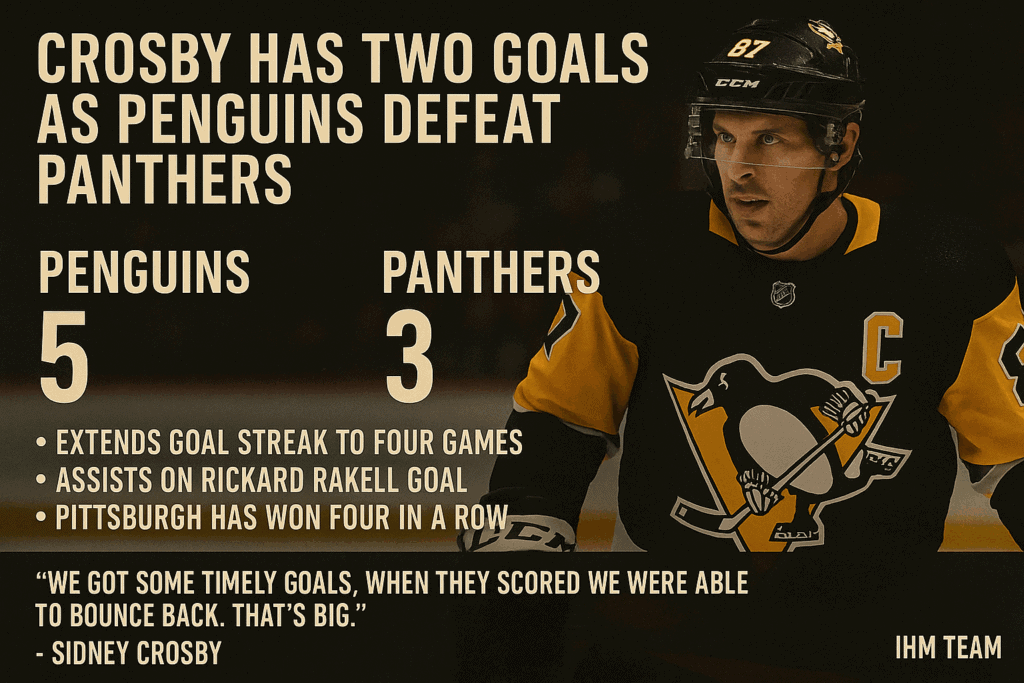
Sidney Crosby celebrates after scoring against the Florida Panthers

Crosby Leads Penguins Past Panthers, Extends Goal Streak to Four

Author: IHM Team | Date: October 24, 2025

SUNRISE, Florida – Sidney Crosby scored twice and added an assist as the Pittsburgh Penguins defeated the Florida Panthers 5-3 for their fourth consecutive win, extending his goal streak to four games. Crosby now sits two points away from reaching 1,700 career points.

Sidney Crosby celebrates after scoring against the Florida Panthers

Penguins’ precision, Crosby’s poise

On the power play, Bryan Rust found Crosby behind the net for a quick one-timer from the left circle, giving Pittsburgh an early 1-0 lead. Rickard Rakell doubled the advantage in the second period, finishing a rebound from Erik Karlsson’s shot.

Brad Marchand responded for Florida with a power-play goal from Mackie Samoskevich’s feed, but Tristan Jarry stood tall with 34 saves, including 16 in the third period. “They carried the fight in the second half,” Crosby said. “Jarry bailed us out a lot.”

Key goals under fire

Ben Kindel restored the two-goal lead at 15:24 of the second with a one-timer off Tommy Novak’s pass. The Panthers closed the gap twice through Sam Reinhart and Marchand, but each time Pittsburgh answered quickly. Connor Dewar and Crosby’s second of the night secured the 5-3 final.

The leadership effect

Coach Dan Muse: “It’s the response, the detail, and the composure. He sets the tone in every situation – we feed off that.”

Crosby has nine points (5G, 4A) during a five-game point streak and continues to redefine consistency and leadership at 38 years old.

Coach Mark’s Comment: “Crosby’s presence stabilizes everything – from puck management to emotional control. You can see the ripple effect in how the younger lines react after goals against.”


Sidney Crosby nearing 1,700 NHL career points with the Pittsburgh Penguins

Crosby Nears 1,700: The Relentless Standard of a Generation

Author: IHM Team | Date: October 23, 2025

PITTSBURGH – Even after two decades in the NHL, Sidney Crosby continues to deflect attention. The Penguins’ captain, now 38 years old, sits at 1,695 career points – just five shy of becoming the ninth player in league history to reach 1,700.

A milestone he won’t celebrate

When asked about joining names like Gretzky, Lemieux, Messier and Howe, Crosby stayed humble:

“I don’t put myself in that category at all. They’re in a whole other world. I just have so much appreciation for what they did.” – Sidney Crosby

Career of quiet dominance

  • 500th goal: February 2022 vs. Philadelphia
  • 1,500th point: April 2023 vs. Detroit (2G, 1A)
  • 1,600th point: October 2024 vs. Buffalo (assisting Malkin’s 500th goal)
  • Franchise assist leader: Surpassed Lemieux in December 2024
  • 20th point-per-game season: March 2025 (breaking Gretzky’s record)

He recently passed Mario Lemieux with 1,896 total points across the regular season and playoffs, the most in Penguins history.

Legacy beyond numbers

“When you play at that level at 38, you don’t chase numbers – they chase you.” – Kris Letang

Head coach Dan Muse called Crosby’s routine “a masterclass in daily preparation.”

Signed, sealed, not done

Under contract through 2026-27, Crosby has averaged 90+ points over his last three seasons. His focus remains on leadership and culture rather than records.

Sidney Crosby: “Being a good role model, good teammate – that’s what matters. Hockey gives you a chance to represent your community. That’s what I’ll always value.”

Coach Mark’s Comment: “Crosby’s evolution is a clinic in consistency. He’s not just producing; he’s teaching the next generation how to prepare, think, and compete.”


Toronto Maple Leafs vs New Jersey Devils - by Coach Mark Lehtonen

Previous analysis recap: Yesterday’s tactical call on Calgary Flames vs Winnipeg Jets delivered again – Winnipeg took a 1-2 win in regulation. It got tense at times, but Coach Mark’s read held true in the end.

Premium Analysis – NHL · 22 Oct 2025

Toronto Maple Leafs vs New Jersey Devils – by Coach Mark Lehtonen

New Jersey arrives with a disciplined two-way game and quick transition through the neutral zone. Toronto leans on perimeter cycles and can be forced into rushed decisions under structured pressure.

Tactical Breakdown

Advanced Metrics (last 5 games)

Line-up & Usage Notes

Coach’s Edge

Coach’s Verdict

Impact Players

Read the full tactical analysis - subscribe to Premium.

Calgary Flames vs Winnipeg Jets - by Coach Mark Lehtonen

Previous analysis recap: Yesterday’s breakdown on Carolina Hurricanes proved right again - another accurate tactical read from Coach Mark Lehtonen

Previous analysis recap: Yesterday’s breakdown on Carolina Hurricanes proved right again - another accurate tactical read from Coach Mark Lehtonen

Premium Analysis - NHL · 21 Oct 2025

Calgary Flames vs Winnipeg Jets - by Coach Mark Lehtonen

Winnipeg enters this matchup as one of the most balanced two-way teams in the league. Their structured play and fast transition make them dangerous through the neutral zone, while Calgary continues to search for consistent inside pressure and offensive rhythm.

Tactical Breakdown

Advanced Metrics (last 5 games)

Line-up & Usage Notes

Coach’s Edge

Coach’s Verdict

Impact Players

Read the full tactical analysis - subscribe to Premium.

See previus post: Los Angeles Kings vs Carolina Hurricanes - by Coach Mark Lehtonen