
Tag: Vegas Golden Knights

Coghlan Emerging As Vegas Playoff Surprise | IHM

Coghlan Emerging As Vegas Playoff Surprise | IHM

Coghlan Emerging As Vegas Playoff Surprise | IHM

Date: May 21, 2026

By IceHockeyMan Newsroom

Every deep playoff run eventually produces an unexpected story.

For the Vegas Golden Knights, Dylan Coghlan is quickly becoming one of them.

In a Western Conference Final filled with superstar names, elite goaltenders and massive playoff pressure, it was the 28-year-old defenseman who delivered one of the biggest momentum swings of Game 1 against Colorado.

Coghlan’s second-period goal helped ignite Vegas’ 4-2 victory over the Avalanche and reinforced one of the biggest strengths inside this Golden Knights roster – contributions are coming from absolutely everywhere.

Not just stars.

Not just first lines.

Every player inside Vegas’ structure currently looks capable of changing a playoff game.


Coghlan Delivered The Breakthrough Moment

The game remained dangerous and emotionally balanced midway through the second period when Coghlan jumped into the offensive sequence and fired a wrist shot through Scott Wedgewood from the high slot.

Suddenly, Ball Arena became quiet.

Vegas immediately gained emotional control.

And Colorado started chasing the game.

Even Coghlan himself admitted afterward that he did not initially realize the puck had crossed the line.

The reaction from teammate Shea Theodore confirmed everything.

IHM Momentum Signal:
That goal changed the emotional flow of the game far more than the scoreboard itself.


Long Road Back To NHL Relevance

Coghlan’s story makes this playoff moment significantly bigger than a simple depth goal.

The defenseman had not scored an NHL goal since December of 2021.

Over multiple seasons, he bounced between NHL organizations and the American Hockey League while constantly fighting to stay relevant inside professional hockey depth charts.

During that stretch, he became a strong offensive contributor in the AHL but struggled finding stable NHL opportunities.

Instead of disappearing mentally, Coghlan continued developing.

And now that patience is suddenly paying off on the biggest stage possible.


Vegas Trusting Him Changed Everything

One of the most important factors behind Coghlan’s emergence is trust.

Vegas coaching staff has allowed him to play aggressively instead of forcing him into a conservative survival role.

That confidence is visible in his gap control, offensive reads and willingness to challenge plays early.

John Tortorella openly praised Coghlan’s fearlessness after Game 1.

According to Tortorella, Coghlan plays without hesitation and does not look overwhelmed by playoff intensity.

IHM Tactical Signal:
Defensemen who hesitate die quickly in playoff hockey. Coghlan is playing aggressively and instinctively right now.


Vegas Depth Becoming The Biggest Playoff Weapon

Coghlan’s rise also highlights something much bigger about Vegas.

This team is not relying on one line or one superstar to survive playoff rounds.

Every series has produced different heroes.

Pavel Dorofeyev continues scoring.

Mitch Marner controls offensive pace.

Carter Hart stabilizes games defensively.

And now depth defensemen like Coghlan are producing momentum-changing goals.

That balance is becoming extremely difficult for opponents to contain over long playoff series.


Tortorella’s Mental Influence Is Visible

The Golden Knights continue playing with a mentality that perfectly reflects John Tortorella’s personality behind the bench.

Confident.

Emotionally stable.

Direct.

Players are not overthinking mistakes or pressure moments.

Vegas currently looks like one of the mentally toughest teams remaining in the playoffs.

Coghlan’s confidence reflects that overall environment perfectly.


Colorado Still Faces A Dangerous Reality

The Avalanche remain one of the NHL’s most dangerous offensive teams.

But Game 1 revealed a serious long-term concern for Colorado.

Vegas depth continues matching Colorado skill level shift after shift.

When role players begin deciding playoff games, defending Vegas becomes significantly harder tactically.

Colorado cannot simply shut down one line or one scoring threat anymore.


Playoff Hockey Changes Careers Quickly

The Stanley Cup Playoffs have always created unexpected career-defining moments.

One major playoff run can completely change how organizations view players moving forward.

Coghlan may currently be entering exactly that type of moment.

He arrived into this series with almost no external pressure.

Now he suddenly looks like another reliable playoff piece inside Vegas’ system.

IHM Insight:
Playoff hockey rewards players who stay mentally ready even when opportunities disappear for long stretches.


Coach Mark Comment

What makes Vegas dangerous right now is not only elite talent. It is belief throughout the entire lineup. Coghlan looks like a player who waited years for this opportunity and arrived completely prepared mentally. Colorado still has superstar firepower, but Vegas currently has deeper emotional confidence across the roster.


Fan Pulse

Which matters more in deep playoff runs: superstar talent or complete lineup depth?


Q&A: Dylan Coghlan And Vegas

Who scored the opening Vegas goal in Game 1?
Dylan Coghlan.

When was Coghlan’s previous NHL goal before this?
December 27, 2021.

Why is Coghlan’s emergence important?
It highlights Vegas’ elite playoff depth.

What has Tortorella praised most about Coghlan?
His confidence and fearlessness.

Why is Vegas difficult to defend right now?
Multiple lines and depth players are contributing offensively.



Golden Knights Bring Swagger Into Western Final | IHM

Golden Knights Bring Swagger Into Western Final | IHM

Golden Knights Bring Swagger Into Western Final | IHM

Date: May 21, 2026

By IceHockeyMan Newsroom

The Vegas Golden Knights are no longer trying to convince anyone they belong among the NHL elite.

They already know it.

And Game 1 of the Western Conference Final became another reminder that Vegas may currently be the most emotionally stable road team left in the Stanley Cup Playoffs.

Inside one of the loudest buildings in hockey against the Presidents’ Trophy-winning Colorado Avalanche, the Golden Knights delivered another cold, composed and structured playoff performance, defeating Colorado 4-2 to immediately steal home-ice advantage.

Vegas looked confident from the opening minutes.

Not reckless.

Not emotional.

Just completely comfortable inside playoff chaos.


Vegas Survived Colorado’s Early Push

Colorado opened the game exactly how most expected.

Fast pace.

Heavy offensive pressure.

Aggressive transition attacks through Nathan MacKinnon and Martin Necas.

But the Golden Knights never looked overwhelmed.

Instead, Vegas absorbed the pressure, blocked shooting lanes and slowly forced Colorado into lower-quality offensive looks.

Once the Avalanche failed to capitalize early, momentum gradually started shifting toward Vegas.

IHM Tactical Signal:
Vegas is becoming elite at surviving the emotional surge of home playoff crowds. They stay structurally calm until the game slows into their rhythm.


Dylan Coghlan Delivered A Massive Momentum Goal

The turning point arrived midway through the second period.

Defenseman Dylan Coghlan scored the first playoff goal of his NHL career to give Vegas a 1-0 lead and completely change the emotional flow of the game.

Colorado suddenly lost control of momentum while Vegas started dictating pace more confidently through the neutral zone.

That goal also reinforced one of the biggest themes of this Vegas playoff run – contributions are coming from everywhere.

Not just stars.

Not just the top line.

Every layer of the roster is producing important playoff moments.


Marner Continues Dominating The Playoffs

Mitch Marner continues playing the best playoff hockey of his NHL career.

The Vegas forward recorded another assist on Pavel Dorofeyev’s power-play goal, giving him 19 playoff points to lead the NHL postseason.

More importantly, Marner is controlling games beyond pure offense.

His defensive positioning, puck support and transition management have become critical parts of Vegas’ playoff identity.

The pressure that followed Marner for years in Toronto is completely gone right now.

He looks free.

And dangerous.


Dorofeyev Quietly Becoming Elite Finisher

Pavel Dorofeyev may still be underrated nationally, but playoff numbers are no longer ignoring him.

His power-play goal gave him 10 goals during the postseason, the highest total among all playoff scorers.

Vegas consistently places him into soft-space shooting areas where his release becomes extremely difficult to defend.

Colorado struggled badly containing Vegas’ weak-side finishing opportunities all night.


Carter Hart Controlled The Pressure

Carter Hart once again looked completely composed under playoff intensity.

The Vegas goaltender stopped 36 shots while making several momentum-saving stops during Colorado pushes.

The Golden Knights trust Hart completely right now.

That confidence is visible in how aggressively Vegas defenders pressure entries and challenge shooting lanes.

Vegas blocked 23 shots overall and repeatedly eliminated second-chance opportunities around the crease.

IHM Goalie Signal:
Hart is currently giving Vegas emotional stability every contender needs deep in the playoffs.


Colorado Felt Different Without Makar

The Avalanche remained dangerous offensively, but something clearly looked different without Cale Makar in the lineup.

Colorado transition speed dropped.

Breakout structure became less fluid.

Defensive recoveries looked slower under Vegas forecheck pressure.

Nathan MacKinnon was also held scoreless for the first time in seven games.

Vegas successfully limited Colorado’s transition explosiveness by aggressively stacking the neutral zone and closing middle-lane entries.


Tortorella Has Completely Changed Vegas’ Mentality

One of the biggest stories of this playoff run remains John Tortorella’s impact behind the bench.

Since taking over late in the season, Tortorella has rebuilt Vegas psychologically.

The Golden Knights now play with controlled aggression and visible confidence in hostile environments.

Vegas is now 5-2 on the road during the playoffs.

The pressure of opposing arenas almost seems to energize this group.

The Golden Knights do not look intimidated by reputation anymore.

They simply look experienced.


This Series Is Far From Over

Vegas understands Game 1 changes nothing long-term.

Colorado remains one of the most explosive teams in hockey and still has enough offensive talent to quickly reset momentum.

But the Golden Knights now hold psychological leverage entering Game 2.

They survived the opening Avalanche storm and proved once again they can win ugly playoff games in difficult environments.

IHM Series Signal:
Vegas currently looks emotionally steadier. Colorado still has the higher offensive ceiling if healthy.


Coach Mark Comment

Vegas is playing mature playoff hockey right now. They are not chasing highlight moments or emotional swings. Everything feels controlled, structured and patient. Colorado still creates dangerous offensive stretches, but without Makar the Avalanche lose a huge part of their transition identity. Right now Vegas looks like the calmer team under pressure.


Fan Pulse

After Game 1, who has the psychological edge in the Western Final: Vegas or Colorado?


Q&A: Golden Knights vs Avalanche

Who won Game 1 of the Western Conference Final?
The Vegas Golden Knights.

Who leads the NHL playoffs in points?
Mitch Marner.

Who leads the playoffs in goals?
Pavel Dorofeyev.

Why was Cale Makar’s absence important?
Colorado lost major transition speed and puck-moving stability.

What has become Vegas’ biggest strength?
Composure and structure in hostile road environments.


Golden Knights vs Avalanche Western Final Preview | IHM

Golden Knights vs Avalanche Western Final Preview | IHM

Golden Knights vs Avalanche Western Final Preview | IHM

Date: May 17, 2026

By IceHockeyMan Newsroom

The Western Conference Final has arrived, and the matchup already feels worthy of the Stanley Cup Final itself.

The Colorado Avalanche and Vegas Golden Knights now collide in a heavyweight playoff battle between two experienced contenders built very differently but driven by the exact same objective – returning to the Stanley Cup Final.

Colorado enters as the Presidents’ Trophy winner with elite transition speed, offensive depth and the most explosive attacking pace left in the postseason. Vegas counters with playoff maturity, structure, special teams execution and one of the deepest forward groups remaining in the NHL playoffs.

This series is not simply about star power. It is about identity versus identity.


Colorado’s Speed Against Vegas Structure

The Avalanche continue looking like the fastest transition team in the postseason.

Nathan MacKinnon remains the emotional and tactical engine of Colorado’s offense, constantly forcing defenders backward with explosive zone entries and aggressive pace through the neutral zone.

Martin Necas has quietly become one of the most important secondary creators in the playoffs, while Gabriel Landeskog’s return has added leadership, physicality and dangerous net-front presence.

At the same time, Vegas may be the most structurally disciplined opponent Colorado has faced so far.

The Golden Knights are comfortable slowing games down, collapsing defensively through the middle and turning small mistakes into immediate scoring pressure through counterattacks and special teams.

IHM Tactical Signal:
The neutral zone may decide the entire series. If Colorado attacks with speed, the Avalanche control momentum. If Vegas slows entries and forces dump-ins, the Golden Knights gain the advantage.


Mitch Marner Has Become Vegas’ Playoff Driver

Mitch Marner enters the Western Conference Final as one of the most productive players in the NHL playoffs.

Since arriving from Toronto, Marner has transformed Vegas offensively with elite puck movement, offensive patience and constant playmaking pressure in high-danger areas.

His chemistry with Jack Eichel has become one of the biggest reasons Vegas survived two difficult playoff rounds.

The Golden Knights no longer rely only on depth scoring or physical play. They now possess elite offensive creativity capable of matching Colorado’s firepower shift for shift.


Nathan MacKinnon Looks Unstoppable

Few players in hockey currently look more dangerous than MacKinnon.

He enters the series scoring in six consecutive games while continuing to dominate transition pace, offensive zone pressure and shot generation.

MacKinnon is not only producing offense. He is controlling emotional momentum inside games.

Colorado’s confidence rises dramatically whenever he accelerates the tempo through the neutral zone.

IHM Insight:
Vegas must force MacKinnon wide and deny clean middle-lane entries. If he controls the center lane with speed, Colorado becomes extremely difficult to contain.


Special Teams Could Become The Difference

Both teams understand that this series may ultimately be decided on special teams.

Vegas has built much of its playoff success around structured penalty killing, net-front pressure and disciplined puck management on the power play.

Colorado, meanwhile, continues creating dangerous seam passes and high-speed rotations through Makar and MacKinnon.

Every unnecessary penalty becomes dangerous in this matchup.

  • Colorado power play strength: speed and movement
  • Vegas power play strength: patience and puck retrievals
  • Colorado penalty kill strength: pressure entries
  • Vegas penalty kill strength: defensive layers and rebounds

Goaltending Battle Quietly Becomes Critical

Scott Wedgewood has stabilized Colorado throughout the postseason and enters the Western Final with growing confidence despite some inconsistency against Minnesota.

Vegas counters with Carter Hart, who has quietly become one of the most reliable playoff goaltenders remaining.

Hart’s positioning, rebound control and calmness under pressure helped Vegas survive difficult moments against both Utah and Anaheim.

If Colorado begins generating heavy transition pressure, Hart may become the single most important player in the series.


Colorado Injury Situation Still Looms

One of the biggest questions entering the series remains Colorado’s health.

Cale Makar has absorbed heavy playoff contact and missed practice recently, while Artturi Lehkonen and Sam Malinski continue dealing with upper-body injuries.

The Avalanche depth remains strong, but against Vegas, even small injury limitations can shift the balance quickly.

IHM Signal:
Colorado’s system depends heavily on mobility and transition speed. Injuries affecting skating efficiency become amplified in a series against Vegas.


Vegas Has Been Here Before

The Golden Knights continue proving why they remain one of the NHL’s most playoff-tested organizations.

This marks Vegas’ fifth conference final appearance since entering the league in 2017-18, an extraordinary level of postseason consistency.

Even after difficult moments earlier in the playoffs, Vegas consistently found ways to reset emotionally and structurally inside games.

That experience becomes critical against a high-speed Colorado team capable of creating emotional swings very quickly.


Key Matchup To Watch

Nathan MacKinnon vs Jack Eichel

This may become the defining superstar duel of the entire postseason.

MacKinnon drives pure speed and offensive chaos. Eichel controls tempo through puck possession, positioning and calculated offensive entries.

Whichever center dictates pace more consistently may decide the outcome of the series.


Coach Mark Comment

This series feels like modern playoff hockey at its highest level. Colorado attacks with overwhelming speed and layered offensive pressure. Vegas slows games down and forces mistakes through structure and experience. The smallest puck-management errors will decide games. This may become the best tactical series of the entire postseason.


Fan Pulse

Who has the edge entering the Western Conference Final: Colorado’s speed or Vegas’ playoff structure?


Q&A: Golden Knights vs Avalanche

Who has home-ice advantage?
The Colorado Avalanche.

Who leads Vegas offensively?
Mitch Marner and Jack Eichel.

Who is Colorado’s offensive leader?
Nathan MacKinnon.

What may decide the series?
Neutral-zone control and special teams execution.

What is Colorado’s biggest concern?
Injuries and overall health entering the Western Final


Golden Knights Eliminate Mammoth | IHM

Golden Knights Eliminate Mammoth | IHM

Golden Knights Eliminate Mammoth as Marner Leads Complete Game 6 Performance

Date: May 2, 2026
By IceHockeyMan Newsroom

Vegas did not leave this series to chance. In Game 6, the Golden Knights delivered one of the most complete elimination performances of the first round, controlling pace, depth and execution to close out Utah.

Mitch Marner scored twice and added an assist in a 5-1 win, sending Vegas into the second round where Anaheim now awaits.


🔥 MARNER CONTROLS THE GAME

This was not just a multi-point night. This was control. Marner dictated tempo, found space and punished mistakes in key moments.

  • 2 goals, 1 assist
  • Power play impact
  • Off-puck positioning creating second chances

His second goal on the power play reflected playoff awareness: react faster than defenders, find the rebound, finish immediately.

IHM Signal:
Elite players do not wait for perfect chances in playoffs. They create goals from broken plays.


⚔️ DEPTH WINS SERIES - NOT JUST STARS

While Marner led the headlines, Vegas closed this series because every line contributed.

Brett Howden extended his goal streak to three games, continuing a trend that defined the matchup: depth production under pressure.

  • All four lines contributing
  • Consistent forecheck pressure
  • Physical control shift-to-shift

This is the difference between contenders and talented teams. Vegas does not rely on one line. It rolls pressure.

IHM Insight:
Depth scoring is not a bonus in playoffs. It is a requirement to finish series.


🧠 GAME TURNING MOMENT - RESPONSE AFTER 2-1

Utah briefly created tension when Yamamoto cut the score to 2-1 early in the third period. That is the moment many series shift.

Vegas answered immediately.

Colton Sissons restored control with a rebound goal just minutes later, killing any potential momentum swing.

IHM Signal:
Championship-level teams do not allow momentum to grow. They shut it down instantly.


🟡 TORTORELLA EFFECT - SIMPLICITY OVER COMPLEXITY

Vegas coach John Tortorella emphasized a simple identity: north-south hockey, puck pressure and fast transitions.

  • Quick zone exits
  • Direct attack mentality
  • Less overhandling, more execution

That approach wore Utah down over the course of the game and the series.

IHM Insight:
In playoffs, simplicity scales better than complexity under pressure.


📉 UTAH MAMMOTH - EXPERIENCE GAINED, SERIES LOST

Utah showed resilience throughout the series but ultimately lacked the consistency required to close games.

  • Strong moments but not sustained pressure
  • Defensive breakdowns in key situations
  • Limited response to Vegas depth attack

Still, for a team in its first playoff appearance, the experience gained is significant.

IHM Signal:
Playoff losses build future contenders when lessons are absorbed correctly.


🚨 ROUND 2 PREVIEW - VEGAS VS ANAHEIM

Now comes a very different challenge.

Anaheim eliminated Edmonton and enters with confidence, speed and comeback ability.

Vegas brings:

  • Experience
  • Depth
  • System stability

Anaheim brings:

  • Momentum
  • Unpredictability
  • Offensive bursts

IHM Projection:
This series will be decided by whether Anaheim can break Vegas structure or Vegas can slow the game down.


🧠 Coach Mark Comment

Vegas played a textbook elimination game. They controlled pace, responded to pressure and never allowed Utah to believe the game was open. That is playoff maturity. Against Anaheim, the challenge changes. The Ducks play faster and more aggressively in transition. Vegas will need to control neutral zone pace to win.


🔥 Fan Pulse

Do you see Vegas as a real Stanley Cup contender after this series?


❓ Q&A: Golden Knights Game 6

Who was the key player?
Mitch Marner with two goals and one assist.

What decided the game?
Vegas depth scoring and immediate response after Utah’s goal.

Why did Vegas win the series?
Better structure, depth and experience.

Who do they face next?
Anaheim Ducks in the second round.

What is the biggest strength of Vegas now?
Balanced attack across all lines.


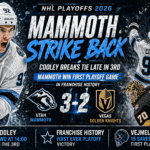
Mammoth Strike Back - Utah Levels Series Against Vegas | IHM

Mammoth Strike Back - Utah Levels Series Against Vegas | IHM

Mammoth Strike Back - Utah Levels Series Against Vegas

Date: April 22, 2026
By IceHockeyMan Newsroom

The Utah Mammoth did more than win Game 2. They changed the emotional and tactical shape of the series.

A 3-2 road victory over the Golden Knights gave Utah its first playoff win in franchise history and, more importantly, erased Vegas’ early momentum. What looked like a clean series advantage for the Golden Knights now becomes a real fight heading to Salt Lake City.


⚡ COOLEY’S WINNER WAS A PLAYOFF-TYPE GOAL

Logan Cooley’s late third-period goal did not come from a perfect setup or a highlight finish. It came from timing, net drive and second-effort awareness - exactly the kind of goal that decides playoff games.

Utah attacked through the middle with speed, forced a rebound sequence, and Cooley arrived at the crease at the right moment to finish the play.

IHM Signal:
Playoff series turn when talented players stop searching for clean goals and start scoring dirty ones.


🚨 UTAH WON THE SECOND PERIOD - AND THE GAME STARTED THERE

The biggest underlying story of Game 2 was not the final goal. It was Utah’s control in the middle phase of the game.

The Mammoth outshot Vegas 13-4 in the second period and pushed the Golden Knights into long defensive sequences. That stretch changed the energy of the night.

  • Utah built speed through the middle of the ice
  • Vegas lost puck control in exits
  • Shift length and defensive fatigue increased for the Golden Knights

IHM Insight:
Series are often decided by who controls the “hidden period” - the stretch where pressure builds before the game-breaking moment arrives.


🎯 GUENTHER AND YAMAMOTO ADDED THE RIGHT KIND OF SUPPORT

Dylan Guenther and Kailer Yamamoto gave Utah exactly what playoff underdogs need: support scoring and pace-driving shifts.

Guenther’s goal was clean, quick and direct, but his larger impact came in how he attacked with pace and forced Vegas defenders to back off. Yamamoto’s two-assist game added another layer of smart puck movement and quick decision-making.

This matters because Utah cannot win this series relying on one line alone. Game 2 showed that their support cast can create real series pressure.


🧱 VEGAS LOST ITS GRIP AFTER A STRONG START

Vegas opened with the right tone and grabbed the first goal, but the game slowly drifted away from its preferred structure.

The Golden Knights were still dangerous in moments. Mark Stone and Ivan Barbashev both produced. Jack Eichel continued to drive offense. But the broader control was missing for too long.

Key issue areas:

  • Too little offensive-zone possession after the first phase
  • Not enough puck support under Utah’s pressure
  • Defensive reads stretched by Utah’s middle-lane speed

IHM Signal:
Vegas did not lose because it lacked talent. It lost because Utah dictated the pace for too many important stretches.


🧠 TORTORELLA’S TEAM NOW FACES A DIFFERENT SERIES

John Tortorella’s group no longer enters Game 3 with calm control. The tone has changed.

What was a chance to push toward a commanding lead is now a tied series moving into Utah’s building, where emotion and belief will be significantly higher.

This is where coaching matters most:

  • Can Vegas recover offensive-zone discipline?
  • Can it slow Utah’s speed through the middle?
  • Can it win back the emotional edge quickly?

IHM Insight:
A tied series is not just about score. It is about which team absorbs the last result better.


🥅 VEJMELKA GAVE UTAH THE RIGHT KIND OF GOALTENDING

Karel Vejmelka did not need to steal the game, but he did exactly what playoff teams need from their goaltender in these spots - he stayed calm, held shape and made the saves that protected momentum.

That type of performance becomes even more valuable for a team trying to establish itself in a series against a higher seed.


📊 GAME 3 OUTLOOK

Now the pressure shifts.

For Utah:

  • Keep attacking with pace through the middle
  • Use home energy without losing structure
  • Continue turning rebounds and net drives into chances

For Vegas:

  • Rebuild offensive-zone time
  • Limit Utah’s transition speed
  • Regain control of the second-period flow

IHM Projection:
Game 3 becomes the real emotional pivot of the series. If Utah wins again, belief turns into pressure on Vegas immediately.


🧠 Coach Mark Comment

This was an important playoff lesson for both teams. Utah learned that it can impose pace and survive against a top seed. Vegas learned that early control means nothing if you stop managing the middle of the game. The team that wins this series will probably be the team that controls the second period best, because that is where rhythm is being decided right now.


🔥 Fan Pulse

Did Utah just turn this into a real upset threat, or will Vegas reset and take back the series in Game 3?


❓ Q&A: Mammoth vs Golden Knights Game 2

Why was Cooley’s goal so important?
Because it came from playoff-style net pressure and gave Utah the decisive late edge.

What really changed the game?
Utah’s control of the second period and its ability to build pressure through the middle.

Did Vegas play badly?
Not overall, but it lost structure for too many stretches and allowed Utah to dictate pace.

Why does this win matter beyond the score?
Because it gives Utah belief and sends the series home tied with real momentum.

What is the key factor in Game 3?
Whether Vegas can slow Utah’s speed and reestablish offensive-zone control.


Golden Knights 4th Line Impact - Playoff X-Factor | IHM

Golden Knights 4th Line Impact - Playoff X-Factor | IHM

Golden Knights 4th Line Impact - The Hidden Engine Behind Vegas Playoff Push

Date: April 21, 2026
By IceHockeyMan Newsroom

Most playoff series are decided by stars. But sometimes, they are controlled by players who never make headlines. In Game 1 against the Mammoth, Vegas showed that their fourth line is not just depth – it is becoming a tactical weapon.

The trio of Nic Dowd, Colton Sissons and Cole Smith delivered one of the most important underlying performances of the night. Not because of raw scoring, but because of how they shifted momentum, zone control and physical pressure.


⚙️ LINE CHEMISTRY BUILT FOR PLAYOFF HOCKEY

This line was not built over a full season. It came together late through trades and adjustments, but the profiles match perfectly. All three players operate with a similar mindset – direct, physical and predictable in structure.

That matters more in the playoffs than creativity. Predictability at high intensity allows faster reads, quicker pressure and more consistent execution inside systems.

IHM Insight:
Playoff chemistry is not about time together. It is about role clarity under pressure.


💥 FORECHECK PRESSURE AS A SYSTEM WEAPON

Vegas did not just forecheck hard. They forechecked with intent and structure. The fourth line consistently forced Utah into rushed decisions, especially on zone exits.

This is where games shift without being obvious:

  • Delayed breakouts
  • Turnovers under pressure
  • Defensive fatigue over shifts

Sissons’ goal came directly from this identity – attacking the back post, staying inside the structure and finishing in traffic.

IHM Tactical Signal:
Heavy forecheck lines are not just about hits. They are about removing time and space from opposing defensemen.


🧱 DOWD AS THE “GLUE PLAYER” FACTOR

Nic Dowd represents a classic playoff profile – not a star, but a connector. Faceoffs, penalty kill, positioning, emotional tone. These players stabilize teams in chaotic moments.

His goal was not accidental. It came from reading space, timing movement and being inside the play instead of around it.

Equally important was his emotional presence. Engaging physically, responding to opponents and maintaining intensity without crossing the line.

IHM Signal:
Teams that win series usually have 1-2 players like Dowd controlling the emotional temperature.


🧠 TORTORELLA EFFECT - IDENTITY OVER TALENT

Since taking over, John Tortorella has clearly shifted Vegas toward identity-based hockey. Less reliance on skill moments, more focus on structure, pressure and accountability.

This fourth line is a perfect reflection of that philosophy:

  • Simple decisions
  • High work rate
  • Clear tactical role

In the playoffs, this often becomes more valuable than individual talent bursts.

IHM Insight:
Coaches do not just change systems. They change which players become important.


⚔️ WHY THIS LINE MATTERS FOR THE SERIES

Against Utah, this line creates a specific type of pressure:

  • Forces defense to play faster than comfortable
  • Creates physical wear over multiple games
  • Builds momentum for top lines starting shifts in offensive zones

Even if they stop scoring, their impact will remain.

That is the key difference between regular season depth and playoff depth.


📊 GAME 2 OUTLOOK

Game 2 will test whether this performance was situational or structural.

If Vegas’ fourth line continues to:

  • Win puck battles
  • Maintain forecheck pressure
  • Control emotional tempo

Then this series could shift faster than expected.

IHM Projection:
If the fourth line repeats even 70% of Game 1 impact, Vegas gains a significant series control advantage.


🧠 Coach Mark Comment

This is classic playoff hockey. Everyone looks at top players, but coaches watch lines like this. If your fourth line is winning shifts, you control the game underneath the surface. Vegas is starting to build that kind of structure. It is not flashy, but it is very difficult to play against over a series.


🔥 Fan Pulse

Can Vegas win the series based on depth and structure, not just star power?


❓ Q&A: Playoff Depth Impact

Why is a 4th line important in playoffs?
Because they control energy, physicality and momentum in non-scoring situations.

What makes this Vegas line effective?
Similar playing styles, strong forecheck and clear tactical roles.

Is scoring from this line sustainable?
Not necessarily, but their impact does not depend on scoring.

What is the biggest advantage they create?
They wear down opposing defenses over time.

How does this affect top lines?
It gives them better starting positions and less defensive pressure.


Golden Knights Clinch Pacific - Late Season Surge Defines Vegas Identity

Golden Knights Clinch Pacific - Late Season Surge Defines Vegas Identity

Golden Knights Clinch Pacific - Late Season Surge Defines Vegas Identity

Date: April 16, 2026
By IceHockeyMan Newsroom

Vegas did not just win a game. They closed the regular season by locking in control of the Pacific Division, confirming what has been building quietly over the final weeks - this is a team peaking at exactly the right moment.

A 4-1 win over Seattle capped a 10-game point streak and completed one of the most important late-season turnarounds in the league. From flirting with wildcard uncertainty to finishing on top, the Golden Knights reshaped their entire trajectory heading into the playoffs.


📊 GAME FLOW SHIFT - FROM CONTROL TO DOMINANCE

Seattle struck first early in the second period, but the response from Vegas was immediate and structured. Instead of opening up the game, they tightened spacing, accelerated puck movement through the neutral zone, and forced Seattle into reactive hockey.

Once Shea Theodore equalized late in the period, momentum shifted fully. The third period was not chaotic. It was controlled pressure. Vegas dictated pace, won key faceoffs, and consistently attacked through high-danger lanes.

Reilly Smith’s two-goal sequence sealed the result, but the real story was territorial control and transition efficiency.


⚙️ SYSTEM CHANGE UNDER TORTORELLA

Since the coaching change, Vegas has not become more complex. They have become more direct.

The focus is clear:

  • Faster exits from the defensive zone
  • Immediate pressure after puck loss
  • Shorter decision windows in transition
  • More aggressive positioning in all three zones

This is not a tactical revolution. It is a behavioral shift. And that is why it is working.

IHM Signal:
Vegas is no longer playing “safe hockey.” They are playing “forward hockey” - reducing hesitation and forcing opponents to react under pressure.


🔥 KEY PERFORMERS - IMPACT BEYOND STATS

Reilly Smith: Two goals and constant net-front presence. Not just finishing, but creating second-chance chaos.

Jack Eichel: Continues to drive offensive flow. His puck distribution is controlling tempo, not just creating chances.

Carter Hart: Quiet but critical. Stable goaltending allowed Vegas to stay composed after conceding first.

Defensive core: Clean puck movement and strong gap control limited Seattle’s ability to generate sustained pressure.


📉 SEATTLE SIGNAL - GAME MANAGEMENT PROBLEM

For Seattle, the issue was not talent. It was decision-making under pressure.

After taking the lead, the Kraken slowed down, lost puck discipline, and allowed Vegas to dictate transitions. Turnovers and poor spacing turned a manageable game into a one-sided third period.

IHM Insight:
Teams that cannot manage the puck late in the season rarely survive playoff-level pressure. Seattle showed exactly why.


⚔️ PLAYOFF CONTEXT - VEGAS VS UTAH

Vegas now moves into the first round against Utah, a matchup that brings together structure versus unpredictability.

Utah enters with nothing to lose. Vegas enters with expectations and momentum.

IHM Matchup Signal:
If Vegas controls pace early in the series, their structure will suffocate Utah. If Utah disrupts rhythm, the series becomes volatile.


📈 TREND SIGNALS

  • Vegas enters playoffs on one of the strongest form runs in the NHL
  • Coaching change created immediate behavioral impact
  • Transition speed is now a core identity trait
  • Confidence level inside the group is visibly rising

⚠️ WHY THIS WIN MATTERS

This was not about standings. It was about identity confirmation.

Teams that finish strong with structure tend to carry that into the playoffs. Teams that rely on moments often collapse under pressure.

Vegas is trending toward the first category.


🧠 Coach Mark Comment

Vegas found the most important thing at the right time - clarity. You can see it in how quickly they move the puck, how little hesitation there is in their decisions, and how they recover after mistakes. This is not about talent. This is about timing and identity. When a team enters the playoffs knowing exactly how it wants to play, it becomes extremely dangerous.


🔥 Fan Pulse

Are the Golden Knights the most dangerous team in the Western Conference right now?


❓ Q&A: Vegas Golden Knights Playoff Outlook

Why is Vegas peaking at the right time?
Because their structure and decision-making have stabilized under pressure.

What changed under the new coach?
Simplification of play, faster transitions and more aggressive positioning.

Is their form sustainable in the playoffs?
Yes, if their system discipline holds under higher intensity.

What is their biggest strength right now?
Controlled pace and efficient transition play.

What could be their weakness?
If forced into chaotic, high-variance games.

Who drives this team the most?
Eichel controls tempo, while depth scoring supports overall balance.


NHL Short Ice: OT Chaos, Playoff Race, Returns | Mar 23

NHL Short Ice: OT Chaos, Playoff Race, Returns | Mar 23

NHL SHORT ICE - OT Chaos, Playoff Race, Returns | March 23

Date: March 23, 2026
By: IceHockeyMan Newsroom

Want to stay on top of everything happening in the NHL without wasting time on long articles? IHM NHL SHORT ICE delivers the most important updates, key moments and league trends in a fast, structured format. Built for busy professionals, hockey fans and anyone who wants real insight without information overload.

Trending Signals

The league is now fully in late-season pressure mode. Overtime games, comeback wins and clinching scenarios are shaping the standings almost every night. Structure, goaltending and emotional control are deciding more games than raw shot volume.

Utah Wins Another Tight One in Overtime

Nick Schmaltz scored twice, including the overtime winner, as the Mammoth defeated the Kings in another high-pressure game. Lawson Crouse added three points, while Los Angeles forced extra time late through a tying goal from Panarin.

Impact: Utah continues to look dangerous in low-margin hockey because it can create second-effort offense without losing defensive shape. Schmaltz remains one of the cleanest puck-touch finishers in their attack.

Vegas Lands a Statement Win Over Dallas

Reilly Smith broke the tie late in the third period as the Golden Knights defeated the Stars and climbed into second place in the Pacific Division. Casey DeSmith made 30 saves for Dallas, but Vegas looked sharper in the final execution phase.

Impact: This was not just a standings win. It was a psychological win against a top Western opponent, and it reinforces Vegas as a team that still trusts its late-game structure.

Colorado Clinches and Keeps Pushing

The Avalanche defeated Chicago and became the first team in the league to clinch a playoff berth. Martin Necas posted a goal and two power-play assists to reach a new career high in points, while Colorado hit the 100-point mark.

Impact: Colorado is no longer playing for qualification. It is playing for playoff control. That changes the pressure profile and allows them to sharpen match details rather than chase points in panic mode.

Landeskog Return Changes the Feel Around Colorado

Colorado also received another emotional lift with Gabriel Landeskog scoring in his return from injury against Washington. The Avalanche then recovered for an overtime win against the Capitals, while Ovechkin reached the 1,000-goal combined mark across regular season and playoffs.

Impact: Landeskog’s return matters beyond production. He adds net-front weight, leadership presence and playoff identity. Colorado suddenly looks deeper and more complete.

Ducks Break Buffalo’s Momentum in Overtime

Anaheim recovered late in the third period and then beat Buffalo in overtime on Troy Terry’s second goal of the game. The Sabres had entered the night on a four-game winning streak, but Anaheim found the extra push after a late power-play equalizer from Granlund.

Impact: Momentum is fragile in March. Buffalo has been one of the hotter teams in the league, but Anaheim showed how one late special-teams moment can flip an entire game script.

Nashville Extends Its Run

Filip Forsberg scored twice and added an assist as the Predators edged Chicago in overtime for their fourth straight win. Nashville continues to strengthen its hold on the second wild-card position in the West.

Impact: Nashville is not just surviving the race. It is building real separation through repeatable late-game execution, which is exactly what bubble teams usually fail to do.

Carolina Stays Hot, Islanders Stay Alive

Seth Jarvis had three points as the Hurricanes handled Pittsburgh for their third straight victory, ending the Penguins’ four-game point streak. In the East, Ilya Sorokin made 26 saves as the Islanders shut out Columbus and gained ground in the wild-card race.

Impact: Carolina continues to win with layered pressure and pace. The Islanders, meanwhile, are proving they can still grind out meaningful points when the race tightens.

Discipline Watch: Greer Suspended

A.J. Greer was suspended three games for boarding Flames center Connor Zary. At this point in the season, discipline decisions matter even more because missing even a short stretch can damage lineup continuity and playoff positioning.

Impact: Teams cannot afford unnecessary physical recklessness now. The line between aggressive hockey and self-inflicted damage gets thinner every week in March.

Goalie Watch

Adin Hill was set to start in Dallas. Spencer Knight got the nod for Chicago against Nashville. Darcy Kuemper started in Salt Lake City, Alex Lyon drew the road start in Anaheim, Juuse Saros returned to the crease for Nashville, Jonas Johansson got the call in Calgary, Frederik Andersen started for Carolina and Stuart Skinner was set for Pittsburgh.

Impact: Starting goalie signals are becoming even more important because many games are now tactical coin flips. One stable performance in net can swing both standings points and game flow.

Injury Radar and Availability Notes

Victor Hedman remained unavailable due to illness. Shayne Gostisbehere stayed out with a lower-body issue. Tyler Toffoli was ruled out, while Mikko Rantanen moved closer to a return and is expected to travel with Dallas on its upcoming road trip.

Impact: Late-season availability is now almost as important as top-line form. Healthy depth wins matchups when the schedule gets tighter and the checking gets heavier.

Playoff Pressure Index

The Stars still had a chance to clinch with at least one point, but Vegas denied them. Utah’s win over Los Angeles also carried direct playoff significance. The West is now being shaped by overlapping races where every overtime result creates damage for one contender and life for another.

Key Takeaways

Colorado has officially moved into playoff-caliber control mode. Utah keeps proving it can win late. Vegas strengthened its Pacific position with a serious statement win. Nashville looks increasingly dangerous in the wild-card race. The East remains volatile, with Carolina and the Islanders both gaining momentum at the right time.

Coach Mark Comment

This is the stage of the season where details stop being background noise and become the result itself. Overtime structure, line-change discipline, net-front coverage and the first clean pass under pressure now decide games more than highlight-reel talent. Colorado is dangerous because its structure matches its skill. That is the combination every contender wants right now.

Fan Pulse

Which team looks more dangerous right now in the West: Colorado because of structure, or Vegas because of timing and late-game composure?

Q&A: NHL Short Ice Insights

Why was Colorado’s clinch so important?

Because it shifts the focus from survival to positioning. Teams that clinch early can start sharpening playoff habits instead of chasing points under stress.

Why do overtime wins matter so much now?

They create double pressure. One team gains extra confidence and points, while the other loses ground in direct competition.

What makes Utah a real factor in this stretch?

Its ability to stay composed in tight games. Utah is creating offense without opening itself up too much defensively.

Why is Nashville’s run significant?

Because bubble teams usually wobble when pressure rises. Nashville is doing the opposite and building consistency through clutch execution.

Why are goalie confirmations so important at this stage?

Because many late-season games are one- or two-goal environments. Starting goaltenders can shift expected game flow immediately.

Why does Landeskog’s return matter beyond the box score?

He changes the emotional and physical profile of Colorado. He adds leadership, puck-retrieval presence and playoff edge.


NHL SHORT RUMORS & TRADES DIGEST - January 19, 2026 | IHM News

NHL SHORT RUMORS & TRADES DIGEST – January 19, 2026 | IHM News

NHL SHORT RUMORS & TRADES DIGEST – January 19, 2026

IHM News

By IceHockeyMan Newsroom | Date: January 19, 2026


For busy readers: a fast, structured digest of the day’s biggest NHL trade moves and rumor signals, written in the IHM newsroom style.

Context

The NHL trade market is heating up as teams begin to define their direction ahead of the deadline. January 19 delivered a wave of movement, signals, and strategic positioning across the league, with clubs prioritizing flexibility, term, and roster clarity.

Trade of the Day

Vancouver Canucks → San Jose Sharks

Vancouver moved forward Kiefer Sherwood to San Jose in exchange for two second-round picks (2026, 2027) and prospect Cole Clayton.

From an IHM angle, this is a classic future-value play. Vancouver adds draft capital and keeps the roster flexible, while San Jose gets an immediate depth piece who can bring pace and detail to a forward group still stabilizing its identity.

Rumors & Signals

Devils & Canucks: Different Paths, Same Pressure

Both New Jersey and Vancouver are trending toward change, but in very different forms.

  • New Jersey remains opportunistic, exploring upgrades without fully committing to a total reset.
  • Vancouver is leaning into future assets and timeline control, which the Sherwood move reinforces.

The key takeaway is not the individual rumor. It is the directional clarity each organization is being forced to show as the market tightens.

Market Watch: Players With Term in Demand

With the rental market thinning, teams are increasingly targeting players who have term remaining. That reduces uncertainty and adds controllable value beyond a single playoff run.

The Minnesota Wild have been linked to this approach, with Vincent Trocheck emerging as a name that fits the profile due to role security, matchup reliability, and playoff utility.

Calgary Flames: Business Mode Activated

Calgary has clearly entered a decisive phase.

  • The Rasmus Andersson situation reached a conclusion after it became clear an extension was not happening.
  • Result: Andersson traded to the Vegas Golden Knights for a 1st-round pick, conditional 2nd-round pick, Zach Whitecloud, and Abram Wiebe.

This is a textbook value-extraction deal. Calgary protects its leverage, Vegas buys impact, and the market receives a loud signal that the dominoes are starting to fall.

Vegas Golden Knights: Not Done Yet

Vegas is not only looking at the blue line. League chatter suggests the Golden Knights are also exploring center options, searching for impact rather than depth. With their competitive window open, Vegas remains one of the most aggressive profiles to track.

Kings, Panarin, and the Coaching Question

The Los Angeles Kings appear to be holding steady behind the bench for now, focusing instead on upgrading scoring on the wing. Artemi Panarin continues to surface in conversations, though there is no clear indication a decision is imminent.

IHM Takeaway

January 19 reinforced one core reality: this market is no longer just about rentals. Teams are paying for term, flexibility, and future control, and early movers are shaping the deadline landscape weeks in advance.

Coach Mark Comment

When the market begins to prioritize players with term, it is usually a sign that contenders do not trust the rental pool to solve structural problems. A short-term add can help a third line, but it rarely fixes transition, matchup pressure, or special-teams reliability. Teams want controllable pieces because they are buying certainty, not hope.

Look closely at the timing of these moves. Early trades often reveal which organizations are making decisions with a long view versus those trying to patch holes under urgency. The best deals are made before leverage collapses, and January is when that leverage begins to move quietly behind the scenes.

Q&A

Why are teams targeting players with term instead of rentals?

Because term reduces risk. It provides cost certainty, lineup continuity, and value beyond a single playoff run, especially when the rental market is thin.

What does Vancouver’s Sherwood trade suggest about their direction?

It signals timeline control and flexibility. Accumulating picks and moving depth pieces often indicates a roster reshaping phase rather than a short-term push.

Why is an early trade like Andersson’s significant?

Early moves often set the price floor for similar players. They also show which teams are acting before leverage disappears, which is usually when value is strongest.

What should fans watch next in the Vegas approach?

Center depth. If Vegas adds a legitimate center option, it changes matchup dynamics and can stabilize their structure through tougher playoff opponents.

How should readers interpret “trade chatter” around star players?

As signal, not certainty. Chatter can reflect real interest, negotiation leverage, or market testing by agents and front offices.

Does Minnesota targeting Trocheck make strategic sense?

Yes, if they believe their core can compete now and they need reliable two-way structure. Term helps them avoid paying rental prices for a short window.

What does “rental market is thin” actually mean?

It means there are fewer proven, playoff-ready players available on expiring deals, so prices rise and teams look for alternatives with term.

Why might a team avoid a coaching change and chase a scorer instead?

Because changing systems midseason can create instability. If the staff is trusted, management often prefers a roster solution over a bench reset.

How can one trade change league behavior?

It sets expectations. Once a comparable player is moved, general managers reference that price point in every negotiation that follows.

What is the IHM quick rule for reading trade signals?

Follow direction first, names second. If a team’s actions align with selling, buying, or reshaping, the next moves become easier to predict.


Internal Link Placement (IHM Standard)

IHM Newsroom
icehockeyman.com

Utah Mammoth 1-4 Vegas Golden Knights | NHL Game Recap | IHM News

Utah Mammoth 1-4 Vegas Golden Knights | NHL Game Recap | IHM News

November 21, 2025  |  Author: IHM News

Utah Mammoth 1-4 Vegas Golden Knights

Vegas leaned on star power and structure, riding a Jack Eichel brace, a deep defensive rotation and Logan Thompson’s 25-save performance to a controlled 1-4 win in Utah.

In their expansion home rink, the Utah Mammoth ran into a Vegas Golden Knights team that looked very much like a seasoned contender. Vegas absorbed an early wave of energy, won the special-teams battle and gradually tightened the screws in a 1-4 victory that never felt out of hand once the Knights found their rhythm. Utah generated volume, but Vegas dictated where those attempts came from, keeping most of the traffic to the outside and trusting Thompson to clean up the rest.

The result underlines the gap in execution between a maturing contender and a still-learning newcomer. Utah’s discipline wobbled in the second period, their shooters could not solve Thompson’s controlled positioning, and their own netminder was left exposed on a series of high-quality looks from the slot and weak-side seams.

First period: feeling-out stretch and rising temperature

The opening twenty minutes were scoreless but hardly quiet. Utah pushed pace with an aggressive F1-F2 forecheck, trying to pin Vegas in its own zone and force rushed exits. The Mammoth created a handful of point shots through traffic, yet Vegas’ defensive layers stayed compact, keeping sticks in lanes and limiting clean looks from the middle.

Physically, the tone escalated early. Scrums around both creases and a cluster of minor penalties foreshadowed the emotional second period to come. For Utah, it was energy without finish; for Vegas, it was the groundwork for exploiting special teams once the whistles really started to pile up.

Second period: Vegas punishes mistakes

The game flipped in the second. Utah’s penalty trouble opened the door and Vegas walked straight through it, taking control with a pair of quick strikes. Eichel finally broke the deadlock on a structured power-play look, drifting into the bumper lane to redirect a seam pass past a screened goaltender. Less than a minute later, a clean neutral-zone transition and layered entry led to the 0-2 goal, with Vegas’ middle lane drive pulling Utah’s coverage apart.

Utah briefly clawed back life when Schmidt jumped into the rush and finished a trailing play to make it 1-2, rewarding one of the few Mammoth sequences where they connected cleanly through the neutral zone. Any momentum disappeared late in the frame, though, as Eichel struck again off sustained zone time, wiring a shot through traffic to restore a two-goal cushion and silence the building heading into intermission.

Third period: professional close-out

Up 1-3, Vegas shifted into a classic road lock-down template. If they can layer in better puck support on exits and build more structured offensive-zone rotations, the foundation of work ethic is already there.

Coach Mark Comment

Vegas executed a mature road game. Their transition defense forced Utah into low-percentage looks all night, and the Golden Knights won every key moment. Utah needs more interior play to stay competitive against structured teams.


Questions & Answers | IHM Performance Metrics

Q1: What was Utah’s biggest issue in this matchup?
Utah failed to generate high-danger opportunities and relied heavily on perimeter shooting, leading to a 3.85% shooting percentage.

Q2: How did Vegas control the neutral zone?
They layered their forecheck, used tight 1-1-3 looks, and forced Utah to dump pucks rather than attack with control.

Q3: Did special teams influence the result?
Indirectly yes - even without power-play goals, Utah’s penalty issues handed Vegas momentum and zone time in crucial sequences.

Q4: Why did Utah collapse defensively in the second period?
Penalty trouble created mismatches, Vegas attacked quickly off set plays, and Utah never reset their defensive spacing.

Q5: What stands out most analytically for Vegas?
Their defensive efficiency - allowing only 26 SOG while producing a 96% save performance suggests elite puck control and goalie stability.

For more NHL insights, systems breakdowns and nightly recaps, visit the IceHockeyMan homepage and follow our dedicated NHL section.