Category: Inside IHM

Explore the inside world of IceHockeyMan. Learn from Coach Mark’s Academy and follow the ideas that shape the future of global hockey analysis.

Performance Metrics Masterclass - Lesson 11 High-Event vs Low-Event Hockey: Identifying Team Identity Through Metrics

IHM Academy · Performance Metrics Masterclass - Lesson 11

Performance Metrics Masterclass – Lesson 11
High-Event vs Low-Event Hockey: Identifying Team Identity Through Metrics

By Coach Mark Lehtonen · IHM Academy

Some teams play chaotic, fast-paced, high-event hockey – trading rushes and relying on skill. Others play low-event, suffocating systems designed to shrink the game and limit volatility. Both styles can win. Metrics reveal which identity a team truly plays, regardless of what the coach claims.

🎯 What “Event Profile” Tells Us

  • How often a team generates vs. allows scoring chances
  • Whether the game becomes chaotic or controlled
  • Which teams thrive in chaos vs structure
  • What game states unlock their strengths

🧠 Key Concepts

1. High-Event Teams

These teams trade rushes, push pace and rely on skill.

  • High xGF and high xGA
  • Fast neutral-zone pace
  • Defensemen join the rush frequently
  • Games often finish 4-3, 5-4

2. Low-Event Teams

These teams compress everything and remove danger.

  • Low xGF and low xGA
  • Long defensive sequences
  • Simple exits, no risky pinches
  • Scorelines like 2-1, 3-2

3. Hybrid Identities

Most elite teams shift between profiles based on opponent and score effects.

💬 Coach Mark Lehtonen says

A high-event team without elite talent dies by chaos. A low-event team without discipline dies by boredom.

❌ Common Mistakes

  • Misreading low-event hockey as “bad offense”
  • Forcing a roster into the wrong identity
  • Ignoring opponent style when game-planning

Q&A – Event Profiles

Q1: Is high-event hockey better?

A: Only if your roster has high-end finishing and fast decision-makers.

Q2: Why do some strong teams play low-event?

A: Because they rely on structure, depth and goaltending, not star-driven chaos.

Q3: Can teams change identity mid-season?

A: Yes – coaching adjustments can shift pace drastically.

Q4: How do analytics determine identity?

A: By measuring overall shot volume, chance creation rate, pace and transition patterns.

🧱 Summary

Understanding event profile reveals how a team actually plays – and whether that identity matches their roster strength.



Performance Metrics Masterclass - Lesson 10 Microstats: Retrievals, Pressure Escapes & Puck-Touch Efficiency

IHM Academy · Performance Metrics Masterclass - Lesson 10

Performance Metrics Masterclass – Lesson 10
Microstats: Retrievals, Pressure Escapes & Puck-Touch Efficiency

By Coach Mark Lehtonen · IHM Academy

Microstats reveal the parts of the game traditional analytics never touch: retrieval timing, pressure escapes, puck-handling efficiency and decision sequencing. These actions don’t always show up in goals or assists, but they directly drive transition success, zone time and scoring chances.

Microstats measure how the play happens, not just what the outcome was.

🎯 What Microstats Capture

  • Speed and angle of puck retrievals
  • Efficiency of first-touch decisions
  • Success under forecheck pressure
  • Whether players choose the optimal lane
  • The tempo of puck movement during breakouts

🧠 Key Concepts

1. Retrieval Efficiency

Elite defenders reach pucks earlier, use better body positioning and escape pressure with fewer touches.

  • Retrieval Time: seconds it takes to reach the puck
  • First-Touch Quality: clean, bobbled, or forced retreat
  • Escape Success: pressure → clean breakout

2. Pressure Escape Rate

This metric evaluates how well skaters survive contact pressure and still make positive plays.

  • Shoulder checks before retrieval
  • Directional changes under pressure
  • Passing accuracy while contested

3. Puck-Touch Efficiency

Every touch either accelerates or slows the attack. Efficient players waste nothing.

  • Minimal unnecessary stickhandling
  • Immediate north-south decisions
  • High percentage of progressive touches

💬 Coach Mark Lehtonen says

Microstats don’t lie. You can’t hide slow retrievals, panic touches or wasted movements.

❌ Common Mistakes

  • Overhandling the puck → slows transition
  • No shoulder checks → blind turnovers
  • Retrieving with bad body angle → trapped instantly

Q&A – Microstats

Q1: Why do microstats matter if they don’t show up on the scoresheet?

A: Because micro-actions build the plays that lead to chances. Strong microstats predict strong systems play.

Q2: How can a coach use these metrics?

A: To identify who handles pressure well, who drives transition and who needs to simplify their puck decisions.

Q3: Are microstats more important for defensemen?

A: They’re vital for everyone, but defenders rely on them more because retrievals start every breakout.

Q4: Do elite players always have elite microstats?

A: Almost always – elite decision speed and puck efficiency are trademarks of top players.

🧱 Summary

Microstats expose the hidden mechanics behind elite play. Retrieval efficiency, pressure escapes and touch quality define a player’s true impact beyond goals and assists.


By Coach Mark Lehtonen · Dallas Stars vs Ottawa Senators · IHM Pre-Game Context & Tactical Outlook

By Coach Mark Lehtonen · Dallas Stars vs Ottawa Senators · IHM Pre-Game Context & Tactical Outlook

Dallas Stars vs Ottawa Senators · IHM Premium Preview

Dallas return to American Airlines Center with one of the most stable offensive identities in the Western Conference. Their recent stretch shows strong puck control, structured breakouts and a clear emphasis on attacking from width. Even in the loss inside the last five matches, the Stars generated consistent rush chances and remained dominant in transition play.

Ottawa arrive with volatile form but improved discipline. Despite several missing players, their structure has tightened over the last games with visible adjustments to forecheck pressure and quicker exits under duress. Their ability to stretch opponents vertically has recently produced more high-danger entries, even against stronger defensive units.

The tactical contrast between the two teams creates an intriguing matchup. Dallas prefer layered offensive pressure with controlled zone entries, while Ottawa rely more on sudden momentum swings and aggressive F1 pressure in the offensive zone. If the Senators maintain clean puck movement through the neutral zone, this game could open up rapidly.

Both teams come into the matchup with important absences on the blue line, which adds another layer of unpredictability. Ottawa’s young forwards continue to show confidence, and Dallas still possess the veteran structure that keeps games under control for long stretches.

To access Coach Mark’s full tactical breakdown, visit our Premium section.


By Coach Mark Lehtonen · IHM Pre-Game Context & Tactical Outlook 28.11.2025 Washington Capitals vs Toronto Maple Leafs - NHL

By Coach Mark Lehtonen · IHM Pre-Game Context & Tactical Outlook 28.11.2025 Washington Capitals vs Toronto Maple Leafs – NHL

Washington Capitals vs Toronto Maple Leafs · Match Preview

The matchup at Capital One Arena brings together two clubs moving in different emotional currents. Washington continue to show stability within their structure, focusing on disciplined puck support and maintaining strong spacing in all three zones. Even through stretches of adversity, the team has demonstrated the ability to reset quickly and protect momentum during key phases of the game.

Toronto enter this contest with a more volatile trajectory. Their recent performances blend high-end individual execution with moments of defensive inconsistency, particularly in transitional phases. The core still delivers impactful shifts, yet the Maple Leafs remain vulnerable when opponents impose physical tempo and extended zone time.

Washington’s home form has been a defining factor in their current rhythm. Even in tight situations, their ability to generate controlled exits and build layered attacks has allowed them to dictate pace against a variety of opponents. Toronto, on the other hand, continue searching for a sustainable middle-ice presence when facing structured defensive teams.

Both teams carry injury concerns into this matchup, and depth utilization will once again play a critical role. Toronto’s defensive rotations have been under pressure, while Washington’s forward balance has helped mitigate several recent absences. The contest shapes into a battle of discipline versus explosiveness - with execution under pressure likely determining the outcome.

To access Coach Mark’s full tactical breakdown, visit our Premium section.


IHM Academy · Defensive Zone Coverage-Lesson 6

IHM Academy · Defensive Zone Coverage-Lesson 6

By Coach Mark Lehtonen · IHM Academy · Defensive Zone Coverage

IHM Academy – Defensive Zone Coverage · Lesson #6
Weak-Side Awareness & Backdoor Protection

The weak side decides games. Teams defend well on the puck side because it’s visible, loud, and instinctive. But goals are scored behind your structure – on delayed seams, weak-side pinches, and backdoor timing routes.

Elite defenders defend both sides of the ice simultaneously. Their head is on a swivel, their stick covers the lane, and their feet stay inside-out. Weak-side awareness is not a luxury – it’s a system requirement.

IHM Academy - Defensive Zone Coverage · Lesson #6
Weak-Side Awareness & Backdoor Protection

🎯 Objective

  • Eliminate backdoor threats
  • Reduce weak-side slot collapses
  • Improve scanning frequency and shoulder checks
  • Build automatic inside-out habits on puck rotations
  • Prevent weak-side defenders from getting “lost” behind coverage

🧠 Core Concepts

1. Head on a Swivel

The most important skill of weak-side defending is continuous scanning. Elite defenders scan every 1-1.5 seconds until threats are identified.

  • Check middle → check point → check net-front
  • Never stare at the puck on the strong side
  • Scan before rotations, not after breakdowns

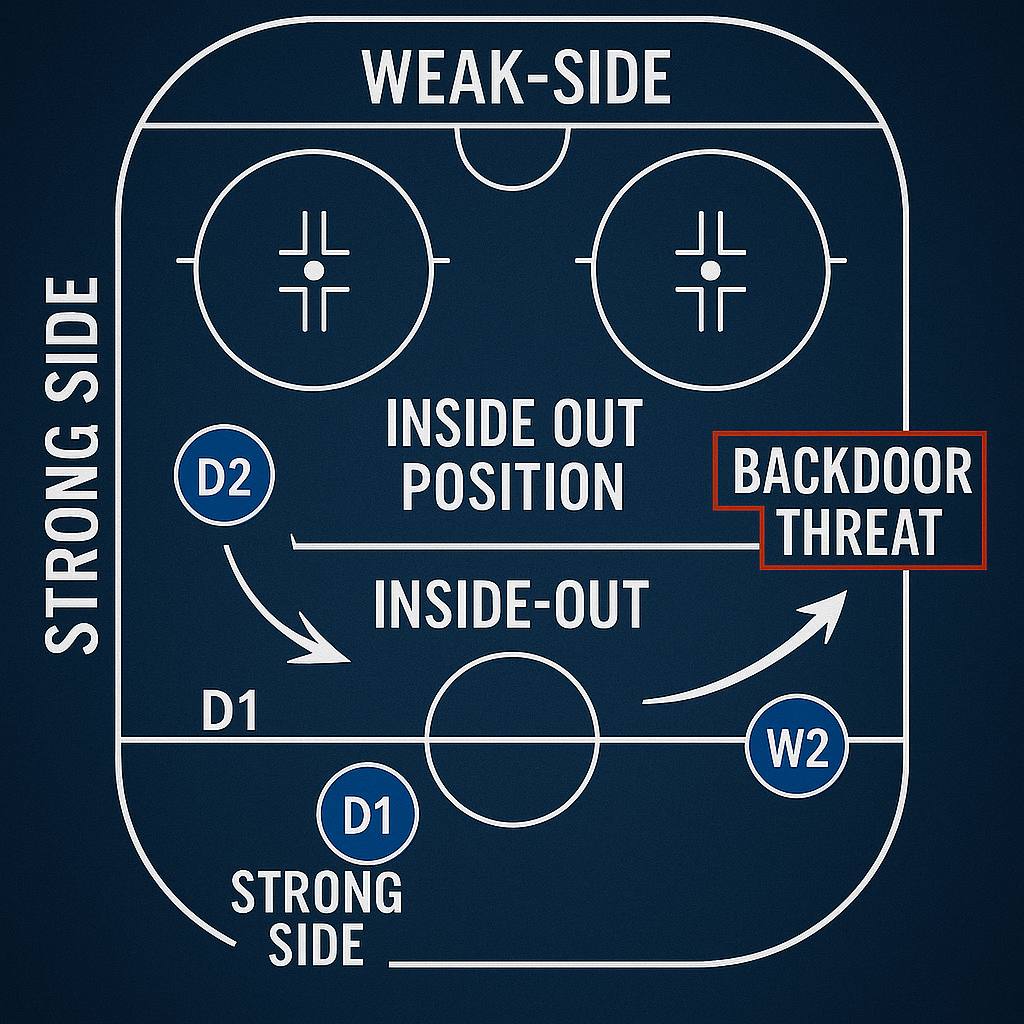
2. Inside-Out Positioning

The defender must stay between the weak-side attacker and the net.

  • Feet inside dots
  • Stick in the passing lane
  • Hip-to-hip on collapse rotations

Inside-out prevents the attacker from getting body position for a tap-in.

3. Backdoor Timing Reads

  • Watch opponent’s weak-side D pinch pattern
  • Recognize “delay passes” from below goal line
  • Track the far-side F driving backside post
  • Identify when puck-carrier turns his feet toward backdoor lane

4. Weak-Side Winger Job

First responsibility: middle ice, not the point.

  • Protect inside lane before jumping high
  • Read if puck is about to rotate D-to-D
  • No chasing when your D1 is engaged low
  • Collapse early on backdoor drivers

5. Defensemen Responsibilities

  • D1: Stay net-front; eliminate stick; read backside pressure
  • D2: Control low-lane; stay connected to D1 on switches
  • No blind chases behind the net
  • Stick must stay in seam – not above hands, not sweeping

🔧 Bench / On-Ice Calls

  • “Middle!” - keep weak-side winger inside
  • “Backdoor!” - D1 tightens low support
  • “Switch!” - D1/D2 hand off weak-side cutter

❌ Common Mistakes

MistakeWhy it hurts coverage
Weak-side winger jumps high earlyOpens center lane → backdoor tap-in
D1 ball-watching on strong sideLoses backside stick → redirect goal
No scanningWeak-side attacker becomes “invisible”
D2 chases outside the dotsGives attacker inside body position

💬 Coach Mark Lehtonen says

Strong-side pressure forces plays. Weak-side awareness kills plays.

Backdoor goals are not talent issues – they are attention issues. Scan or get punished.

🧪 Micro-Drills

  • Weak-side shoulder-check timing drill
  • Backdoor cut recognition sequences
  • D-to-D rotation with winger collapse reps
  • Inside-out positioning footwork circuit

🧱 Summary

Weak-side awareness is the antidote to backdoor goals. With structured scanning habits, inside-out positioning, and disciplined winger reads, teams shut down far-side attacks and eliminate tap-in threats. Strong-side pressure wins battles – weak-side awareness wins games.

Q&A – Defensive Zone Coverage

Q1: Why is weak-side awareness more important at higher levels?

A: Because elite offenses hunt backdoor lanes. They know that one defender losing inside positioning on the weak side creates an uncontested tap-in. The higher the level, the faster these reads happen.

Q2: What causes most backdoor breakdowns?

A: Weak-side players ball-watching. When W2 or D2 stare at the puck instead of maintaining inside-out body position, attackers slip behind them and receive uncontested passes.

Q3: Should the weak-side winger chase the point immediately?

A: No. The middle comes first. You jump to the point only after the slot and backdoor are secure. Good teams give up low-danger point shots before they ever give up the backdoor.

Q4: How do defensemen support weak-side protection?

A: D1 and D2 must communicate constantly – “Middle!”, “Inside!”, “Switch!”. D1 holds strong-side net-front, D2 protects weak-side lanes. If one defender overcommits, the other fills inside.

Q5: What is the golden rule of backdoor protection?

A: Inside-out positioning. If you stay between your man and the net, the pass cannot hurt you. Lose the inside, and the play becomes uncontrollable.


IHM Academy · Defensive Zone Coverage-Lesson 5

IHM Academy · Defensive Zone Coverage-Lesson 5

IHM Academy – Defensive Zone Coverage · Lesson #5
D-Zone Faceoff Coverage & Responsibilities

Defensive-zone faceoffs decide momentum, possession, and scoring chances. A single blown assignment can turn a harmless draw into a Grade-A chance against. Elite teams treat D-zone faceoffs as structured mini-systems, with fixed roles, predictable rotations, and non-negotiable responsibilities.

You don’t react in the D-zone circle – you execute.

IHM Academy - Defensive Zone Coverage · Lesson #5
D-Zone Faceoff Coverage & Responsibilities

🎯 Objective

  • Win back-possession clean
  • Deny quick shots off the draw
  • Protect the middle first, then the point
  • Prevent lost-net coverage and backdoor threats
  • Execute clean breakout routes after recovery

🧠 Core Concepts

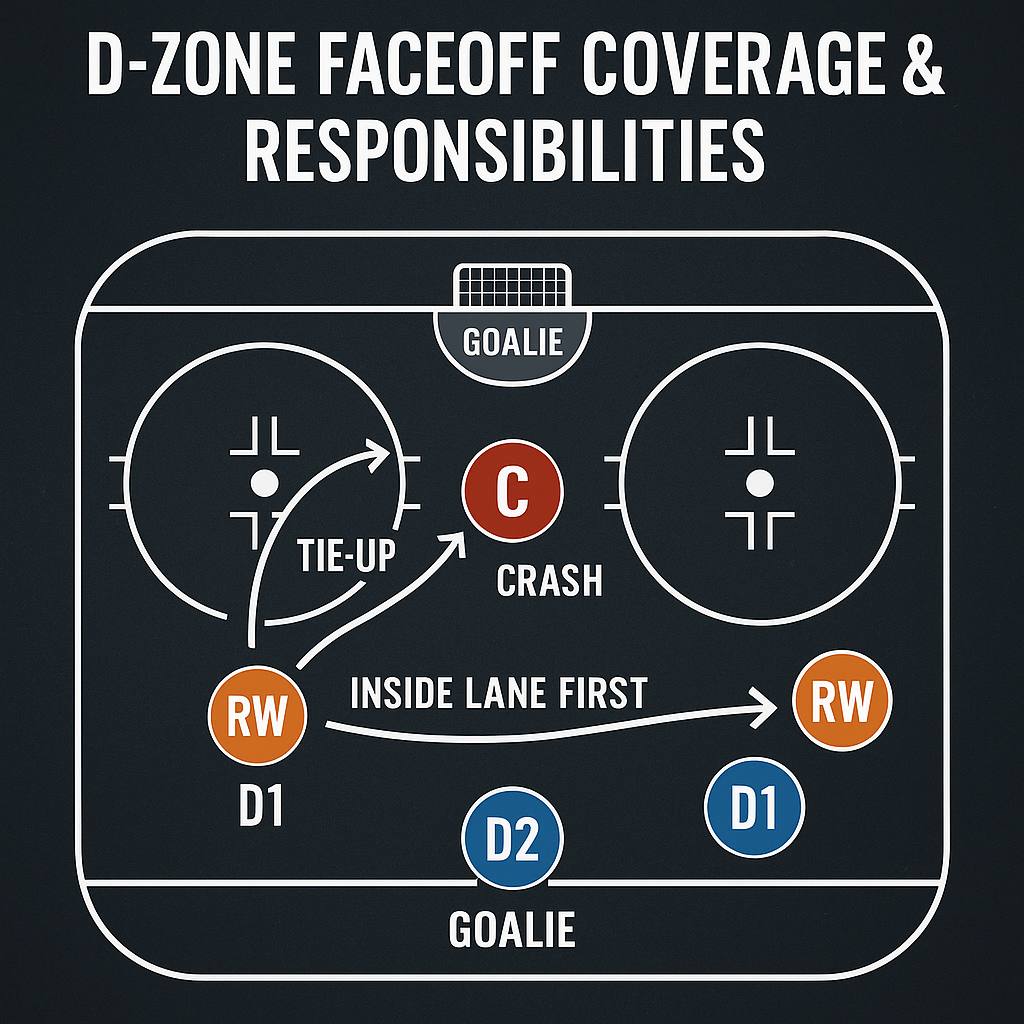
1. Center Responsibilities

  • Tie up opposing center immediately
  • Steer puck toward your strong-side support
  • Stay low for inside support if the puck is lost
  • Communicate “Tie-up” / “Win back” / “Switch” before puck drop

2. Strong-Side Winger

  • Crash the circle on tie-ups
  • Deny direct shot from the dot
  • Box-out screen attempts
  • Be ready to rim-and-out on clean wins

3. Weak-Side Winger

  • Protect the inside dot lane
  • Cover the high slot shooter
  • Jump to point only after securing the middle
  • Read if the puck is lost: collapse, then expand

4. Defensemen

  • D1: Take net-front, eliminate stick, hold inside body position
  • D2: Handle strong-side wall, control low pressure, be first on loose pucks
  • Switch only on clear communication (“Bump”, “Switch”, “Middle”)
  • Never chase behind the net off lost faceoff

🔧 Bench / On-Ice Calls

  • “Middle!” – weak-side winger stays inside
  • “Hold!” – no rotations, protect net first
  • “Switch!” – D1 and D2 exchange assignments on scramble

❌ Common Mistakes

MistakeWhy it hurts coverage
Weak-side winger jumps to point earlyOpens slot → instant high-danger chance
D1 loses stick tie-upNet-front redirect / screen opportunity
Center loses body positionOpposing center walks into slot
No communication on tie-upsBoth wingers chase → lost structure

💬 Coach Mark Lehtonen says

D-zone faceoffs aren’t battles – they’re rehearsed executions.

A weak-side winger who protects the middle wins more shifts than a winger who chases the point.

🧪 Micro-Drills

  • 3v3 D-zone tie-up drill with live release
  • Winger crash vs. quick-shot denial reps
  • D1/D2 communication resets after lost draw
  • Rim-and-out breakout under pressure

🧱 Summary

D-zone faceoff coverage is the backbone of defensive reliability. With proper communication, tight role execution, and disciplined inside-out coverage, teams turn defensive draws from danger into opportunity.

Q&A – Defensive Zone Coverage

Q1: Why are D-zone faceoffs treated like mini-systems?

A: Because every player has a fixed role and a fixed read. If one assignment breaks – the entire structure collapses. Elite teams execute rehearsed patterns, not improvisation.

Q2: What is the most common mistake at D-zone draws?

A: Weak-side winger cheating high. The slot opens instantly and becomes the most dangerous shooting lane on the ice.

Q3: Should centers always try to win the draw clean?

A: Not always. Sometimes a tie-up is the correct play because it allows the strong-side winger to crash and win the loose puck with better leverage.

Q4: When do defensemen switch coverage?

A: Only on clear verbal triggers like “Bump” or “Switch.” Silent switches cause both D to chase and leave the net-front uncovered.

Q5: How fast should the breakout happen after a clean win?

A: Immediately. The strong-side winger must be ready for rim-and-out, while the weak-side winger reads middle support. Delay equals pressure, and pressure equals turnovers.


IHM Academy · Defensive Zone Coverage-Lesson 4

IHM Academy · Defensive Zone Coverage-Lesson 4

By Coach Mark Lehtonen · IHM Academy · Defensive Zone Coverage

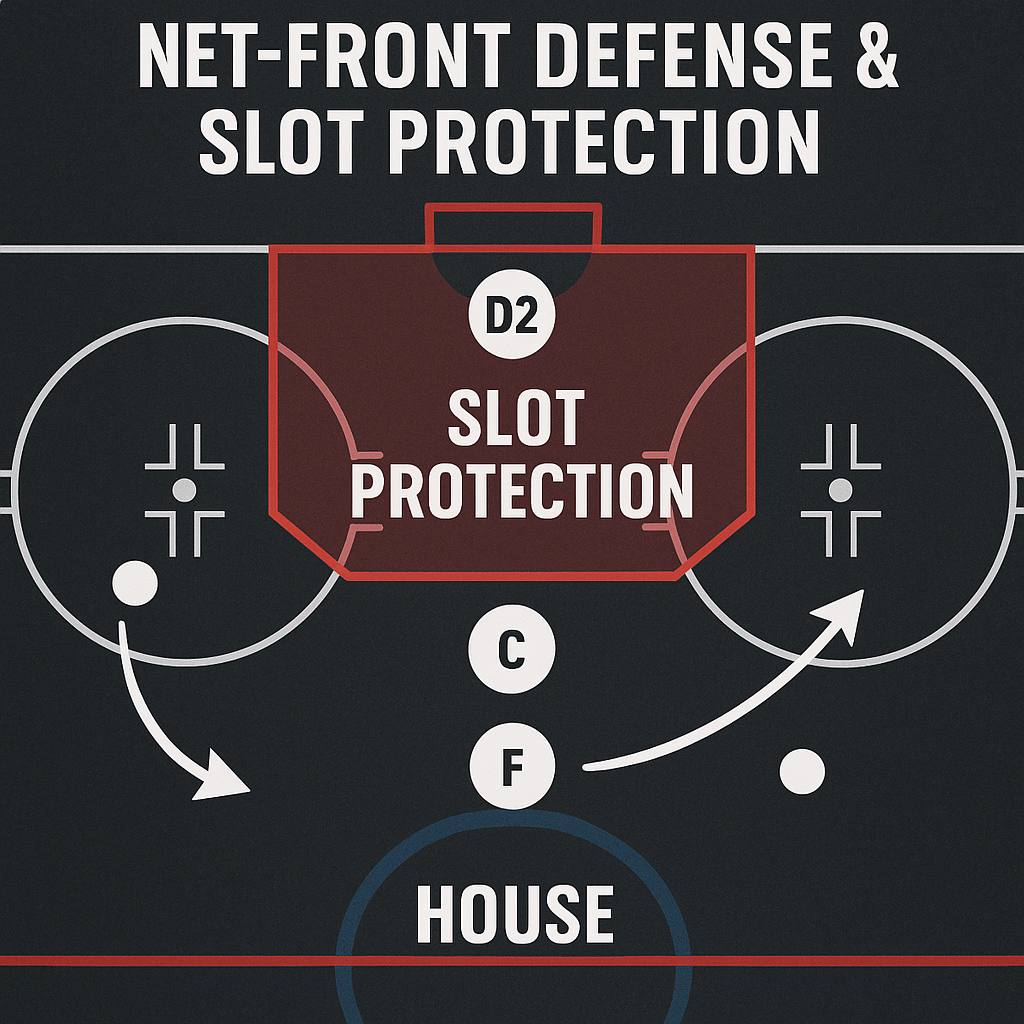
IHM Academy – Defensive Zone Coverage · Lesson 4: Net-Front Defense & Slot Protection

The defensive zone does not break first on the boards - it breaks in the slot.

Teams that lose the middle of the ice give up screens, tips, and rebounds no system can survive. Net-front defense and slot protection are the backbone of every coverage. If the house stays strong, the rest of the structure can bend without breaking.

In this lesson we build clear rules for how defenders and forwards protect the blue paint, manage sticks, and control body position when the puck is high, low, or on the move.

IHM Academy - Defensive Zone Coverage · Lesson 4: Net-Front Defense & Slot Protection

🎯 Core Objectives

  • Keep the middle of the ice sealed in all coverages (box+1, overload, switch systems).
  • Establish simple, repeatable rules for who owns the net-front at every moment.
  • Teach defenders how to battle without taking unnecessary penalties.
  • Control sticks first, then bodies, then rebounds.
  • Turn net-front wins into clean exits instead of second and third chances.

🧠 Net-Front Role Definitions

1. D1 – Primary Net-Front Defender

  • Owns the space from the top of the crease to the low slot.
  • Plays inside position: body between attacker and goalie at all times.
  • Eyes on chest, stick under the attacker’s hands, not chasing the puck.
  • Finishes every shot sequence with a box-out and a quick shoulder check.

2. D2 – Support & Box Help

  • Stays one step above D1, ready to help on rebounds or second net-front attackers.
  • Protects the high slot when the puck is low, closes to the crease when it rises.
  • Responsible for “second touch” - clearing loose pucks after the first save.

3. Center – Slot Security

  • Is the first forward responsible for the middle lane.
  • Tracks late slot entries from opposing centers and high forwards.
  • Communicates switches when wingers are pulled down or inside.

4. Wingers – Inside-Then-Out

  • When the puck is high, start inside the dots before closing to the point.
  • If beaten inside, collapse to help on the slot rather than chasing wide.
  • On shot release, box out their side-lane attacker and look for loose pucks.

🔧 Technique – How to Defend the Net Front

Body Position

  • Feet outside the opponent’s skates, hips between attacker and goalie.
  • Stick blade on the ice in front of the attacker’s blade, not behind.
  • Shoulders low, legs loaded - ready to handle bumps without losing balance.

Stick & Hands

  • “Stick first” - lift, pin, or tie up before delivering contact.
  • Hands stay inside the frame; avoid wrapping arms around the opponent.
  • After shot release, attack the attacker’s stick for tips and rebounds.

Box-Out Timing

  • Engage early when the puck moves high - don’t wait on the crease.
  • Drive the attacker out of the blue paint, then hold ice, not the jersey.
  • Release contact quickly when your team gains possession to avoid penalties.

📊 Read Structure by Puck Location

Puck High at the Blue Line

  • D1 locks net-front attacker; sticks and screens managed first.
  • D2 protects mid-slot and is ready to step into shooting lane.
  • Center shades toward the high slot to deny bumper and seam plays.
  • Wingers stay inside dots, then close to their points on the pass.

Puck Low Below the Goal Line

  • D1 fronts the net-front attacker, not the puck carrier.
  • D2 supports behind or beside the net battle depending on system rules.
  • Center collapses to the middle to protect the “royal road” pass.
  • Weak-side winger slides into the hashmarks to help on backdoor threats.

Puck in the Slot or on Net-Front Scramble

  • All defenders collapse inside hashmarks with sticks sweeping inside-out.
  • Priority order: 1) sticks, 2) bodies, 3) loose puck, 4) exit.
  • First touch clears the danger area, even if it means an icing when under heavy pressure.

💬 Coach Mark Lehtonen says

If we own the blue paint, we can survive bad shifts. If we lose the blue paint, even good structure breaks.

Net-front defense is not about cross-checks. It’s about inside feet, strong sticks, and winning the first rebound.

❌ Common Mistakes & Consequences

MistakeWhy it breaks coverage
D1 plays puck, not bodyScreen and tip are uncontrolled; goalie never sees the shot
Center cheats low boardsHigh slot opens; one-timers from the middle become automatic chances
Late box-out on shot releaseAttacker already set inside; defender is chasing from behind and takes penalties
Wingers defend outside the dotsInterior lanes open, weak-side sticks are free on backdoor plays
Poor rebound decisionsPuck cleared into traffic instead of corners, leading to extended pressure

🧪 Micro-Drills & Coaching Cues

  • 1v1 Net-Front Battle Ladder: D1 vs. net-front forward, shots from the point, focus on stick ties and early box-out.
  • 2v2 Low & Net-Front: Puck starts below the goal line; D1 and D2 communicate who owns net-front, who supports the puck.
  • Rebound Clear Drill: Coach shoots from the blue line; defenders must box out, win first touch, and clear to safe lanes within two seconds.
  • Center Slot Read Drill: Centers start high, track late slot entries, and arrive inside the offensive player at shot release.

Q&A – Defensive Zone Coverage

Q1: What matters more – moving the attacker or clearing sightlines for the goalie?

A: They are connected. If you win inside position early, you remove both the screen and the inside stick. When you are late, don’t chase the hit - first fight to open the goalie’s eyes, then move the attacker out of the crease.

Q2: Should defenders cross-check in front of the net?

A: Controlled bumps are fine; constant cross-checks are not. We teach “lift, bump, hold inside ice” - strong posture and stick work instead of reckless force that leads to penalties.

Q3: How do smaller defensemen survive net-front battles?

A: With feet and leverage. Get under the attacker’s hands, win inside lane early, and use quick bumps and stick lifts. Smaller D who arrive first with good angles often win more net-front battles than big D who arrive late and upright.

Q4: Where should the first rebound go?

A: Out of the house – into the corners or behind the net. Middle ice is never an option. The first touch doesn’t need to be pretty; it just needs to remove the immediate scoring threat.

🧱 Summary

Net-front defense and slot protection are the insurance policy of every defensive-zone system. When your team owns the blue paint with clear roles, strong sticks, and disciplined body position, you turn dangerous shots into one-and-done chances instead of extended chaos.

Systems may change from year to year – box+1, overload, rotations - but the rule stays the same: the middle never breaks.

By Coach Mark Lehtonen · IHM Pre-Game Context & Tactical Outlook 27.11.2025 - NHL

By Coach Mark Lehtonen · IHM Pre-Game Context & Tactical Outlook 27.11.2025 - NHL

Detroit Red Wings vs Nashville Predators – Tactical Overview

Detroit enter this matchup in a strong rhythm, showing a noticeable rise in transitional pace and improved puck retrieval efficiency in the offensive zone. Their recent performances highlight a growing confidence in first-pass exits and aggressive regrouping, especially at home.

Nashville, meanwhile, have been navigating inconsistency. The Predators continue to struggle generating sustained zone time, particularly when facing teams that press high and deny controlled entries. Recent matches showed flashes of structure, yet gaps remain in coverage during defensive rotations.

The dynamic between these two teams sets up an intriguing stylistic contrast: Detroit’s expanding offensive structure against a Nashville side searching for rhythm. Both clubs approach this clash with different tactical priorities, and each will attempt to impose their preferred pace early.

With key absences on both benches, special teams and forward depth distributions are expected to play a decisive influence on momentum swings across all three periods.

Tonight’s matchup in New Jersey tested everyone’s nerves. Coach Mark’s analysis proved accurate again, as the Devils secured the result with a tight 4-3 finish. It wasn’t a calm one, but the structure of the game unfolded just as projected, and the momentum swings aligned with Mark’s pre-game breakdown.

Another successful verdict from Coach Mark.
We move forward with confidence.

To access Coach Mark’s full tactical breakdown, visit our Premium section.


By Coach Mark Lehtonen · IHM Pre-Game Context & Tactical Outlook 25.11.2025 - NHL

By Coach Mark Lehtonen · IHM Pre-Game Context & Tactical Outlook 25.11.2025 – NHL

New Jersey Devils vs Detroit Red Wings – Tactical Preview

The Devils and Red Wings meet in Newark in a matchup that should tell us a lot about where both teams are heading. New Jersey is trying to stabilise after a choppy run that mixed strong offensive performances with costly defensive lapses. Detroit arrives with a more controlled, structured game, looking to turn their recent form into a statement road performance at Prudential Center.

At five on five, New Jersey still leans on pace and puck possession. Their forwards attack through quick exits and aggressive entries, using width in the neutral zone to create space for their skill players to cut inside. When the rhythm is right, the Devils generate long offensive zone shifts and a steady flow of shots from the slot and the high circles. The risk comes when that same aggressive posture leaves gaps behind their forwards and exposes the back end to rush chances against.

Detroit plays a more measured style built around layers of support. The Wings are comfortable in a tighter, lower event game where they can use their heavier forwards on the forecheck and lean on structured routes through the neutral zone. Their blue line prefers controlled gaps and good sticks at the line rather than trading chances. When they execute, Detroit can slow opponents down, force dump ins and turn recoveries into quick counter attacks.

Injuries are an important part of this picture. New Jersey is still managing absences among their forwards and defence group, which has forced adjustments in pairings and matchups. Detroit has also had to shuffle the back end, with young pieces in and out of the lineup, but their overall structure has remained recognisable. How both coaching staffs manage deployment against top lines and special teams minutes will be a key storyline.

Special teams could become the swing factor. The Devils traditionally build their power play around quick puck movement, a strong half wall threat and one touch passing through the middle. Detroit’s penalty kill prefers a compact box with pressure on the half boards and quick clears rather than extended scrambles. Discipline, both with and without the puck, will decide how often each side gets to lean on those units.

To access Coach Mark’s full tactical breakdown, visit our Premium section.


https://icehockeyman.com/2025/11/23/ihm-academy-%c2%b7-performance-metrics-masterclass-lesson-9/
Washington Capitals vs Tampa Bay Lightning - Pre-Game Context & Tactical Outlook 23.11.2025 - NHL

Washington Capitals vs Tampa Bay Lightning – Pre-Game Context & Tactical Outlook 23.11.2025 – NHL

Washington enters this matchup looking to steady their rhythm after a mixed stretch that showcased both resilience and inconsistency. Their recent win displayed strong puck management in transition, while their previous outings underlined moments where defensive spacing broke down at key moments. Tampa Bay, meanwhile, continues to rely on structured offensive entries and quick-release shooting patterns that regularly stress opponents in the neutral zone.

Both teams arrive with notable absences that influence the structural balance of this matchup. Washington’s depth chart has been stretched on the forward side, while Tampa Bay’s blue line is dealing with its own instability. These absences have recently forced both coaching staffs to adjust usage patterns, shorten rotations and rely more heavily on specific core units to generate flow.

Their head-to-head dynamic traditionally produces a high-tempo brand of hockey defined by aggressive forechecking and controlled exits. Washington’s recent games highlight an emphasis on rapid counterattacks, especially when their top-six forwards are given space to accelerate through the middle lanes. Tampa Bay, on the other hand, continues leaning on layered offensive pressure and high-slot creation to push scoring momentum.

Earlier in the week, Washington’s matchup was also reviewed, and that verdict was delivered exactly as described. The consistency reflects our ongoing focus on structural precision and tactical clarity in every evaluation.

As always, the full tactical breakdown for this matchup is available exclusively to Premium members. It includes advanced metrics, lineup structures, coaching duel insights and Coach Mark Lehtonen’s complete verdict.

To access Coach Mark’s full tactical breakdown, visit our Premium section.