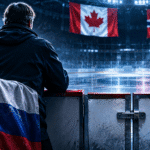
Russia Out of 2027 World Juniors Despite CAS Ruling: Canada Blocks Participation, Norway Returns
By IceHockeyMan Editorial Team | Published: 17 November 2026
Russia will not participate in the 2027 IIHF World Junior Championship in Canada, despite a landmark ruling by the Court of Arbitration for Sport (CAS) ordering the International Ice Hockey Federation (IIHF) to allow Russian national teams to return to five major international championships.
On 15 November 2026, the IIHF officially confirmed that restrictions communicated by the Canadian government prevent Russia’s under-20 national team from competing at the tournament.
The championship will remain in Edmonton and Red Deer, Canada, from 26 December 2026 to 5 January 2027. Norway, which had temporarily lost its place following the CAS ruling, has now been reinstated.
The development marks another dramatic turn in a story that IceHockeyMan first reported on 30 October, when CAS overturned the IIHF’s continued exclusion of Russian national teams.
What initially appeared to be a significant step towards Russia’s return to international hockey has now become a complicated dispute involving sporting arbitration, national government restrictions, tournament organisation and the rights of participating teams.
IIHF Confirms Russia Will Miss the 2027 World Juniors
In its official statement published on 15 November, the IIHF confirmed that the Russian under-20 national team cannot participate in the upcoming championship because of the position and restrictions formally communicated by the Canadian government.
The federation also confirmed that alternative arrangements had been considered before its Council decided to retain Canada as the tournament host.
The decision means the championship will proceed in Edmonton and Red Deer without Russia.
This is an important distinction: the CAS ruling has not simply disappeared or been overturned by a new arbitration judgment.
Instead, the IIHF faces a situation in which an arbitration decision concerning eligibility must be considered alongside restrictions imposed by the government of the host country.
The legal and sporting questions raised by the October ruling therefore remain relevant, even though Russia’s participation in this particular tournament is no longer possible under the arrangements confirmed by the IIHF.
How the Situation Changed: From Russia’s Return to Exclusion
The sequence of events explains why supporters have encountered contradictory headlines and tournament graphics during November.
30 October 2026: CAS Orders Russia’s Reinstatement
CAS ruled in favour of the Russian Ice Hockey Federation in its dispute with the IIHF, ordering the governing body to permit Russian participation in five international championships scheduled for 2027.
Those events included the World Junior Championship in Canada and the Men’s World Championship in Germany.
The IIHF expressed disagreement with the ruling but acknowledged its obligation to act in accordance with the arbitration decision.
IceHockeyMan reported the development in our original article, Russia’s Return to World Hockey: CAS Orders IIHF to Allow Russian Teams at 2027 Championships.
7 November 2026: IIHF Addresses Implementation
In a further statement concerning Russia and Belarus, the IIHF confirmed that it was examining how to implement the CAS decision, including the conditions necessary to protect its championships and address organisational concerns.
The federation also indicated that discussions with affected national associations would be part of the process.
8 November 2026: Norway Temporarily Loses Its Place
The Norwegian Ice Hockey Association announced that it had been informed of arrangements to bring Russia into the 2027 World Junior Championship.
Under that proposed tournament structure, Russia would become the tenth participating nation, while Norway, the lowest-ranked team, would be moved to Division I Group A.
For Norway’s players and coaches, this created considerable uncertainty after the national team had earned promotion through competition.
However, the situation was not yet settled. Canada’s position on Russian participation remained a major obstacle.
15 November 2026: Russia Is Ruled Out, Norway Returns
The IIHF confirmed that Russia would be unable to participate because of Canadian government restrictions.
On the same day, the Norwegian Ice Hockey Association confirmed that its under-20 national team would participate in Edmonton as originally planned.
The result was a reversal of the arrangements announced only one week earlier.
Why Canada’s Decision Matters
The central issue is the distinction between eligibility under international sporting regulations and permission to enter a host country for a sporting event.
CAS considered whether the IIHF had sufficient grounds under its applicable regulations to maintain Russia’s exclusion.
The Canadian government’s position concerns participation on Canadian territory.
According to Reuters, Canadian officials made clear that Russian and Belarusian athletes and officials seeking to participate in the event would not be admitted, even where valid visas had previously been issued.
Canada has linked its position to Russia’s continuing war against Ukraine. Canadian officials maintain that restrictions on national-team representation should continue under the present circumstances.
Russia’s hockey federation has rejected the outcome as politically motivated and unlawful, while the IIHF has maintained that practical arrangements and the responsibilities of host authorities must be taken into account.
These are distinct positions within the same dispute.
A decision about a federation’s eligibility rules does not, by itself, guarantee that a host government will permit the entry and participation of every athlete or official.
The 2027 World Juniors have now become a clear example of that distinction.
Norway Returns to the Championship After a Week of Uncertainty
Norway’s reinstatement is another significant part of this story.
The Norwegian under-20 national team had earned its place at the top-level World Junior Championship through promotion.
Following the CAS decision, Norway faced the possibility of losing that place without having been relegated on the ice.
For the players, the uncertainty affected preparations for one of the most important international tournaments of their junior careers.
On 15 November, the Norwegian Ice Hockey Association confirmed that the team would return to the championship and continue its planned preparations, including its pre-tournament camp and games in Canada.
The federation also emphasised that the resolution applies specifically to this tournament and does not settle the question of Russian participation at other championships.
That distinction will be important as the IIHF continues addressing the wider consequences of the CAS ruling.
Confirmed Groups for the 2027 World Junior Championship
With Russia unable to participate and Norway reinstated, the official tournament schedule dated 15 November lists the following preliminary-round groups:
Group A – Red Deer
- Finland
- Germany
- Slovakia
- Sweden
- United States
Group B – Edmonton
- Canada
- Czechia
- Latvia
- Norway
- Switzerland
Norway is scheduled to open its championship against Czechia on 26 December at Rogers Place in Edmonton.
Canada will begin its tournament against Switzerland on the same day, while Latvia’s first game is scheduled against Czechia on 27 December.
The championship concludes with the medal games on 5 January 2027.
Social-media graphics claiming that Russia has been definitively placed in Canada’s group are therefore inconsistent with the IIHF’s latest confirmed arrangements.
What Happens to Russia’s Other 2027 Championships?
Russia’s exclusion from the World Junior Championship does not automatically settle its status for the other four championships covered by the October CAS ruling.
Those competitions are:
- 2027 IIHF U18 Women’s World Championship – Czech Republic
- 2027 IIHF U18 Men’s World Championship – United States
- 2027 IIHF Men’s World Championship – Germany
- 2027 IIHF Women’s World Championship – Canada
Each tournament involves different host-country arrangements, participating teams and organisational requirements.
The Men’s World Championship in Germany is particularly significant because several national federations have publicly expressed opposition to playing against Russia while the war in Ukraine continues.
The German Ice Hockey Federation has also raised concerns about the security, political and economic consequences of Russia’s possible participation.
Following the World Junior decision, German hockey officials called for greater clarity from the IIHF ahead of the May tournament.
As of 17 November 2026, the latest World Junior decision should not be interpreted as a final determination of Russia’s participation in those other events.
Further official decisions and practical arrangements remain essential.
Coach Mark Lehtonen’s Earlier Message: Let Hockey Be Hockey
This latest development also brings renewed attention to the principles discussed in Coach Mark Lehtonen’s column published by IceHockeyMan on 30 October.
In Coach Mark Lehtonen: Let Hockey Be Hockey – Russia’s Return, Politics in Sport and a New Chapter for IceHockeyMan, the Finnish coach welcomed the possibility of Russia returning to international competition from a sporting perspective.
His argument focused particularly on young athletes whose opportunities to compete internationally can be affected by circumstances beyond their control.
However, the column also recognised the suffering caused by the war in Ukraine, the legitimate concerns of other national federations and the importance of protecting sporting fairness.
One principle from that earlier discussion is especially relevant now: young athletes deserve fair treatment, and teams that have earned their championship places should not be casually displaced.
The situation involving Russia and Norway illustrates just how difficult it can be to reconcile those principles when international sporting decisions collide with national restrictions and existing competition structures.
Russia’s junior players have again lost an opportunity to participate internationally.
Norway’s junior players, meanwhile, have recovered an opportunity they earned through promotion.
Both outcomes have genuine sporting consequences for the athletes involved.
Recognising those consequences does not require ignoring the war, dismissing security concerns or treating the competing circumstances as equivalent.
It requires understanding that major international decisions affect individual sporting careers as well as national federations.
IHM Insight: A Legal Victory Is Not the Same as a Guaranteed Return
The most important lesson from the past three weeks is that a successful arbitration ruling does not necessarily resolve every practical obstacle to participation.
The CAS decision changed the legal position concerning the IIHF’s exclusion of Russian teams.
The subsequent events demonstrated that national government restrictions, host-country responsibilities and the rights of other participating teams can still determine whether a championship can proceed with a particular national team.
For international hockey, this creates an important question extending beyond the 2027 World Juniors.
How should international federations implement binding sporting decisions when host countries, national associations and tournament organisers disagree about the consequences?
There is no simple answer that eliminates every competing responsibility.
But greater clarity, consistent rules and timely communication are essential if athletes, coaches and supporters are to have confidence in international competitions.
The situation involving Norway also demonstrates why tournament allocations cannot be treated as an insignificant administrative detail.
For a promoted junior national team, participating in a top-level World Championship is the result of years of development and an achievement earned on the ice.
That sporting achievement deserves consideration alongside the eligibility rights established by arbitration.
What Comes Next?
Russia will not participate in the 2027 World Junior Championship under the arrangements confirmed by the IIHF on 15 November.
Norway will compete in Edmonton, and the championship will proceed in Canada as scheduled.
The wider dispute over Russia’s return to international hockey, however, remains unresolved.
The coming decisions concerning the 2027 Men’s World Championship and the remaining events covered by CAS will help determine whether October’s ruling leads to a broader return or further disagreements between sporting authorities and national governments.
IceHockeyMan will continue following the official decisions, the reactions of national federations and the implications for international hockey.
Our editorial approach remains focused on verified information, sporting fairness and independent hockey coverage.
The legal ruling was real. The possibility of Russia returning was real. The subsequent restrictions are real as well.
Understanding the full sequence matters far more than relying on a single viral headline.
IceHockeyMan Editorial Team – Independent international hockey news, intelligence and reporting.