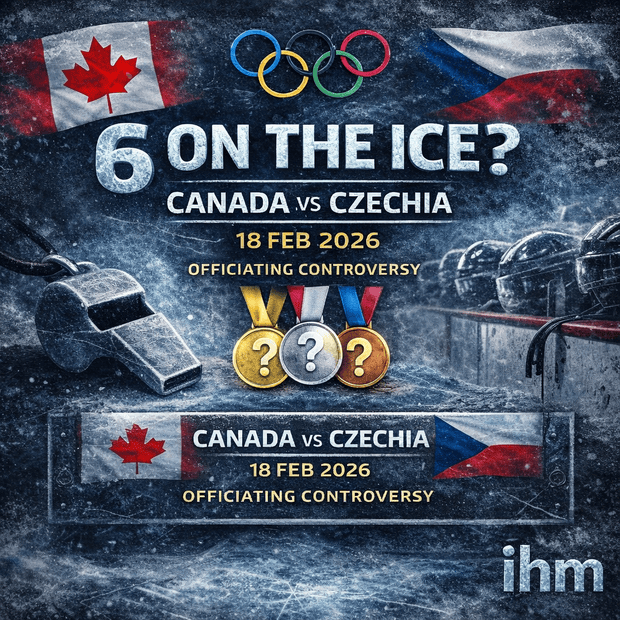
Date: 19 February 2026
By IceHockeyMan Newsroom
The Moment That Nearly Redefined the Tournament
Canada survived. That is the headline. But survival erased what could have become the defining officiating controversy of the Milano Cortina 2026 tournament.
Midway through the third period of the Olympic quarterfinal between Canada and Czechia, Ondrej Palat scored to give Czechia a 3-2 lead. The rush looked ordinary at full speed. The replay did not.
Video angles strongly indicated that Czechia had six skaters on the ice during the turnover sequence that initiated the counterattack. No penalty was called. Under IIHF regulations, the situation was not reviewable. The goal stood.
Breaking Down the Sequence Frame by Frame
The play began with a Thomas Harley shot blocked by Tomas Hertl high in the zone. Martin Necas collected the loose puck and immediately accelerated through the neutral zone.
At the moment of puck transition, Canadian defenders began their standard read: two layers collapsing toward middle ice. But the recognition timing appeared disrupted. Why? Because there was an additional Czech skater exiting the zone.
In elite hockey, defensive reads are based on pattern recognition. Three attackers. Two defenders. Support layer tracking late. When that pattern becomes four attackers plus trailer against two defenders, reaction timing shifts by fractions of a second. Fractions are everything.
Palat trailed the rush and finished the play with a clean wrist shot past Jordan Binnington. Execution was not the controversy. Structure was.
The Rulebook Problem
Under current IIHF rules, too-many-men infractions tied to transitional sequences are not eligible for video review. Officials must catch the violation live. If they do not, play continues.
In regular-season tournaments, that is controversial. In elimination Olympic hockey, it becomes systemic risk.
If Canada Had Been Eliminated
Now imagine the alternate timeline. No Suzuki equalizer. No Marner overtime winner. Canada eliminated 3-2.
The international hockey community would be demanding answers within minutes. Review protocols would dominate headlines. Players would question integrity. Sponsors would question process.
Instead, Canada tied the game minutes later and ultimately advanced. Narrative avoided crisis. Structure avoided scrutiny.
Jon Cooper’s Silent Response
After the game, head coach Jon Cooper was asked directly about the too-many-men situation. He smiled. And walked away.
That reaction carried more weight than a press conference.
Competitive Impact Analysis
Let us be clear about something important. An extra skater does not guarantee a goal. But it changes defensive mathematics.
- Gap control timing shifts.
- Passing lanes widen.
- Backtracking assignments hesitate.
- Communication layers overload.
In high-speed elimination hockey, hesitation equals exposure. Exposure equals high-danger chance probability increase.
Canada’s defensive pair had to read four potential lanes instead of three. That changes angling decisions instantly.
Coach Mark Comment
I will say this without drama but with clarity. At the Olympic level, this is unacceptable.
You cannot have structural violations during elimination play and hide behind technical non-reviewability. We are not discussing a borderline offside. We are discussing numerical imbalance during a turnover sequence.
Elite players train four years for this stage. Every line change is drilled. Every defensive rotation is rehearsed. And yet the officials are left with a split-second manual call system in a tournament that claims to represent the highest standard of international hockey.
If Canada had lost, the governing body would be facing global scrutiny. Not because of conspiracy. Because of protocol weakness.
Modern hockey moves too fast for human-only enforcement in transition chaos. Technology exists. Expanded review protocols exist. The refusal to implement them at this stage is a governance decision.
Survive and advance saved the story. But the clip remains. And credibility should not rely on overtime redemption.
What Should Change?
The Olympic tournament must consider:
- Automatic video review for too-many-men infractions tied to goals.
- Expanded off-ice officiating monitoring during transitions.
- Transparent post-game review reports for elimination rounds.
If medals define legacy, then officiating clarity must match the magnitude of the moment.
Q&A: The Controversy Explained
Was there clearly a sixth player?
Replay angles strongly suggested six Czech skaters were on the ice during the turnover sequence.
Did officials miss it?
No penalty was called, indicating the on-ice officials did not identify a violation during live play.
Can IIHF review too-many-men situations?
Not under current protocol when tied to transitional sequences unless directly challenged within reviewable categories.
Did it decide the game?
Canada ultimately won in overtime, but the goal altered third-period momentum significantly.
Why does this matter beyond one game?
Elimination tournaments are defined by narrow margins. Structural enforcement integrity protects competitive fairness.