
Category: IHM Newsroom

Official IceHockeyMan editorial hub. Breaking hockey updates, league insights, and major headlines from the world of ice hockey.

NHL Projected Lineups May 11 2026 | IHM

NHL Projected Lineups May 11 2026 | IHM

NHL Projected Lineups – Game Day May 7, 2026

Date: May 10, 2026
By IceHockeyMan Newsroom

Final update: All projected lineups for today have been added.

Matchup: Montreal Canadiens vs Buffalo Sabres

Faceoff: 01:00 CET

Montreal Canadiens – Projected lineup

Forwards
Cole Caufield – Nick Suzuki – Juraj Slafkovsky
Zachary Bolduc – Jake Evans – Kirby Dach
Additional offensive support
Depth rotational units

Defense
Lane Hutson – Noah Dobson
Ivan Demidov support structure
Additional defensive layers

Goalies
Jakub Dobes – Expected
Jacob Fowler

Power Play 1
Nick Suzuki – Cole Caufield – Juraj Slafkovsky
Ivan Demidov – Lane Hutson

Power Play 2
Jake Evans – Zachary Bolduc – Kirby Dach
Alex Newhook – Noah Dobson

Injured: Patrik Laine (IR)

IHM Lineup Note:
Montreal continues to build around speed, puck movement and young offensive skill. Suzuki, Caufield, Slafkovsky, Demidov and Hutson remain the main engines behind the Canadiens’ attack, while Dobson adds another important puck-moving layer on the second power-play unit. Dobes expected gives Montreal stability entering another high-pressure playoff game.

IHM Tactical Signals:
Forecheck Signal: Montreal must pressure Buffalo’s exits before the Sabres establish transition rhythm.
Transition Signal: Suzuki and Demidov remain Montreal’s main pace-driving creators.
Blue Line Signal: Hutson and Dobson give Montreal dynamic offensive support from the back end.
Goalie Stability Signal: Dobes expected keeps Montreal’s defensive structure predictable and organized.
X-Factor Signal: Montreal needs clean puck management because Buffalo punishes turnovers extremely quickly.

Buffalo Sabres – Projected lineup

Forwards
Zach Benson – Tage Thompson – Jack Quinn
Jason Zucker – Ryan McLeod – Alex Tuch
Additional scoring depth
Bottom-six support rotation

Defense
Rasmus Dahlin – Bowen Byram
Support defensive structure
Additional depth pairings

Goalies
Alex Lyon – Expected
Ukko-Pekka Luukkonen

Power Play 1
Tage Thompson – Zach Benson – Jack Quinn
Rasmus Dahlin – Josh Doan

Power Play 2
Ryan McLeod – Jason Zucker – Alex Tuch
Bowen Byram – Josh Norris

Injured: Noah Ostlund (OUT), Justin Danforth (IR), Jiri Kulich (IR)

IHM Lineup Note:
Buffalo still carries one of the fastest transition identities in the postseason. Dahlin and Byram continue to drive the pace from the blue line, while Thompson, Quinn, Tuch and McLeod create layered offensive pressure through speed and quick puck movement. Lyon expected keeps the Sabres stable in goal entering another important playoff matchup.

IHM Tactical Signals:
Forecheck Signal: Buffalo wants aggressive puck recovery and fast offensive-zone reloads.
Transition Signal: Dahlin remains the primary pace accelerator from the back end.
Blue Line Signal: Dahlin and Byram still provide elite puck-distribution potential.
Goalie Stability Signal: Lyon expected gives Buffalo a calm structure behind an aggressive style.
X-Factor Signal: Buffalo becomes dangerous when the defense activates into second-wave offense.

IHM Match Pressure Index:
Offensive Pressure: Even
Transition Edge: Sabres slight edge
Defensive Stability: Even
Goaltending Edge: Even
Game Control Projection: Buffalo projects to carry slightly more transition pressure through its blue-line mobility, while Montreal’s route depends on creativity, efficient puck movement and quick offensive execution.

Matchup: Anaheim Ducks vs Vegas Golden Knights

Faceoff: 03:30 CET

Anaheim Ducks – Projected lineup

Forwards
Chris Kreider – Mikael Granlund – Troy Terry
Alex Killorn – Ryan Poehling – Beckett Sennecke
Leo Carlsson support structure
Additional depth rotation

Defense
John Carlson – Jackson LaCombe
Cutter Gauthier support pairings
Additional defensive depth

Goalies
Lukas Dostal – Confirmed
Ville Husso

Power Play 1
Mikael Granlund – Chris Kreider – Troy Terry
Leo Carlsson – John Carlson

Power Play 2
Ryan Poehling – Alex Killorn – Beckett Sennecke
Jackson LaCombe – Cutter Gauthier

Injured: Radko Gudas (DTD), Drew Helleson (OUT), Petr Mrazek (IR)

IHM Lineup Note:
Anaheim continues to lean heavily on youthful speed and offensive creativity. Carlsson, Terry, Gauthier, Sennecke and McTavish still provide the offensive upside, while Dostal confirmed remains the Ducks’ most important stabilizing factor. The uncertainty around Gudas also affects Anaheim’s physical defensive identity.

IHM Tactical Signals:
Forecheck Signal: Anaheim needs selective pressure and disciplined defensive spacing.
Transition Signal: Carlsson and Terry remain the main pace-driving threats.
Blue Line Signal: Carlson and LaCombe must move pucks quickly before Vegas establishes cycle pressure.
Goalie Stability Signal: Dostal confirmed gives Anaheim a real chance to survive long defensive stretches.
X-Factor Signal: Anaheim’s young offensive core must finish efficiently because Vegas rarely gives away momentum twice.

Vegas Golden Knights – Projected lineup

Forwards
Jack Eichel – Pavel Dorofeyev – Mitch Marner
William Karlsson – Brett Howden – Ivan Barbashev
Tomas Hertl support structure
Depth playoff rotation

Defense
Shea Theodore – Rasmus Andersson
Noah Hanifin support pairing
Additional defensive structure

Goalies
Carter Hart – Expected
Adin Hill

Power Play 1
Jack Eichel – Pavel Dorofeyev – Mitch Marner
Tomas Hertl – Shea Theodore

Power Play 2
William Karlsson – Brett Howden – Ivan Barbashev
Rasmus Andersson – Noah Hanifin

Injured: Jeremy Lauzon (OUT), Mark Stone (OUT), Alex Pietrangelo (IR-LT)

IHM Lineup Note:
Vegas still carries major offensive control through Eichel, Marner, Theodore, Hertl and Hanifin, but the absence of Stone removes an important playoff leadership and two-way presence. Karlsson returning to the power-play structure helps stabilize the depth scoring layers, while Hart expected gives Vegas a clear crease plan.

IHM Tactical Signals:
Forecheck Signal: Vegas wants extended offensive-zone pressure and controlled puck possession.
Transition Signal: Eichel and Marner remain elite controlled-entry creators.
Blue Line Signal: Theodore and Hanifin continue to anchor Vegas puck movement.
Goalie Stability Signal: Hart expected keeps the defensive structure composed and stable.
X-Factor Signal: Without Stone, Vegas needs stronger secondary scoring support around the top unit.

IHM Match Pressure Index:
Offensive Pressure: Golden Knights edge
Transition Edge: Golden Knights slight edge
Defensive Stability: Golden Knights edge
Goaltending Edge: Even
Game Control Projection: Vegas projects to control more possession and playoff structure despite missing Stone, while Anaheim’s path depends on Dostal, quick-strike offense and surviving extended defensive-zone pressure.

Q&A: Projected Lineups and Starting Goalies

What are NHL projected lineups?
Projected lineups are expected player combinations, goalie starts and special-teams units before official warmup confirmation.

Why are projected lineups important in the playoffs?
Because playoff hockey depends heavily on matchups, injuries, defensive structure and goalie stability.

What does expected goalie mean?
It means the goalie is projected to start but has not yet been officially confirmed.

What does confirmed goalie mean?
It means the goalie has officially been named as the starter.

Why are power-play units important?
Because they reveal offensive hierarchy and show how teams plan to generate scoring pressure.

How important are injuries in playoff hockey?
Very important, especially when top centers, defensemen or leaders are unavailable.

Why does IHM include tactical notes?
Because understanding structure and matchup logic matters more than only listing names.

What should readers analyze first?
Goalie status, center depth, top defensive pairings and transition-driving players.

Can projected lineups change before puck drop?
Yes. Warmups, late scratches and coaching adjustments can still modify the final lineup.

Why are playoff power plays so important?
Because one special-teams sequence can completely shift momentum and game control.

What is the IHM Match Pressure Index?
It is a tactical summary evaluating offensive pressure, transition edge, defensive structure and projected control.

Why does playoff structure matter more than regular-season style?
Because playoff hockey is tighter, more physical and far more dependent on repeatable execution.
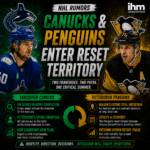

Canucks Penguins Reset Signals

Canucks Penguins Reset Signals

NHL Rumors: Canucks and Penguins Quietly Enter Reset Territory

Date: May 8, 2026
By IceHockeyMan Newsroom

The Vancouver Canucks and Pittsburgh Penguins are approaching the offseason from different timelines, but both organizations are entering the same dangerous territory - controlled reset mode.

In Vancouver, the GM search is nearing completion, and that decision could redefine the franchise direction immediately. The next executive will inherit pressure surrounding Elias Pettersson, roster balance concerns, and a fan base demanding clarity.

Meanwhile in Pittsburgh, the future of Evgeni Malkin remains one of the defining emotional and strategic decisions of the summer. Kyle Dubas understands the complexity: loyalty, legacy, cap flexibility, and roster evolution are all colliding together.

What connects both franchises is identity uncertainty. Neither team is fully rebuilding, but neither can continue operating exactly as before.

These are the most dangerous transitions in hockey - not full collapse, but gradual structural drift.

IHM Tactical Layer

Reset phases often create unstable systems. Coaches simplify tactics, veterans lose role certainty, and younger players inherit pressure before the structure around them is fully stabilized.

That transitional instability usually defines the first half of the following season.

Trending Signals

* Vancouver leadership transition nearing completion
* Pettersson future still influences direction
* Penguins evaluating emotional vs strategic decisions
* Malkin situation tied to roster evolution
* Identity uncertainty growing in both markets

IHM Market Signals

* Canucks expected to reshape organizational philosophy
* Penguins likely entering hybrid retool phase
* Veteran leadership decisions becoming critical
* League monitoring Vancouver front-office move closely

Coach Mark Comment

The hardest phase in hockey is not rebuilding. It is deciding whether you are rebuilding without admitting it publicly.

Fan Pulse

Which franchise faces the more dangerous offseason?
A) Vancouver Canucks
B) Pittsburgh Penguins

Q&A: Canucks & Penguins

Is Vancouver rebuilding?
Not officially, but structural change is happening.

Will Malkin stay?
Still uncertain.

Why is the GM search important?
It defines the next direction.

Are Penguins retooling?
Most likely.

Main risk?
Losing identity without replacing it.

Matthews Toronto Power Shift

Matthews Toronto Power Shift

NHL Rumors: Matthews Holds the Power as Toronto Reshapes the Franchise

Date: May 8, 2026
By IceHockeyMan Newsroom

The Toronto Maple Leafs won the draft lottery and secured the right to select Gavin McKenna, but internally the franchise understands one thing clearly – none of it matters if Auston Matthews loses belief in the direction of the organization.

This offseason is no longer just about roster upgrades. It is about persuasion. Toronto must convince Matthews that the next phase of the franchise can truly compete for championships.

The hiring of Mats Sundin and John Chayka signals a deeper transformation. Toronto are attempting to modernize leadership structure while reconnecting with organizational identity and long-term vision.

At the same time, discussions surrounding Morgan Rielly, William Nylander, and even hypothetical Matthews scenarios show that the Leafs are entering a dangerous but necessary evaluation phase.

The pressure is psychological as much as tactical. Once a superstar begins evaluating long-term trust in the organization, every decision becomes amplified.

IHM Tactical Layer

Toronto’s offensive talent remains elite, but playoff structure continues breaking down under layered defensive pressure. The issue is not scoring ability – it is sustainability under heavy forecheck environments.

That is why management changes matter. The Leafs are trying to redesign the environment around the core, not simply replace pieces around it.

Trending Signals

* Matthews evaluating long-term vision
* Chayka influence expected to grow quickly
* McKenna changes franchise timeline
* Core evaluation phase underway
* Defensive identity still unresolved

IHM Market Signals

* Toronto preparing for aggressive strategic reset
* Leadership structure shifting rapidly
* Matthews timeline influencing all decisions
* Trade market monitoring Leafs core closely

Coach Mark Comment

Elite players do not just evaluate teammates. They evaluate direction, trust, and stability. Toronto are trying to rebuild all three at once.

Fan Pulse

If you are Toronto, what matters more this summer?
A) Keeping Matthews fully committed
B) Building around McKenna’s future
C) Trading part of the current core
D) Changing playoff system identity

Q&A: Leafs Future

Is Matthews unhappy?
Not publicly, but evaluation is ongoing.

Why are leadership hires important?
They signal structural change.

Does McKenna affect strategy?
Massively.

Will Toronto trade core players?
Possible depending on direction.

Main challenge?
Restoring belief in long-term contention.


Oilers Pressure Zone Signals

Oilers Pressure Zone Signals

NHL Rumors: Oilers Enter Full Pressure Zone Around McDavid Era

Date: May 8, 2026
By IceHockeyMan Newsroom

The Edmonton Oilers are no longer dealing with normal offseason pressure. The situation has escalated into something larger – organizational urgency surrounding the Connor McDavid window.

Comments from Leon Draisaitl and Connor McDavid about the team trending in the wrong direction were not emotional reactions. They were internal signals. In modern NHL dynamics, star players rarely speak publicly unless frustration has already reached a meaningful level behind closed doors.

The Oilers now face layered instability. Coaching uncertainty around Kris Knoblauch, questions about roster construction, defensive structure problems, and long-term cap limitations are all colliding at the same moment.

What makes this dangerous is timing. McDavid still has elite years remaining, but the perception of “unlimited time” is gone. Edmonton understands the pressure. The league understands it too.

The Darnell Nurse discussions with Toronto before the deadline revealed another important detail – Edmonton is actively exploring structural changes, not cosmetic ones.

IHM Tactical Layer

The Oilers problem is not pure talent. It is structural balance. Their transition game remains elite, but defensive recovery, neutral-zone control, and matchup stability continue breaking down under playoff pressure.

When a team relies too heavily on offensive pace to compensate for defensive instability, playoff hockey exposes those weaknesses quickly.

Trending Signals

* McDavid pressure window shrinking
* Draisaitl frustration becoming public
* Coaching future uncertainty
* Defensive structure under review
* Aggressive offseason likely

IHM Market Signals

* Edmonton expected to explore major roster adjustments
* Veteran contracts under evaluation
* Coaching discussions tied to playoff direction
* League executives watching McDavid timeline closely

Coach Mark Comment

Championship windows do not collapse all at once. They tighten slowly until panic decisions begin. Edmonton are approaching that danger zone now.

Fan Pulse

What is Edmonton’s biggest problem right now?
A) Coaching structure
B) Defensive roster balance
C) Mental pressure around McDavid era
D) Cap management

Q&A: Oilers Future

Is McDavid leaving?
No indication yet, but pressure is increasing.

Why are Draisaitl comments important?
Because public frustration usually reflects internal concern.

Will Edmonton make major changes?
Very likely.

Is coaching safe?
Not fully.

Main offseason goal?
Stabilize structure around elite core.

NHL Projected Lineups May 7 2026 | IHM

NHL Projected Lineups May 7 2026 | IHM

NHL Projected Lineups – Game Day May 7, 2026

Date: May 6, 2026
By IceHockeyMan Newsroom

Final update: All projected lineups for today have been added.

Matchup: Buffalo Sabres vs Montreal Canadiens

Faceoff: 01:00 CET

Buffalo Sabres – Projected lineup

Forwards
Jason Zucker – Tage Thompson – Ryan McLeod
Zach Benson – Josh Norris – Alex Tuch
Depth offensive rotation
Checking and support units

Defense
Rasmus Dahlin – Bowen Byram
Additional defensive pairings
Support rotation

Goalies
Alex Lyon – Expected
Ukko-Pekka Luukkonen

Power Play 1
Tage Thompson – Jason Zucker – Ryan McLeod
Rasmus Dahlin – Bowen Byram

Power Play 2
Josh Norris – Zach Benson – Alex Tuch
Josh Doan – Jack Quinn

Injured: Sam Carrick (DTD), Noah Ostlund (OUT), Justin Danforth (IR), Jiri Kulich (IR)

IHM Lineup Note:
Buffalo continues to lean into its modern speed-and-skill structure with Dahlin, Byram, Thompson, Tuch, McLeod and Norris driving transition pressure. Lyon expected gives the Sabres continuity in goal, while the blue line still provides one of the strongest puck-moving foundations in the playoffs.

IHM Tactical Signals:
Forecheck Signal: Buffalo wants quick recoveries and layered offensive-zone pressure.
Transition Signal: Dahlin and Byram remain the key pace accelerators from the back end.
Blue Line Signal: The Sabres still own a strong puck-moving defensive structure.
Goalie Stability Signal: Lyon expected gives Buffalo a calm and controlled crease option.
X-Factor Signal: Buffalo’s offensive depth can create matchup problems if Montreal loses defensive spacing through the neutral zone.

Montreal Canadiens – Projected lineup

Forwards
Cole Caufield – Nick Suzuki – Juraj Slafkovsky
Zachary Bolduc – Kirby Dach – Alexandre Texier
Additional scoring depth
Bottom-six support rotation

Defense
Mike Matheson – Noah Dobson
Lane Hutson – support pairings
Additional defensive structure

Goalies
Jakub Dobes – Expected
Jacob Fowler

Power Play 1
Nick Suzuki – Cole Caufield – Juraj Slafkovsky
Ivan Demidov – Lane Hutson

Power Play 2
Kirby Dach – Zachary Bolduc – Alexandre Texier
Mike Matheson – Noah Dobson

Injured: Patrik Laine (IR)

IHM Lineup Note:
Montreal still brings one of the most dangerous young offensive cores in the postseason. Suzuki, Caufield, Slafkovsky, Demidov and Hutson continue to drive creativity and transition pace, while Dobson’s inclusion on the second power-play unit gives the Canadiens another layer of blue-line control.

IHM Tactical Signals:
Forecheck Signal: Montreal must pressure Buffalo’s exits before Dahlin and Byram fully activate the transition game.
Transition Signal: Suzuki and Demidov remain the central pace manipulators for the Canadiens.
Blue Line Signal: Hutson and Dobson increase Montreal’s offensive blue-line mobility.
Goalie Stability Signal: Dobes expected keeps Montreal’s crease structure stable entering another high-pressure matchup.
X-Factor Signal: Montreal needs disciplined puck management because Buffalo punishes turnovers quickly through transition.

IHM Match Pressure Index:
Offensive Pressure: Even
Transition Edge: Sabres slight edge
Defensive Stability: Sabres slight edge
Goaltending Edge: Even
Game Control Projection: Buffalo projects to carry more repeatable transition pressure through its puck-moving defense, while Montreal’s route depends on young offensive skill, creativity and quick-strike execution.

Matchup: Anaheim Ducks vs Vegas Golden Knights

Faceoff: 03:30 CET

Anaheim Ducks – Projected lineup

Forwards
Chris Kreider – Leo Carlsson – Troy Terry
Alex Killorn – Mason McTavish – Beckett Sennecke
Additional offensive support
Depth rotation

Defense
Mikael Granlund – John Carlson structure
Jackson LaCombe – Cutter Gauthier support unit
Additional defensive depth

Goalies
Lukas Dostal – Confirmed
Ville Husso

Power Play 1
Leo Carlsson – Chris Kreider – Troy Terry
Mikael Granlund – John Carlson

Power Play 2
Mason McTavish – Alex Killorn – Beckett Sennecke
Jackson LaCombe – Cutter Gauthier

Injured: Radko Gudas (OUT), Petr Mrazek (IR)

IHM Lineup Note:
Anaheim continues to lean on youthful skill and offensive pace with Carlsson, Terry, McTavish, Sennecke and Gauthier carrying much of the attack-driving responsibility. Dostal confirmed gives the Ducks a defined crease plan, but the absence of Gudas still reduces defensive bite and crease-clearing presence.

IHM Tactical Signals:
Forecheck Signal: Anaheim must avoid getting trapped in extended defensive-zone cycles.
Transition Signal: Carlsson and Terry remain the most important pace carriers.
Blue Line Signal: Carlson and LaCombe must move pucks efficiently under Vegas pressure.
Goalie Stability Signal: Dostal confirmed is critical if Anaheim wants to survive Vegas offensive volume.
X-Factor Signal: Anaheim needs its young skill players to convert chances before Vegas settles into game control.

Vegas Golden Knights – Projected lineup

Forwards
Mitch Marner – Jack Eichel – Mark Stone
Ivan Barbashev – Brett Howden – Tomas Hertl
Additional playoff depth
Bottom-six support structure

Defense
Pavel Dorofeyev – Shea Theodore structure
Noah Hanifin – Rasmus Andersson
Additional defensive support

Goalies
Carter Hart – Expected
Adin Hill

Power Play 1
Mitch Marner – Jack Eichel – Mark Stone
Pavel Dorofeyev – Shea Theodore

Power Play 2
Ivan Barbashev – Brett Howden – Tomas Hertl
Noah Hanifin – Rasmus Andersson

Injured: Jeremy Lauzon (OUT), Alex Pietrangelo (IR-LT)

IHM Lineup Note:
Vegas still looks like the more structurally complete playoff team. Eichel, Marner, Stone, Hertl, Theodore, Hanifin and Andersson provide elite puck control, experience and layered offensive pressure. Even without Pietrangelo, the Golden Knights continue to control pace effectively through possession and defensive discipline.

IHM Tactical Signals:
Forecheck Signal: Vegas wants controlled wall pressure and repeated offensive-zone possession.
Transition Signal: Eichel and Marner remain elite controlled-entry creators.
Blue Line Signal: Theodore and Hanifin continue to anchor Vegas puck movement.
Goalie Stability Signal: Hart expected gives Vegas a stable playoff crease structure.
X-Factor Signal: Vegas becomes dangerous when Anaheim gets stretched defending the cycle and cross-ice puck movement.

IHM Match Pressure Index:
Offensive Pressure: Golden Knights edge
Transition Edge: Golden Knights edge
Defensive Stability: Golden Knights edge
Goaltending Edge: Slight Golden Knights edge
Game Control Projection: Vegas projects to control puck possession and playoff structure through deeper defensive layers and more mature offensive sequencing, while Anaheim’s path depends on Dostal, speed and efficient finishing from its young core.

Q&A: Projected Lineups and Starting Goalies

What are NHL projected lineups?
Projected lineups show expected forward lines, defense pairs, goalies and power-play units before official warmup confirmation.

Why do projected lineups matter in the playoffs?
Because playoff hockey is heavily matchup-driven and every lineup adjustment can impact the series balance.

What does a confirmed goalie mean?
It means the starting goalie has officially been confirmed by the team or reliable lineup source.

What does expected goalie mean?
It means the goalie is projected to start but not yet officially confirmed.

Why are power-play units important?
They reveal offensive hierarchy, puck-touch priority and tactical deployment in key scoring situations.

How important are injuries in playoff hockey?
Very important, because missing top centers, defensemen or goalies can completely shift matchup structure.

Why does IHM include tactical signals?
Because line combinations alone do not explain how teams are likely to function under playoff pressure.

What should readers focus on first?
Goalie status, center depth, top defense pairs and transition-driving players.

Can line combinations reveal strategy?
Yes. Coaches often adjust lines to emphasize speed, defensive structure or matchup control.

When are final lineups confirmed?
Usually during warmups or shortly before puck drop.

Why are playoff power plays so important?
Because special teams often decide low-scoring postseason games.

What is the IHM Match Pressure Index?
It is a tactical summary measuring offensive pressure, transition edge, defensive stability, goaltending and projected game control.

NHL SHORT ICE - MacKinnon Dominates & Lottery Shock

NHL SHORT ICE - MacKinnon Dominates & Lottery Shock

NHL SHORT ICE – MacKinnon Explosion & Lottery Shockwaves

Date: May 5, 2026
By IceHockeyMan Newsroom

Want to stay on top of everything happening in the NHL without wasting time on long articles? IHM NHL SHORT ICE delivers the most important updates, key moments and league trends in a fast, structured format. Built for busy professionals, hockey fans and anyone who wants real insight without information overload.


🔥 HEADLINE STORIES

🚨 MacKinnon dominates again as Avalanche stay perfect

Nathan MacKinnon delivered another elite playoff performance with three more points as Colorado defeated Minnesota 5-2 in Game 2. The Avalanche remain undefeated this postseason and continue looking like the fastest offensive machine left in the playoffs.

➡️ FULL BREAKDOWN: Avalanche overpower Wild in Game 2

🍁 Maple Leafs win NHL Draft Lottery

Toronto landed the No. 1 overall pick and now controls one of the biggest franchise decisions in years – choosing between superstar prospects Gavin McKenna or Stenberg.

➡️ FULL BREAKDOWN: Leafs win Draft Lottery


⚔️ PLAYOFF BATTLES & SERIES SIGNALS

🌀 Avalanche overwhelming opponents with speed

Colorado’s transition game continues destroying defensive structures. MacKinnon now has three straight three-point playoff performances and Cale Makar continues controlling pace from the blue line.

🦬 Sabres preparing for emotional second round

Alex Tuch says Buffalo is hungry for more after finally ending its playoff drought. Niagara Falls was lit in Sabres and Canadiens colors ahead of the series opener.

⚡ Lightning searching for answers

Another first-round elimination has Tampa Bay facing difficult offseason questions. Vasilevskiy openly admitted the group needs to “man up” after a fourth straight early playoff exit.

🦆 Ducks remain confident despite Game 1 loss

Anaheim believes its energy and structure against Vegas were strong enough to build from moving forward in the series.


📈 TRENDING SIGNALS

  • Colorado currently looks like the most explosive offensive team in hockey
  • Young playoff cores are accelerating development under pressure
  • Elite transition speed continues dominating slower defensive systems
  • Goaltending stability becoming the difference in Round 2

🏒 PLAYER & TEAM NOTES

  • Demidov, Schaefer and Sennecke named Calder Trophy finalists
  • Victor Hedman activated from LTIR
  • Nikishin may return for Carolina in Game 3
  • Joel Eriksson Ek ruled out for first two games vs Colorado
  • Rutherford stepping down after Draft in Vancouver
  • Quest for the Stanley Cup documentary premieres Tuesday

📊 GOALIE WATCH

  • Wedgewood starts again for Colorado
  • Lyon vs Dobes becomes major tactical battle in East
  • Gustavsson struggled badly against Avalanche pressure

🧠 Coach Mark Comment

Colorado is doing something very few teams can survive against right now - they attack in layers with speed. It is not only MacKinnon or Makar individually. The danger comes from how quickly they turn one broken structure into three scoring threats within seconds.


🔥 Fan Pulse

Right now, is Colorado clearly the Stanley Cup favorite?


❓ Q&A: NHL Playoff Trends

Who is the hottest player right now?
Nathan MacKinnon.

Who won the Draft Lottery?
Toronto Maple Leafs.

Biggest playoff concern?
Tampa Bay’s aging core and repeated early exits.

Which team looks strongest?
Colorado Avalanche.

Most emotional upcoming matchup?
Sabres vs Canadiens.


Maple Leafs land No. 1 pick in NHL Draft Lottery

Maple Leafs land No. 1 pick in NHL Draft Lottery

Maple Leafs Land No. 1 Pick in NHL Draft Lottery

Date: May 6, 2026
By IceHockeyMan Newsroom


Toronto Wins Massive Franchise Opportunity

The Toronto Maple Leafs officially won the 2026 NHL Draft Lottery on Tuesday night and secured the first overall pick in one of the most talent-loaded draft classes in recent years.

Despite entering the lottery with only the fifth-best odds, Toronto jumped to the top spot and now controls the entire direction of the upcoming NHL Draft.

The organization now faces a franchise-defining decision between several elite prospects led by Penn State star Gavin McKenna and Swedish phenom Ivar Stenberg.


McKenna vs Stenberg Debate Already Begins

Most scouts currently view Gavin McKenna as the favorite to go first overall after a dominant freshman season at Penn State.

McKenna combines:

  • Elite puck creativity
  • Dynamic skating
  • High-end playmaking vision
  • Dangerous shot release

Meanwhile, Swedish forward Ivar Stenberg continues pushing hard into the conversation after an impressive SHL season with Frolunda.

Many evaluators believe Stenberg may already be more NHL-ready physically and tactically.


New Era in Toronto?

This lottery victory arrives at a critical moment for Toronto after major front-office changes.

John Chayka now controls the hockey operation direction, while Mats Sundin returned to the organization in an executive advisory role.

The pressure surrounding this selection will be enormous because the Maple Leafs are not simply drafting talent - they are potentially drafting the face of the franchise for the next decade.


San Jose and Vancouver Also Win Big

The San Jose Sharks landed the No. 2 overall pick and continue stacking elite young talent after recent additions including Macklin Celebrini and Michael Misa.

Meanwhile, Vancouver secured the No. 3 pick and remains positioned to add another major building block to its future core.

This draft could significantly reshape the long-term balance of power across the NHL.


Defensemen Class Could Change Everything

Beyond the star forwards, several elite defense prospects are generating massive attention:

  • Chase Reid
  • Carson Carels
  • Keaton Verhoeff
  • Daxon Rudolph
  • Alberts Smits

Latvian defenseman Alberts Smits is becoming one of the biggest risers internationally after strong Olympic and European performances.

Several NHL executives reportedly believe this defensive class could produce multiple future No. 1 NHL defensemen.


IHM Draft Analysis

The biggest storyline here is not simply who Toronto drafts - it is what identity they want to build.

McKenna represents explosive offensive creativity and pace.

Stenberg represents structure, intelligence and elite pro-level detail.

This decision may define Toronto’s hockey philosophy for years.


Coach Mark Comment

A first overall pick changes pressure inside an organization immediately. The dangerous part is when teams draft purely for hype instead of system fit. McKenna may have the highest offensive ceiling, but teams also need to ask which player survives playoff hockey mentally and structurally over four playoff rounds.


Fan Pulse

Who should Toronto select first overall: Gavin McKenna or Ivar Stenberg?


Q&A: NHL Draft Lottery 2026

Who won the NHL Draft Lottery?
The Toronto Maple Leafs.

Who has the second pick?
The San Jose Sharks.

Who are the top draft favorites?
Gavin McKenna and Ivar Stenberg.

Where will the NHL Draft take place?
KeyBank Center in Buffalo.

Why is this draft important?
Many scouts view it as one of the strongest draft classes in years.


MacKinnon dominates again as Avalanche stay unbeaten

MacKinnon dominates again as Avalanche stay unbeaten

MacKinnon Dominates Again as Avalanche Stay Unbeaten

Date: May 6, 2026
By IceHockeyMan Newsroom


Colorado Tightens Control of the Series

The Colorado Avalanche continued their playoff dominance Tuesday night, defeating the Minnesota Wild 5-2 in Game 2 and extending their unbeaten postseason run.

At the center of everything once again was Nathan MacKinnon, who delivered another elite playoff performance with one goal and two assists while driving Colorado’s pace from shift to shift.

The Avalanche now head to Minnesota with a 2-0 series lead and complete control of the tempo.


MacKinnon Taking Over the Playoffs

MacKinnon has now recorded three consecutive three-point playoff games, putting himself into rare historical company.

But beyond the points, his overall impact continues defining the series:

  • Explosive zone entries
  • Fast puck movement through transition
  • Relentless pace pressure on Minnesota defenders
  • Elite power-play execution

Every time the Wild stabilize defensively, MacKinnon forces the game back into open ice.


Special Teams Changed Everything

Minnesota competed well at 5-on-5 for long stretches, but special teams became the deciding factor.

  • Wild power play: 0-for-2
  • Penalty kill: 3-for-5
  • Colorado power play generated momentum repeatedly

Gabriel Landeskog and MacKinnon both capitalized with key power-play goals that shifted momentum permanently toward Colorado.


Fast Start Crushed Minnesota Early

Colorado attacked immediately.

Martin Necas opened the scoring after another dangerous MacKinnon zone entry, but Minnesota responded instantly through Kirill Kaprizov just six seconds later on a breakaway.

Still, Colorado never truly lost control.

The Avalanche repeatedly attacked through speed and quick puck movement, forcing Minnesota’s defensive structure into constant recovery mode.


IHM Tactical Breakdown

The biggest issue for Minnesota right now is not effort - it is pace management.

Colorado forces defensive hesitation because every turnover instantly becomes a transition threat.

  • Defensemen backing off too early
  • Penalty killers collapsing too deep
  • Colorado controlling middle-lane speed

The Wild are competing physically, but they are reacting instead of dictating.


Landeskog Effect

Gabriel Landeskog’s return continues stabilizing Colorado emotionally and structurally.

Beyond his goal and assist, his puck support and net-front presence are giving Colorado another layer of playoff control.

This Avalanche team suddenly looks deeper, calmer and more complete than previous playoff versions.


Goaltending Layer

Filip Gustavsson made his first playoff start this postseason and finished with 18 saves, but Colorado’s speed and puck movement created too many broken defensive sequences around him.

Meanwhile Scott Wedgewood remained steady again and continues building one of the quietest strong playoff runs in the league.


What This Means

Minnesota now faces enormous pressure heading home for Game 3.

If the Wild cannot slow Colorado’s transition game and improve special teams immediately, this series could shift out of reach quickly.

Colorado currently looks like the most dangerous offensive team remaining in the Stanley Cup Playoffs.


Coach Mark Comment

Colorado is winning because they attack before defensive structures fully form. Most teams attack after setup. The Avalanche attack during movement. That difference is why they create panic so easily. Minnesota has talent, but right now they are defending chaos instead of controlling space.


Fan Pulse

Can anyone in the West actually slow down Colorado’s speed right now?


Q&A: Avalanche vs Wild Game 2

Who was the best player in Game 2?
Nathan MacKinnon.

What is the series score?
Colorado leads 2-0.

Biggest difference in the game?
Special teams and transition speed.

Can Minnesota recover?
Only if they slow the pace and tighten structure.

Which player is controlling the series?
Nathan MacKinnon.

IHM TOP 50 - NHL Player Rankings 2026

IHM TOP 50 – NHL Player Rankings 2026

IHM TOP 50 – The Most Dominant Players In Hockey Right Now

Date: May 6, 2026

By IceHockeyMan Newsroom

The NHL has entered a completely new power cycle.

Old dynasties are fading. New contenders are accelerating. Some superstars continue controlling the league, while others are evolving into franchise-defining forces capable of reshaping the balance of power entirely.

This is not a simple points ranking.

The IHM TOP 50 is built around one core principle:

Which players currently have the strongest ability to control modern NHL hockey?

The rankings combine:

  • Offensive creation
  • Transition control
  • Defensive impact
  • Puck-driving ability
  • Matchup pressure
  • Special teams influence
  • System importance
  • Consistency
  • Clutch projection
  • Overall game-breaking potential

Some players dominate with speed. Some with intelligence. Some through puck possession. Some through pure scoring gravity.

But all 50 names below change hockey games the moment they step onto the ice.


1. Nathan MacKinnon – Colorado Avalanche

MacKinnon currently sits alone at the top of the hockey world.

No player combines explosive acceleration, offensive violence, transition pressure and puck-carry dominance at the same level right now. Entire defensive structures collapse the moment he gains speed through the neutral zone.

What separates MacKinnon from almost everyone else is not just production. It is fear generation.

Opponents back off early. Defensive gaps widen. Coverage layers panic. Colorado’s entire attack becomes more dangerous because MacKinnon forces defensive systems to retreat deeper than normal NHL structure allows.

At full speed, he remains the single hardest player in hockey to contain.

IHM Signal: When MacKinnon controls middle-lane entries cleanly, Colorado instantly becomes the most dangerous offensive machine in hockey.


2. Connor McDavid – Edmonton Oilers

McDavid remains the most naturally unstoppable offensive force in hockey.

No player attacks open ice like him. His edge work, acceleration and ability to manipulate defenders while moving at maximum speed still separate him from the rest of the league.

The difference between McDavid and MacKinnon right now is team structure consistency around them.

McDavid still creates offense almost entirely by force when necessary, carrying enormous responsibility inside Edmonton’s system. Even when defensive support weakens, he can still drag games into chaos and overwhelm teams through puck transport alone.

He remains hockey’s ultimate transition weapon.

IHM Signal: If Edmonton stabilizes defensively around McDavid, the entire Western Conference becomes vulnerable immediately.


3. Nikita Kucherov – Tampa Bay Lightning

Kucherov may be the smartest offensive player alive.

Nobody manipulates timing, passing lanes and defensive spacing quite like him. While many elite players attack with speed, Kucherov attacks with control.

He slows games mentally while everyone else is still moving physically.

That is what makes him terrifying.

Tampa Bay’s offensive identity still revolves around Kucherov’s ability to create scoring opportunities from broken structure. He remains the engine behind one of hockey’s most intelligent power-play systems.

IHM Signal: Kucherov does not just create offense. He controls how defenses react before the play even develops.


4. Cale Makar – Colorado Avalanche

Makar remains the most dynamic offensive defenseman in hockey.

His skating alone changes defensive posture instantly. One fake shot or one edge movement can force coverage rotations that open the entire offensive zone.

Makar creates offense without needing time or space. That is rare even among elite defensemen.

Colorado’s transition game becomes nearly impossible to track when both MacKinnon and Makar attack downhill together.

Very few defensemen in NHL history have combined skating, offensive creation and transition control this cleanly.

IHM Signal: Makar turns defensive recoveries into instant offensive pressure faster than almost any player in hockey.


5. Leon Draisaitl – Edmonton Oilers

Healthy Draisaitl changes everything for Edmonton.

His combination of size, puck protection and elite finishing ability creates matchup problems few teams can solve consistently.

What makes Draisaitl so dangerous is how efficiently he operates under pressure. He does not need high-volume puck touches to dominate games.

One shot can change momentum instantly.

His ability to attack from both forehand and backhand angles makes him one of hockey’s most difficult finishers to read.

IHM Signal: Edmonton’s offensive ceiling drops dramatically if Draisaitl is not operating near full power.


SECOND ALPHA TIER

6. Jason Robertson – Dallas Stars

Dallas’ offensive balance starts with Robertson’s puck patience, release timing and possession control.

7. Andrei Vasilevskiy – Tampa Bay Lightning

Still one of the few goaltenders capable of controlling the emotional direction of entire games.

8. Quinn Hughes – Minnesota Wild

One of hockey’s elite transition manipulators and puck-possession defensemen.

9. Rasmus Dahlin – Buffalo Sabres

The backbone behind Buffalo’s transformation into a legitimate hockey power.

10. Kirill Kaprizov – Minnesota Wild

One of the league’s most explosive offensive momentum-changers.


RISING NHL SUPERSTARS

11. Cole Caufield – Montreal Canadiens

One of the deadliest pure finishers in hockey right now.

12. Nick Suzuki – Montreal Canadiens

Montreal’s offensive structure and game management now run directly through Suzuki.

13. Martin Necas – Colorado Avalanche

Colorado unlocked another offensive level in his game after the trade.

14. Matt Boldy – Minnesota Wild

One of hockey’s fastest-rising elite forwards.

15. Tage Thompson – Buffalo Sabres

Size, reach and release combine into nightmare matchup pressure.


FULL IHM ALPHA 50

  1. Sebastian Aho - Carolina Hurricanes
  2. Seth Jarvis - Carolina Hurricanes
  3. Jake Guentzel - Tampa Bay Lightning
  4. Jack Eichel - Vegas Golden Knights
  5. Mitch Marner - Vegas Golden Knights
  6. Filip Gustavsson - Minnesota Wild
  7. Jeremy Swayman - Boston Bruins
  8. Scott Wedgewood - Colorado Avalanche
  9. Jesper Wallstedt - Minnesota Wild
  10. Wyatt Johnston - Dallas Stars
  11. Dylan Guenther - Utah Mammoth
  12. Adrian Kempe - Los Angeles Kings
  13. Alex Tuch - Buffalo Sabres
  14. Drake Batherson - Ottawa Senators
  15. Travis Konecny - Philadelphia Flyers
  16. Brayden Point - Tampa Bay Lightning
  17. Darren Raddysh - Tampa Bay Lightning
  18. Erik Karlsson - Pittsburgh Penguins
  19. Sidney Crosby - Pittsburgh Penguins
  20. Artemi Panarin - Los Angeles Kings
  21. Mikko Rantanen - Dallas Stars
  22. Clayton Keller - Utah Mammoth
  23. Lane Hutson - Montreal Canadiens
  24. Zach Hyman - Edmonton Oilers
  25. Mattias Ekholm - Edmonton Oilers
  26. Shea Theodore - Vegas Golden Knights
  27. Jake Sanderson - Ottawa Senators
  28. Nikolaj Ehlers - Carolina Hurricanes
  29. Shayne Gostisbehere - Carolina Hurricanes
  30. Mark Stone - Vegas Golden Knights
  31. Tim Stutzle - Ottawa Senators
  32. John Carlson - Anaheim Ducks
  33. Brandon Hagel - Tampa Bay Lightning
  34. David Pastrnak - Boston Bruins
  35. Evan Bouchard - Edmonton Oilers

Coach Mark Comment

The modern NHL is no longer controlled only by scoring totals.

The real elite players are the ones who control structure.

That means forcing defensive adjustments before the puck even arrives. That means manipulating spacing, controlling transition lanes, creating matchup panic and accelerating offensive pressure.

MacKinnon creates fear through speed.

McDavid destroys defensive posture through puck transport.

Kucherov manipulates timing.

Makar controls movement from the blue line.

Draisaitl punishes defensive hesitation with finishing efficiency.

The NHL is entering a new era where systems remain important, but elite players are once again becoming the defining difference between contenders and champions.


Fan Pulse

Which player would you choose to build a franchise around right now?

  • Nathan MacKinnon
  • Connor McDavid
  • Cale Makar
  • Nikita Kucherov
  • Someone else entirely

Q&A - IHM ALPHA 50

Why is Nathan MacKinnon ranked above Connor McDavid?

Because MacKinnon currently combines elite individual dominance with the strongest overall team structure around him.

Which team has the most players inside the top rankings?

Colorado, Tampa Bay and Edmonton dominate the upper tiers of the list.

Which young stars are rising the fastest?

Cole Caufield, Matt Boldy, Dylan Guenther and Lane Hutson are rapidly becoming elite-tier players.

Why is Quinn Hughes ranked so highly?

Because few defensemen in hockey influence puck possession and transition flow more consistently.

Which player is the most dangerous pure scorer?

Kirill Kaprizov, Leon Draisaitl and Cole Caufield remain among hockey’s deadliest finishers.

Which goaltender has the highest ceiling?

Andrei Vasilevskiy still remains the most feared proven elite goaltender in hockey.

Which player could rise dramatically next season?

Matt Boldy and Dylan Guenther both look capable of entering true superstar territory.

Which franchise changed the league balance most recently?

Minnesota became dramatically more dangerous after adding Quinn Hughes to an already talented core.

Why are Buffalo players ranked higher now?

Because Buffalo finally looks structurally dangerous instead of simply talented.

What matters most in modern NHL dominance?

Transition control, puck possession under pressure and the ability to manipulate defensive spacing at high speed.


NHL Projected Lineups May 6 2026 | IHM

NHL Projected Lineups May 6 2026 | IHM

NHL Projected Lineups – Game Day May 6, 2026

Date: May 5, 2026
By IceHockeyMan Newsroom

Final update: All projected lineups for today have been added.

Matchup: Minnesota Wild vs Colorado Avalanche

Faceoff: 02:00 CET

Minnesota Wild – Projected lineup

Forwards
Kirill Kaprizov – Ryan Hartman – Mats Zuccarello
Marcus Johansson – Marco Rossi – Matt Boldy
Vladimir Tarasenko – Danila Yurov – Yakov Trenin
Depth rotation – checking line structure

Defense
Quinn Hughes – Brock Faber
Jake Middleton – Jared Spurgeon
Depth rotation

Goalies
Filip Gustavsson – Confirmed
Jesper Wallstedt

Power Play 1
Matt Boldy – Kirill Kaprizov – Mats Zuccarello
Quinn Hughes – Brock Faber

Power Play 2
Ryan Hartman – Marcus Johansson – Vladimir Tarasenko
Jake Middleton – Jared Spurgeon

Injured: Jonas Brodin (OUT), Joel Eriksson Ek (OUT), Charlie Stramel (OUT)

IHM Lineup Note:
Minnesota goes with Gustavsson confirmed, which is critical in a matchup where defensive structure and rebound control matter against Colorado’s speed. The Wild still have high-end offensive creativity through Kaprizov, Boldy, Zuccarello and Tarasenko, but the absence of Eriksson Ek removes an important two-way center element that usually stabilizes both matchup play and defensive coverage.

IHM Tactical Signals:
Forecheck Signal: Minnesota should apply pressure in controlled waves, not open-chase sequences against Colorado speed.
Transition Signal: Kaprizov and Boldy remain the primary play drivers and entry creators.
Blue Line Signal: Hughes and Faber must handle puck movement cleanly under pressure.
Goalie Stability Signal: Gustavsson confirmed gives Minnesota a defined and reliable crease plan.
X-Factor Signal: Without Eriksson Ek, Minnesota must protect the middle of the ice with tighter defensive layers.

Colorado Avalanche – Projected lineup

Forwards
Artturi Lehkonen – Nathan MacKinnon – Martin Necas
Gabriel Landeskog – Brock Nelson – Valeri Nichushkin
Nazem Kadri – depth rotation – Nicolas Roy structure
Energy line with speed support

Defense
Devon Toews – Cale Makar
Sam Malinski – depth rotation
Additional defensive support units

Goalies
Scott Wedgewood – Expected
Mackenzie Blackwood

Power Play 1
Nathan MacKinnon – Artturi Lehkonen – Martin Necas
Devon Toews – Nazem Kadri

Power Play 2
Brock Nelson – Gabriel Landeskog – Valeri Nichushkin
Cale Makar – Sam Malinski

Injured: Josh Manson (DTD), Joel Kiviranta (OUT)

IHM Lineup Note:
Colorado continues to operate with one of the highest ceilings in the playoffs. MacKinnon, Makar, Toews, Landeskog, Nichushkin and Nelson give the Avalanche a combination of speed, puck control and offensive layering that can overwhelm teams if the pace opens up. Wedgewood expected provides stability, even if the true edge still comes from Colorado’s ability to dictate tempo.

IHM Tactical Signals:
Forecheck Signal: Colorado thrives on quick pressure and second-touch puck recovery.
Transition Signal: MacKinnon and Makar remain the most dangerous pace drivers in the matchup.
Blue Line Signal: Makar and Toews give Colorado a strong puck-moving advantage.
Goalie Stability Signal: Wedgewood expected keeps the crease predictable and structured.
X-Factor Signal: Colorado wants to force Minnesota into a faster game where defensive gaps become exposed.

IHM Match Pressure Index:
Offensive Pressure: Avalanche edge
Transition Edge: Avalanche clear edge
Defensive Stability: Slight Avalanche edge
Goaltending Edge: Even
Game Control Projection: Colorado projects to control the pace and create more high-danger situations through speed and puck movement, while Minnesota’s best path is a structured, disciplined game with strong goaltending and controlled counterattacks.

Q&A: Projected Lineups and Starting Goalies

What are NHL projected lineups?
Projected lineups show expected forward lines, defense pairs, goalies and special teams before official confirmation.

How accurate are projected lineups?
They are usually close but can change due to late scratches, injuries or coaching decisions.

Why are starting goalies important?
The starting goalie directly affects game flow, confidence and defensive structure.

What does confirmed goalie mean?
It means the team or reliable source has officially named the starting goalie.

What does expected goalie mean?
It means the goalie is projected to start but not officially confirmed yet.

Why are power play units included?
They reveal offensive hierarchy and which players are trusted in key scoring situations.

How do injuries affect lineups?
Missing key players can change matchups, defensive structure and scoring depth.

Why are playoff lineups more important?
Because matchups, structure and goalie performance have greater impact in playoff games.

What should fans analyze first?
Center depth, top defense pairs, goalie status and overall team structure.

Can lineups reveal strategy?
Yes. They show whether a team prioritizes speed, defense, physical play or puck control.

When are final lineups confirmed?
Usually during warmups or shortly before puck drop.

Why does IHM add tactical analysis?
Because understanding how a lineup functions is more important than just listing player names.