IHM Knowledge Center
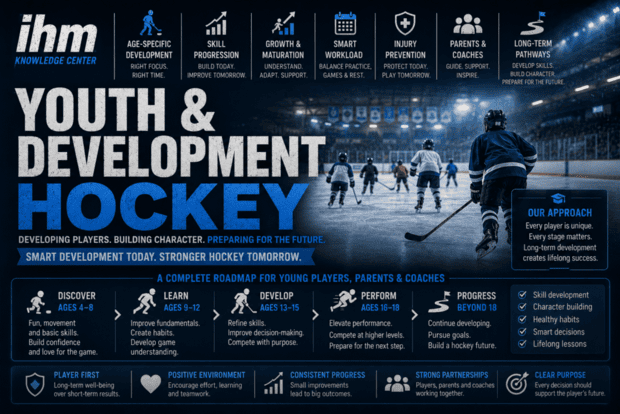
This hub helps young hockey players, parents and coaches understand age-specific development, skill progression, growth and maturation, workload, injury prevention, try-outs and long-term player pathways.
Editor: Coach Mark • Updated: August 27, 2026
What This Section Is
The IHM Youth & Development Hockey hub is a long-term knowledge resource built around one of the most important questions in the sport: how should a young hockey player develop over time?
With hundreds of focused evergreen questions, this section follows the development journey from a child’s first years in hockey through adolescence and the transition towards higher levels of competition.
The emphasis is not on rushing development. It is on building skills progressively, understanding how growth changes performance, managing workload intelligently, creating healthy learning environments and making better long-term decisions for each individual player.
Young players develop at different rates. Biological maturity, experience, confidence, opportunity, coaching environment and individual strengths can all influence progression. Development should therefore be evaluated over years rather than through isolated games, tournaments or short-term comparisons with teammates.
How to Use This Hub
- Choose the development question that matches the player’s current age, stage or situation.
- Use the Short Answer for a direct explanation.
- Read the Full Explanation for development context, practical guidance and long-term considerations.
- Explore related questions when moving between age groups, development stages or competitive levels.
- Parents and coaches can use the hub to separate normal development challenges from decisions that may require a change in approach.
Core Youth & Development Hockey Topics
- Early Hockey Development - first experiences on the ice, basic movement, enjoyment, confidence and foundational hockey skills.
- Age-Specific Development - realistic priorities and expectations at different stages of childhood and adolescence.
- Skill Progression - skating, puck control, passing, shooting, decision-making and the progression from basic execution to game application.
- Growth & Maturation - growth spurts, biological maturity, temporary coordination changes and differences between early and late developers.
- Development Milestones - understanding progress without treating development as a rigid age-by-age checklist.
- Practice & Game Balance - training frequency, game volume, repetition, learning opportunities and age-appropriate workload.
- Workload & Injury Prevention - managing hockey exposure, recognising excessive workload and supporting sustainable participation.
- Confidence & Motivation - mistakes, setbacks, competition, enjoyment, resilience and maintaining a healthy relationship with the sport.
- Parents in Youth Hockey - expectations, communication, support, costs, playing time, team decisions and creating a positive development environment.
- Coaching Young Players - feedback, teaching, development priorities, communication and age-appropriate expectations.
- Tryouts & Team Selection - preparation, evaluation, roster decisions, moving levels and responding constructively to selection outcomes.
- Playing Up or Down - evaluating whether a different age or competition level supports the individual player’s development.
- Specialisation & Multi-Sport Development - year-round hockey, other sports, variety and long-term athletic development.
- Position Development - when to specialise, learning multiple positions and developing broader game understanding.
- Youth Goalie Development - introducing goaltending, skill progression, workload and development expectations for young goalies.
- Academies, Camps & Extra Training - evaluating additional development opportunities and deciding when more training actually adds value.
- Competitive Pathways - recreational hockey, club hockey, elite programmes, academies and progression towards higher levels.
- Long-Term Player Development - building a sustainable pathway based on progression rather than short-term results.
Latest Youth & Development Hockey Questions
Explore the IHM Youth & Development Hockey library. This growing collection is being built as a comprehensive resource covering the questions young players, parents and coaches face throughout the development journey.
Development Is Not a Race
One of the biggest mistakes in youth hockey is assuming that the strongest player today will automatically become the strongest player several years from now.
Children grow and mature at different rates. An early-maturing player may temporarily have advantages in size, strength or speed, while a later-maturing player may need more time before similar physical qualities emerge.
Short-term performance should therefore never be confused with final potential.
The objective of youth development is to keep improving the qualities that will remain valuable as competition becomes faster and more demanding: skating, puck skills, hockey intelligence, decision-making, adaptability, confidence and the ability to learn.
Age Matters, but Development Stage Matters More
Chronological age provides useful context, but two players of the same age can be at very different stages physically, technically and emotionally.
Training expectations should reflect the individual player rather than relying entirely on age. A development programme that is appropriate for one 13-year-old may be inappropriate for another.
This becomes particularly important during adolescence, when growth spurts can temporarily affect balance, coordination and movement.
Growth Can Temporarily Change Performance
Rapid growth does not always produce immediate performance improvements. Players may temporarily feel less coordinated as their body proportions change and movement patterns adjust.
Periods of awkwardness during growth should not automatically be interpreted as regression. Coaches and parents should consider the player’s physical development before making conclusions from short-term performance.
Patience during these stages can be important for both confidence and long-term progression.
Skill Development Should Progress in Layers
Young players first need to learn a movement or skill, then perform it consistently, then execute it at greater speed and finally apply it under pressure during real game situations.
Being able to perform a drill successfully does not necessarily mean that the skill has transferred into competition.
Good development progressively increases speed, pressure, decision-making and variability while preserving technical quality.
Games Are Important, but Games Alone Are Not Development
Games provide competition, decision-making and emotional experience, but they do not always provide enough repetition to develop specific skills efficiently.
Practice gives players opportunities to repeat movements, experiment, make mistakes and receive feedback. Games then test whether those skills can be applied under pressure.
A healthy development environment therefore needs an appropriate balance between practice and competition.
More Hockey Is Not Automatically Better Hockey
Additional camps, private coaching, tournaments and extra ice sessions can provide useful development opportunities, but volume alone does not guarantee improvement.
Extra training should have a clear purpose. When additional sessions simply repeat fatigue without improving learning quality, the benefit becomes smaller.
Young players also need adequate time away from structured hockey for recovery, school, family life and other activities.
The Role of Parents
Parents have enormous influence on a young player’s hockey experience. Supportive behaviour can strengthen confidence and motivation, while excessive pressure can make performance feel more important than learning.
Parents do not need to become additional coaches. In many situations, their most valuable role is providing stability, perspective and support while allowing qualified coaches to manage technical instruction.
Questions about playing time, team selection or development should be approached calmly and with the player’s long-term interests in mind.
The Role of Coaches
Youth coaches influence far more than tactical results. They help shape how players understand mistakes, competition, teamwork and improvement.
Effective youth coaching creates demanding standards without making players afraid to experiment or fail. Feedback should help the player understand what can be improved and how to improve it.
Winning matters in competitive sport, but youth development should not sacrifice long-term learning simply to maximise short-term results.
Tryouts Are a Snapshot, Not a Career Verdict
Tryouts evaluate players during a limited period. Performance on those days matters, but selection decisions can also reflect roster needs, position balance, team philosophy and competition for specific roles.
Not making a particular team does not define a player’s long-term potential.
The useful question after any selection decision is what the player can improve next and which environment provides the best opportunity to continue developing.
Playing at the Highest Level Is Not Always the Best Development Choice
Moving to a stronger team or older age group can expose a player to faster competition and stronger teammates, but the highest available level is not automatically the best environment.
Playing time, puck involvement, coaching quality, role, confidence and opportunities to practise important skills all matter.
A player who receives meaningful responsibility at one level may sometimes develop more effectively than a player who receives very limited involvement at a higher level.
Long-Term Development Requires Perspective
Youth hockey development is measured in years. Progress will rarely follow a perfectly straight line.
Players experience periods of rapid improvement, plateaus, growth changes, confidence fluctuations, stronger competition and occasional setbacks.
A strong development pathway keeps the player learning through each stage rather than constantly searching for immediate proof of success.
Common Youth Hockey Development Mistakes
- Comparing children only by current performance.
- Treating early physical maturity as proof of greater long-term potential.
- Expecting every player to develop at the same rate.
- Prioritising team status over actual development opportunities.
- Playing too many games without enough purposeful practice.
- Adding extra training simply because other players are doing more.
- Specialising too early without considering the individual player.
- Parents coaching continuously from outside the team environment.
- Making major decisions immediately after one poor tournament or tryout.
- Ignoring changes associated with growth and maturation.
- Using professional or adult expectations for young players.
- Confusing short-term winning with successful long-term development.
- Removing enjoyment from the development process.
Youth & Development Hockey FAQ
What age should a child start hockey?
There is no single perfect starting age. Early programmes should focus on basic movement, skating confidence, enjoyment and positive experiences rather than competitive results.
How quickly should a young hockey player improve?
Development rates vary considerably. Age, experience, maturation, coaching, practice quality and individual ability all influence how quickly progress becomes visible.
How do growth spurts affect hockey players?
Rapid growth can temporarily change balance, coordination and movement because the player must adapt to changing body proportions. This does not necessarily mean that skill has been lost.
Should young hockey players practise every day?
Training frequency should reflect age, development stage, total workload and recovery. Daily structured hockey is not automatically necessary for effective long-term development.
Should children play hockey all year?
Year-round participation is possible in some environments, but young players still benefit from appropriate breaks, recovery and opportunities to develop through other physical activities.
When should a hockey player specialise in one position?
Early exposure to different positions can help players develop broader game understanding. The appropriate time to specialise depends on age, interest, ability and development environment.
Should a talented child play up an age group?
Only when the environment supports the player’s overall development. Skill level, physical maturity, playing time, confidence, coaching and social readiness should all be considered.
How important is playing time for youth development?
Meaningful playing time provides opportunities to make decisions, handle the puck and apply skills under pressure. Team level should therefore be considered alongside the role a player will actually receive.
Are hockey camps necessary for development?
No. Camps can provide useful instruction or additional practice, but they are tools rather than requirements. Quality, purpose and suitability matter more than simply attending more camps.
How should parents react after a bad game?
A poor performance should be kept in perspective. Immediate technical criticism is rarely necessary. Players often benefit more from support, time to process the game and constructive discussion later when appropriate.
What should a player do after being cut from a team?
The player should identify useful feedback, continue developing and find an environment that provides meaningful opportunities. One roster decision should not be treated as a judgement of long-term potential.
Is winning important in youth hockey?
Competition and learning to win are legitimate parts of sport, but short-term results should not consistently override skill development, appropriate playing opportunities and long-term progression.
How can parents tell if a hockey programme is good?
Look beyond the team name and competitive level. Coaching quality, communication, development opportunities, practice structure, player involvement and the overall environment are important indicators.
What matters most in long-term hockey development?
There is no single factor. Consistent skill development, appropriate challenge, quality coaching, motivation, patience, intelligent workload and an environment that keeps the player learning all contribute to long-term progression.
Editorial Scope
This section focuses specifically on youth hockey development, progression, growth, workload, injury prevention and long-term player pathways.
General strength, speed, conditioning, mobility and recovery topics are covered separately in the IHM Training & Performance hub. Medical diagnosis and treatment are outside the editorial scope of the IHM Knowledge Center.