IHM Knowledge Center
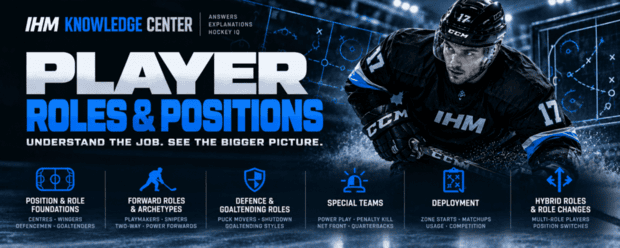
The IHM Player Roles & Positions hub explains what different hockey players are responsible for, how roles change within modern systems and why position alone does not fully describe what a player is asked to do.
From centres, wingers, defencemen and goaltenders to playmakers, shooters, forecheckers, shutdown players, puck-moving defencemen, net-front specialists, penalty killers and hybrid roles, this section explores how individual responsibilities fit into team structure, deployment and game situations.
Editor: Coach Mark • Updated: October 19, 2026
What This Section Is
Hockey positions provide the basic structure of a team, but modern hockey roles are much more detailed than simply centre, winger, defenceman and goaltender.
Two players listed at the same position may be asked to perform very different jobs. One winger may be responsible for driving transition and controlled entries, while another is used primarily as a forechecker, net-front player or defensive matchup option. One defenceman may activate aggressively and transport the puck, while another may remain above the play, defend the middle and handle difficult defensive-zone assignments.
The IHM Player Roles & Positions hub explains those differences. It separates formal position from functional role and shows how responsibilities change according to system, linemates, opposition, manpower, zone starts, score, coaching decisions and player strengths.
The objective is to help players, coaches and fans understand not only where a player lines up, but what that player is expected to accomplish.
How to Use This Hub
- Start with Position & Role Foundations to understand the difference between formal positions, responsibilities and functional roles.
- Explore Forward Roles & Archetypes for centres, wingers, scorers, playmakers, forecheckers, power forwards and other offensive or defensive profiles.
- Use Defence & Goaltending Roles to understand defensive pairings, puck movers, shutdown roles, goaltending styles and support responsibilities.
- Explore Special Teams to understand how player responsibilities change on the power play, penalty kill and other manpower states.
- Use Deployment to understand line matching, zone starts, competition level, usage, shift context and coaching decisions.
- Read Hybrid Roles & Role Changes to understand players who perform several functions or whose responsibilities change over a season, game or career.
Core Player Roles & Positions Topics
Position & Role Foundations Centres, wingers, defencemen, goaltenders, positional responsibilities and the difference between position and role.
Forward Roles & Archetypes Playmakers, shooters, finishers, power forwards, forecheckers, two-way forwards, defensive forwards and offensive drivers.
Defence & Goaltending Roles Puck movers, shutdown defencemen, offensive defencemen, defensive specialists, pairing roles and goaltender profiles.
Special Teams Power-play units, penalty-kill roles, net-front players, flank shooters, bumpers, quarterbacks and shorthanded specialists.
Deployment Zone starts, line matching, competition, usage, shift starts, offensive and defensive assignments and coaching trust.
Hybrid Roles & Role Changes Multi-role players, changing responsibilities, promotion, demotion, line changes, position switches and evolving player identity. Latest Questions
Latest Player Roles & Positions Questions
Explore the growing IHM Player Roles & Positions library. This section explains how hockey positions, player archetypes, deployment, special-team responsibilities and changing roles work across modern hockey.
Complete Knowledge Library – What the Player Roles & Positions Hub Covers
This category is organised around six major areas that move from basic positional understanding into specialised roles, deployment decisions and the way responsibilities evolve over time. 01
Position & Role Foundations
Learn the core responsibilities of centres, left wings, right wings, defencemen and goaltenders, while understanding why a player’s listed position does not fully explain the job that player performs.
This section covers positional structure, strong-side and weak-side responsibilities, support relationships, offensive and defensive responsibilities, position switching and the difference between position, role, assignment and player archetype. 02
Forward Roles & Archetypes
Explore the many ways forwards can contribute beyond traditional centre and winger labels.
Topics include playmakers, shooters, finishers, puck carriers, transition drivers, forecheckers, net-front players, power forwards, two-way forwards, defensive forwards, checking-line players, energy players, possession forwards, complementary players and offensive catalysts. 03
Defence & Goaltending Roles
Understand how different defensive and goaltending profiles fit into team structure.
This section covers puck-moving defencemen, offensive defencemen, shutdown defenders, transition defenders, stay-at-home roles, first-pass responsibilities, defensive pairing balance, left-right combinations, goaltending styles, puck-playing goaltenders and the way goalies support team structure. 04
Special Teams
Player responsibilities often change dramatically when manpower changes.
This section explains power-play quarterbacks, flank shooters, bumper players, net-front specialists, goal-line players, retrieval players, penalty-kill forwards, penalty-kill defencemen, faceoff specialists, shorthanded pressure roles and the relationship between special-team skill and even-strength role. 05
Deployment
Role cannot be understood without understanding how a coach uses the player.
This section covers zone starts, line matching, quality of competition, offensive and defensive deployment, sheltered minutes, difficult minutes, late-game usage, protecting leads, chasing games, home-ice last change, matchup assignments, shift timing and coaching trust. 06
Hybrid Roles & Role Changes
Modern hockey increasingly rewards players who can perform more than one function.
This section explains hybrid forwards, centre-wing versatility, offensive-defensive flexibility, defencemen who change roles depending on partner or game state, promotion and demotion, line changes, special-team changes, position switches and how injuries, coaching changes or roster movement can redefine a player’s responsibilities. Core Principle
Position Tells You Where a Player Starts. Role Tells You What the Player Does.
A position is the broad structural label used to organise players: centre, winger, defenceman or goaltender.
A role describes the player’s functional responsibility inside that structure.
Two centres may both take faceoffs and play through the middle, but one may function primarily as a transition playmaker while another is used as a matchup centre responsible for defensive-zone starts, penalty killing and difficult opposition.
The same principle applies across every position. Understanding hockey players therefore requires looking beyond roster labels and studying what they are actually asked to do.
Four Questions That Help Identify a Player’s Role
Player roles can become complicated, but most can be understood by answering four basic questions.
Where? Where does the player operate most often – middle, wall, net front, blue line, weak side or below the goal line?
When? In which situations is the player used – even strength, power play, penalty kill, late-game defence or offensive situations?
Against Whom? Does the player face top competition, protected competition, offensive matchups or defensive assignments?
For What Purpose? Is the player expected to create offence, transport the puck, finish chances, defend, recover possession or support teammates?
Forward Positions Do Not Define Forward Roles
A centre is generally responsible for supporting play through the middle of the ice, helping below the puck defensively and connecting different areas of the rink. But not every centre performs those responsibilities in the same way.
Some centres drive possession through passing and puck distribution. Others attack through skating and controlled entries. Some are used primarily against elite opposition, while others receive offensive zone starts and power-play responsibility.
Wingers also vary significantly. A winger may be a high-volume shooter, forechecker, puck retriever, transition carrier, net-front player, defensive specialist or complementary support player.
The important question is therefore not simply whether someone plays centre or wing. It is how that player contributes within the line and team structure.
Player Archetypes Are Useful, but They Are Not Permanent Labels
Terms such as playmaker, sniper, power forward, two-way forward and shutdown defenceman are useful because they describe common patterns of contribution.
They should not be treated as rigid categories.
A strong player may combine several archetypes. A winger can be both a scorer and an effective forechecker. A puck-moving defenceman may also become an excellent defensive matchup player. A centre can move from an offensive role into a more complete two-way role as experience develops.
The best description is therefore often a combination of traits rather than one permanent label.
Roles Work Together Inside Line Combinations
Coaches do not build effective lines by collecting three players with identical strengths.
A line may work because one player transports the puck, another creates passing options and a third drives the net or retrieves loose pucks. Another line may be designed around forechecking pressure, defensive reliability and matchup responsibility.
Role compatibility can therefore be as important as individual talent. A player’s performance may improve or decline when linemates change because the responsibilities inside the line change with them.
Defensive Pairings Require Role Balance
Defencemen are often described individually, but their responsibilities are strongly influenced by their partner.
An aggressive offensive defenceman may have more freedom when paired with a partner who reads transition risk well and remains above the puck. Two strong puck-moving defencemen may create excellent exits, while a more defensive pairing may be preferred against difficult competition or when protecting a lead.
Handedness, skating ability, puck retrieval, first-pass quality, offensive activation and defensive awareness can all influence how a pairing is constructed.
Goaltenders Also Have Functional Roles
Goaltenders share the same primary objective – prevent goals – but they can influence team play in different ways.
Some goaltenders are especially active handling the puck and can help their defence escape forechecking pressure. Others influence play through rebound control, communication, aggressive depth or more conservative positioning.
A goaltender’s style can affect defensive retrievals, breakout decisions and the confidence defenders have when managing dump-ins and pressure.
Special Teams Create Entirely Different Roles
A player’s even-strength role does not automatically determine the player’s special-team role.
A forward who plays a relatively balanced five-on-five game may become a specialised flank shooter on the power play. Another forward may have limited offensive usage but become extremely valuable as a penalty killer because of anticipation, stick positioning, faceoff ability or pressure timing.
Power plays and penalty kills compress player responsibilities into very specific jobs, making special-team role identification an important part of understanding overall player usage. Deployment Matters
Minutes Alone Do Not Explain How a Player Is Being Used
Two players can each play eighteen minutes and receive very different assignments.
One may start frequently in the offensive zone, play on the first power-play unit and face secondary competition. Another may take defensive-zone faceoffs, kill penalties and be matched against the opponent’s best line.
Ice time therefore needs context. Zone starts, opponents, linemates, special-team usage, score state and shift timing all help explain the actual difficulty and purpose of a player’s deployment.
Player Roles Can Change Quickly
A role is not permanent.
Injuries can move a player higher in the lineup. A trade can create new power-play opportunities. A coaching change can alter forechecking or defensive responsibilities. A struggling scorer may temporarily be moved into a simpler role, while a young player may gradually earn more difficult assignments.
Line combinations, special-team units, position changes and changes in competition can all reveal that a player’s role is evolving.
Role changes are therefore important for understanding performance. The same player may produce very different results when the responsibilities and opportunities surrounding that player change.
Modern Hockey Increasingly Rewards Hybrid Players
Many valuable modern players do not fit cleanly into one traditional archetype.
A forward may take faceoffs but spend much of the shift on the wing. A winger may rotate into the middle defensively. A defenceman may function almost like a fourth attacker during sustained offensive-zone possession while still carrying difficult defensive responsibilities.
Hybrid players give coaches more options because their responsibilities can change without requiring a complete lineup adjustment.
Understanding hybrid roles requires watching behaviour rather than relying only on the position printed beside a player’s name.
Role and Player Quality Are Not the Same Thing
A defensive role does not automatically mean a player lacks offensive ability, and an offensive role does not necessarily mean a player is poor defensively.
Coaches assign roles according to team needs, roster balance, individual strengths and the responsibilities already handled by other players.
Evaluation should therefore separate what a player is capable of doing from what the player is currently being asked to do.
Common Player Role & Position Misunderstandings
- Assuming every centre performs the same responsibilities.
- Treating left wing and right wing as complete descriptions of player style.
- Calling every high-scoring forward a playmaker or sniper.
- Assuming every large forward is automatically a power forward.
- Assuming every defensive forward has limited offensive skill.
- Treating offensive defencemen and puck-moving defencemen as the same thing.
- Judging defenders only by goals and assists.
- Judging defensive players without considering quality of competition or zone starts.
- Assuming equal ice time means equal deployment.
- Ignoring special-team responsibilities when evaluating role.
- Assuming a player’s role remains unchanged throughout a season.
- Treating line combinations as collections of three independent players rather than interacting roles.
- Ignoring how a defensive partner changes a defenceman’s responsibilities.
- Confusing player archetype with permanent identity.
- Evaluating a player’s performance without considering whether the role itself has changed.
Coach Mark
Understand the Job Before Evaluating the Player
One of the easiest mistakes in hockey analysis is evaluating every player by the same criteria.
A fourth-line penalty killer should not be judged as if his primary responsibility is to produce like a first-line scorer. A defenceman used against elite opposition in defensive-zone situations may have a very different performance profile from a partner receiving easier offensive deployment.
Before evaluating a player, first understand the job: where the player is used, against whom, with which teammates and for what purpose.
Once the role is clear, performance becomes much easier to understand. Player Roles & Positions FAQ
Player Roles & Positions FAQ
What is the difference between a hockey position and a hockey role?
A position describes a player’s broad structural location, such as centre, winger, defenceman or goaltender. A role describes the specific responsibilities that player performs within the team.
What are the main positions in hockey?
The traditional positions are centre, left wing, right wing, left defence, right defence and goaltender. Functional responsibilities within those positions can vary significantly.
What is a player archetype in hockey?
A player archetype is a broad description of how a player typically contributes, such as playmaker, shooter, power forward, two-way forward, puck-moving defenceman or shutdown defender.
Can one hockey player have several roles?
Yes. Many players perform several functions depending on linemates, zone, manpower, score and coaching decisions. Hybrid roles are increasingly common in modern hockey.
What is a two-way forward?
A two-way forward contributes meaningfully both offensively and defensively. The term usually describes players trusted in several areas of the game rather than specialists in only one phase.
What is a power forward?
A power forward combines offensive ability with physical strength, puck protection, pressure around the net and the ability to win space through contact.
What is a puck-moving defenceman?
A puck-moving defenceman is particularly valuable in retrieving, transporting and distributing the puck, helping the team exit the defensive zone and advance possession through transition.
What is a shutdown defenceman?
A shutdown defenceman is generally trusted against dangerous opposition and in difficult defensive situations, with an emphasis on protecting space, controlling entries, defending the slot and ending possession.
What does deployment mean in hockey?
Deployment describes how and when a player is used, including zone starts, quality of competition, linemates, special teams, game state, matchups and shift timing.
Why do coaches change player roles?
Roles may change because of injuries, performance, roster changes, coaching strategy, line combinations, special-team needs or the player’s own development.
Does more ice time always mean a bigger role?
Not necessarily. Total minutes matter, but role also depends on when those minutes occur, the opposition faced, zone starts, special teams and the importance of particular situations.
How can you identify a player’s real role?
Look at where the player operates, who the player faces, which linemates and units are used, where shifts begin and which situations the coach repeatedly assigns to that player.
Editorial Scope
This section focuses specifically on hockey positions, functional player roles, player archetypes, forward responsibilities, defence and goaltending roles, special-team roles, deployment, matchup usage, hybrid roles, position changes and changes in player responsibility.
Detailed tactical systems, forechecking structures, breakouts, neutral-zone systems and team-wide tactical concepts are covered separately where the primary subject is the system itself.
Individual skating, puck control, shooting and technical skill development are covered separately in IHM Academy and relevant Training & Performance sections.