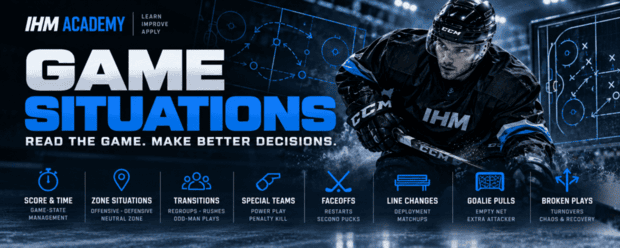
Game Situations
The IHM Game Situations hub explains how players and teams should read, understand and respond to the situations that actually decide hockey games – from basic possession and pressure decisions to late-game management, transitions, faceoffs, special teams, broken plays, line changes and complex combined scenarios.
Editor: Coach Mark Lehtonen• Updated: October 5, 2026
What This Section Is
Hockey is rarely a sequence of perfect, isolated plays. The game is constantly changing. Score, time, zone location, puck possession, pressure, manpower, support, fatigue and available space can turn the same technical action from the correct decision into the wrong one within seconds.
The IHM Game Situations hub is built to explain those decisions. Instead of teaching hockey only through systems or individual skills, this section focuses on the question players and coaches repeatedly face during competition: what should happen now?
The library progresses from fundamental situational reading into increasingly complex game states. It covers routine situations, high-pressure moments, unusual events and combinations of several problems occurring at the same time.
The objective is to help players recognise the most important information earlier, understand how context changes the correct decision and develop better habits for solving game problems at speed.
How to Use This Hub
- Choose the game situation that most closely matches the problem you want to understand.
- Start with the Short Answer for the direct decision principle.
- Read the Full Explanation to understand the context, reads, risks and alternatives behind the decision.
- Compare related situations to see how score, time, pressure, manpower and location can change the correct response.
- Players can use the hub to improve game recognition and Hockey IQ.
- Coaches can use individual questions as teaching points for video sessions, practices and situational training.
Core Game Situations Topics
Game Reading & Decision Logic Pressure, support, possession quality, space, risk and changing priorities.
Score, Time & Game State Leading, trailing, protecting leads, chasing games and adjusting risk as time changes.
Zone-Specific Situations Offensive-zone, defensive-zone and neutral-zone decisions.
Transition & Odd-Man Plays Regroups, counters, rushes, turnovers and numerical advantages.
Faceoffs & Restarts Faceoff location, second-puck decisions, icing, offside and stoppage situations.
Special Teams & Manpower Power plays, penalty kills, four-on-four, three-on-three and changing manpower.
Bench & Line Management Changes, fatigue, matchups, deployment and short-bench situations.
Late, Rare & Emergency Situations Goalie pulls, empty nets, unusual events and complex late-game decisions. Latest Questions
Latest Game Situations Questions
Explore the growing IHM Game Situations library. This section is being built as a comprehensive decision-making resource covering hundreds of situations players, coaches and teams encounter during real hockey games. Complete Knowledge Library
✴︎
✴︎
✴︎
✴︎
✴︎
✴︎
✴︎
✴︎
✴︎
✴︎
✴︎
✴︎
✴︎
✴︎
✴︎
What the Game Situations Hub Covers
The complete IHM Game Situations programme contains 700 focused questions organised into fourteen major areas. The progression begins with the fundamental logic of reading a hockey situation and develops towards multi-variable scenarios where several situational priorities must be processed at the same time. 01 · QUESTIONS 1-50
Core Game Situation Reading & Decision Logic
Learn how possession quality, time, score, zone location, pressure, manpower, support and fatigue change the correct decision. This foundation also covers safe versus passive play, aggression versus recklessness, controlled and broken situations, second pucks, overloads, isolation, numerical advantages and recognising when the situation has changed. 02 · QUESTIONS 51-100
Score, Time & Game-State Management
Understand how teams should adapt when leading, trailing or tied during different stages of the game. Topics include protecting leads, chasing deficits, shifts immediately after goals, regulation-versus-overtime priorities, tournament standings, goal difference and changing risk as the clock runs down. 03 · QUESTIONS 101-150
Goalie Pulls, Empty Net & Extra-Attacker Situations
Explore when to pull the goaltender, how to establish six-on-five, how possession quality affects goalie-pull timing and how both attacking and defending teams should manage empty-net situations, failed entries, faceoffs, icing risk, rebounds and late-game extra-attacker decisions. 04 · QUESTIONS 151-200
Offensive-Zone Game Situations
Covers clean and messy entries, net drives, delays, cutbacks, trailers, cycles, low-to-high and high-to-low movement, weak-side attacks, below-goal-line possession, defenceman activation, blocked shots, rebounds, pressure recovery and protecting against transition while sustaining offence. 05 · QUESTIONS 201-250
Defensive-Zone Game Situations
Covers puck retrievals, rims, reverses, first passes, corner and wall situations, rebounds, net-front defence, defending cycles, weak-side threats, recovering defensive structure, failed exits, icing decisions, long shifts and creating safe changes after extended defensive pressure. 06 · QUESTIONS 251-300
Neutral Zone, Regroups & Transition
Learn when to counterattack, regroup, stretch the ice, stay connected, attack through the middle or wide, carry, chip or dump the puck, attack different neutral-zone structures and manage turnovers, backpressure, rush defence and line changes during transition. 07 · QUESTIONS 301-350
Faceoff Situations
Understand how faceoff location, score, time, handedness, manpower and tactical objectives change the draw. The section includes clean wins, ties, scrambled draws, icing situations, special-team faceoffs, late-game draws, set plays and the importance of winning the second puck. 08 · QUESTIONS 351-400
Manpower & Special-Team Situations
Covers five-on-four, four-on-five, five-on-three, four-on-four, three-on-three and other manpower states. Learn how entries, possession, shooting decisions, seam attacks, clears, pressure, compactness, delayed penalties and the final seconds of a power play change situational priorities. 09 · QUESTIONS 401-450
Line Changes, Bench Situations & Deployment
Covers safe and dangerous line changes, partial changes, long and short changes, tired players, too-many-men risk, shortening the bench, double-shifting, line matching, zone-start deployment, injuries, penalty trouble and using possession or territory to create a safe change. 10 · QUESTIONS 451-500
Puck Pressure, Battles, Corners & Net Front
Learn when to protect or release the puck, how support players should enter board battles, how teams respond after battles are won or lost, how body position and stick skill interact and how attackers and defenders manage rebounds, screens, tips, net-front scrambles and possession below the goal line. 11 · QUESTIONS 501-550
Broken Plays, Turnovers & Odd-Man Situations
Understand how structure should change when normal patterns break down. The section covers turnovers in every zone, failed passes, unexpected bounces, sudden numerical advantages, two-on-ones, three-on-twos, breakaways, backpressure and rebuilding structure after chaotic sequences. 12 · QUESTIONS 551-600
Goaltender Puck Play, Icing, Offside & Stoppages
Examines the decisions that surround goaltender puck handling, communication with defencemen, icing, delayed offside, whistles, stoppages and restarts. These moments often appear routine but can change possession, pressure, fatigue and the next tactical advantage. 13 · QUESTIONS 601-650
Rare, Emergency & Unusual Game Situations
Covers infrequent situations players still need to recognise: unusual overtime circumstances, major and double-minor penalties, shortened benches, injuries during games, losing key positional players, backup goaltenders entering unexpectedly and other situations where normal team structure must be adjusted quickly. 14 · QUESTIONS 651-700
Advanced Combined Game Situations
The final section combines multiple pressures at once: score, clock, fatigue, icing, manpower, empty nets, injuries, turnovers, line changes and risk. These questions teach players and coaches to identify which situational priority matters most when several problems exist simultaneously. Hockey IQ
The Same Play Is Not Always the Same Decision
One of the most important principles in hockey decision-making is that a technically correct play can become strategically wrong when the context changes.
A cross-ice pass may be valuable when a team needs offence and has controlled support. The same pass may be unnecessary when protecting a one-goal lead late in the third period. A defenceman may activate aggressively when possession is secure, but hold position when the forwards are trapped below the puck. A player may attack immediately after a turnover or delay when support has not yet recovered.
Understanding hockey therefore means more than knowing what actions are possible. Players must understand which action has the greatest value in that particular moment.
The Core Reads Behind Every Game Situation
Individual situations vary, but the information used to solve them repeatedly comes from the same core signals.
Score Leading, trailing or tied changes the acceptable balance between risk and control.
Time The value of a decision changes dramatically as the remaining time becomes shorter.
Possession Secure possession, unstable possession and a 50-50 puck require different decisions.
Pressure Players must recognise how much time and space remain before the next opponent arrives.
Support The number, location and readiness of teammates determine which options are actually available.
Manpower Numerical advantage or disadvantage changes space, coverage, support and risk.
Location The same turnover or pass can carry very different consequences depending on where it occurs.
Fatigue Tired players have different execution limits and may require a simpler, safer solution.
Good Decisions Begin Before the Puck Arrives
Elite players often appear to have more time than everyone around them. In many situations, they do not actually receive more time. They have simply collected more information before they need to act.
Pre-scanning allows the player to recognise pressure, locate support, identify open ice and understand where the next defender or passing layer is likely to appear. The player can therefore begin eliminating poor options before receiving the puck.
This makes decision-making faster without requiring the player to physically move faster.
Possession, Territory and Risk
Keeping the puck is valuable, but possession is not automatically the correct priority in every situation. Sometimes territory, pressure relief or a safe line change has greater value.
A team trapped late in a long defensive-zone shift may accept an icing or controlled territorial play that would be unnecessary under normal circumstances. A team chasing a goal may instead preserve possession and accept greater risk because simply moving the puck away from danger does not solve the game-state problem.
Situational hockey is therefore about identifying the priority of the moment rather than applying one universal rule to every possession.
Structured Plays and Broken Plays Require Different Thinking
Hockey systems give players a shared framework, but games frequently leave that framework. A blocked shot, lost edge, deflection, broken stick, missed pass or unexpected turnover can instantly create a broken play.
During these moments, players may no longer have time to return immediately to their normal positional structure. The first priority becomes identifying the most dangerous threat, protecting critical space, supporting the puck and gradually rebuilding team shape.
Strong situational players understand when to follow structure and when the game temporarily requires a different solution.
Score and Time Change Risk
A one-goal lead with fifteen minutes remaining is not the same situation as a one-goal lead with thirty seconds remaining. Likewise, trailing by one in the first period should not create the same risk profile as trailing by one during the final minute.
Teams that become too conservative too early can surrender possession, territory and initiative. Teams that increase risk too early while trailing can create unnecessary chances against.
Effective game management means changing risk progressively rather than simply switching between attacking and defending.
Individual Decisions Must Fit the Team Situation
Hockey decisions are made by individual players, but their value is determined by the position of the entire team.
A defenceman cannot decide whether to pinch only by looking at the puck. The decision also depends on forward support, opponent position, score, time and the risk of transition. A forward deciding whether to force a play through the middle must understand whether teammates are available to recover if possession is lost.
Situational awareness connects individual skill with team structure. The strongest players do not simply execute difficult actions. They recognise when those actions help the team and when a simpler choice has greater value.
Game Situations Should Be Trained, Not Just Discussed
Players cannot build situational intelligence only by memorising tactical rules. They need repeated exposure to decisions where the available information changes.
Coaches can create this through small-area games, constrained situations, score-and-time scenarios, transition drills, faceoff situations, special-team repetitions and competitive exercises where players must read rather than simply follow a predetermined pattern.
Video can then help players understand why a decision succeeded or failed and which information should have been recognised earlier.
Common Game-Situation Decision Mistakes
- Making the same decision regardless of score or time.
- Looking only at the puck instead of scanning pressure and support.
- Treating every aggressive play as a good offensive decision.
- Treating every safe play as good game management.
- Forcing the first option after it has disappeared.
- Ignoring fatigue when choosing the complexity of the next play.
- Chasing possession without recognising dangerous space.
- Protecting a lead too early and surrendering all attacking threat.
- Increasing risk too early simply because the team is trailing.
- Changing lines while the puck or opponent can immediately attack.
- Failing to adjust when manpower changes.
- Overcommitting below the puck during offensive-zone possession.
- Attempting a difficult controlled play when territory is the more valuable objective.
- Treating broken plays as if normal structure still exists.
- Focusing on the original play instead of recognising that the situation has already changed.
Coach Mark
Hockey IQ Is the Ability to Recognise What the Game Requires Now
A player can know every system and still make poor decisions if he does not recognise how the situation has changed.
Good situational players understand what information matters first. They see pressure earlier, recognise support, understand the score and clock and know when risk is justified. They also understand that the best decision is not always the most creative decision.
Sometimes elite hockey means attacking immediately. Sometimes it means keeping possession. Sometimes it means moving the puck behind the defence, protecting the middle, buying a line change or simply surviving the next ten seconds.
The objective of this hub is to teach that difference. Game Situations FAQ
Game Situations FAQ
What is a game situation in hockey?
A game situation is the combination of conditions surrounding a decision at a particular moment, including puck possession, score, time, zone location, pressure, support, manpower, fatigue and available space.
Why can the same hockey play be correct once and wrong later?
Because the value and risk of an action change with context. Score, time, pressure, support and location can make the same pass, shot, pinch or carry appropriate in one situation and unnecessary in another.
What information should a player read first?
Players should quickly identify immediate pressure, puck security, dangerous space and available support, while also understanding the wider game state such as score, time and manpower.
How does score change decision-making?
Score affects the acceptable balance between risk and control. Teams protecting a lead normally have different priorities from teams that must create a goal.
How does time affect hockey decisions?
As remaining time decreases, the consequences of both successful and failed decisions become greater. A team may therefore need to progressively change its risk profile.
Is the safest play always the correct play?
No. A safe play can become passive if it repeatedly gives away possession, territory or attacking opportunities when the game situation requires pressure.
Is the most aggressive play always the best offensive play?
No. Effective offence also requires possession management, support, timing and recognition of transition risk. Aggression without structure can create dangerous chances against.
What is a broken play?
A broken play occurs when the expected structure or sequence of the play is disrupted by a turnover, deflection, missed assignment, bounce, fall or another unexpected event.
Why do elite players seem to have more time?
Elite players often scan earlier and process information before the puck reaches them. This allows them to eliminate poor options and begin the next action sooner.
Should players always try to keep possession?
No. Possession is highly valuable, but there are situations where territory, pressure relief, defensive security or creating a line change is the greater priority.
How can players improve situational awareness?
Players can improve through scanning habits, video study, situational practice, small-area games and exercises where score, time, pressure, manpower or available options continually change.
What is the difference between Hockey IQ and game situations?
Hockey IQ is the broader ability to read and understand the game. Game situations provide the specific contexts in which that intelligence must be applied through real decisions.
Editorial Scope
This section focuses specifically on hockey game situations, situational awareness, decision-making, game-state management, possession and pressure decisions, score-and-time context, zone situations, transitions, faceoffs, manpower changes, line changes, broken plays, unusual scenarios and advanced combined situations.
Detailed individual skating, puck-handling and technical skill instruction is covered separately in IHM Academy. Broader tactical systems, structured forechecks and team-system teaching may also be covered separately where the primary subject is the system itself rather than the situational decision.