IHM Knowledge Center
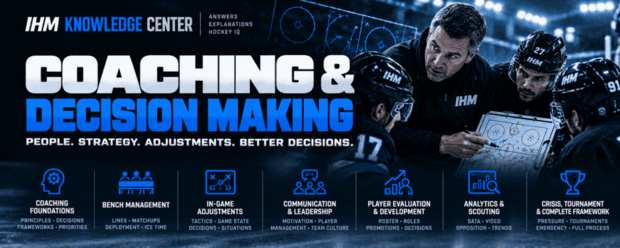
The IHM Coaching & Decision Making hub explains how hockey coaches make decisions before, during and after games – from building lines, assigning roles and managing the bench to adjusting tactics, evaluating players, communicating under pressure and making difficult roster or tournament decisions.
This section connects tactical knowledge with leadership, player management, deployment, analytics, scouting and the real decision frameworks coaches use when several competing priorities must be managed at the same time.
Editor: Coach Mark • Updated: October 19, 2026
What This Section Is
Coaching is not simply choosing a system and telling players where to stand. A coach constantly makes decisions involving tactics, personnel, matchups, communication, player development, fatigue, confidence, injuries, score, time and opposition behaviour.
Many coaching decisions also involve trade-offs. A coach may need to choose between offensive potential and defensive reliability, short-term results and long-term development, maintaining confidence and demanding accountability, or staying patient with a game plan and making an immediate tactical adjustment.
The IHM Coaching & Decision Making hub explains how those choices can be approached systematically.
The objective is not to provide one rigid answer for every situation. It is to explain the information coaches should consider, the risks attached to different options and how better decisions can be made under real hockey conditions.
How to Use This Hub
- Start with Coaching Foundations & Decision Frameworks to understand how coaching decisions should be structured.
- Use Bench Management, Lines, Matchups & Deployment for decisions involving shifts, combinations, ice time and player usage.
- Explore In-Game Tactical Adjustments & Game-State Decisions for changes made while the game is developing.
- Use Communication, Leadership, Motivation & Player Management for the human side of coaching and team leadership.
- Explore Player Evaluation, Development, Roster & Role Decisions when assessing players or determining future responsibilities.
- Use Analytics, Scouting, Crisis, Tournament & Complete Framework for advanced preparation, high-pressure decisions and integrated coaching processes.
Core Coaching & Decision Making Topics
Coaching Foundations & Decision Frameworks Coaching principles, information gathering, priorities, risk, trade-offs and structured decision-making.
Bench Management, Lines, Matchups & Deployment Ice time, line combinations, defensive pairs, matchup strategy, shift management and player usage.
In-Game Tactical Adjustments & Game-State Decisions Tactical changes, score and time management, momentum, special situations and responding to opposition adjustments.
Communication, Leadership, Motivation & Player Management Feedback, accountability, trust, confidence, conflict, motivation and communication with individuals and teams.
Player Evaluation, Development, Roster & Role Decisions Performance evaluation, player development, roster selection, promotions, demotions and changing responsibilities.
Analytics, Scouting, Crisis, Tournament & Complete Framework Data, video, opposition scouting, tournament strategy, emergency decisions and complete coaching frameworks. Latest Questions
Latest Coaching & Decision Making Questions
Explore the growing IHM Coaching & Decision Making library. This section covers the tactical, personnel, communication, leadership and analytical decisions hockey coaches make across practices, games, seasons and high-pressure situations.
Complete Knowledge Library – What the Coaching & Decision Making Hub Covers
The complete category is organised around six major areas covering the full coaching process - from basic decision principles and bench management to player development, tactical adjustments, analytics, crisis management and complete coaching frameworks. 01
Coaching Foundations & Decision Frameworks
Learn how coaches identify the real problem before choosing a solution, separate important information from noise and evaluate different options according to game context, team identity and available personnel.
Topics include coaching philosophy, decision priorities, evidence, uncertainty, risk management, short-term versus long-term thinking and frameworks for making repeatable decisions rather than reacting emotionally. 02
Bench Management, Lines, Matchups & Deployment
Explore how coaches manage the players available during a game and decide who should be used, when and against whom.
This section covers line combinations, defensive pairings, shortening the bench, rolling four lines, double-shifting, matchup strategy, home-ice last change, zone starts, protecting tired players, managing stars, young players and specialists, and adjusting deployment as game conditions change. 03
In-Game Tactical Adjustments & Game-State Decisions
Learn when a coach should stay patient with the original plan and when the game requires a tactical change.
Topics include forecheck adjustments, neutral-zone changes, defensive coverage, breakout responses, special-team changes, protecting leads, chasing goals, goalie pulls, timeout decisions, momentum management and reacting to opposition adjustments without overreacting to short-term events. 04
Communication, Leadership, Motivation & Player Management
Coaching decisions must be understood and accepted by people, which makes communication and leadership central to performance.
This section covers feedback, accountability, trust, confidence, motivation, difficult conversations, bench communication, communication after mistakes, handling frustration, managing stars and depth players, team standards, leadership groups, conflict and maintaining a productive environment under pressure. 05
Player Evaluation, Development, Roster & Role Decisions
Understand how coaches evaluate what a player currently provides while also considering what that player may become.
Topics include role evaluation, performance trends, development priorities, player promotion and demotion, healthy scratches, lineup selection, roster balance, young-player usage, veterans, changing roles, position changes and determining whether poor performance reflects the player, role, linemates, tactics or deployment. 06
Analytics, Scouting, Crisis, Tournament & Complete Framework
The advanced section connects coaching decisions with data, scouting, tournament environments and situations where normal planning breaks down.
Topics include analytics, video review, opposition scouting, identifying tactical tendencies, tournament scheduling, back-to-back games, elimination situations, injuries, shortened rosters, sudden goaltending changes, losing streaks, high-pressure decisions and complete frameworks for integrating tactical, personnel and leadership information. Core Principle
Good Coaching Is Not About Making More Decisions. It Is About Making Better Ones.
Hockey gives coaches an enormous number of possible interventions. Lines can be changed, systems adjusted, players moved, matchups targeted, ice time redistributed and communication altered.
The existence of an available change does not mean the change should be made.
Strong coaching requires understanding which problems need immediate intervention, which need patience and which may disappear without any change at all.
The quality of the decision matters more than the number of visible adjustments.
A Simple Coaching Decision Framework
Coaching situations can become complicated, but many decisions can be improved by working through four basic stages.
Observe Identify what is actually happening before deciding that a change is required.
Diagnose Determine whether the real problem is tactical, technical, physical, psychological or personnel-related.
Decide Compare available options, their risks and the likely effect on the rest of the team.
Evaluate Watch what happens after the intervention and decide whether to maintain, modify or reverse it.
Diagnose the Problem Before Changing the Solution
The same visible problem can have several different causes.
A team struggling to exit the defensive zone may have a breakout structure problem, but it may also be losing retrieval races, receiving poor support from forwards, making slow first passes or facing an opponent whose forecheck specifically disrupts the normal exit.
Changing the breakout system will not solve every one of those problems.
Strong coaching therefore begins with diagnosis. The adjustment should target the cause rather than simply the most visible symptom.
Bench Management Is Continuous Decision-Making
Managing a bench involves much more than deciding which line goes next.
Coaches must track fatigue, matchups, previous shifts, penalties, special-team usage, injuries, momentum, game state and which players are currently handling particular assignments effectively.
A player who normally receives major minutes may need rest after a long penalty kill. A fourth line may earn additional shifts because it is controlling play. A young player may need protection from a difficult matchup without being removed from meaningful involvement.
Good bench management balances the immediate needs of the game with the ability to keep enough players engaged and physically available for what comes next.
Line Combinations Should Solve Problems, Not Simply Reward Names
The most talented individual players do not automatically create the best possible line combination.
Coaches must consider puck distribution, transition ability, forechecking, finishing, defensive responsibility, handedness, pace and how responsibilities are shared between linemates.
Matchups add another layer. A line that works extremely well against one opponent may struggle against another because of speed, physical pressure, defensive structure or the way the opposing line attacks.
Line decisions should therefore evaluate both internal chemistry and external matchup demands. In-Game Decisions
Know the Difference Between a Bad Result and a Bad Process
A goal against does not automatically prove that the defensive system is wrong. A failed power play does not necessarily require an immediate unit change. A line can create several quality chances and still finish a shift without scoring.
Coaches need to distinguish between poor outcomes and repeated structural problems.
Overreacting to individual events creates instability. Ignoring repeated evidence creates a different problem.
The challenge is recognising when the underlying process remains sound and when the evidence is strong enough to justify adjustment.
Game State Should Change Coaching Decisions
Coaching choices should reflect the score, remaining time and competitive context.
Protecting a one-goal lead late in the third period may justify different deployment from a tied game in the second period. Trailing late may require shortening the bench, increasing offensive risk or changing defensive activation.
Tournament standings, aggregate scores, overtime rules and the value of a regulation win can also change what the team actually needs from the remaining minutes.
Tactical decisions cannot be separated from game state.
Communication Is Part of the Decision
A tactical adjustment only works if players understand what is changing, why it matters and what their own responsibilities become.
Coaches therefore need to decide not only what information to provide, but how much information is useful in the available time.
A bench conversation during a game may require one clear instruction. A video session the following day can provide deeper explanation.
Effective communication matches the detail of the message to the situation in which the player must use it.
Accountability and Confidence Must Work Together
Players need clear standards, but accountability does not require creating fear around every mistake.
Coaches need to distinguish between an execution error, a poor decision, a repeated habit and a lack of effort. Each may require a different response.
Correcting every mistake with the same consequence can make feedback less useful. Ignoring repeated problems can weaken team standards.
Effective player management maintains demanding expectations while helping players understand how to improve.
Evaluate Players in the Context of Their Role
Player evaluation becomes misleading when every player is judged by the same criteria.
A defensive-zone matchup centre should not be evaluated exactly like a highly sheltered offensive winger. A penalty-killing defenceman may provide significant value without producing major offensive numbers.
Coaches should consider role, deployment, teammates, opposition, tactical responsibilities and development stage when evaluating performance.
The key question is not simply whether the player produced. It is whether the player performed the responsibilities required by the assigned role.
Short-Term Winning and Long-Term Development Can Compete
Coaches frequently make decisions where the best immediate option is not necessarily the best developmental option.
A veteran may currently provide a safer late-game option, while a younger player needs meaningful exposure to those situations in order to develop.
The correct balance depends on level, competitive objectives, individual readiness and the consequences of the decision.
Good coaching recognises both timelines rather than pretending the conflict does not exist.
Analytics Should Inform Coaching, Not Replace Coaching
Data can help coaches identify patterns that are difficult to see through memory or isolated observation.
Shot quality, zone entries, exits, possession trends, matchup results, special-team performance and player usage can all provide useful evidence.
Analytics still require context. Numbers may describe what happened without fully explaining why it happened.
The strongest approach combines data with video, tactical knowledge, direct observation and understanding of player responsibilities.
Opposition Scouting Should Identify Tendencies, Not Create Paralysis
Scouting helps teams anticipate how opponents prefer to enter zones, forecheck, break out, defend special teams, create scoring chances and use key players.
The objective is not to overwhelm players with every available detail.
Coaches should identify which tendencies materially affect the game plan and which information players can actually use at game speed.
Useful scouting simplifies the opponent into actionable priorities.
Crisis Situations Test the Coaching Framework
Injuries, losing streaks, unexpected lineup changes, goaltender problems, shortened benches and major momentum swings can force coaches away from the original plan.
These situations reward clear priorities.
Coaches need to identify what must be protected, which responsibilities can be simplified, which players can absorb additional work and which tactical elements remain essential.
Crisis management is not about pretending normal conditions still exist. It is about rebuilding a functional plan from the resources still available.
Tournament Coaching Requires a Different Time Horizon
Tournament hockey can compress several important games into a short period and create decisions that differ from normal league play.
Coaches may need to manage fatigue across consecutive games, consider goal difference or qualification scenarios, choose when to use the starting goaltender and determine how aggressively to chase a result.
The importance of the current game must be balanced against what the team may need several hours or one day later.
Common Coaching Decision-Making Mistakes
- Changing tactics without identifying the real cause of the problem.
- Overreacting to one goal, turnover or unsuccessful shift.
- Waiting too long when the same structural problem keeps repeating.
- Judging every player by the same performance criteria.
- Using ice time without considering fatigue and special-team workload.
- Changing lines constantly without allowing combinations time to develop.
- Keeping ineffective combinations together only because they worked previously.
- Confusing a poor result with a poor process.
- Providing too much tactical information during high-pressure moments.
- Using punishment when instruction would solve the problem more effectively.
- Protecting player confidence by avoiding necessary accountability.
- Ignoring role and deployment when evaluating performance.
- Using analytics without tactical or video context.
- Overloading players with opposition scouting information.
- Making emotional lineup decisions immediately after a poor game.
- Focusing only on the current game without considering player development or tournament workload.
Coach Mark
The Coach’s Job Is to Improve the Quality of the Next Decision
Coaches cannot control every bounce, result or individual execution. They can control how clearly the team is prepared, how quickly problems are recognised and how intelligently adjustments are made.
The best decision is not always the most aggressive adjustment or the most complicated tactical solution.
Sometimes the team needs a system change. Sometimes it needs a different matchup. Sometimes one player needs a different role. Sometimes the correct coaching decision is to change nothing and allow a strong process to continue.
Good coaching begins with understanding the difference. Coaching & Decision Making FAQ
Coaching & Decision Making FAQ
What does hockey coaching decision-making involve?
Coaching decision-making includes tactical choices, player usage, line combinations, matchups, communication, development, roster decisions and responses to changing game conditions.
When should a hockey coach change tactics?
A tactical change is most useful when repeated evidence shows that the current structure is being consistently disrupted or no longer matches the conditions of the game.
When should a coach avoid making an adjustment?
Coaches should avoid changing a sound process purely because of one unsuccessful result, unusual bounce or isolated execution error.
What is bench management in hockey?
Bench management is the process of controlling line changes, ice time, matchups, fatigue, special-team usage and player deployment throughout a game.
How should coaches build line combinations?
Lines should be built around complementary skills, responsibilities, chemistry, tactical needs and the types of opponents or situations the line is expected to handle.
What is matchup coaching?
Matchup coaching involves selecting which players or lines should face particular opponents based on strengths, weaknesses, role, game state and tactical objectives.
How important is communication in hockey coaching?
Communication is essential because tactical plans and role changes only work when players understand what is expected and can apply the information under game conditions.
How should a coach respond to player mistakes?
The response should depend on whether the mistake came from execution, decision-making, misunderstanding, repeated habits or effort. Different causes require different coaching responses.
How should coaches evaluate players?
Evaluation should consider role, deployment, teammates, competition, tactical responsibilities, performance trends and development stage rather than relying only on traditional statistics.
How should analytics be used by hockey coaches?
Analytics should provide additional evidence about patterns and performance. They are most useful when combined with video, tactical understanding and direct observation.
What should coaches look for when scouting an opponent?
Useful scouting focuses on repeatable tendencies that affect the game plan, including breakouts, forechecks, entries, defensive structures, special teams and the usage of important players.
How should coaches manage a crisis during a game or tournament?
Coaches should simplify priorities, identify the resources still available, redistribute responsibilities and build the most functional plan possible for the changed conditions.
Editorial Scope
This section focuses specifically on hockey coaching principles, coaching decision frameworks, bench management, line combinations, defensive pairings, matchups, deployment, tactical adjustments, game-state decisions, communication, leadership, motivation, player management, evaluation, development, roster decisions, analytics, scouting, tournament strategy and crisis management.
Detailed explanations of individual hockey systems, forechecks, breakouts, neutral-zone structures and defensive coverage are covered separately in the IHM Tactics & Systems hub when the primary subject is the tactical structure itself.
Individual player roles and positional responsibilities are covered separately in the IHM Player Roles & Positions hub, while individual skill development and coaching instruction are covered within the relevant IHM Academy sections.