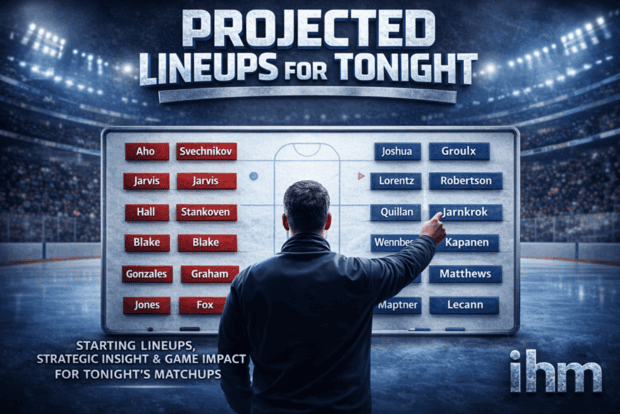
NHL Projected Lineups – Game Day March 21, 2026
Date: 20 March 2026
By IceHockeyMan Newsroom
Update: Additional matchups will be added as projected lineups are updated throughout the day.
Toronto Maple Leafs vs Carolina Hurricanes
Faceoff: 01:00 CET
Maple Leafs – Projected lineup
Forwards
Matias Maccelli – John Tavares – William Nylander
Matthew Knies – Max Domi – Easton Cowan
Dakota Joshua – Bo Groulx – Nicholas Robertson
Steven Lorentz – Jacob Quillan – Calle Jarnkrok
Defense
Morgan Rielly – Brandon Carlo
Jake McCabe – Oliver Ekman-Larsson
Simon Benoit – Troy Stecher
Goalies
Joseph Woll
Anthony Stolarz
Scratched
Michael Pezzetta
Philippe Myers
Injured
Auston Matthews (MCL)
Chris Tanev (groin)
IHM Lineup Note:
Toronto still has enough wing skill to threaten off transition, but the center spine looks thinner without Matthews. Rielly’s return matters because the Maple Leafs need smoother exits and quicker puck delivery into the offensive zone.
IHM Tactical Signals:
Toronto should try to use Nylander and Tavares to create offense before Carolina settles into its forecheck rhythm. If the Leafs get pinned into repeated retrievals, their missing center depth becomes a much bigger problem.
Hurricanes – Projected lineup
Forwards
Andrei Svechnikov – Sebastian Aho – Seth Jarvis
Taylor Hall – Logan Stankoven – Jackson Blake
Nikolaj Ehlers – Jordan Staal – Jordan Martinook
William Carrier – Mark Jankowski – Eric Robinson
Defense
Jaccob Slavin – Jalen Chatfield
K’Andre Miller – Sean Walker
Mike Reilly – Alexander Nikishin
Goalies
Brandon Bussi
Frederik Andersen
Scratched
Jesperi Kotkaniemi
Nicolas Deslauriers
Injured
Shayne Gostisbehere (lower body)
Pyotr Kochetkov (lower body)
IHM Lineup Note:
Carolina still brings one of the league’s strongest pressure identities through pace, retrievals and repeat attacks. Aho, Svechnikov and Jarvis can tilt the top-end talent battle, but the real strength is how deep the Hurricanes can keep the forecheck going.
IHM Tactical Signals:
Carolina should want a game built on territorial pressure, quick reloads and low-zone support. Their clearest route is to suffocate Toronto’s exits and force the Maple Leafs into a lower-quality attack profile.
IHM Match Pressure Index:
Toronto carries the heavier pressure because it must protect a thinner middle against one of the league’s strongest structure-and-pace teams. Carolina owns the cleaner tactical path, but the Hurricanes still need to finish enough of their volume to keep Toronto from hanging around on talent alone.
Washington Capitals vs New Jersey Devils
Faceoff: 01:00 CET
Capitals – Projected lineup
Forwards
Anthony Beauvillier – Dylan Strome – Alex Ovechkin
Aleksei Protas – Pierre-Luc Dubois – Tom Wilson
Connor McMichael – Justin Sourdif – Ryan Leonard
Brandon Duhaime – Hendrix Lapierre – Ethen Frank
Defense
Martin Fehervary – Rasmus Sandin
Jakub Chychrun – Trevor van Riemsdyk
Cole Hutson – Matt Roy
Goalies
Logan Thompson
Charlie Lindgren
Scratched
David Kampf
Ivan Miroshnichenko
Declan Chisholm
Dylan McIlrath
Timothy Liljegren
Injured
None
IHM Lineup Note:
Washington keeps enough veteran bite and finishing gravity to stay difficult to play against, especially with Ovechkin and Wilson shaping the interior pressure. The Capitals are most effective when they can make games physical and controlled rather than loose and rush-heavy.
IHM Tactical Signals:
The Capitals should try to close the middle, protect the slot and lean on line matching to disrupt New Jersey’s pace. If Washington forces the Devils into a more direct, heavier game, the matchup becomes far more manageable.
Devils – Projected lineup
Forwards
Timo Meier – Nico Hischier – Dawson Mercer
Jesper Bratt – Jack Hughes – Connor Brown
Arseny Gritsyuk – Cody Glass – Lenni Hameenaho
Paul Cotter – Nick Bjugstad – Maxim Tsyplakov
Defense
Jonas Siegenthaler – Dougie Hamilton
Luke Hughes – Johnathan Kovacevic
Brenden Dillon – Simon Nemec
Goalies
Jake Allen
Jacob Markstrom
Scratched
Dennis Cholowski
Evgenii Dadonov
Injured
Stefan Noesen (knee)
Zack MacEwen (ACL)
Brett Pesce (lower body)
IHM Lineup Note:
New Jersey’s game still runs through speed, skill and quick transition reads from Hughes, Bratt and Hamilton. The Devils are dangerous when they get into open-ice exchanges and attack with layers rather than single-man rushes.
IHM Tactical Signals:
The Devils should want pace, lateral movement and fast exits from the back end. If they can keep the Capitals from locking the game into a half-ice structure, New Jersey’s speed advantage becomes much more visible.
IHM Match Pressure Index:
Washington carries pressure to disrupt the game early and prevent New Jersey from dictating the pace. The Devils carry pressure to turn their transition edge into actual territorial control instead of letting the Capitals drag them into a slower, heavier contest.
Chicago Blackhawks vs Colorado Avalanche
Faceoff: 02:30 CET
Blackhawks – Projected lineup
Forwards
Ryan Greene – Connor Bedard – Andre Burakovsky
Tyler Bertuzzi – Frank Nazar – Teuvo Teravainen
Andrew Mangiapane – Ryan Donato – Ilya Mikheyev
Nick Lardis – Sam Lafferty – Landon Slaggert
Defense
Alex Vlasic – Artyom Levshunov
Wyatt Kaiser – Sam Rinzel
Matt Grzelcyk – Louis Crevier
Goalies
Arvid Soderblom
Spencer Knight
Ethan Del Mastro
Scratched
Dominic Toninato
Sacha Boisvert
Injured
Oliver Moore (lower body)
IHM Lineup Note:
Chicago still depends on Bedard and Nazar to create the offensive spark, but against Colorado that is not enough by itself. The Blackhawks need disciplined support, sharper puck decisions and strong goaltending just to keep the game within reach.
IHM Tactical Signals:
Chicago should try to keep the game chaotic and opportunistic rather than controlled and territorial. If the Blackhawks allow Colorado to build speed through the neutral zone and activate the blue line cleanly, the matchup can get away quickly.
Avalanche – Projected lineup
Forwards
Valeri Nichushkin – Nathan MacKinnon – Martin Necas
Nazem Kadri – Brock Nelson – Nicolas Roy
Parker Kelly – Jack Drury – Joel Kiviranta
Ivan Ivan – Zakhar Bardakov – Gavin Brindley
Defense
Brett Kulak – Cale Makar
Devon Toews – Sam Malinski
Josh Manson – Brent Burns
Goalies
Mackenzie Blackwood
Scott Wedgewood
Scratched
Nick Blankenburg
Injured
Ross Colton (upper body)
Gabriel Landeskog (lower body)
Artturi Lehkonen (upper body)
Logan O’Connor (hip surgery)
IHM Lineup Note:
Colorado still has enough speed, puck movement and star power to dictate most matchups, especially with MacKinnon, Makar and Nichushkin leading the top end. Even when the lineup is not at full health, the Avalanche remain extremely dangerous through transition and blue-line support.
IHM Tactical Signals:
Colorado should want open ice, quick reloads and repeated speed entries that put Chicago’s coverage under stress. Their strongest route is to overwhelm the Blackhawks with pace and turn defensive-zone retrievals into sustained offensive pressure.
IHM Match Pressure Index:
Chicago carries almost all the structural pressure because the Blackhawks need a near-perfect support game to survive Colorado’s pace. The Avalanche hold the tactical edge, but they still need to avoid careless turnovers that could give Bedard and company enough life to create swings.
Calgary Flames vs Florida Panthers
Faceoff: 03:00 CET
Flames – Projected lineup
Forwards
Blake Coleman – Mikael Backlund – Joel Farabee
Matvei Gridin – Morgan Frost – Matt Coronato
Yegor Sharangovich – Ryan Strome – Connor Zary
Victor Olofsson – Martin Pospisil – Adam Klapka
Defense
Kevin Bahl – Zach Whitecloud
Olli Maatta – Hunter Brzustewicz
Joel Hanley – Zayne Parekh
Goalies
Dustin Wolf
Devin Cooley
Scratched
Ryan Lomberg
John Beecher
Tyson Gross
Brayden Pachal
Injured
Jake Bean (undisclosed)
Samuel Honzek (upper body)
Jonathan Huberdeau (hip surgery)
Yan Kuznetsov (upper body)
IHM Lineup Note:
Calgary continues to rely on Backlund’s line and Wolf’s stability to keep games under control. The Flames are more dangerous when they can play layered hockey, stay patient and make opponents work through traffic and pressure.
IHM Tactical Signals:
The Flames should try to keep this game measured, close the middle and lean on Wolf to handle the first wave. Their best chance is to frustrate Florida’s forecheck and make the Panthers chase offense through a less natural rhythm.
Panthers – Projected lineup
Forwards
Carter Verhaeghe – Sam Bennett – Matthew Tkachuk
Eetu Luostarinen – Anton Lundell – Jesper Boqvist
A.J. Greer – Evan Rodrigues – Vinnie Hinostroza
Cole Reinhardt – Tomas Nosek – Luke Kunin
Defense
Gustav Forsling – Aaron Ekblad
Niko Mikkola – Seth Jones
Dmitry Kulikov – Michael Benning
Goalies
Daniil Tarasov
Sergei Bobrovsky
Scratched
Nolan Foote
Mackie Samoskevich
Donovan Sebrango
Injured
Uvis Balinskis (lower body)
Aleksander Barkov (lower body)
Jonah Gadjovich (upper body)
Brad Marchand (lower body)
Sam Reinhart (undisclosed)
Cole Schwindt (lower body)
IHM Lineup Note:
Florida is still missing major pieces, but the Panthers retain enough edge and forecheck identity through Tkachuk, Bennett, Forsling and Jones. Their lineup can still make games physically demanding even when the top-end scoring depth is thinner than usual.
IHM Tactical Signals:
Florida should want a grinding, physical game where the forecheck and defensive engagement wear Calgary down over time. If the Panthers establish enough offensive-zone pressure, they can offset some of the injury losses through sheer territorial force.
IHM Match Pressure Index:
Both teams are managing absences, but Florida carries more pressure because the Panthers need to replace missing elite offense with structure and edge. Calgary has a clearer low-event survival route, but the Flames still need to handle Florida’s physical push and avoid getting trapped below the dots.
Utah Mammoth vs Anaheim Ducks
Faceoff: 04:00 CET
Mammoth – Projected lineup
Forwards
Clayton Keller – Nick Schmaltz – Lawson Crouse
JJ Peterka – Logan Cooley – Dylan Guenther
Jack McBain – Barrett Hayton – Michael Carcone
Alexander Kerfoot – Kevin Stenlund – Kailer Yamamoto
Defense
Mikhail Sergachev – MacKenzie Weegar
Nate Schmidt – John Marino
Ian Cole – Sean Durzi
Goalies
Karel Vejmelka
Vitek Vanecek
Scratched
Liam O’Brien
Brandon Tanev
Nick DeSimone
Injured
None
IHM Lineup Note:
Utah remains a fast, balanced team with strong puck movement from the back end and enough top-six skill to create constant pressure. Cooley, Peterka and Guenther continue to give the Mammoth a dangerous transition identity.
IHM Tactical Signals:
The Mammoth should try to keep the game moving and use their speed to stretch Anaheim’s defensive support. If Utah turns this into a fast north-south contest, their depth and blue-line mobility become major advantages.
Ducks – Projected lineup
Forwards
Chris Kreider – Leo Carlsson – Troy Terry
Alex Killorn – Mikael Granlund – Beckett Sennecke
Jeffrey Viel – Ryan Poehling – Cutter Gauthier
Jansen Harkins – Tim Washe – Mason McTavish
Defense
Jackson LaCombe – Jacob Trouba
Olen Zellweger – John Carlson
Pavel Mintukov – Ian Moore
Goalies
Lukas Dostal
Ville Husso
Scratched
Drew Helleson
Frank Vatrano
Injured
Ross Johnston (lower body)
Suspended
Radko Gudas
IHM Lineup Note:
Anaheim gets McTavish back into the lineup, which gives the Ducks another key puck carrier and offensive layer. The concern remains defensive edge and net-front bite without Gudas, especially against a team that can attack with speed from multiple lines.
IHM Tactical Signals:
The Ducks should try to create offense off skill plays and quick counters rather than prolonged defensive-zone work. If they get drawn into a heavy-speed hybrid game without enough puck support, Utah’s balance can take control.
IHM Match Pressure Index:
Anaheim carries more tactical pressure because the Ducks need both top-end skill and better defensive discipline to survive Utah’s pace. The Mammoth own the more natural structure for this matchup, but they still need to finish enough of their zone time to prevent Anaheim’s skill from hanging around.
Pittsburgh Penguins vs Winnipeg Jets
Faceoff: 19:00 CET
Penguins – Projected lineup
Forwards
Rickard Rakell – Sidney Crosby – Bryan Rust
Egor Chinakhov – Tommy Novak – Evgeni Malkin
Anthony Mantha – Ben Kindel – Justin Brazeau
Elmer Soderblom – Connor Dewar – Noel Acciari
Defense
Parker Wotherspoon – Erik Karlsson
Samuel Girard – Kris Letang
Ryan Shea – Connor Clifton
Goalies
Arturs Silovs
Stuart Skinner
Scratched
Ryan Graves
Ville Koivunen
Jack St. Ivany
Ilya Solovyov
Injured
Caleb Jones (lower body)
Kevin Hayes (upper body)
Filip Hallander (blood clot)
Blake Lizotte (upper body)
IHM Lineup Note:
Pittsburgh looks much more dangerous with Crosby back in the middle and the Karlsson-Letang spine intact. Girard potentially returning also helps the transition game and gives the Penguins more composure on exits.
IHM Tactical Signals:
The Penguins should want controlled puck possession through the middle and enough support to avoid gifting Winnipeg easy counterattacks. If Crosby and Malkin can dictate offensive-zone time, Pittsburgh becomes much harder to out-structure.
Jets – Projected lineup
Forwards
Kyle Connor – Mark Scheifele – Alex Iafallo
Cole Perfetti – Adam Lowry – Gabriel Vilardi
Gustav Nyquist – Jonathan Toews – Isak Rosen
Cole Koepke – Morgan Barron – Brad Lambert
Defense
Josh Morrissey – Dylan DeMelo
Dylan Samberg – Elias Salomonsson
Haydn Fleury – Jacob Bryson
Goalies
Connor Hellebuyck
Eric Comrie
Scratched
Ville Heinola
Injured
Nino Niederreiter (knee)
Neal Pionk (undisclosed)
Colin Miller (knee)
Vladislav Namestnikov (lower body)
IHM Lineup Note:
Winnipeg remains difficult to play against because of Hellebuyck’s stability and the structure around Scheifele, Morrissey and Lowry. The Jets do not need fireworks if they can keep the game under control and lean on their defensive shape.
IHM Tactical Signals:
The Jets should want a layered, patient game where their back pressure and defensive reads limit Pittsburgh’s playmakers through the middle. If they force the Penguins into rushed puck decisions, their structure becomes a major edge.
IHM Match Pressure Index:
Pittsburgh carries pressure to prove the reloaded spine can immediately translate into structure and results. Winnipeg carries the more stable tactical platform, but the Jets still need to handle Crosby and Malkin carefully because that veteran skill can punish small defensive lapses.
Minnesota Wild vs Dallas Stars
Faceoff: 22:00 CET
Wild – Projected lineup
Forwards
Marcus Johansson – Danila Yurov – Matt Boldy
Vladimir Tarasenko – Ryan Hartman – Mats Zuccarello
Nick Foligno – Michael McCarron – Bobby Brink
Nico Sturm – Hunter Haight – Yakov Trenin
Defense
Quinn Hughes – Jared Spurgeon
Jonas Brodin – Brock Faber
Jake Middleton – Zach Bogosian
Goalies
Filip Gustavsson
Jesper Wallstedt
Scratched
Daemon Hunt
Jeff Petry
Hunter Haight
Robby Fabbri
Injured
Marcus Foligno (lower body)
Joel Eriksson Ek (lower body)
Kirill Kaprizov (upper body)
IHM Lineup Note:
Minnesota is missing major top-end pieces, especially Kaprizov and Eriksson Ek, which changes both the finishing ceiling and center structure. The Wild still have enough blue-line strength and enough support players to stay competitive, but the margin is smaller.
IHM Tactical Signals:
The Wild should want a lower-event game built on goaltending, slot protection and disciplined support off the puck. Their best route is to slow Dallas down and avoid giving the Stars easy transitional rhythm.
Stars – Projected lineup
Forwards
Jason Robertson – Wyatt Johnston – Mavrik Bourque
Sam Steel – Matt Duchene – Jamie Benn
Michael Bunting – Justin Hryckowian – Colin Blackwell
Oskar Back – Nathan Bastian – Adam Erne
Defense
Esa Lindell – Miro Heiskanen
Thomas Harley – Nils Lundkvist
Tyler Myers – Lian Bichsel
Goalies
Jake Oettinger
Casey DeSmith
Scratched
Arttu Hyry
Kyle Capobianco
Ilya Lyubushkin
Alexander Petrovic
Injured
Radek Faksa (lower body)
Roope Hintz (lower body)
Mikko Rantanen (lower body)
Tyler Seguin (ACL)
IHM Lineup Note:
Dallas remains one of the most structurally reliable teams in the league even while carrying injuries. Heiskanen, Robertson and Johnston still give the Stars enough all-zone quality to control possession and create offense without forcing pace.
IHM Tactical Signals:
The Stars should prefer a measured territorial game with strong exits, patient offensive-zone play and quick defensive resets. If they avoid overextending, their lineup depth and structure should gradually wear Minnesota down.
IHM Match Pressure Index:
Minnesota carries the heavier burden because its lineup is missing critical offensive and center pieces. Dallas owns the cleaner tactical route, but the Stars still need to respect the Wild’s blue-line quality and the possibility of a lower-event grind shaped by Gustavsson.
Columbus Blue Jackets vs Seattle Kraken
Faceoff: 23:00 CET
Blue Jackets – Projected lineup
Forwards
Mason Marchment – Adam Fantilli – Kirill Marchenko
Kent Johnson – Sean Monahan – Conor Garland
Cole Sillinger – Charlie Coyle – Mathieu Olivier
Isac Lundestrom – Boone Jenner – Danton Heinen
Defense
Zach Werenski – Damon Severson
Ivan Provorov – Denton Mateychuk
Dante Fabbro – Erik Gudbranson
Goalies
Elvis Merzlikins
Jet Greaves
Scratched
Miles Wood
Dimitri Voronkov
Egor Zamula
Jake Christiansen
Injured
None
IHM Lineup Note:
Columbus continues to look dangerous because Fantilli, Marchenko and Werenski give the Blue Jackets real speed and offensive-driving quality. The Monahan line also adds a more controlled layer that helps balance the overall attack.
IHM Tactical Signals:
The Blue Jackets should try to control the game through puck support and cleaner middle-lane play rather than allowing Seattle to make it overly chaotic. If Columbus exits well, its top six has enough bite to turn possession into sustained pressure.
Kraken – Projected lineup
Forwards
Bobby McMann – Matty Beniers – Jordan Eberle
Jared McCann – Chandler Stephenson – Frederick Gaudreau
Berkly Catton – Shane Wright – Kaapo Kakko
Ryan Winterton – Ben Meyers – Jacob Melanson
Defense
Vince Dunn – Adam Larsson
Jamie Oleksiak – Brandon Montour
Ryker Evans – Ryan Lindgren
Goalies
Joey Daccord
Philipp Grubauer
Scratched
Josh Mahura
Cale Fleury
Matt Murray
Jani Nyman
Injured
Jaden Schwartz (upper body)
Eeli Tolvanen (upper body)
IHM Lineup Note:
Seattle still has enough depth and enough blue-line movement to make this uncomfortable for Columbus, especially if Dunn and Montour are controlling the pace of exits. The Kraken’s issue is replacing some forward finish and support with Schwartz and Tolvanen out.
IHM Tactical Signals:
The Kraken should try to push tempo and create movement off the rush before Columbus locks into its structure. If Seattle can keep the game wide enough and use its blue line to support transition, the matchup becomes more even than it looks on paper.
IHM Match Pressure Index:
Seattle carries the bigger pressure load because the Kraken need to replace lost support minutes and still solve a Blue Jackets team that has been more stable lately. Columbus has the more balanced offensive profile, but the Blue Jackets still need to defend Seattle’s mobile blue line and avoid allowing the game to drift into a transition-heavy track meet.
Q&A: Projected Lineups and Starting Goalies
Q1: What is the difference between a projected lineup and the final lineup card?
A projected lineup is the best available estimate based on practices, media reports, travel notes and coach comments. The final lineup card can still change because of warmup decisions, illness, visa delays, maintenance issues or last-minute scratches.
Q2: Why is lineup order important when reading hockey analysis?
Line order tells you more than just talent hierarchy. It shows who is expected to handle top matchups, who may get offensive-zone starts, and which players are trusted in defensive situations or special teams rotation.
Q3: What is the first thing serious readers should look at in a lineup post?
Start with the top two centers, the first two defense pairs and the expected starting goalie. Those three areas usually reveal the tactical identity of the matchup more clearly than any other section.
Q4: Why can one scratched defenseman change an entire game plan?
Because a single blue-line change affects puck retrievals, breakout speed, gap control, penalty killing and offensive blue-line stability. The effect often spreads far beyond the player being replaced.
Q5: How should readers interpret a maintenance day in a status report?
A maintenance day usually suggests workload management rather than a full injury absence, but it still matters. It can signal reduced minutes, uncertain usage or a real chance of a late caution call before faceoff.
Q6: What does IHM Tactical Signals add that raw line combinations do not?
IHM Tactical Signals translates personnel into game logic. It tells you who may control pace, who brings the stronger forecheck, where the blue-line edge sits, which goalie gives the best stability and what hidden factor could swing the matchup.
Q7: What does IHM Match Pressure Index do?
It condenses the matchup into a direct tactical read of stress points, execution demands and likely game-flow pressure. It helps readers quickly understand which side carries more structural burden and where the game may tilt.
Q8: Why does center depth matter so much in projected lineups?
Centers drive faceoffs, low-zone support, matchup defense and transition structure. When a team loses top centers, its entire shape often becomes less stable in all three zones.
Q9: Why do some teams dress 11 forwards and 7 defensemen?
That setup is usually used to protect an injured roster, give a coach more blue-line options or shelter certain matchups. It can help tactically, but it also puts more pressure on bench management and shift timing.
Q10: What lineup clue usually points to a lower-event game?
Heavier bottom-six usage, more conservative third-pair deployment and a strong shutdown center profile usually indicate a game expected to be tighter, slower and more territorial rather than rush-heavy.
Q11: Why is home ice important in lineup analysis?
Because the home coach gets last change and can better target matchups. That allows stronger control over which line sees the opponent’s best players and which defense pair gets exposed or protected.
Q12: Can projected lineups still change after this post is published?
Yes. Treat projected lineups as the latest reliable snapshot, not the final card. Always recheck closer to puck drop for confirmed goalies, illness updates and late scratches.